Wagamama’s Free Tasting Events Are Clever Marketing. Here’s How HighLevel Could Take the Idea Even Further

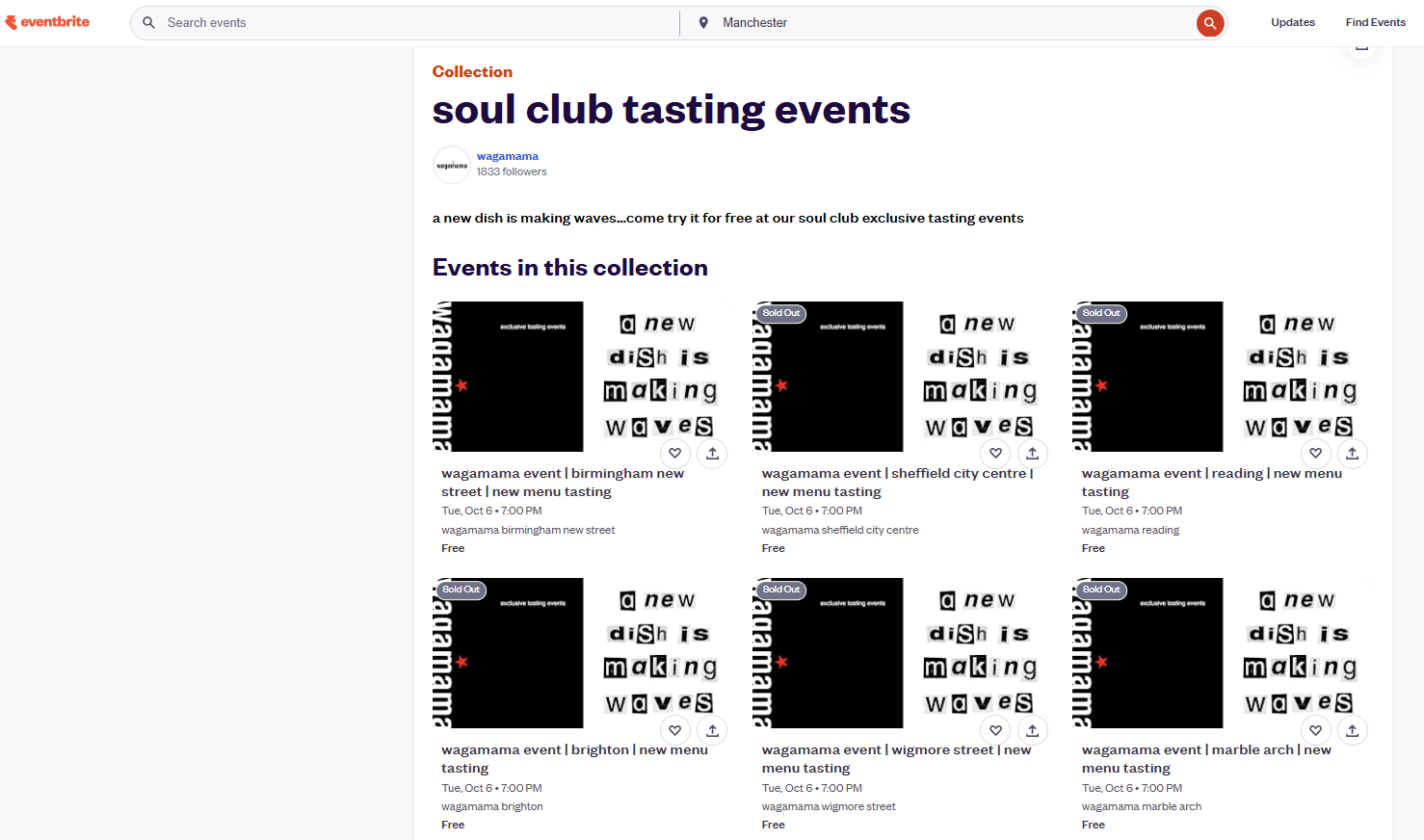
wagamama tasting events eventbrite

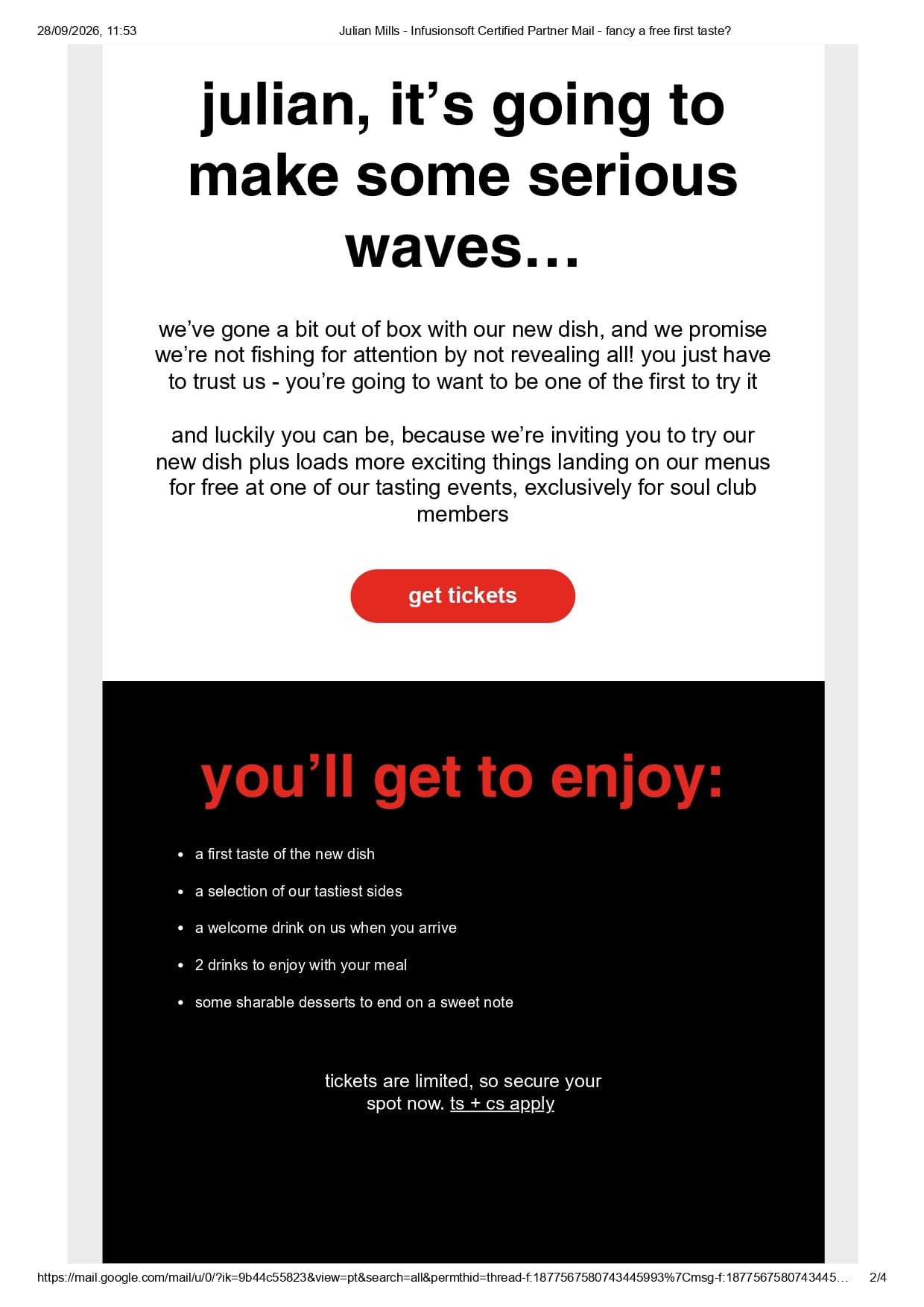
I received an email from Wagamama this morning with a subject line that immediately caught my attention:

“fancy a free first taste?”

wagamana_free_event_invite_email

The idea is beautifully simple.

Wagamama is inviting members of its Soul Club to exclusive tasting events where they can try new dishes for free before they are launched to everyone else.

Click through from the email and you’re taken to an Eventbrite collection containing individual tasting events at Wagamama restaurants around the country.

Wagamama_tasting_event

And I really like this marketing.

They’re Not Just Giving Away Free Food

At first glance, you could look at this as Wagamama giving existing customers something for nothing.

I think that misses the point.

This is customer loyalty marketing.

Rather than constantly trying to tempt customers back with discounts, Wagamama is giving its regular customers something that feels exclusive:

Come and try something before everyone else does.

That makes customers feel like insiders.

It gives them another reason to engage with the Wagamama brand between normal restaurant visits. It potentially generates word of mouth and social media activity. And, importantly, it brings existing customers physically back into a restaurant.

There’s also something psychologically very different between:

“Here’s 20% off your next meal.”

and:

“We’d like you to be one of the first people to try our new dish.”

I’d take the second approach every time.

Then I Noticed They Were Using Eventbrite

There’s absolutely nothing wrong with Eventbrite. For this campaign it appears to be doing a relatively straightforward job.

Choose a restaurant. Reserve a free place. Turn up.

But it immediately made me think about the new HighLevel Events & Tickets functionality.

HighLevel can now create free RSVP events and paid ticketed events, manage capacity and registrations, issue tickets and check attendees in using QR codes.

For a relatively simple tasting event such as this, HighLevel could potentially replace Eventbrite.

I’ve previously written about using HighLevel as an Eventbrite alternative, but the really interesting part isn’t simply replacing another piece of software.

It’s what becomes possible when the event booking system is also connected to your CRM, WhatsApp, email, SMS, reputation management, social media and marketing automation.

Imagine Wagamama Had Run the Whole Campaign Through HighLevel

Someone receives:

Fancy a free first taste?

They click through and reserve a place at their local restaurant.

HighLevel now knows that customer has registered for that particular tasting event.

Before the event, workflows can automatically send confirmations and reminders.

Then the customer arrives at the restaurant and their QR code is scanned.

Now HighLevel knows something much more important:

They didn’t just book. They actually showed up.

And that single action can start an entirely different marketing journey.

This is where I’d start having some fun.

1. Build Anticipation Before the Tasting

Don’t just send a boring booking confirmation.

A couple of days beforehand:

“You’re one of the first people who’ll get to try our new dish. Any guesses what it might be?”

Perhaps reveal a clue.

Then another one on the morning of the event.

The event experience has started before the customer has even arrived.

2. Reduce No-Shows With Reminders

Free events have an obvious problem.

It’s very easy to reserve a free place and then decide not to bother going.

So use email, SMS or WhatsApp reminders in the run-up to the event.

You could even include:

“Can’t make it? Let us know and we’ll give your place to another Soul Club member.”

Now you’re potentially recovering capacity rather than simply accepting no-shows.

3. WhatsApp People When They Actually Arrive

This is where things start getting much more interesting.

When someone checks in, HighLevel can trigger an automation because that person has actually arrived at the event.

So perhaps 20 or 30 minutes after check-in they receive a WhatsApp:

“Enjoying your first taste? 🍜 You’re one of the first people to try our new dish. We’d love to know what you think…”

The timing matters.

Don’t ask them tomorrow.

Ask them while they’re sitting in the restaurant, eating the food and enjoying the experience.

4. Turn the Event Into a Video Testimonial Machine

This might be my favourite idea.

HighLevel now has Video Testimonials built into its reputation management functionality.

You can create a branded video testimonial request and send the customer a link by WhatsApp while they are still at the tasting.

The customer can then use their phone to record a short reaction.

So the WhatsApp message could say:

“You’re one of the first people in the country to try this. Fancy giving us your verdict? Tap below and record a quick 20-second video.”

Think about the timing.

They’ve just eaten something new.

They’re at an exclusive event.

They’re probably with other Wagamama fans.

They’re excited enough about the brand to have booked a tasting event in the first place.

That’s exactly when I’d ask for the testimonial.

Rather than a marketing department trying to manufacture social content afterwards, you’ve created the conditions for customers to create it for you.

5. Turn Those Videos Into Social Proof

Once somebody submits their video, another HighLevel workflow could be triggered.

So you could potentially have:

Customer checks in → receives WhatsApp → records video → grants marketing consent → marketing team is notified → video reviewed → approved content repurposed for social media.

I wouldn’t automatically publish every video without somebody reviewing it first.

That’s not a limitation. I’d deliberately build human approval into the process.

Imagine Wagamama running 20 tasting events and receiving 100 short videos.

The marketing team isn’t starting with a blank sheet of paper wondering what to post on Instagram, Facebook or TikTok.

They’ve got dozens of genuine reactions from real customers trying the product.

“We gave Soul Club members the first taste of our new dish. Here’s what they thought…”

That’s potentially fantastic social content.

And because HighLevel brings CRM and marketing automation together, the event doesn’t need to exist as an isolated marketing activity.

6. Ask Everyone for Their Verdict

Not everybody wants to record a video.

That’s fine.

After the event, send everyone who checked in a simple survey:

What did you think?

⭐
⭐⭐
⭐⭐⭐
⭐⭐⭐⭐
⭐⭐⭐⭐⭐

Now the event isn’t just marketing.

It’s also market research.

You can discover which dishes people loved, which divided opinion and potentially why.

And because this information sits against the contact in the CRM, it can influence what happens next.

7. Treat the People Who Loved It Differently

Suppose someone gives the dish five stars.

Don’t just record the answer in a spreadsheet and forget about it.

That’s a marketing signal.

When the dish officially launches, send them:

“Remember that dish you tried before everyone else?”

“It’s now officially on the menu.”

You could invite them back to have it again, perhaps with a friend.

That’s an incredibly natural reason to contact somebody.

You’re not sending another generic restaurant promotion.

You’re continuing a conversation that started when they attended the tasting.

8. Treat the No-Shows Differently Too

Imagine 100 people book and 80 actually check in.

Those two groups shouldn’t receive the same follow-up.

The 80 attendees might receive:

“Thanks for joining us. What did you think?”

The 20 people who didn’t attend might receive:

“Sorry we missed you. Would you like first refusal on our next tasting event?”

Same event.

Completely different follow-up based on customer behaviour.

9. Create a VIP Tasting Panel

Now think beyond a single event.

HighLevel is a CRM.

Over time, you could identify people who:

register → attend → give feedback → submit videos → engage with future invitations

Those people are telling you something.

They’re not merely customers.

They’re potentially some of your biggest brand advocates.

So why not create a Wagamama Tasting Panel?

Give those customers priority invitations to future tastings.

Ask them to help choose between two potential dishes.

Invite them to preview a seasonal menu.

Give them a vote on which discontinued dish should return.

Now the loyalty programme starts feeling like a genuine club rather than another database with a membership number.

10. Encourage Attendees to Bring Someone Next Time

Here’s another opportunity.

After somebody attends and gives the experience a high score:

“Glad you enjoyed it. Next time, would you like to bring a friend?”

That’s clever because your existing customer becomes the acquisition channel.

Their friend gets introduced to Wagamama through an exclusive experience rather than an advertisement.

If the objective is customer acquisition, I’d be measuring how many guests subsequently join Soul Club themselves.

11. Reward Your Best Advocates

You could take this further still.

Someone has attended three tastings.

They’ve completed every survey.

They’ve recorded two video testimonials.

They’ve brought a friend.

Why not recognise that?

Perhaps they get invited to a particularly exclusive menu preview.

Or receive a surprise reward.

Or get first access to the next tasting before invitations go to everybody else.

The technology makes it possible to recognise behaviour rather than treating every person in the database identically.

12. Close the Loop on Social Media

There’s one final twist I particularly like.

After somebody submits a video testimonial and gives permission for it to be used, send them:

“Thanks! We loved your reaction. Keep an eye on our socials. You might just spot yourself 👀”

Now you’ve potentially given them another reason to follow the brand.

And if their video does get used?

Tell them.

They’re quite likely to share it themselves.

So one customer interaction potentially becomes:

Event attendance → testimonial → Wagamama social content → customer shares Wagamama content → customer’s friends see it → more awareness of the next event.

Now you’ve created a marketing loop.

This Is Why I’m Excited About HighLevel Events

If all HighLevel did was issue tickets, I’d be considerably less interested.

There are already plenty of systems that can do that.

HighLevel Events & Tickets can create event pages, handle RSVP and ticketed registrations, control capacity, issue QR-code tickets and manage attendee check-in.

But that’s only the starting point.

The bigger opportunity is:

Invitation → Registration → Reminder → Attendance → WhatsApp → Feedback → Video testimonial → Marketing consent → Social proof → Segmentation → Follow-up → Repeat visit → Referral → Next event

And all of those interactions can potentially contribute to the same customer record.

That’s much more interesting than simply asking:

“Can HighLevel replace Eventbrite?”

For a relatively straightforward event like Wagamama’s tasting sessions, I think the better question is:

“What becomes possible when your event platform is also your CRM and marketing automation platform?”

What Can Other Businesses Learn From Wagamama?

I’m not suggesting Wagamama should rip out Eventbrite and install HighLevel.

I don’t know their technology stack, their requirements or what happens behind the scenes.

I’m highlighting their campaign because the marketing idea itself is excellent.

And it’s an idea businesses of almost any size can borrow.

A restaurant can run menu tastings.

A gym can invite members to an exclusive new class.

A dentist can hold an Invisalign information evening.

An accountant can run a Budget update.

An estate agent can host a property investment evening.

A software company can invite its best customers to preview a new feature.

A martial arts club can run gradings, tournaments and presentation evenings.

The event doesn’t necessarily need to make money.

Sometimes the purpose is to give your customers another reason to interact with you and another reason to feel good about being one of your customers.

Wagamama has done that with one very simple proposition:

Come and try our new food before everyone else.

I think that’s clever marketing.

But combine that idea with CRM data, event check-ins, WhatsApp, workflows, customer feedback, video testimonials and social media, and it could become something considerably more powerful.

If you’d like to explore the technology itself, I’ve written a more detailed guide to HighLevel Events & Tickets.

You can also join us for our free live HighLevel Courses, Events & Ticketing workshop, where we look at how these features can be used in a real HighLevel account.

So yes, Wagamama. I like this one.

And I’ll be particularly interested to see what they send me after the tasting event.

Julian Mills HighLevel Consultant and Marketing Automation Strategist

About the Author

Julian Mills

HighLevel Consultant & Marketing Automation Strategist

Julian Mills helps business owners automate lead generation, sales follow-up, customer communication and business processes using HighLevel and MarketerM8. Since 2009 he has helped businesses implement CRM, marketing automation and AI-powered systems that save time, improve customer experience and generate more sales.

About Julian
Book a Discovery Call
Join a Free HighLevel Workshop
Learn About HighLevel with MarketerM8


Run HighLevel from Your Personal WhatsApp: Ask AI Comes to WhatsApp

Run HighLevel from Your Personal WhatsApp: Ask AI Comes to WhatsAppWhat if you could update a contact, check your diary or move an opportunity forward without opening HighLevel?

HighLevel has introduced a WhatsApp connection for Ask AI, its built-in AI copilot. Once you connect your own WhatsApp number, you can send a message to your copilot from a normal WhatsApp conversation. It can answer questions and carry out supported actions in your HighLevel account. There is no need to open the HighLevel website or mobile app for every small task.

Important distinction: This is a free way to use your own WhatsApp to interact with Ask AI in your HighLevel sub-account. You do not need to purchase HighLevel’s separate paid WhatsApp add-on to connect this feature. It does not enable you to send WhatsApp messages to your contacts from HighLevel. Customer messaging through HighLevel is what the paid WhatsApp add-on is for.

I have recorded a quick demonstration so you can see the idea in action: watch my HighLevel Ask AI WhatsApp demo.

What can Ask AI do through WhatsApp?

According to HighLevel’s announcement, this is the same Ask AI copilot available inside HighLevel, rather than a separate, limited chatbot. HighLevel gives these examples:

  • Work with contacts: find a contact, add a note or update a field.
  • Keep your pipeline current: move an opportunity to another stage after speaking to a prospect.
  • Check your calendar: ask what is coming up today or next.
  • Draft content: request a blog draft or reusable email template.
  • Set tasks in motion: ask for a follow-up or a recurring summary of new leads.
  • Get help: ask a question about the product and receive an answer in the conversation.

For me, the most useful part is capturing work at the moment it happens. Imagine leaving a client meeting and sending a WhatsApp message asking Ask AI to add a note to the contact and move the opportunity to the next pipeline stage. That is much easier than trusting yourself to remember it when you return to your desk.

How is this different from HighLevel’s paid WhatsApp add-on?

Think of the direction of the conversation. With Ask AI in WhatsApp, you message HighLevel from your personal WhatsApp to ask questions or make changes inside your sub-account. Connecting it does not require the paid WhatsApp add-on.

With the paid WhatsApp add-on, your business uses HighLevel to send and receive WhatsApp messages with contacts and to include WhatsApp in customer communications and automations. Connecting Ask AI to your personal WhatsApp does not switch on those customer messaging features.

Each person connects their own number to their own Ask AI access. HighLevel says your exchanges can also be reviewed in the Dispatch tab. As with any AI action affecting customer records, check the contact and requested change carefully, especially where two people have similar names.

How do you connect it?

  1. In HighLevel, open Dispatch (or Customize → Dispatch) and choose Connect WhatsApp.
  2. Scan the QR code with your phone and send the first WhatsApp message to the number shown.
  3. Enter the verification code you receive in WhatsApp back in HighLevel.
  4. Once connected, message that number whenever you want to reach Ask AI.

These are the steps in HighLevel’s announcement. The menus available to you may depend on your account and access.

Does this mean you never need to log in again?

For many quick questions and updates, you can stay in WhatsApp. You will still want the HighLevel interface when reviewing detailed records, checking an AI-generated draft or building and testing a larger automation. The practical benefit is removing the friction from the small jobs that otherwise get put off.

The announced connection centres on WhatsApp messages. I would not assume that WhatsApp voice calls or voice notes offer the same functionality without testing them in your account.

Watch my demonstration

See my video demo of Ask AI in WhatsApp here. If you already use HighLevel, try a simple request first, such as checking your upcoming appointments or finding a contact. Then test an update and check the result in HighLevel.

If you want help setting up HighLevel so that your team actually uses it, book a 20-minute discovery call with me. We can talk through your sales process, the work your team does every day and where tools like Ask AI fit.

For the official feature details and connection steps, read HighLevel’s Ask AI WhatsApp changelog.

Julian Mills HighLevel Consultant and Marketing Automation Strategist

About the Author

Julian Mills

HighLevel Consultant & Marketing Automation Strategist

Julian Mills helps business owners automate lead generation, sales follow-up, customer communication and business processes using HighLevel and MarketerM8. Since 2009 he has helped businesses implement CRM, marketing automation and AI-powered systems that save time, improve customer experience and generate more sales.

About Julian
Book a Discovery Call
Join a Free HighLevel Workshop
Learn About HighLevel with MarketerM8

How I work with HighLevel clients

Julian Mills HighLevel marketing automation consultant strategist

Julian Mills HighLevel marketing automation consultant strategistWhether you are new to HighLevel, moving an existing sub account or trying to get more from a system you already use, the first step is to understand your business. Then we agree what needs doing, in what order and who will do it.

I am Julian Mills, a UK-based HighLevel consultant and marketing strategist. I work with over a 100 businesses with HighLevel sub accounts to plan and implement practical sales and marketing systems. The work can include software setup, but the starting point is your customer journey and the results you want it to produce. If you are still weighing up the platform itself, read when I would and would not recommend HighLevel.

Start with a conversation

1. A 20-minute discovery call

We talk about your business, your current systems, where leads or customers are being lost, and what you would like to improve. This is also a chance for us to get to know each other. There needs to be a mutual fit and good chemistry: you need to feel confident working with me, and we are selective about the clients we take on. You do not need to arrive with a technical specification.

Book a 20-minute discovery call.

2. A one-hour Discovery and Strategy call

If it makes sense to explore the project further, we spend an hour going through your goals and your existing sales and marketing process in more detail. We look at how an enquiry becomes a customer, what follow-up happens now, which systems are involved and where the most useful improvements may lie. The scope and next actions depend on what we find.

3. Your MAP: Marketing Automation Plan

For projects that need a structured build, I turn the discovery work into a MAP. This is a practical plan for what we want the system to do, the order in which to build it and the responsibilities involved. It can cover lead capture, pipelines, appointments, follow-up, customer communication, integrations and measurement, as relevant to your business.

The MAP becomes our architect’s blueprint for the implementation. By working out the process before we build it, we can implement more efficiently and avoid unnecessary work. It helps us identify what can create an early result, what needs more design and what can wait.

It is also a living document. As we learn from the work, your team and your customers, we revisit and develop the MAP rather than treating the first version as a fixed specification. The depth of planning reflects the complexity of the project.

Choose the route that fits your starting point

There is no requirement to buy every phase. Some clients need a complete setup; others have a working HighLevel account and want focused advice or implementation.

  • Brand new to HighLevel: Discovery, MAP where appropriate, Phase 1, Phase 2, then Phases 3 and 4 if needed.
  • Transferring an existing sub-account: Discovery and review, Phase 1b, then Phases 2, 3 and 4 if needed.
  • Already using HighLevel: Discovery and an assessment of the current setup, then focused Phase 4 consulting and implementation. If the account needs foundational repairs or a larger redesign, we agree that scope first.
  • Starting your own HighLevel agency: Discovery and strategy, followed by the separate MarketerM8 HighLevel SaaS Entrepreneur Programme.

Phase 1: Initial setup for a new HighLevel account

We establish the essentials needed to make HighLevel usable for your team and your first agreed marketing or sales processes. Depending on your needs, that might include account settings, users, contact organisation, calendars, lead capture, pipelines and the basic communications setup.

We also decide how your team will use the system day to day. My aim is to build a dependable foundation around your business process rather than switch on every available feature at once.

Phase 1b: Transfer and review of an existing sub-account

If you already have a HighLevel sub-account with another agency, we start by reviewing what exists and what needs to move or change. We look at access and ownership, active workflows, phone and email arrangements, connected services, calendars, data and any business-critical pages or processes before agreeing a transfer plan.

The priority is continuity. Once we understand the account, we can decide which parts are worth keeping, which need attention and whether any further phases would be useful. A transfer does not automatically mean rebuilding the account.

If you are also moving from another CRM or marketing platform, see my HighLevel migration services.

Phase 2: Quick wins

With the foundations in place, we implement a small number of improvements likely to make an immediate practical difference. Examples might include a better enquiry response, a missed-call follow-up, appointment reminders, a clearer sales pipeline or reactivating appropriate past enquiries.

We choose these from your MAP and current priorities. The aim is to put useful work into operation early, observe what happens and use that learning to guide the next build.

Phase 3: Advanced setup

Where the business case supports it, we move into more involved work. This could include multi-step automations, complex customer journeys, integrations, more detailed reporting, AI-assisted processes or specialist use of HighLevel features. The exact scope is agreed for your business rather than taken from a standard feature checklist.

Some clients will not need this phase. Others may need a specific advanced project without a broad rebuild.

Phase 4: Ongoing consulting and implementation

HighLevel works best when someone continues to improve the processes behind it. I can work with you and your team on priorities, implementation, troubleshooting and training as your business changes. This can be the next stage after a build, or the starting point if you already have an established account.

Where possible, I help develop an internal CRM Champion: someone close to the day-to-day sales and marketing activity who can learn the system, coordinate requests and help the team become more self-sufficient. You retain a clearer understanding of what the system is doing and why.

My ongoing involvement can also act as an insurance policy for your business. If your CRM Champion leaves, I can step in as a backup because I understand the initial setup and the changes we have made since. The living Marketing Automation Plan gives us a shared reference for why the system was built as it was and what needs to happen next. That helps your business maintain continuity while a new person gets up to speed.

We can work together through remote HighLevel training and implementation or on-site training and implementation. Your team can also join our free live HighLevel workshops to build its confidence with the platform.

Want to start your own HighLevel agency?

That is a different journey from setting up HighLevel for your own business. After the discovery and strategy conversations, the route is the MarketerM8 HighLevel SaaS Entrepreneur Programme. It covers getting your agency started, setting up your own account and onboarding your first client, with ongoing learning and support described on the programme page.

Frequently asked questions

Do I have to complete all four phases?

No. We agree the work that fits your current setup and goals. You may only need an initial setup and a few quick wins, or you may come to me with an established account and a specific project.

Can you help if my HighLevel account is with another agency?

Yes. We review the existing sub-account and agree a transfer plan before making changes to business-critical systems. What needs to be transferred or reconnected depends on the account and the services currently in use.

Can you work with an account I already have directly with HighLevel?

Yes. We can start with your goals and the current state of the account, then agree focused consulting, training or implementation work.

What is a Marketing Automation Plan?

The MAP documents the processes we want to improve, how people and systems should respond at each step, and the order in which to build and test the work. It keeps the implementation tied to the business outcome.

Will you train my team?

Yes. I favour working with a person in your team who can become your CRM Champion, while involving the people who will use the system in practice. Training and the level of ongoing support can be agreed as part of the scope.

Tell me where you are now

You do not need to know which phase you need before we speak. Tell me what you are trying to achieve and what you already have in place, and we can work out the next sensible step together.

Book your 20-minute discovery call with Julian Mills.

Julian Mills HighLevel Consultant and Marketing Automation Strategist

About the Author

Julian Mills

HighLevel Consultant & Marketing Automation Strategist

Julian Mills helps business owners automate lead generation, sales follow-up, customer communication and business processes using HighLevel and MarketerM8. Since 2009 he has helped businesses implement CRM, marketing automation and AI-powered systems that save time, improve customer experience and generate more sales.

About Julian
Book a Discovery Call
Join a Free HighLevel Workshop
Learn About HighLevel with MarketerM8
Want More Website Enquiries? Add a WhatsApp Button to Your HighLevel Form

Add a WhatsApp button to your HighLevel form, respond with AI in 60 seconds and book calls before prospects start contacting your competitors

Add a WhatsApp button to your HighLevel form, respond with AI in 60 seconds and book calls before prospects start contacting your competitorsWhat if, instead of asking somebody to fill in your website contact form, press Submit and then wait for you to respond, you could start a WhatsApp conversation with them within 60 seconds?

Better still, what if you could answer their initial questions and even get a call booked before they felt the need to go back to Google and contact your competitors?

That’s the really exciting idea behind a very simple change we’ve recently been experimenting with on HighLevel forms.

Twice as Many Prospects Choose WhatsApp

Atticus and I were speaking with a client recently who had added an interesting twist to his HighLevel contact form.

At the bottom of the form, prospects have two choices.

They can press the traditional Submit button and expect a response within 24 hours.

Or they can press a large green WhatsApp button and get a much quicker response.

The client told us something that immediately got our attention:

Around twice as many people choose the WhatsApp button as the traditional Submit button.

That’s impressive on its own.

But I think the really interesting part is what happens next.

Because once you combine this simple button with HighLevel’s WhatsApp integration, Workflows, Conversation AI, WhatsApp Flows and Calendars, you’re no longer simply collecting an enquiry.

You’re starting a sales conversation while the prospect is still interested.

And that could be far more valuable than simply doubling your response rate.

I’ve Now Added the WhatsApp Button to My Own Contact Form

I liked the idea enough to try it myself.

You can see it working on my own Contact Us page.

Complete the form and, underneath the normal Submit button, you’ll see the green WhatsApp option.

But there is an important little bit of cleverness going on behind the scenes.

If somebody has already typed their name, email address, telephone number and enquiry into the form, I don’t want them to have to type it all again when they choose WhatsApp.

So the WhatsApp button grabs the information they’ve already entered and uses it to draft their WhatsApp message.

For example, somebody might complete the form with:

Name: John Smith
Email: john@example.com
Phone: 07123 456789
Enquiry: We’re currently using HubSpot and are considering moving to HighLevel. Can you help?

They press the green WhatsApp button.

WhatsApp opens with something like this already prepared:

Hi Julian,

I’m John Smith.

Email: john@example.com
Phone: 07123 456789

My enquiry:
We’re currently using HubSpot and are considering moving to HighLevel. Can you help?

All John has to do is press Send.

No retyping. No copying and pasting. No additional form.

We’ve simply made it easier for the prospect to start talking to us.

But Then We Realised This Could Go Much Further

Initially, we thought this was simply a clever way of making a HighLevel form more convenient.

Then we started thinking about what could happen after the prospect presses Send in WhatsApp.

With WhatsApp connected to HighLevel, that incoming message can become part of the prospect’s CRM conversation and trigger a HighLevel Workflow.

HighLevel allows a Customer Replied Workflow trigger to be filtered to Reply Channel = WhatsApp.

The Workflow can then bring Conversation AI into the conversation.

Suddenly our customer journey changes from:

Website → Form → Submit → Wait → Human responds

to:

Website → Form → WhatsApp → AI responds within 60 seconds → Conversation → Appointment booked

That’s a completely different experience.

The Biggest Benefit Isn’t Actually the 2x Response Rate

This, for me, is the killer idea.

Our client is seeing roughly twice as many people choose WhatsApp.

Great.

But think about what normally happens after somebody submits a contact form.

They see something like:

Thanks for your enquiry. We’ll respond within 24 hours.

What do they do next?

Twenty years ago, perhaps they waited.

I’m not convinced people behave like that today.

We’ve all completed online forms and never received a response. Or received one three days later. Or received an automated acknowledgement followed by silence.

People have become conditioned not to rely on a website form producing a quick response.

So imagine I’m looking for an accountant, solicitor, builder, mortgage adviser, dentist, IT company or marketing consultant.

I find your website.

I like what I see.

I submit your contact form.

But I still have a problem I want solving.

So what am I likely to do while I wait?

Go straight back to Google.

I find your competitor.

I submit their form as well.

Perhaps I contact a third company.

Now three businesses are competing for my attention and my business.

The first one to actually engage me has an enormous advantage.

I’ve written previously about why businesses can lose opportunities through slow WhatsApp responses. The same principle applies here. Every minute the prospect is left waiting is another opportunity for them to continue their search.

What If We Stop the Search?

Now consider the WhatsApp experience.

The prospect sends their question.

Within 60 seconds they receive a response.

We’re open about the fact that the immediate response is AI. There is no reason to pretend otherwise.

But it’s useful AI.

It understands their enquiry.

It asks a relevant question.

It answers something they wanted to know.

The prospect replies.

Now they’re engaged in a conversation.

Perhaps the AI answers their next question.

Then it asks:

Would you like to book a quick call with us to discuss this?

The prospect says yes.

And now we get the appointment booked.

At that point, why does the prospect need to return to Google?

We’ve satisfied their immediate need.

They wanted information. They got it.

They wanted to know whether we could help. We’ve established that.

They wanted reassurance. They’ve received it.

They wanted a next step. They now have an appointment.

We haven’t simply generated a lead.

We’ve potentially stopped the prospect’s search.

That, to me, is where this gets really exciting.

Response Speed Becomes a Competitive Advantage

This is why I think businesses sometimes underestimate response time.

Speed isn’t simply about giving better customer service.

It can become a competitive advantage.

The Traditional Contact Form

Prospect searches → Finds you → Submits form → Waits → Returns to Google → Finds competitors → Sends more enquiries → Businesses compete for prospect

HighLevel + WhatsApp + AI

Prospect searches → Finds you → Sends WhatsApp → Gets immediate engagement → Question answered → Conversation develops → Call booked

The prospect may never get as far as the next competitor.

That’s potentially worth considerably more than simply increasing the number of people who submit your form.

Could You Really Respond Within 60 Seconds?

Yes. Technically this is very achievable with HighLevel.

Once somebody sends you a WhatsApp message, HighLevel can use the Customer Replied Workflow trigger and filter it specifically for the WhatsApp channel.

That means an incoming WhatsApp message can immediately start a Workflow.

The Workflow can then use HighLevel’s Conversation AI to respond to the prospect based on the information and instructions you’ve given it.

Conversation AI is part of what HighLevel calls its AI Employee, bringing AI into conversations and other areas of the platform.

So rather than promising that a human being will personally respond within 60 seconds, your button could say:

Get a response within 60 seconds on WhatsApp

And underneath you could explain:

Our AI assistant can answer many questions immediately or help you book a call with our team.

Be Upfront That It’s AI

Personally, I would always tell the prospect that the immediate response is coming from AI.

There is a good marketing reason for doing that. I don’t believe you should trick somebody into thinking they’re talking to a human.

The objective is to be genuinely useful incredibly quickly.

But there is increasingly a legal reason to be transparent too.

In the European Union, transparency requirements under the EU AI Act now apply to certain AI systems that interact directly with people. In general, people need to be informed that they are interacting with AI unless that is already obvious from the circumstances.

The position in the UK is different. There isn’t currently an equivalent blanket requirement covering every business chatbot, but UK consumer-law guidance also emphasises that businesses should avoid misleading consumers about the use of AI agents.

So rather than trying to disguise your AI, why not make its speed and availability part of the benefit?

Your first WhatsApp response could begin:

Hi John, I’m Julian’s AI assistant. I can answer many questions immediately or help you book a call with Julian.

There’s no ambiguity.

The prospect knows they’re talking to AI, understands what it can do and can immediately take advantage of it.

Being upfront about AI isn’t a weakness. The fact that you’ve provided a useful response within 60 seconds is the selling point.

The AI Could Answer Their Question There and Then

Imagine our prospect asks:

We’re currently using HubSpot and are considering moving to HighLevel. Can you help?

Your Conversation AI could respond:

Hi John. I’m Julian’s AI assistant. Yes, we regularly help businesses migrate from other CRM systems to HighLevel. Are you mainly using HubSpot for your CRM and sales pipeline, or are you also using its marketing automation, forms and email tools?

John replies.

The AI can continue the conversation using the information and instructions you’ve provided.

It can answer straightforward questions.

It can collect additional information.

It can ask qualifying questions.

And when appropriate, it can move towards the next logical step.

For many businesses, that’s going to be booking an appointment.

They Don’t Even Have to Leave WhatsApp to Book

This is where another HighLevel feature makes the whole idea even more interesting.

HighLevel supports WhatsApp Flows for appointment booking.

That means we don’t necessarily have to send the prospect a calendar link and ask them to leave WhatsApp, open another webpage, choose an appointment and complete another form.

We can potentially keep the experience inside WhatsApp.

So our journey becomes:


Complete form
↓
Press WhatsApp button
↓
Press Send
↓
Conversation AI responds
↓
AI answers questions
↓
Prospect wants a call
↓
WhatsApp booking Flow appears
↓
Prospect selects an available appointment
↓
Appointment booked into the HighLevel calendar

And the prospect has remained inside WhatsApp.

Think about how little friction there is in that journey.

Every additional click, webpage and form we remove makes it easier for the prospect to take the next step.

And because HighLevel can bring WhatsApp conversations into the wider customer service process, the conversation doesn’t have to disappear onto somebody’s personal phone. It can become part of the customer’s ongoing CRM history.

How the HighLevel Automation Could Work

At a practical level, we would build the system something like this:

1. HighLevel Contact Form
The prospect enters their name, email, telephone number and enquiry.

2. WhatsApp Button
Some simple JavaScript takes those values and creates a pre-populated WhatsApp message.

3. Prospect Presses Send
Pressing the green button on your website doesn’t itself send the WhatsApp message. It opens WhatsApp with the message drafted. The prospect then presses Send.

4. Incoming WhatsApp Message Reaches HighLevel
If you’re using HighLevel’s WhatsApp integration, the conversation can come into HighLevel.

5. Customer Replied Workflow Trigger
Create a Workflow using Customer Replied, filtered so the Reply Channel is WhatsApp.

6. Conversation AI Responds
Conversation AI uses the prospect’s message, conversation history, your instructions and its training to provide an appropriate response.

7. The Conversation Continues
The AI can answer questions, collect information and establish what the prospect wants.

8. Identify Booking Intent
When the prospect indicates they would like to talk, the conversation can move towards appointment booking.

9. WhatsApp Appointment Booking Flow
The prospect can be presented with the opportunity to book from within WhatsApp itself.

10. Appointment Enters the HighLevel Calendar
Once the appointment has been booked, your normal HighLevel appointment confirmations, reminders, workflows and sales processes can take over.

That’s a serious sales process sitting behind one little green button.

The Code for the WhatsApp Button

The button itself requires surprisingly little code.

Here is a simplified example:

<div style="margin-top:12px;">
  <button
    type="button"
    id="julian-whatsapp-button"
    style="
      width:100%;
      background:#25D366;
      color:#ffffff;
      border:none;
      border-radius:30px;
      padding:15px 20px;
      font-size:16px;
      font-weight:700;
      cursor:pointer;
    ">
    Get a response within 60 seconds on WhatsApp
  </button>
</div>

<script>
document.getElementById('julian-whatsapp-button').addEventListener('click', function () {

  const form = this.closest('form') || document;

  const nameField =
    form.querySelector('input[name="name"]') ||
    form.querySelector('input[name="full_name"]');

  const emailField =
    form.querySelector('input[type="email"]');

  const phoneField =
    form.querySelector('input[type="tel"]');

  const messageField =
    form.querySelector('textarea');

  const name = nameField ? nameField.value.trim() : '';
  const email = emailField ? emailField.value.trim() : '';
  const phone = phoneField ? phoneField.value.trim() : '';
  const enquiry = messageField ? messageField.value.trim() : '';

  const message =
`Hi,

I'm ${name}.

Email: ${email}
Phone: ${phone}

My enquiry:
${enquiry}`;

  const whatsappURL =
    'https://wa.me/44712345678?text=' +
    encodeURIComponent(message);

  window.open(whatsappURL, '_blank');

});
</script>

You need to replace 44712345678 with the WhatsApp telephone number that should receive the enquiry.

Use the international format without the +, spaces or leading zero.

Depending on the fields in your particular HighLevel form, you may also need to adjust the field selectors in the JavaScript.

One Important Point About the Form Submission

There is an important technical distinction to understand.

Clicking the WhatsApp button does not automatically mean the visitor has submitted the normal HighLevel form.

The JavaScript reads what they’ve typed into the form and uses it to construct their WhatsApp message.

The important event then becomes the prospect pressing Send inside WhatsApp.

Once that message arrives through your connected WhatsApp account, HighLevel can identify the incoming conversation and your automation can take over.

If capturing the original form submission in HighLevel as well is important to your process, you would need to account for that separately.

Don’t Remove Your Normal Submit Button

I wouldn’t replace the normal HighLevel form.

Give people a choice.

Some prospects will prefer submitting a traditional form and receiving an email response.

Others will prefer WhatsApp.

That’s exactly what we’re trying to discover.

You might therefore have:

Submit Enquiry
We’ll normally respond within 24 hours.

followed by:

🟢 Get a response within 60 seconds on WhatsApp

Then measure what actually happens.

And don’t just measure button clicks.

Measure the whole journey:

Form submissions → WhatsApp conversations → Engaged conversations → Appointments booked → Sales

That’s where we’ll discover whether the idea really works.

It’s Not Really About the WhatsApp Button

This started with a very simple idea.

Add a second button to a HighLevel form.

Our client tells us that around twice as many prospects choose his WhatsApp option.

That’s fascinating.

But I now think the button is actually the least interesting part.

The real opportunity is what happens after somebody presses it.

HighLevel allows us to bring together:

Forms + WhatsApp + Workflows + Conversation AI + WhatsApp Flows + Calendars

to potentially move somebody from:

“I have a question.”

to:

“My question has been answered and I’ve booked a call.”

within a single WhatsApp conversation.

And perhaps most importantly, we’ve done it while their interest is at its highest.

They haven’t submitted a form and gone back to Google.

They haven’t contacted another three companies while waiting for somebody to respond.

We’ve engaged them.

We’ve helped them.

We’ve given them a next step.

Perhaps the real goal of rapid response isn’t simply to reply before your competitors do.

It’s to satisfy the prospect so quickly that they don’t feel the need to contact your competitors at all.

That’s the idea I’m now going to be testing.

Would You Like to Do This With HighLevel?

If you’re already using HighLevel, or considering using it, this is a good example of what becomes possible when you stop looking at Forms, WhatsApp, Workflows, AI and Calendars as separate features and start connecting them around your customer’s journey.

If you’d like to discuss how HighLevel could work within your business, book a discovery call with me.

Book a Discovery Call

Julian Mills HighLevel Consultant and Marketing Automation Strategist

About the Author

Julian Mills

HighLevel Consultant & Marketing Automation Strategist

Julian Mills helps business owners automate lead generation, sales follow-up, customer communication and business processes using HighLevel and MarketerM8. Since 2009 he has helped businesses implement CRM, marketing automation and AI-powered systems that save time, improve customer experience and generate more sales.

About Julian
Book a Discovery Call
Join a Free HighLevel Workshop
Learn About HighLevel with MarketerM8
Is HighLevel Right for My Business? When I Would and Wouldn’t Recommend It

Is HighLevel right for your business? Discover when to use it, when to choose another approach, and what to consider before investing in CRM software

Is HighLevel right for your business? Discover when to use it, when to choose another approach, and what to consider before investing in CRM softwareIf you’re considering HighLevel for your business, it’s easy to get caught up in the long list of features. But the more useful question is whether it will help with what your business actually needs.

In this article, I’ll explain when I would recommend HighLevel, when I would suggest another approach, and what I would check before you commit to it.

I run a HighLevel agency, MarketerM8, so I have a commercial interest in the platform. But that doesn’t mean I recommend it for every business.

I’ve worked with CRM and marketing automation since 2009. My starting point is always the same: what are you trying to improve?

When I Would Recommend HighLevel

Your enquiries and follow-up are slipping through the cracks

Perhaps enquiries arrive through your website, telephone, email and social media. Different people respond, some prospects get chased, and others quietly disappear.

HighLevel can help you organise those enquiries, track sales opportunities and build a consistent follow-up process.

For a business selling through consultations, appointments or quotations, that can be a practical starting point.

You don’t necessarily need more leads. You may need to handle the ones you already receive better.

You have repeatable customer journeys

Think about what happens between an initial enquiry and a completed sale.

Do you repeatedly send the same information, arrange appointments, chase quotations, remind customers or request reviews?

Those are processes worth examining for automation.

A window installer might need better quotation follow-up. A consultant might need enquiry qualification and discovery-call booking. A training company might need registration, reminders and ongoing communication.

The value comes from improving the process, rather than switching on every feature.

Your software is fragmented: Multi System Chaos

Perhaps your contacts live in one system, appointments in another, email marketing somewhere else, and landing pages in a fourth.

Your team spends time copying information between tools, checking which records are current and fixing connections when something breaks.

I call this Multi System Chaos.

HighLevel can potentially bring several of those functions together, reducing the number of subscriptions, integrations and separate systems your team needs to manage.

But consolidation should solve a business problem. I would check what each existing tool does before recommending that you replace it.

Your existing CRM works, but there are holes

You don’t have to replace your existing CRM to benefit from HighLevel.

Perhaps your existing system works well and your team has no desire to move. But it doesn’t cover everything you need for marketing and customer communication.

You can use HighLevel as a digital marketing toolbox, choosing the tools that fill those gaps. Depending on your requirements, these could include:

  • Social media scheduling and publishing.
  • Landing pages, sales funnels and websites.
  • Forms, surveys and quizzes.
  • Appointment booking and calendars.
  • Email marketing and automated follow-up.
  • SMS and WhatsApp communication.
  • Website live chat and AI chatbots.
  • Telephone systems and AI voice agents.
  • Document signing and contracts.
  • Payments, invoices and subscriptions.
  • Google review requests and reputation management.
  • Online courses and communities.
  • Advertising campaign management.
  • Workflow automation.

You can explore the HighLevel tools and features available through MarketerM8. Availability and additional charges depend on the features and plan you choose.

For example, you might keep your established CRM and use HighLevel for landing pages, appointment booking and follow-up. Another business might primarily need social media scheduling, document signing and review requests.

You don’t need to use every feature for the platform to be worthwhile. Compare the cost and practical benefits of the tools you need with buying separate subscriptions.

The important question is how information should move between HighLevel and your existing CRM. The aim is to fill the gaps while avoiding more Multi System Chaos.

You need an agile system for a new division or business opportunity

HighLevel can also deserve consideration inside a larger organisation.

Imagine a business with a substantial, complex Salesforce implementation. It launches a new division or wants to test a business opportunity, but extending the main system would involve considerable time and expense.

A separate HighLevel account could provide an agile way to manage enquiries, build landing pages, book appointments and test follow-up processes.

That fits a lean approach: start with what the new venture needs, test the opportunity and develop the system as the business model becomes clearer.

I would still assess data ownership, security requirements and how the new operation connects with the wider organisation. The aim is to support a new opportunity without disrupting an established enterprise system.

Somebody interested has the time to take ownership

HighLevel needs an internal owner. I call that person your CRM Champion.

Two things matter: they must be interested in improving how the business uses the system, and they must have time allocated to do it.

Giving the responsibility to someone whose diary is already full is unlikely to work.

The role may initially involve a few hours each week: learning the platform, helping colleagues and improving everyday processes.

As the business grows, it can develop into a full-time role covering automation, customer communication, reporting and ongoing improvements.

That investment can be fully justified when better follow-up, conversion and customer retention produce enough additional sales and profit. The role should grow with the value it delivers.

When I Wouldn’t Recommend HighLevel, or Would Pause First

Your immediate problem is a shortage of new leads

If your business has very few enquiries, buying HighLevel alone will not solve that problem.

Much of its value comes from helping you capture, organise and make more of your leads and customer relationships.

It cannot magic up new prospects simply because you have subscribed.

HighLevel’s Ad Manager can support paid advertising through Facebook, Google and LinkedIn. You still need an advertising budget, a suitable audience, a convincing offer and effective campaigns.

Websites, landing pages and referral campaigns can also support lead generation, but people still need a reason and a route to find you.

So if your immediate challenge is generating demand, I would start with your lead-generation strategy. HighLevel may support that strategy, but the software is not a substitute for it.

You only need one straightforward function

If you only want a booking link or an occasional email newsletter, a simpler tool may be enough.

HighLevel’s breadth becomes valuable when the functions you need justify the subscription, setup and learning involved.

Buying a larger platform because it has more features isn’t automatically a better decision.

You expect software to fix an unclear offer

HighLevel won’t decide who your ideal customers are or make an unconvincing offer attractive.

You still need to understand your audience, what you are selling and why someone should choose you.

Automating a weak sales process can simply make the weaknesses happen faster.

You need a specialist system to run your operation

A contractor may need job scheduling, stock management and engineer dispatch. An accountant may need practice management. A retailer may depend on detailed inventory and fulfilment.

I would assess those requirements separately.

HighLevel may still be useful for marketing and customer communication alongside specialist software. I wouldn’t assume it should replace the system that runs your core operation.

Your current system already works well

If your team uses your existing CRM confidently and it supports the business, switching needs a clear reason.

Compare the expected benefit with migration, rebuilding, training and disruption. A lower subscription price alone may not justify the move.

You may be better off improving your current system or using selected HighLevel tools alongside it.

Nobody has time to implement it

A HighLevel account subscription isn’t a finished business system.

You need to decide what happens when an enquiry arrives, who takes responsibility, what should be automated and how exceptions are handled.

If nobody can contribute to those decisions, I would resolve that before buying.

You can get help with implementation, but your business still needs to provide direction and take ownership.

Look Beyond the Monthly Subscription

Your decision should include the cost of setup, training and ongoing use.

HighLevel’s plans via MarketerM8 start at £97 per month. Some communication and AI services attract usage charges, and optional extras may cost more.

If you’re comparing buying routes, you can also read about buying HighLevel through MarketerM8.

The useful comparison is the total cost of a working system, weighed against the problems it could realistically solve.

How I Would Decide Whether HighLevel Fits Your Business

Before recommending HighLevel, I would ask:

  • Where are you losing time, enquiries or sales opportunities?
  • Which customer processes happen repeatedly?
  • What software already works and should stay?
  • Which gaps do you need to fill?
  • Who has the interest and time to own the system?
  • What would worthwhile progress look like in the first three months?

Start with one customer journey and test whether HighLevel can improve it. You don’t have to rebuild your whole business at once.

You can also explore the platform through our free live HighLevel training workshops before deciding how much of it you need.

Would You Like Help Assessing the Fit?

You don’t need to know which HighLevel features you want before we speak.

We can start with your business, your existing tools and what you are trying to achieve.

Then we can decide whether HighLevel should become your main system, fill selected gaps, support a new venture, or whether another approach would make more sense.

Book a Discovery Call with Julian Mills

Julian Mills HighLevel Consultant and Marketing Automation Strategist

About the Author

Julian Mills

HighLevel Consultant & Marketing Automation Strategist

Julian Mills helps business owners automate lead generation, sales follow-up, customer communication and business processes using HighLevel and MarketerM8. Since 2009 he has helped businesses implement CRM, marketing automation and AI-powered systems that save time, improve customer experience and generate more sales.

About Julian
Book a Discovery Call
Join a Free HighLevel Workshop
Learn About HighLevel with MarketerM8

Best CRM & Software for Asbestos Consultants and Removal Contractors

Compare asbestos CRM and software for consultants and removal contractors. See how HighLevel can work with Alpha Tracker, Phoenix and Assure360

Compare asbestos CRM and software for consultants and removal contractors. See how HighLevel can work with Alpha Tracker, Phoenix and Assure360If you run an asbestos consultancy, surveying company or asbestos removal business and you’re researching CRM or specialist asbestos software, you will probably come across platforms such as Alpha Tracker, Phoenix Asbestos Software, Assure360 and Footprint WFM.

You may even have arrived here searching for an alternative to Alpha Tracker, Phoenix, Assure360 or Footprint WFM.

But there is an important distinction to make before choosing or replacing any software:

What type of asbestos business are you running?

An asbestos consultant or surveying company has very different software requirements from a contractor physically removing asbestos.

For an asbestos consultancy, a CRM and business automation platform such as HighLevel could potentially manage a substantial part of the business.

For an asbestos removal contractor, HighLevel is more likely to form one part of the technology stack, managing marketing, enquiries, sales and customer communication while specialist asbestos software handles operational delivery and compliance.

So the real question isn’t necessarily:

“Which is the best asbestos software?”

It is:

“Which parts of my asbestos business does each system need to manage?”

Asbestos Consultants and Removal Contractors Are Different Businesses

The term asbestos company can cover several different types of business.

For example:

  • Asbestos consultants
  • Asbestos surveyors
  • Asbestos analysts and laboratories
  • Asbestos management companies
  • Licensed asbestos removal contractors
  • Non-licensed asbestos removal contractors
  • Businesses combining several of these services

That distinction matters when choosing software.

Asbestos Consultants and Surveyors

An asbestos consultancy may need to manage:

  • New enquiries
  • Commercial clients
  • Prospect follow-up
  • Quotations
  • Sales opportunities
  • Survey bookings
  • Consultant or surveyor calendars
  • Appointment reminders
  • Email and SMS communication
  • Recurring inspections
  • Customer relationships
  • Reviews
  • Marketing

A platform such as HighLevel could potentially manage a large proportion of this.

However, asbestos surveyors and analysts still have specialist technical requirements. HSE guidance makes clear that surveying, sampling, analysis and clearance work involve specific competence, procedures and in some cases accreditation requirements.

So an asbestos consultancy may still need specialist software for areas such as:

  • Survey data capture
  • Asbestos registers
  • Laboratory processes
  • Technical reports
  • Site-specific asbestos data

The important difference is that HighLevel could potentially become the main commercial CRM and business automation platform for the consultancy, with specialist software used where required.

Asbestos Removal Contractors

The requirements become considerably more specialised once a business physically carries out asbestos work.

Depending on the type and risk of the work, asbestos contractors may have responsibilities around licensing, notification, plans of work, worker medicals, health records, exposure controls, equipment, site documentation and other operational requirements.

For a removal contractor, I would therefore normally separate the business into two connected systems:

HighLevel = Marketing, CRM & Customer Acquisition

Specialist Asbestos Software = Operations, Service Delivery & Compliance

They don’t necessarily need to be the same system.

Where HighLevel Could Fit Into an Asbestos Consultancy

I am a consultant myself, and HighLevel sits at the centre of how I manage many aspects of my own consultancy.

The same principle can potentially apply to an asbestos consultancy.

HighLevel could manage areas including:

  • Website and landing pages
  • CRM and contact database
  • Incoming enquiries
  • Telephone calls
  • Missed-call follow-up
  • Enquiry forms
  • Document and report uploads
  • Lead qualification
  • Survey bookings
  • Consultant calendars
  • Email
  • SMS
  • WhatsApp
  • Appointment confirmations and reminders
  • Sales pipelines
  • Quotation follow-up
  • Automated workflows
  • Conversation AI
  • Voice AI
  • Google review requests
  • Referral campaigns
  • Database reactivation
  • Marketing campaigns

A typical consultancy journey might look like:

Enquiry → Qualification → Survey Booking → Survey → Report → Recommendation → Follow-up → Repeat Work

HighLevel could potentially manage most of the customer-facing journey.

The specialist survey, analytical or reporting component can then remain within the specialist system best suited to that work.

Where HighLevel Fits Into an Asbestos Removal Business

HighLevel can still play a major role for an asbestos removal contractor.

But I wouldn’t recommend trying to turn HighLevel into specialist asbestos compliance software.

Instead, HighLevel can manage:

  • Advertising and lead generation
  • Websites and landing pages
  • Incoming telephone calls
  • Missed-call follow-up
  • Online enquiries
  • Photograph and survey-report uploads
  • Lead qualification
  • Site-visit bookings
  • Email, SMS and WhatsApp communication
  • Appointment reminders
  • Sales pipelines
  • Quotation follow-up
  • Reviews
  • Referrals
  • Database reactivation

Then, once the customer accepts the quotation, the job can move into specialist asbestos operational software.

The overall journey could become:

Lead → HighLevel → Survey / Site Visit → Quote → Follow-up → Won → Specialist Asbestos Software → Job Completed → HighLevel → Review / Referral

CRM vs Specialist Asbestos Software

Software / Requirement CRM & Marketing Consultancy / Survey Management Removal Operations & Compliance Integration Potential
HighLevel Strong Strong for commercial/customer journey No. Not its purpose APIs, webhooks and integration tools
Alpha Tracker Includes CRM and sales functionality Strong Specialist asbestos functionality API and Zapier available
Phoenix Not its main published focus Specialist functionality Strong Would need to be investigated
Assure360 Not its primary proposition Specialist asbestos management Strong Integration opportunities need scoping
Footprint WFM Designed to work with external CRMs Field workflow focus Strong Strong CRM / API integration approach

Alpha Tracker

Alpha Tracker is particularly relevant to asbestos consultants and surveyors.

Its published asbestos-management platform covers much more than compliance. It includes sales, scheduling, site data capture, laboratory and reporting workflows, invoicing and a client portal.

That means Alpha Tracker already crosses significantly into the territory normally associated with CRM and business-management software.

So it would be inaccurate to say:

“Alpha Tracker manages asbestos. HighLevel manages CRM.”

Alpha Tracker can already manage a substantial part of both.

HighLevel vs Alpha Tracker

The better question for an asbestos consultancy is:

Do you want your specialist asbestos-management platform to also be your primary marketing and CRM platform?

For some companies, Alpha Tracker may provide everything they need.

Others may want much deeper marketing automation around:

  • Websites and landing pages
  • Incoming leads
  • Missed calls
  • SMS and WhatsApp
  • Automated lead nurturing
  • Calendars
  • Marketing campaigns
  • Conversation AI
  • Voice AI
  • Review management
  • Database reactivation

That’s where HighLevel becomes interesting.

Alpha Tracker also publicly supports Zapier and its own API, which makes an architecture such as:

HighLevel ↔ Alpha Tracker

worth exploring.

If you’re searching for an Alpha Tracker alternative, you therefore may not need an alternative at all.

You could potentially use HighLevel as the commercial CRM and marketing platform while retaining Alpha Tracker for specialist asbestos survey, site-data and reporting requirements.

Phoenix Asbestos Software

Phoenix Asbestos Software is much more clearly orientated towards asbestos removal operations.

Its published functionality includes areas such as:

  • Site daily checks
  • Photographic evidence
  • Live signatures
  • Plans of work
  • Risk assessments
  • Smoke tests
  • Project completion reports
  • Training records
  • Health and safety forms

That is exactly the type of specialist functionality I would not try to recreate inside HighLevel.

Phoenix could potentially become the asbestos contractor’s service delivery system.

HighLevel could sit in front of it as the marketing, CRM and customer acquisition system.

For example:

Google enquiry → HighLevel → qualification → site visit → quotation → follow-up → customer accepts → Phoenix → asbestos project delivery

If you’re searching for a Phoenix Asbestos Software alternative because you’re unhappy with lead management, sales follow-up or customer communications, replacing Phoenix may therefore be solving the wrong problem.

You may need a CRM alongside it instead.

Assure360

Assure360 is another specialist asbestos-management platform.

Its proposition is heavily focused on areas such as asbestos compliance, audits, site processes, health and safety, record keeping and management information.

If Assure360 is successfully managing the operational side of your asbestos business, replacing it simply because you want better marketing automation may make little sense.

Instead, the architecture could become:

HighLevel
Marketing → enquiries → CRM → quotations → sales → customer communication

Assure360
Asbestos operations → site processes → compliance

If you’re researching an Assure360 alternative, first establish which problem you’re actually trying to solve.

If the issue is lead generation, enquiry management, quotation follow-up or customer communication, the answer may be adding a CRM rather than replacing Assure360.

Footprint WFM

Footprint WFM provides perhaps the clearest example of the two-system approach.

Footprint provides specialist field-workforce and asbestos functionality, but it also openly supports integration with external business systems.

Footprint demonstrates a workflow using Salesforce as the CRM.

An opportunity can progress through Salesforce, a job can then be created within Footprint, the field work is completed and information can flow back into the CRM.

In other words:

CRM → Service Delivery → CRM

That’s very similar to the architecture I would consider with HighLevel.

What If HighLevel Were the CRM?

An asbestos contractor could potentially use:

HighLevel
Marketing → enquiry → sales pipeline → quotation → customer communication

↓

Footprint WFM
Job management → field operatives → asbestos service delivery

↓

HighLevel
Customer communication → review → referral → reactivation

This isn’t a claim that an off-the-shelf HighLevel and Footprint integration already exists.

It means the technical and business architecture is worth investigating, particularly because Footprint already supports the principle of integrating its field-service platform with external CRM systems.

Looking for an Alternative to Alpha Tracker, Phoenix, Assure360 or Footprint?

This is where I would encourage you to stop comparing software for a moment.

Instead, write down the actual problems you’re trying to solve.

Perhaps:

  • We’re losing enquiries.
  • Nobody follows up missed calls.
  • We take too long to respond to website leads.
  • Survey appointments get forgotten.
  • Customers don’t receive reminders.
  • Quotations aren’t consistently followed up.
  • We don’t know which prospects need calling today.
  • We don’t know our enquiry-to-sale conversion rate.
  • We don’t systematically ask customers for reviews.
  • We don’t market to our existing database.

Those are predominantly CRM, sales and marketing problems.

Changing from one asbestos-management package to another may not solve them.

Now consider a different list:

  • We need better survey data capture.
  • We need specialist asbestos reports.
  • We need better field-service management.
  • We need better site documentation.
  • We need better asbestos compliance processes.
  • We need specialist operational workflows.

Those are much more likely to be specialist asbestos software problems.

Understanding which list your problems belong to makes choosing software much easier.

Could an Asbestos Consultancy Run Primarily on HighLevel?

Potentially, yes.

If the company is primarily providing consultancy, advice, surveys and client management, HighLevel could potentially manage a very large proportion of its commercial operations.

For example:

Website → Enquiry → Qualification → Quote → Survey Booking → Reminder → Customer Communication → Follow-up → Review → Repeat Work

The consultancy could then supplement HighLevel with specialist tools for survey data capture, asbestos registers, laboratory processes or technical reporting where required.

That is a very different proposition from a licensed asbestos removal contractor.

Why Removal Contractors Are Different

Removal contractors have operational responsibilities that extend well beyond conventional CRM.

HSE distinguishes between non-licensed, notifiable non-licensed and licensed asbestos work. Higher-risk asbestos work must be undertaken by an appropriately licensed contractor, and licensed work carries additional requirements around notification, planning and safe working practices.

This is why I wouldn’t recommend trying to make HighLevel become your asbestos operational or compliance system.

Instead:

HighLevel manages the customer.

Marketing → Lead → Survey → Quote → Follow-up → Won

Specialist software manages the job.

Project → People → Site → Documentation → Compliance → Completion

Then HighLevel picks the customer journey back up.

Completion → Customer Communication → Review → Referral → Reactivation

A Real-World Example for an Asbestos Removal Contractor

Imagine someone searches Google for:

“asbestos garage roof removal”

They click your advert and arrive on a HighLevel landing page.

They complete an enquiry form and upload photographs or an existing asbestos survey.

HighLevel creates an opportunity in your sales pipeline immediately.

An automated SMS confirms that you’ve received their enquiry.

Someone reviews the enquiry and decides a site visit is required.

The customer books an appointment.

HighLevel sends confirmation and reminders.

Following the visit, you send a £4,500 quotation.

The customer doesn’t immediately respond.

Two days later, HighLevel follows up.

A few days after that another follow-up takes place.

If necessary, a task is automatically created telling a salesperson to telephone them.

The customer accepts.

At that point the project moves into the specialist asbestos service-delivery system.

The contractor now manages the specialist operational and compliance requirements using software designed for that purpose.

When the job is complete, the customer journey can return to HighLevel.

HighLevel can then send appropriate customer communication and request a Google review at the right time.

One customer journey. Two systems doing the jobs they’re best at.

A Real-World Example for an Asbestos Consultancy

Now imagine a facilities manager needs asbestos surveys carried out across several commercial properties.

They visit the consultancy’s website and complete an enquiry.

HighLevel creates the contact and opportunity and alerts the appropriate consultant.

The enquiry is qualified and a proposal is sent.

If the prospect doesn’t respond, HighLevel follows up automatically and prompts the consultant when personal contact is required.

Once accepted, survey appointments can be scheduled and reminders sent.

The specialist asbestos surveying software then handles the technical site data and reporting.

Once the work is complete, HighLevel continues managing the wider client relationship.

That could include:

  • Future survey reminders
  • Account management
  • Additional service opportunities
  • Newsletters and updates
  • Review requests
  • Referral opportunities

For a consultancy, HighLevel can therefore potentially sit much closer to the centre of the business.

Frequently Asked Questions About CRM & Software for Asbestos Companies

What is the best CRM for an asbestos consultancy?

There isn’t one CRM that will be best for every asbestos consultancy, but HighLevel is worth considering where the business needs CRM, enquiry management, sales pipelines, quotation follow-up, calendars, email, SMS, WhatsApp, marketing automation and customer relationship management in one platform.

A consultancy may still require specialist asbestos software for survey data capture, laboratory processes or technical report production.

Can an asbestos consultancy use HighLevel?

Yes. An asbestos consultancy could potentially use HighLevel as its main CRM, marketing and customer-management platform.

It can manage enquiries, quotations, appointments, pipelines, follow-up, email, SMS, WhatsApp, reviews and ongoing client communication.

Specialist asbestos surveying, analytical and reporting requirements may still require additional software.

Can asbestos surveyors use HighLevel?

Yes, particularly for the commercial and customer-management side of the business.

HighLevel could manage leads, survey bookings, reminders, pipelines, communications and follow-up, while specialist surveying software manages technical site information and report production.

Does an asbestos consultant need specialist software?

It depends on the services being provided.

A consultancy carrying out asbestos surveys, sampling, analysis or specialist reporting may require specialist systems for technical data capture and reporting even if HighLevel manages the wider CRM and business process.

What is the best CRM for an asbestos removal company?

HighLevel is worth considering if the priority is managing enquiries, sales pipelines, quotation follow-up, appointments, email, SMS, WhatsApp, reviews and marketing automation.

However, HighLevel isn’t specialist asbestos operational or compliance software.

A removal contractor may therefore benefit from HighLevel working alongside specialist asbestos software.

Can HighLevel replace asbestos management software?

For a removal contractor, generally no.

HighLevel is primarily a CRM, marketing and automation platform. It isn’t designed to replace specialist asbestos operational, site-management or compliance software.

For a consultancy, HighLevel may be able to manage a much larger proportion of the overall business, although specialist technical software may still be required.

Can HighLevel integrate with asbestos software?

Potentially, yes.

The possibilities depend on the specialist software and which integration methods it provides.

Some platforms provide APIs or third-party integration capabilities. Alpha Tracker, for example, publishes both API and Zapier capabilities, while Footprint WFM is designed to integrate with external business systems.

The integration should be scoped rather than assuming an off-the-shelf HighLevel integration already exists.

What is the difference between HighLevel and Alpha Tracker?

Alpha Tracker is specialist asbestos-management software that already includes sales, scheduling, site data capture, reporting, invoicing and other functionality.

HighLevel is primarily a CRM, marketing, communications and automation platform.

An asbestos consultancy might therefore use Alpha Tracker alone, HighLevel with specialist tools, or potentially connect HighLevel and Alpha Tracker depending on its requirements.

Is HighLevel an alternative to Alpha Tracker?

Sometimes, but not necessarily.

If your main requirements are CRM, marketing, sales follow-up, calendars and customer communication, HighLevel could potentially replace some of the commercial functionality you are considering Alpha Tracker for.

If you also require specialist asbestos survey data capture, laboratory processes and technical reporting, HighLevel isn’t a like-for-like replacement.

The two systems could potentially complement each other.

Is HighLevel an alternative to Phoenix Asbestos Software?

Not as specialist asbestos removal software.

If Phoenix successfully manages your asbestos projects and site processes, you could retain it while using HighLevel to manage marketing, enquiries, sales, quotations and customer communication.

What is the difference between HighLevel and Assure360?

They solve different problems.

Assure360 focuses on specialist asbestos and health-and-safety management.

HighLevel focuses on CRM, marketing, sales and customer communication.

For an asbestos removal contractor, using the two types of system together can potentially make more sense than trying to make either one perform both roles.

Can HighLevel work with Footprint WFM?

Potentially.

Footprint already supports the principle of connecting an external CRM to its field-service system.

That makes a HighLevel and Footprint architecture worth investigating, although the precise technical integration would need to be scoped and tested.

What is the best alternative to Alpha Tracker, Phoenix, Assure360 or Footprint?

It depends entirely on why you’re looking for an alternative.

If you’re unhappy with asbestos surveying, reporting, compliance or field-service functionality, compare specialist asbestos platforms.

If you’re unhappy because leads aren’t followed up, quotations go cold, missed calls are lost or customers aren’t being nurtured, changing asbestos software may not solve your problem.

You may need a dedicated CRM and marketing platform instead.

Does an asbestos removal company need both CRM and asbestos management software?

Potentially, yes.

The CRM can manage the commercial journey from initial enquiry through qualification, site visit, quotation and sale.

The specialist asbestos platform can then manage the technical, operational and compliance requirements involved in delivering the work.

How can a CRM help an asbestos company win more work?

A CRM helps make sure every enquiry and quotation is recorded and followed up.

An asbestos business could automatically respond to website enquiries and missed calls, send survey appointment reminders, track quotations in a pipeline and automatically follow up prospects who haven’t yet accepted.

The objective isn’t always to generate more leads.

Often it is to convert more of the enquiries the company already receives.

Can a CRM automatically follow up asbestos quotations?

Yes.

A quotation could enter an automated follow-up process involving email, SMS and salesperson tasks.

When the customer accepts, the automated sales follow-up can stop and the opportunity can progress into the service-delivery process.

Should an asbestos business use one software platform for everything?

Not necessarily.

An asbestos consultancy may be able to operate with HighLevel as its primary commercial CRM and supplement it with specialist technical tools.

An asbestos removal contractor is more likely to benefit from a clear separation between CRM and customer acquisition on one side and specialist operational and compliance software on the other.

The important part is ensuring the overall customer journey remains connected.

HighLevel for Asbestos Consultants and Removal Contractors

I’ve worked with CRM and marketing automation systems since 2009 and today specialise in helping businesses implement HighLevel around their actual sales and operational processes.

My approach isn’t to start with the software.

We first map how your business actually works.

If you’re an asbestos consultant, we can look at how much of your business could potentially be managed within HighLevel and identify where specialist surveying or reporting software is still required.

If you’re an asbestos removal contractor already using Phoenix, Assure360, Alpha Tracker, Footprint or another specialist platform that performs an important job well, I’m not going to suggest replacing it simply to sell you HighLevel.

Instead, we can look at the complete journey from first enquiry through sales, asbestos service delivery and the ongoing customer relationship.

Then decide:

  • What should HighLevel manage?
  • What should your specialist asbestos software manage?
  • Where should the systems connect?
  • Where are enquiries, quotations or customers currently falling through the gaps?

Looking for a Better CRM or Software Setup for Your Asbestos Business?

Whether you’re an asbestos consultant looking for a CRM, a surveying company trying to improve its sales and customer processes, or an asbestos removal contractor researching alternatives to Alpha Tracker, Phoenix, Assure360 or Footprint, let’s start with the problem you’re actually trying to solve.

We can map your marketing, sales and service-delivery process and work out whether HighLevel could become your main CRM, whether it should work alongside your specialist asbestos software, and where the systems should connect.

Book a Discovery Call

Julian Mills HighLevel Consultant and Marketing Automation Strategist

About the Author

Julian Mills

HighLevel Consultant & Marketing Automation Strategist

Julian Mills helps business owners automate lead generation, sales follow-up, customer communication and business processes using HighLevel and MarketerM8. Since 2009 he has helped businesses implement CRM, marketing automation and AI-powered systems that save time, improve customer experience and generate more sales.

About Julian
Book a Discovery Call
Join a Free HighLevel Workshop
Learn About HighLevel with MarketerM8
How to Build an AI-Powered Dream 100 B2B Prospecting System. Mark 1

How I’m using AI, HighLevel, Prospeo, QuickProsp, LinkedIn and direct mail to build a modern Dream 100 B2B prospecting system

How I’m using AI, HighLevel, Prospeo, QuickProsp, LinkedIn and direct mail to build a modern Dream 100 B2B prospecting systemMy 2026 take on Chet Holmes’ Dream 100 strategy, using Prospeo, QuickProsp, LinkedHelper 2, HighLevel, AI and good old-fashioned direct mail.

This is Mark 1.

I’m calling it that deliberately.

What follows isn’t the definitive way to implement Chet Holmes’ famous Dream 100 strategy using today’s technology.

It’s my 2026 take on how I would build it.

And I fully expect it to change.

I’ll run it. I’ll test it. I’ll find things that work brilliantly and probably discover other things that don’t work as well as I expected. New technology will appear. I’ll change the process.

And when I’ve learned enough, there will be a Mark 2.

But before we get anywhere near the technology, we need to understand what we’re actually trying to achieve.

We’re looking for Dream Clients.

Not leads.

Not names to put into an email campaign.

Not 10,000 people who happen to match a database search.

Businesses that we would genuinely love to have as clients.

Depending on your business, winning just one of these Dream Clients could be worth £20,000, £100,000, £250,000 or potentially considerably more over the lifetime of the relationship.

And that completely changes the economics of prospecting.

Dream 100 Is Not About Doing Things as Cheaply as Possible

If you’re buying a database containing 20,000 prospects for a conventional cold email campaign, you naturally start thinking about cost per prospect.

Dream 100 requires a different mindset.

If you’ve identified a business that could potentially be worth £250,000 to you, spending several hours researching the company and the people within it isn’t expensive.

It’s an investment.

Likewise, suppose you come up with a brilliant direct mail idea involving a £50 gadget that you know would appeal specifically to the Managing Director.

If it costs £100 by the time you’ve bought it, created the accompanying material, packaged it and had it delivered, is that extravagant?

Not necessarily.

If that business could become a £250,000 client, spending £100 to get noticed could be an extremely sensible investment.

Dream 100 is about spending disproportionately more time, thought and money pursuing disproportionately more valuable clients.

That’s one of Chet Holmes’ original principles I want to preserve in my Mark 1 system.

A Quick Recap. What Is Chet Holmes’ Dream 100?

The Dream 100 concept comes from the late Chet Holmes, author of The Ultimate Sales Machine.

Holmes recognised that a relatively small number of companies represented a disproportionately large share of the potential business available to him.

Instead of spreading his sales effort equally across the entire market, he concentrated enormous effort on the relatively small group of companies he really wanted as clients.

The exact number isn’t really the point.

The principle is:

Who are the businesses that could make the biggest difference to your company if you managed to win them?

Holmes then pursued those businesses persistently using multiple forms of communication, education, direct mail and follow-up.

This wasn’t a seven-email automation followed by “prospect didn’t respond” and moving on.

It was long-term, determined pursuit of companies worth pursuing.

I’ve written separately about the history and principles behind the concept in my article The Dream 100 Strategy: A Modern Look at Chet Holmes’ Classic Client Acquisition Concept.

What I want to explore here is a different question.

What Would Chet Holmes’ Dream 100 Look Like If We Built It Today?

Chet didn’t have LinkedIn.

He didn’t have modern B2B databases.

He didn’t have AI.

He didn’t have modern marketing automation.

He didn’t have a CRM capable of coordinating email, telephone calls, pipelines, appointments, workflows, websites, forms, events and ticketing.

We do.

That gives us an opportunity to take the principles behind Dream 100 and build something Chet simply couldn’t have built at the time.

But there’s a danger too.

Technology makes it incredibly easy to turn a great strategy into another mass prospecting system.

That’s precisely what I don’t want to do.

The objective isn’t to use AI to turn the Dream 100 into the Dream 100,000.

It’s to use technology to give more carefully selected businesses the individual attention previously possible with only a very small number of accounts.

And that starts with human judgement.

Stage 1. Finding Potential Dream Clients

The first technology in my Mark 1 stack is Prospeo.

And this is where the Dream Client Conveyor Belt starts.

The objective isn’t simply to build a list of companies that happen to match a few database filters.

We want to identify potential Dream Clients.

Businesses that, if we won them, could become significantly more valuable than the average client.

A useful starting point is to look at the clients you already love working with.

Which existing customers are:

  • particularly profitable?
  • easy to work with?
  • growing?
  • buying several services?
  • staying with you for a long time?
  • introducing you to other clients?
  • exactly the sort of business you would like more of?

Those existing clients can help us define what a Dream Client actually looks like.

Prospeo can then help us search for other businesses and people with similar characteristics.

Its search tools allow us to narrow down potential targets using company and individual characteristics such as industry, location, seniority, role, size, revenue and other business criteria.

It can also use AI Lookalikes to help identify companies or people resembling examples we’ve already identified as a good fit.

That changes the starting question.

Instead of:

“Find me 10,000 businesses in this industry.”

we’re trying to get closer to:

“These are the sorts of companies we genuinely want as clients. Help us find more businesses that look like them.”

Prospeo can then help us identify the relevant people inside those businesses and obtain useful information such as:

  • name
  • job title
  • verified work email
  • mobile number
  • LinkedIn profile
  • company information
  • company address information

That gives us much more than an email list.

It gives us much of the raw information required to approach a potential Dream Client through several different channels.

AI Finds Candidates. Humans Decide Who Gets In.

This may be one of the most important principles in the whole Mark 1 system.

Technology can identify possible Dream Clients.

AI can help us analyse them.

But a human should still decide whether a business actually deserves Dream Client treatment.

Someone should look at the company properly.

Visit its website.

Look at its LinkedIn presence.

Understand what it does.

Research the people running it.

Look at its size and structure.

Look for growth, change or other useful signals.

Think about what the business could realistically be worth as a client.

And ask:

If we could choose our clients, would we genuinely choose this company?

If the answer is yes, it earns its place in the Dream Client system.

If not, it doesn’t.

We’re using technology to find the needles in the haystack, then applying human judgement before deciding which companies justify the extra time, creativity and investment that Dream 100 deserves.

Stage 2. From a Dream 100 List to a Dream Client Conveyor Belt

This is probably the biggest departure in my 2026 interpretation of Chet Holmes’ original methodology.

Traditionally, we think about creating the Dream 100 list.

You identify your ideal clients and systematically pursue them.

But modern technology means I don’t think the list needs to be static.

Instead, I think we can build a Dream Client Conveyor Belt.

Imagine our initial searches identify 100 businesses each month that appear to match our Dream Client criteria.

Those 100 don’t automatically enter the programme.

They’re researched and qualified.

Perhaps only 20 or 25 make the cut.

Those companies enter our Dream Client programme.

Next month another 20 or 25 enter.

And another group the following month.

Meanwhile, companies already in the system are progressing at different speeds.

Some engage with an email.

Some connect on LinkedIn.

Some speak to us on the telephone.

Some receive direct mail.

Some attend a workshop.

Some request a meeting.

Some become active sales opportunities.

Some aren’t ready and remain in long-term nurture.

Some are disqualified.

And some eventually become clients.

As businesses move through the system, carefully selected new Dream Clients continually enter at the top.

That’s why I call it a conveyor belt.

At 25 new companies per month, after a year we could have introduced 300 carefully selected businesses into our Dream Client programme.

That’s very different from putting 300 businesses into an automated sales sequence.

We’re scaling Chet Holmes’ methodology, not turning it into mass marketing.

The Dream 100 B2B Prospecting System. Mark 1

FIND POTENTIAL DREAM CLIENTS
Prospeo + AI
Companies • people • email • mobile • LinkedIn • company information

↓

HUMAN RESEARCH & QUALIFICATION
Would we genuinely choose them as a client?
Value • fit • opportunity • people • timing

↓

APPROVED DREAM CLIENT
Enter the Dream Client Conveyor Belt

↓

HIGHLEVEL: THE OPERATING SYSTEM BEHIND IT ALL

Cold Email via QuickProsp + AI
↓
LinkedIn via LinkedHelper 2 / human activity
↓
Telephone managed through HighLevel
↓
Direct Mail automated or deliberately handmade
↓
Education through workshops, events and useful content

AI supports research, personalisation, signals, analysis and next-best actions across the entire system.

↓

ENGAGE → NURTURE → OPPORTUNITY → DREAM CLIENT

While new researched and approved Dream Clients continue entering at the top.

Stage 3. QuickProsp. AI-Personalised Cold Email

Yes, we are cold emailing our Dream Clients.

For Mark 1, I’m using QuickProsp to do this.

But there’s an important difference between what I’m describing here and taking a database of 20,000 people and sending everybody essentially the same cold email.

By this point in the Dream Client Conveyor Belt, we already know quite a lot.

We know who the company is.

We know why it fits our Dream Client profile.

We’ve researched the business.

We’ve identified the appropriate people within it.

And we have information about both the company and the person we’re approaching.

QuickProsp can use AI to research the individual prospect and their company, look at information such as the company website and relevant signals, and then adjust the email around something genuinely relevant to that recipient.

That allows us to create a much more personal first approach.

This is where I think AI is especially useful.

We’re not using AI simply so that we can send more emails.

We’re using it to help us write a better cold email to a prospect who matters.

If somebody is one of 20,000 prospects in a database, there’s an obvious temptation to optimise for volume.

If the company has been specifically selected because it could potentially become a £100,000 or £250,000 client, I want the recipient to feel that we’ve actually taken an interest in them and their business.

AI helps us scale that personalisation.

And because this is Dream 100, email is only one part of the strategy.

QuickProsp gives us one route into the business.

LinkedIn gives us another.

Telephone gives us another.

Direct mail gives us another.

Workshops and events give us yet another.

The objective isn’t to make email do all the work.

It’s to make each channel contribute to one coordinated Dream Client relationship.

Stage 4. LinkedHelper 2. Building the LinkedIn Relationship

I’ve been interested in combining Dream 100 with LinkedIn for years.

In fact, I’ve previously written about using LinkedHelper 2 as part of a LinkedIn Dream 100 strategy.

LinkedIn gives us another route into the companies we’ve deliberately selected.

We can identify relevant people.

Connect.

Follow their activity.

See what they’re talking about.

Engage where appropriate.

Share useful material.

And gradually build familiarity.

Again, I don’t see this as an excuse to automate hundreds of generic LinkedIn messages.

The whole point is that these people matter more to us than an ordinary prospect.

QuickProsp and LinkedIn therefore aren’t two separate prospecting campaigns.

They’re two channels within one coordinated Dream Client strategy.

A Note on LinkedIn Automation

LinkedHelper 2 can automate a number of LinkedIn activities, but LinkedIn’s rules prohibit unauthorised third-party software that automates actions on the platform.

If you choose to use tools of this type, you should understand the potential account risk and review LinkedIn’s current rules before deciding how you use them.

That doesn’t undermine the multi-channel strategy.

It simply means each business needs to decide how much of its LinkedIn activity should be automated and how much should remain manual.

Stage 5. Telephone. HighLevel Helps Us Manage the Calling

Another channel available to us is the telephone.

And sometimes the best thing to do with a telephone number is surprisingly simple.

Call it.

A well-researched human telephone call may be far more effective than another automated message.

Because we’ve already researched the business, the call doesn’t have to begin:

“Hi, can I speak to the person responsible for…”

We should already have a pretty good idea who we’re trying to reach, what their role is and why we want to speak with them.

And this is where HighLevel can help us organise, make, record and manage the calling process.

HighLevel can help us:

  • organise who needs calling
  • create tasks and reminders
  • make and record calls
  • capture notes and outcomes
  • trigger follow-up activity
  • update opportunities and pipeline stages
  • schedule future callbacks
  • use AI to assist with conversation summaries and next actions

If somebody says:

“Interesting, but call me again in September.”

that’s valuable information.

The system should make sure somebody actually calls them in September.

If we speak with another person inside the same Dream Client company, that information should become part of our wider understanding of the account.

If the call creates a genuine opportunity, that should feed directly into the sales process.

Use HighLevel and AI to manage the process so the human can concentrate on having a better conversation.

Stage 6. Direct Mail. Don’t Automate Everything

This is one of my favourite parts of Chet Holmes’ original Dream 100 methodology.

Direct mail.

I started in direct response marketing in the 1990s, so perhaps I have a natural bias towards it.

But I actually think physical mail may have become more interesting because digital communication has become so easy.

We can certainly automate direct mail today.

HighLevel could trigger an integration with a digital print and mailing service such as Stannp.

There are plenty of situations where that makes perfect sense.

But for our most valuable Dream Clients, I think there’s a strong argument for deliberately not automating it.

Someone in your office could actually handwrite the envelope.

Put the contents inside.

Add a handwritten note.

Include something unusual.

A book.

A relevant report.

A small gift.

A physical object connected to the message.

The sort of lumpy, memorable direct mail that Chet Holmes enthusiastically taught.

You Cannot Automate Memorable

When your prospect receives hundreds of emails, another email is easy to ignore.

When they receive endless digital messages, another one is easy to ignore.

A handwritten package containing something interesting is different.

And we come back to the economics.

If this company could potentially become a £250,000 client, does spending £100 creating and delivering something memorable really sound expensive?

I don’t think it does.

Technology should help us decide who deserves the expensive human attention. It doesn’t mean technology has to deliver every interaction.

Stage 7. Stop Asking for Meetings. Give Them Something Valuable

Another aspect of Chet Holmes’ thinking that I believe fits beautifully into a modern Dream Client system is education.

Rather than repeatedly asking prospects:

“Would you like a 30-minute call?”

give them a reason to engage.

Teach them something.

Invite them to something genuinely useful.

That could be:

  • an online workshop
  • an in-person workshop
  • a webinar
  • a breakfast briefing
  • a roundtable
  • a seminar
  • a demonstration
  • an expert Q&A
  • a small invitation-only event

I’ve taken this idea considerably further and built my own Workshop Marketing System using HighLevel.

It uses regular workshops as an ongoing way to educate prospects, demonstrate expertise and build relationships rather than constantly asking people to book a sales call.

I’ve even created a free Workshop Marketing with HighLevel blueprint and Snapshot showing how the system works.

For Dream 100, I think this becomes particularly powerful.

We’re not inviting 10,000 random people to another generic webinar.

We can create genuinely useful events around the interests, challenges and opportunities faced by the businesses we most want to work with.

And HighLevel’s Events functionality makes this even more interesting because registrations, attendee information, reminders, follow-up and the CRM can increasingly sit within the same ecosystem.

Think what that does to our Dream Client Conveyor Belt.

Instead of:

Cold email → Sales meeting

we might have:

Research → Personalised email → LinkedIn → Direct mail → Telephone → Workshop invitation → Workshop attendance → Follow-up → Sales conversation

That’s a very different experience for the prospect.

And importantly, the workshop shouldn’t simply be a disguised sales pitch.

It should be genuinely useful.

We’re demonstrating expertise before asking the Dream Client to buy anything.

Stage 8. HighLevel. The Operating System Behind It All

You may have noticed that I’ve already mentioned HighLevel several times before we’ve even reached the section specifically about HighLevel.

That’s deliberate.

HighLevel isn’t simply another channel alongside QuickProsp, LinkedIn, telephone and direct mail.

It’s the operating system sitting behind the whole Dream Client Conveyor Belt.

Prospeo helps us find and enrich potential Dream Clients.

Humans and AI help us research and qualify them.

QuickProsp helps us initiate personalised cold email conversations.

LinkedIn gives us another relationship-building channel.

HighLevel can help us manage telephone activity.

Direct-mail actions can be recorded and, where appropriate, triggered from the system.

Our workshops and events can run through HighLevel.

Appointments can be booked through HighLevel.

Opportunities can be managed through HighLevel.

Follow-up and longer-term nurture can be managed through HighLevel.

So although HighLevel keeps appearing throughout this article, this is the point where its role becomes clear.

HighLevel is where we orchestrate the whole system.

This also ties into something I’ve written about elsewhere. I increasingly see HighLevel as an AI Operating System for your marketing and business.

Individual AI tools can be enormously useful, but the really interesting part is what happens when the tools, data, communication and customer journey all connect into one underlying system.

A Dedicated Dream Client Pipeline

I’d create a dedicated Dream Client pipeline.

The exact stages will undoubtedly evolve as Mark 1 is tested, but initially they might look something like:

Potential Dream Client
↓
Research & Qualification
↓
Approved Dream Client
↓
Initial Outreach
↓
Engaging
↓
Education / Workshop
↓
Conversation
↓
Active Opportunity
↓
Client

But the pipeline is only the visible part.

Behind it, HighLevel can help manage:

  • contacts and companies
  • opportunities
  • pipeline stages
  • tasks
  • telephone activity
  • appointments
  • notes
  • emails
  • workflows
  • forms and surveys
  • events and ticketing
  • reminders
  • long-term nurture

And that’s what makes the conveyor-belt model practical.

Once the system has been running for a while, we may have hundreds of carefully selected Dream Clients at different points in the relationship.

Some may be brand new.

Some may have attended three workshops.

Some may have spoken to us six months ago.

Some may be active opportunities.

Some may have told us to come back next year.

Nobody can reliably keep all of that in their head.

The technology can.

HighLevel’s job is to give us the structure, memory and automation needed to scale Chet Holmes’ persistence without losing the individual relationships that made the Dream 100 strategy powerful in the first place.

Stage 9. AI Becomes the Intelligence Layer

So where does AI fit?

Everywhere.

But I don’t want AI to become the headline act.

The strategy is still Dream 100.

AI makes the system smarter.

It can help us:

  • research potential Dream Clients
  • summarise websites
  • understand what companies do
  • research individual decision makers
  • identify recent developments
  • analyse news and business signals
  • personalise communication
  • suggest direct-mail ideas
  • prepare telephone calls
  • summarise conversations
  • recommend next actions
  • identify disengaged accounts
  • help prepare workshop content
  • analyse which approaches are working

We can go further still.

I’ve also been experimenting with tools such as Browse AI.

I’ve written about combining Browse AI and HighLevel for lead generation research and business intelligence.

For a Dream Client strategy, this opens up the possibility of continuously monitoring our most valuable target companies.

Imagine watching the websites of your Dream Clients.

A new director appears.

A new office opens.

A new service launches.

A recruitment page suddenly has 20 vacancies.

A major announcement appears.

That information could feed into our system and create a task:

Something has changed at Dream Client X. Take a look.

Now AI isn’t simply helping us write emails.

It’s helping us know when there is a good reason for a human to make contact.

I think that’s much more powerful.

Stage 10. The Complete Mark 1 Dream Client Conveyor Belt

Put everything together and my initial system looks like this:

DEFINE
What does a genuinely valuable Dream Client look like?

↓

FIND
Use Prospeo, search criteria and AI Lookalikes to identify potential companies and relevant people.

↓

RESEARCH
Use humans supported by AI to investigate each potential Dream Client.

↓

QUALIFY
Would we genuinely choose this company as a client?

↓

ENRICH
Build the contact picture. Email, mobile, company information, LinkedIn and relevant decision makers.

↓

ENTER HIGHLEVEL
Create the company, contacts and Dream Client opportunity.

↓

EMAIL
Use AI-personalised cold outreach through QuickProsp.

↓

LINKEDIN
Build familiarity and relationships through LinkedIn.

↓

TELEPHONE
Create opportunities for genuine human conversations, managed through HighLevel.

↓

DIRECT MAIL
Use automated mail where appropriate, but deliberately use handwritten and lumpy mail where the potential value justifies it.

↓

EDUCATE
Invite Dream Clients to genuinely valuable workshops, webinars, roundtables and events.

↓

ENGAGE
Track interactions, conversations, attendance and buying signals.

↓

NURTURE
Stay useful and visible even when the timing isn’t right.

↓

OPPORTUNITY
When a genuine requirement emerges, move into the appropriate sales process.

↓

DREAM CLIENT

And all the time, new potential Dream Clients are being identified, researched and qualified at the top.

That’s the conveyor belt.

What Would You Spend to Win a £250,000 Client?

I keep coming back to this because I think it’s the question that keeps the entire system honest.

If a prospect could genuinely be worth £250,000 to your business, what would you sensibly invest to win them?

£10?

£100?

£1,000?

Several days of somebody’s time spread over two years?

There’s no universal answer.

But it almost certainly isn’t:

“As little as humanly possible.”

And that’s why I don’t want this system to become another automated prospecting machine.

Automation should remove unnecessary administration.

AI should improve our intelligence.

Data should help us find the right businesses.

The CRM should make sure nothing falls through the cracks.

But those efficiencies allow us to invest more human thought, creativity and attention where it matters most.

That’s the paradox at the heart of my 2026 Dream 100 system.

I’m using AI and automation so that I can afford to be more human, not less.

Mark 1. Not the Finished System

This is Mark 1.

There will almost certainly be things I change.

Maybe 25 new Dream Clients a month is too many.

Perhaps it’s too few.

Maybe certain combinations of email, LinkedIn, telephone and direct mail work better than others.

Perhaps workshops turn out to be the most effective component.

Perhaps AI monitoring identifies opportunities I haven’t considered yet.

Maybe I’ll replace one of the tools.

That’s precisely why I’m calling this Mark 1.

I want to build it, use it, measure it and learn from it.

And then I’ll build Mark 2.

But one thing I don’t expect to change is the underlying principle Chet Holmes taught.

Some potential clients are dramatically more valuable to your business than others.

Identify them.

Understand them.

Invest in them.

Educate them.

Stay visible.

Be persistent.

And give yourself enough time to be there when the opportunity eventually appears.

Chet Holmes gave us the Dream 100.

My Mark 1 experiment is to find out just how far we can take it with the technology available to us in 2026.

Resources & Tools Mentioned in This Article

Here are the main tools and resources I’ve referenced in building my Mark 1 Dream 100 B2B Prospecting System.

  • HighLevel via MarketerM8
    The CRM and marketing automation platform I use as the operating system behind the Dream Client Conveyor Belt. MarketerM8 is our HighLevel agency, where we provide HighLevel alongside implementation, consultancy, training and support.
    Visit MarketerM8
  • Prospeo
    B2B prospecting and enrichment software for finding potential companies and decision makers, including verified contact and company information.
    Visit Prospeo
  • QuickProsp
    The cold email platform I’m currently using for AI-personalised prospecting. Its AI can research individual prospects and companies and help make outreach more relevant to each recipient.
    Visit QuickProsp
  • LinkedHelper 2
    LinkedIn automation software that can assist with prospect identification, connection campaigns and LinkedIn messaging. Remember that LinkedIn restricts unauthorised third-party automation, so understand the current platform rules before deciding how you use it.
    Visit LinkedHelper 2
  • Browse AI
    A no-code web scraping and monitoring platform. I see particular potential for using it within Dream 100 to monitor target companies for website changes, new staff, services, vacancies, announcements and other useful signals.
    Visit Browse AI
  • Stannp
    A direct mail platform that can print and send letters, postcards and other physical mail. Useful when we want to automate part of the direct-mail element of the Dream Client system.
    Visit Stannp

Further Reading from Julian Mills

Would You Like to Build Your Own Dream Client System?

If you’d like help working out how HighLevel, AI, automation and a Dream 100-style approach could work inside your business, let’s have a conversation.

We can look at how you currently find, nurture and follow up your most valuable potential clients and where HighLevel could sit behind the process.

Book a Discovery Call with Julian

Julian Mills HighLevel Consultant and Marketing Automation Strategist

About the Author

Julian Mills

HighLevel Consultant & Marketing Automation Strategist

Julian Mills helps business owners automate lead generation, sales follow-up, customer communication and business processes using HighLevel and MarketerM8. Since 2009 he has helped businesses implement CRM, marketing automation and AI-powered systems that save time, improve customer experience and generate more sales.

About Julian
Book a Discovery Call
Join a Free HighLevel Workshop
Learn About HighLevel with MarketerM8
HighLevel Migration Services

julian Mills highlevel

Migrate your CRM, marketing and business systems to HighLevel. Expert help moving from Keap, HubSpot, Salesforce, Mailchimp and more.Migrate Your CRM, Marketing and Business Systems to HighLevel

Thinking about moving your CRM, marketing automation or other business software to HighLevel (GoHighLevel)?

I can help you plan and manage the migration.

But I don’t believe a HighLevel migration should simply be a technical exercise of exporting data from one system and importing it into another.

A migration gives you an opportunity to look at what you’ve already got, what is working, what isn’t, and how your new HighLevel system should work for your business going forward.

Marketing first. HighLevel second.

What Does a HighLevel Migration Involve?

The simplest HighLevel migration might involve exporting a list of contacts from your existing software and importing them into HighLevel.

But most established businesses have considerably more than a contact list.

You may have:

  • Contacts and companies
  • Custom fields and tags
  • Sales pipelines and opportunities
  • Email campaigns
  • Marketing automations
  • Forms and surveys
  • Appointment calendars
  • Landing pages and funnels
  • Websites
  • Documents and contracts
  • Courses and memberships
  • Integrations with other software
  • Years of customer and prospect data

Some of these can be imported.

Some need to be recreated.

Some should probably be left behind.

And some present an opportunity to build something considerably better in HighLevel.

That’s why I prefer to start a migration by understanding the business rather than simply starting with the software.

Don’t Just Migrate the Old System. Question It.

One of the biggest mistakes you can make when migrating to HighLevel is assuming that your existing system should be recreated exactly as it is.

If a workflow was designed five years ago, does it still make sense today?

If you’ve accumulated hundreds of tags, do you actually need them all?

Are your sales pipelines still appropriate?

Are there old automations nobody really understands?

Are you paying for several pieces of software that HighLevel could potentially replace?

And what opportunities are hiding in the data you’re about to migrate?

A migration is one of those rare occasions when you have a very good reason to examine the entire system.

I think it’s worth taking advantage of it.

A HighLevel Migration That Uncovered £50,000+ in Booked Work

In 2023, I was helping a London window repair company migrate from Infusionsoft to HighLevel.

They had a database of approximately 20,000 contacts.

We could simply have exported those contacts from Infusionsoft and imported them into HighLevel.

But during the discovery process I wanted to understand who those 20,000 people actually were.

It turned out the database included previous prospects who had requested quotations but hadn’t gone ahead. Some of those enquiries were several years old.

That raised another question:

Could some of those people still need their sash windows repaired?

Before simply moving everything into the new CRM, we sent a very simple three-email reactivation campaign over approximately one week.

The client subsequently reported more than £50,000 of booked work within roughly two weeks.

The migration created the opportunity to find something valuable that was already sitting inside the business.

Had we treated the project purely as a data-transfer exercise, those contacts might simply have moved from one CRM database to another.

What Are You Migrating to HighLevel From?

Over the years I’ve written guides covering migrations from many of the systems businesses commonly want to replace or consolidate into HighLevel.

CRM & Marketing Automation

Keap / Infusionsoft to HighLevel

I’ve worked with Infusionsoft and Keap since 2009, so this is an area where I have particularly deep experience.

Rather than trying to recreate an old Infusionsoft application exactly, I recommend reviewing the existing setup, deciding what remains valuable and designing the HighLevel implementation around how the business operates today.

How to Migrate from Keap / Infusionsoft to HighLevel →

Salesforce to HighLevel

For businesses that no longer require the complexity of Salesforce, HighLevel can provide CRM, pipelines, marketing automation and customer communications within one platform.

How to Migrate from Salesforce to HighLevel →

HubSpot to HighLevel

If you’re considering moving away from HubSpot, the migration may involve much more than contacts. Pipelines, forms, automations, email marketing and other processes need to be considered.

How to Migrate from HubSpot to HighLevel →

Zoho to HighLevel

Contacts, leads, deals and other data can form part of the migration, while automations and business processes may need to be redesigned inside HighLevel.

How to Migrate from Zoho to HighLevel →

ActiveCampaign to HighLevel

For businesses using ActiveCampaign primarily for email and marketing automation, moving to HighLevel can also bring CRM, pipelines, calendars and customer communications into the same system.

How to Migrate from ActiveCampaign to HighLevel →

Pipedrive to HighLevel

Moving from Pipedrive can be an opportunity to combine the sales pipeline with marketing automation, conversations and follow-up.

How to Migrate from Pipedrive to HighLevel →

Email Marketing

Mailchimp to HighLevel

Moving from Mailchimp doesn’t have to mean simply exporting your email list.

It’s also an opportunity to review lists, segments, campaigns, forms and automations before rebuilding what you actually need inside HighLevel.

How to Migrate from Mailchimp to HighLevel →

MailerLite to HighLevel

Existing contacts can be moved into HighLevel while email campaigns and automations can be reviewed and recreated as part of the wider CRM and marketing system.

How to Migrate from MailerLite to HighLevel →

Websites & Sales Funnels

ClickFunnels to HighLevel

HighLevel can potentially replace considerably more than the funnel itself.

Funnels, forms and pages are only the beginning. Leads can flow directly into your CRM, pipelines, appointment calendars and automated follow-up.

HighLevel also includes tools that can make importing existing ClickFunnels pages considerably easier.

How to Move from ClickFunnels to HighLevel →

Wix to HighLevel

If your Wix website forms part of a larger migration, moving to HighLevel provides the opportunity to connect the website directly to your CRM, forms, calendars, workflows and marketing automation.

How to Migrate from Wix to HighLevel →

Squarespace to HighLevel

A Squarespace migration can similarly be considered as part of a wider consolidation of your website, lead capture and marketing systems.

How to Migrate from Squarespace to HighLevel →

Courses & Communities

Skool to HighLevel

HighLevel has significantly improved its Skool migration capabilities and can now import members, posts and comments while retaining much more of the community structure.

If your community is part of a wider marketing and sales system, consolidating it into HighLevel may be worth considering.

How to Migrate from Skool to HighLevel →

Kajabi to HighLevel

Courses and membership content are another area where businesses may be able to consolidate software when moving to HighLevel.

How to Migrate from Kajabi to HighLevel →

Calendars & Appointments

Calendly to HighLevel

Moving your calendars into HighLevel means appointments can become an integrated part of your CRM and marketing automation rather than operating as a separate system.

How to Migrate from Calendly to HighLevel →

Acuity to HighLevel

If you’re currently using Acuity for appointment scheduling, HighLevel calendars can potentially bring your bookings, reminders, follow-up and CRM together.

How to Migrate from Acuity to HighLevel →

Other Business Software

Monday.com to HighLevel

This one needs some thought because HighLevel isn’t intended to be a complete replacement for every aspect of Monday.com.

If you’re using Monday.com as a CRM, sales tracker or for client-facing processes, HighLevel may replace a substantial part of it.

If you’re using Monday.com for detailed internal project management, there may still be good reasons to retain it.

How to Migrate from Monday.com to HighLevel →

DocuSign to HighLevel

For businesses with relatively straightforward document and electronic-signature requirements, HighLevel Documents & Contracts may remove the need for a separate DocuSign subscription.

How to Migrate from DocuSign to HighLevel →

Already Using HighLevel? Move Your Account to Another HighLevel Agency

Not every HighLevel migration involves moving from another piece of software.

You may already have a HighLevel account but be considering moving away from your current HighLevel agency or white-label provider.

Perhaps you’re looking for better support, more practical training, clearer pricing or simply a provider that is more involved in helping you get value from HighLevel.

The good news is that you may not need to rebuild your HighLevel account from scratch.

In many cases, an existing HighLevel sub-account can be transferred from one HighLevel agency to another. Your contacts, pipelines, workflows and other account assets can therefore move with you rather than having to be recreated.

The exact process depends on how your existing account has been supplied and whether your current provider is willing to transfer the sub-account.

If a direct transfer isn’t possible, we can look at the alternatives, including a manual migration. And just as with moving from another CRM, a manual migration can be an opportunity to tidy up and improve the system rather than blindly recreating everything.

Moving Your HighLevel Sub-Account to MarketerM8

If you’re currently using HighLevel through another white-label agency, MarketerM8 may be able to take over the existing sub-account.

That means you can retain HighLevel while changing the agency providing the software, training and support.

Before doing anything, we’d look at your existing setup, how your account is currently supplied and what you want from a new HighLevel provider.

Read: How to Switch Your HighLevel Host Agency →

Read: How to Move Your HighLevel Sub-Account to Another White-Label Agency →

Migrating Several Systems into HighLevel

Sometimes there isn’t one system you’re migrating from.

There are five.

For example, a business might currently use:

  • HubSpot for CRM
  • Mailchimp for email
  • Calendly for appointments
  • ClickFunnels for landing pages
  • DocuSign for contracts

In that situation, the project isn’t really:

HubSpot → HighLevel

It’s:

Five disconnected systems → one more integrated marketing and sales system.

This can potentially reduce software costs, integrations and duplication.

More importantly, it can simplify the customer journey because the CRM, conversations, pipelines, appointments and marketing automation are working together.

But I wouldn’t recommend cancelling everything simply because HighLevel contains a similar feature.

The first question is always whether HighLevel can genuinely meet the requirements of your particular business.

My Approach to a HighLevel Migration

1. Discovery

First we establish what you’re currently using, how it works and why.

This includes understanding the business processes behind the technology.

2. Map What Should Move

We identify what needs migrating, what needs rebuilding and what doesn’t need to come across at all.

3. Look for Opportunities

This is where we deliberately look beyond the migration itself.

  • Is there valuable dormant data?
  • Can processes be simplified?
  • Can unnecessary software be eliminated?
  • Are there automations that should be improved rather than copied?
  • Are there opportunities hidden in the existing system that we’ve never noticed before?

4. Build HighLevel Around the Business

We then configure HighLevel around the processes we’ve agreed rather than blindly reproducing the previous software.

5. Test Before Switching

Contacts, workflows, pipelines, calendars, forms and integrations need to be tested before the old system is switched off.

6. Train Your Team

Ultimately, the people using HighLevel need to understand the new system.

I prefer to work with businesses rather than disappear into the background and simply hand over a finished technical build.

Do You Need to Migrate Everything at Once?

Not necessarily.

For larger migrations, a phased approach can make considerably more sense.

We can prioritise the systems and processes responsible for generating and converting leads, then migrate less important elements later.

It may also make sense to run the old and new systems alongside one another for a period while everything is tested.

The right approach depends on the complexity of your existing setup.

Should You Move to HighLevel at All?

Possibly. But not automatically.

I’ve worked with CRM and marketing automation since 2009 and with HighLevel since 2023.

I like HighLevel enormously, but I don’t believe businesses should change software simply because something newer has appeared.

Migration costs time and money.

If your existing system works well, your team likes it and there isn’t a strong commercial reason to move, staying where you are may be the right decision.

The purpose of a discovery conversation isn’t to convince you to migrate.

It’s to establish whether moving to HighLevel makes commercial and operational sense.

Need Help Migrating to HighLevel?

If you’re considering moving from another CRM, marketing platform or collection of software into HighLevel, I’m happy to talk through what you’re currently using and what you’re trying to achieve.

I’m Julian Mills, a UK-based HighLevel Consultant and marketing automation strategist.

I’ve worked with CRM and marketing automation since 2009 and have been running a HighLevel agency since 2023. Through MarketerM8 we now manage and support more than 100 HighLevel client sub-accounts.

I work with businesses in the UK and internationally.

Julian Mills HighLevel Consultant and Marketing Automation Strategist

About the Author

Julian Mills

HighLevel Consultant & Marketing Automation Strategist

Julian Mills helps business owners automate lead generation, sales follow-up, customer communication and business processes using HighLevel and MarketerM8. Since 2009 he has helped businesses implement CRM, marketing automation and AI-powered systems that save time, improve customer experience and generate more sales.

About Julian
Book a Discovery Call
Join a Free HighLevel Workshop
Learn About HighLevel with MarketerM8

HighLevel for Franchises: Build a CRM, Marketing and Sales System for Your Franchisees

Discover how HighLevel helps franchisors give every franchisee a proven CRM, marketing and sales system that can scale across the network

Discover how HighLevel helps franchisors give every franchisee a proven CRM, marketing and sales system that can scale across the networkIf you run a franchise, one of your biggest challenges is ensuring that every franchisee follows the systems that helped make the original business successful.

You can give franchisees your brand, operations manuals, training and marketing materials. But what happens when they start generating enquiries?

How are those leads captured? How quickly are they followed up? Where are sales opportunities managed? Who remembers to call a prospect again next Tuesday? What happens to somebody who enquires today but isn’t ready to buy for another six months?

And, perhaps most importantly, are all your franchisees following the same proven marketing and sales process?

This is where I think HighLevel can be particularly powerful for franchises.

A branded CRM, marketing and sales system in a box that you can give to every franchisee.

You can build the core system centrally, systemise how it is customised for each franchisee, incorporate it into your franchisee onboarding and then continue improving it as the network grows.

I’ve recently been involved in doing exactly this for a UK childcare consultancy franchise.

And one of the biggest things I’ve learned from the project is that there is a significant difference between simply setting up a HighLevel CRM and designing a HighLevel system that could eventually be used by tens or even hundreds of franchisees.

Can HighLevel Be Used as a CRM for Franchises?

Yes.

HighLevel’s Agency structure makes it possible to operate multiple individual sub-accounts from one central Agency account.

For a franchise operation, that potentially allows the franchisor to create the central framework while individual franchisees or locations operate within their own HighLevel sub-accounts.

A franchisee can therefore have their own contacts, opportunities, calendars and day-to-day CRM while following a marketing and sales system designed by the franchisor.

HighLevel snapshots are particularly important here.

A snapshot can package many elements of a HighLevel setup so that they can be deployed into additional sub-accounts. HighLevel itself describes snapshots as a way to standardise proven setups and maintain consistency across multiple accounts and locations.

That is exactly what we want in a franchise.

You don’t want to reinvent your CRM and marketing system every time franchisee number 27 joins.

You want to have already done the hard work.

Don’t Just Give Your Franchisees a CRM

I think this distinction is fundamental.

A CRM by itself isn’t necessarily much of a franchise benefit.

Imagine telling a new franchisee:

“Here’s your CRM login. Good luck.”

They still have to decide how to configure it.

  • What stages should their sales pipeline contain?
  • What happens when somebody completes an enquiry form?
  • Which emails should be sent?
  • When should a salesperson follow up?
  • How should leads be nurtured?
  • What should happen when an appointment is booked?
  • How do they request reviews?
  • Which landing pages should they build?
  • Which forms should they use?
  • How do they know whether their marketing is working?

For a typical small business owner, that’s a lot to work out.

And most franchisees haven’t bought a franchise because they want to become CRM and marketing automation experts.

They have bought into a franchise because they want a proven system.

So why shouldn’t the marketing and sales system be part of that proven system?

That’s the opportunity I see with HighLevel.

Give Every Franchisee a Marketing and Sales System in a Box

Instead of giving franchisees a blank CRM, imagine giving every new franchisee a system that already contains the framework they need.

Depending on the franchise, that could include:

  • CRM and contact management
  • Standard sales pipelines
  • Automated lead follow-up
  • Email campaigns and templates
  • SMS communications
  • Appointment calendars
  • Service Appointments
  • Rentals
  • Events & Ticketing
  • Invoicing
  • Forms and surveys
  • Landing pages and funnels
  • Lead magnets
  • Review generation
  • Missed-call text back
  • Social media tools
  • Lead nurturing
  • Reporting
  • AI functionality
  • Websites or campaign pages
  • Standard workflows and automations

Not every franchise needs every HighLevel feature.

That’s not the point.

The important thing is that the franchisor determines what the proven marketing and sales system should contain.

That system can then become part of the franchise offering.

Don’t simply give your franchisees access to software.
Give them your proven marketing and sales system built inside the software.

A Real Example: Building HighLevel for a Childcare Consultancy Franchise

We’ve recently been working with a childcare consultancy franchise that wanted to provide its network of consultants with exactly this type of system.

Before the project, the individual consultants didn’t have a standard CRM and marketing platform.

The franchisor could see two important reasons for changing that.

The first was operational.

They wanted consultants to have a proper system for managing their marketing, enquiries and sales opportunities.

But there was another reason that I think is particularly interesting.

Franchisee recruitment.

Franchising itself is a competitive marketplace. A prospective franchisee may compare several different opportunities before deciding which franchise to join.

The franchisor recognised that being able to say:

“When you join us, you receive our complete branded CRM, marketing and sales system.”

could become another point of differentiation.

The technology therefore wasn’t simply an internal administrative tool. It became part of the franchise proposition itself.

What Did We Actually Build?

The client had already heard of HighLevel and believed it could provide the underlying technology.

Our job was to help turn HighLevel into their system.

We were involved in the strategic planning, HighLevel architecture and coordination of the master build.

The franchisor brought something equally important to the project: their own intellectual property and expertise.

They supplied the specialist copy for the emails, lead magnets, landing pages, surveys and other marketing materials.

That distinction is important.

HighLevel provides the technology.

We provide the HighLevel, CRM and marketing automation experience.

The franchisor provides the specialist knowledge, processes, content and understanding of its marketplace.

Combining those elements allowed us to build something specifically around how their consultants operate.

The resulting system includes CRM, sales pipelines, workflows, automated emails, forms, surveys, lead magnets, landing pages, calendars and other marketing functionality.

And crucially, it is branded to the franchisor rather than presented to consultants as an unrelated piece of third-party software.

Considering HighLevel for Your Franchise?

If you’re thinking about giving your franchisees a standard CRM, marketing and sales system, let’s discuss what you’re trying to achieve.

Book a Discovery Call with Julian

Build the Master System Once, Then Systemise the Rollout

The objective was never to manually build another CRM from scratch every time a new consultant joined.

We created a master system that could be replicated and then systematically customised for an individual consultant.

This is where HighLevel’s sub-account and snapshot architecture becomes particularly useful.

The master setup provides the framework.

When another consultant joins, the onboarding process becomes one of deploying and configuring an established system rather than inventing another one.

There will still be franchisee-specific information to configure.

But the fundamental marketing and sales architecture has already been decided.

HighLevel has continued developing this functionality too. In August 2026 it introduced the ability to load a snapshot into multiple selected sub-accounts from a central process.

For a growing franchise network, functionality like this makes standardisation across multiple franchisee accounts increasingly practical.

The principle is simple: invest in building the system properly once. Then systemise its deployment.

A Simple Example: The Franchise Sales Pipeline

One of the simplest examples from our childcare consultancy project is the sales pipeline.

Without a structured system, an individual consultant might manage prospects using a spreadsheet, notebook, email inbox or simply their memory.

That may just about work when there are ten opportunities.

It becomes considerably more difficult when there are 100.

Or 500.

  • Who needs following up?
  • Who requested more information?
  • Who has an appointment booked?
  • Who said to call back in three months?
  • Which prospects have gone quiet?
  • Which opportunities are closest to becoming clients?

A properly designed pipeline gives the consultant a structured process for managing those opportunities.

Automation can then support that process.

The objective isn’t to replace the consultant.

It’s to make it much harder for good opportunities to slip between the cracks.

And instead of every franchisee inventing their own sales process, the franchisor provides the process they believe gives their franchisees the best chance of success.

The Franchisee Gets a Working CRM From Day One

Think about this from the perspective of somebody who has just bought a franchise.

They probably have enough to learn already.

They need to understand the product or service. They need to learn the franchisor’s operating procedures. They may need to find premises, recruit staff or develop a local territory. They need to learn how to sell and they need to start marketing.

The last thing many of them need is:

“Now choose a CRM and spend the next three months figuring out how to configure it.”

With the model we’ve been developing, the franchisee instead starts with a working CRM and marketing system from day one.

The pipelines are there. The workflows are there. The forms are there. The marketing assets are there. The follow-up processes are there.

The system has been designed around the business they have just bought into.

That can be a substantial franchisee benefit.

Make CRM Training Part of Franchisee Training

There is another lesson from our childcare consultancy project that I think is particularly important.

Don’t make the CRM a separate technology project.

Make it part of how you train franchisees to run the business.

We’ve trained someone within the franchisor’s organisation to become what I call the CRM Champion.

The CRM Champion understands the system, owns it internally and can onboard new consultants.

Training on the marketing and CRM system is then incorporated into the franchise’s existing onboarding and training programme.

So instead of saying:

“Tuesday afternoon is your HighLevel training.”

the training can be contextual.

  • This is how we deal with a new enquiry.
  • This is how you move an opportunity through the pipeline.
  • This is how you book an appointment.
  • This is how you follow up.
  • This is how you nurture somebody who isn’t ready yet.

In other words, the franchisee isn’t really learning HighLevel.

They’re learning how to operate the franchise’s marketing and sales system.

I think that’s a much better way to approach it.

Central Control or Franchisee Freedom?

This is one of the strategic decisions that needs to be made when designing HighLevel for a franchise.

How much control should the franchisor retain?

There isn’t necessarily one answer for every franchise.

In our childcare consultancy project, the consultants aren’t particularly technically minded.

The system is therefore heavily controlled centrally.

That’s deliberate.

We don’t want every consultant redesigning pipelines, changing important workflows or modifying automation that has been developed as part of the proven franchise system.

The objective is consistency.

Another franchise might take a different approach.

It could provide a standard core system while allowing franchisees greater freedom over local campaigns, calendars, pages or other elements.

HighLevel provides agency-level and sub-account permissions that can help determine what different users can access.

But the important thing is to make these decisions before building the system.

Technology should support the franchise model.

The technology shouldn’t determine it.

HighLevel for Multi-Location Franchises

The same principles can apply where the franchise structure is more complicated than one franchisee equals one location.

One franchisee might own several territories.

Another might operate multiple physical locations.

A larger franchise group could contain company-owned locations alongside independently owned franchise locations.

The precise HighLevel architecture needs to reflect the commercial and operational structure of the franchise.

But the underlying principle remains the same.

You want appropriate separation of local contacts, opportunities and operations while maintaining as much consistency as possible across the wider network.

This is another reason why architecture becomes increasingly important as the franchise grows.

What Happens When You Improve the System?

This is where the model gets particularly interesting.

Suppose you have 30 franchisees.

You discover that a new follow-up process generates more appointments.

Or you create a better email sequence.

Or a new lead magnet performs particularly well.

Or you develop an AI process that saves franchisees several hours each week.

That learning may have originated with one part of the network.

But it can inform improvements to the system used by the wider franchise.

This is one of the major differences between a franchise network operating on a common technology platform and 30 independent businesses all using different systems.

The collective learning can become part of the franchise’s intellectual property.

There is an important technical caveat.

Updating centrally deployed HighLevel assets needs to be managed carefully, particularly if franchisees have been allowed to make local modifications.

That is another reason to decide what is centrally controlled and what franchisees are free to customise before rolling the system out widely.

AI Creates Another Opportunity

I wouldn’t recommend adding AI simply because everybody is talking about AI.

Start with the business process.

But HighLevel’s expanding AI functionality creates another interesting opportunity for franchise networks.

For example, a franchisor could potentially develop an AI agent around a proven process and then deploy that configuration across appropriate franchisee accounts rather than expecting every franchisee to work out how to build their own AI solution.

HighLevel now supports certain Agent Studio and Managed Agent configurations within snapshots.

Again, the value isn’t simply having AI.

The value is developing something centrally that can help franchisees perform a particular process more consistently or efficiently.

A HighLevel Franchise System Is More Like Building Software Than Setting Up a CRM

This is probably the biggest lesson I’ve personally taken from our first major franchise implementation.

It took longer than we anticipated.

In hindsight, that’s understandable.

We weren’t simply setting up somebody’s CRM.

We were creating a system that needed to be repeatable.

Every workflow needed to be considered in terms of the next consultant. Every field, pipeline and automation had to make sense as part of the wider system. The onboarding needed to be repeatable. Customisation needed to be systemised. Training needed to be considered. Permissions and control needed to be considered.

Building a really good HighLevel franchise system is more like building software than setting up a CRM.

That’s something I would encourage any franchisor considering this approach to factor into the project.

There can be considerable work involved upfront.

But you’re not doing that work simply for franchisee number one.

You’re creating an asset that could ultimately support franchisee number 10, 50 or 100.

Having now been through that process ourselves, we also have a much better understanding of what needs to be considered at the beginning of the next franchise project.

Your Marketing and Sales System Becomes a Franchise Asset

What makes a franchise valuable?

It isn’t simply the logo.

A franchisee is buying into a combination of brand, knowledge, processes, training, support and proven ways of doing things.

A well-designed marketing and sales system can become part of that infrastructure.

The franchisor has invested the time and money required to work out:

  • How leads should be captured
  • How enquiries should be followed up
  • What the sales process should look like
  • What communications should be sent
  • How prospects should be nurtured
  • Which marketing assets should be used
  • How appointments should be managed
  • How results should be tracked

The individual franchisee doesn’t have to solve all those problems independently.

This is where I think the question changes.

Instead of asking:

“Which CRM should we tell our franchisees to buy?”

ask:

“What marketing and sales system should we give our franchisees to help them succeed?”

Those are two very different questions.

Your HighLevel System Can Help You Attract Franchisees Too

There’s another potential return on the investment.

The system can help your existing franchisees.

But it can also strengthen your proposition when recruiting new franchisees.

Imagine two similar franchise opportunities.

One says:

“We’ll train you how to run the business and give you our operations manual.”

The other says:

“We’ll train you how to run the business and give you our complete branded marketing and sales platform. Your CRM, sales pipeline, lead follow-up, marketing campaigns, landing pages, appointment system and automation are already built for you.”

Which sounds like the more complete business opportunity?

Obviously, technology alone won’t make a successful franchise.

But in a competitive franchise recruitment market, it can be another tangible reason for somebody to choose your proposition.

This was one of the motivations behind the childcare consultancy system we’ve been building.

Should HighLevel Be Included in the Franchise Fee?

That’s a commercial decision for the franchisor.

In our childcare consultancy example, access to the CRM and marketing system is included within the franchisee fee.

I like the logic behind this.

The CRM isn’t positioned as an optional piece of third-party software.

It’s part of the way the franchise operates.

Depending on the business model, another franchisor might choose to itemise technology separately.

The important point is that HighLevel’s agency architecture gives the franchisor options in how the technology is packaged and delivered.

Planning a HighLevel Franchise System?

A serious franchise implementation can involve much more than creating a few workflows. We can help with strategy, system architecture and implementation.

Book a Discovery Call with Julian

Why Use HighLevel for a Franchise?

There are plenty of CRMs available.

The reason I find HighLevel particularly interesting for the franchise model is the breadth of functionality contained within one platform.

CRM is only one part of it.

HighLevel can provide pipelines, forms, surveys, calendars, workflows, email, SMS, websites, funnels, reputation management, social media tools, courses, communities, AI functionality and considerably more.

A franchise doesn’t necessarily need all of those.

But having so much functionality available within the underlying platform gives the franchisor considerable scope to develop a system around the specific needs of its franchisees.

And the system can evolve.

You might initially launch with CRM, pipeline and basic marketing automation.

Later you might add AI, a customer portal, additional lead-generation funnels or new nurturing campaigns.

You don’t necessarily need to replace the underlying platform every time the franchise’s requirements become more sophisticated.

HighLevel’s Agency Pro plan is currently listed at $497 per month, offers unlimited accounts and provides a potentially interesting underlying framework for an organisation that ultimately wants to manage many fanchisees.

I’ve written separately about HighLevel co-founder Shaun Clark’s statement regarding the scale HighLevel has now reached and its position behind Salesforce in the CRM market.

Read: HighLevel Is Now the World’s Second Largest CRM Behind Salesforce, According to Shaun Clark

For me, the important point isn’t simply the headline ranking.

It’s that we’re no longer talking about a small CRM platform with limited scope.

With HighLevel we’re talking about a substantial platform on which a franchisor can potentially build something much more specialised.

What About Other Software Used by the Franchise?

HighLevel doesn’t necessarily need to replace every piece of software used by a franchise.

A franchise may already require specialist operational systems.

A field-service business, for example, might require job management, scheduling or quoting functionality from specialist field-service software.

An accountancy franchise will have specialist accounting systems.

Other industries may have operational or regulatory requirements that require dedicated software.

The objective shouldn’t be to force every business process into HighLevel simply because HighLevel exists.

Instead, determine what HighLevel should be responsible for and where specialist systems remain appropriate.

Where necessary, APIs, webhooks and integrations can connect systems together.

This is another area where strategic planning before implementation becomes important.

HighLevel for a New Franchise vs an Existing Franchise Network

Building a New Franchise

If you’re currently developing a franchise model, you have an opportunity to design the CRM and marketing system into the franchise from the beginning.

You can decide:

  • What every franchisee receives
  • What the standard sales process is
  • Which marketing assets are included
  • How onboarding works
  • What the franchisor controls
  • What the franchisee controls
  • How technology is incorporated into training
  • How future improvements are rolled out

The system becomes part of the franchise architecture.

Introducing HighLevel to an Existing Franchise

An established network presents a different challenge.

If you already have 20, 50 or 100 franchisees, they may already be using different systems.

Some may have spreadsheets. Some may have their own CRM. Some may have developed their own processes.

Now you’re dealing with migration, adoption, training and change management as well as technology.

That doesn’t mean it can’t be done.

It simply means the implementation needs to be approached differently.

Could Your Business Become a Digital Franchise?

There’s also an interesting development beyond conventional franchising.

I’ve written separately about what I call the Digital Franchise.

The idea is that a successful business can increasingly package not only its knowledge and processes but also much of the technology required to operate the business.

HighLevel can form part of that infrastructure.

A proven business might therefore package its branding, methodology, training, CRM, workflows, pipelines, marketing campaigns, AI and operating processes into a repeatable system.

Read: The Rise of the Digital Franchise: How HighLevel Agencies Are Packaging AI-Powered Business Systems

I’ve also written a follow-up specifically looking at whether an existing business is suitable for this model:

Read: Is Your Business Suitable for Digital Franchising With HighLevel?

This starts to blur some of the traditional boundaries between software, licensing, consulting and franchising.

What If I Want to Build and Sell My Own HighLevel System?

You don’t necessarily need to operate a traditional franchise to use some of these principles.

Consultants, agencies and entrepreneurs can use HighLevel’s white-label and agency capabilities to create systems for particular niches and sell access to them on a recurring basis.

This is one of the models we explore through the MarketerM8 HighLevel SaaS Entrepreneur Programme.

Read: HighLevel SaaS Entrepreneur Programme

There is a natural crossover.

One person may want to create a SaaS business selling a marketing system to independent businesses within a niche.

Another may already own a franchise and want to provide essentially the same type of technology as part of their franchise package.

The underlying HighLevel architecture can support both models.

Is the HighLevel SaaS Entrepreneur Programme Free for Franchisors?

The core MarketerM8 HighLevel SaaS Entrepreneur Programme is available without a programme fee to qualifying participants who open their HighLevel Agency account through MarketerM8.

For somebody who wants some guidance getting started, understanding the Agency structure and learning how the model works, that may be all the support they require.

A serious franchise implementation can be very different.

If you need help strategically designing your franchise system, architecting HighLevel, creating the master setup and snapshot, coordinating implementation, migrating existing systems, developing integrations or building bespoke functionality, this can become a substantial project.

We provide this type of advanced strategy and implementation as a paid consultancy service.

We’ll discuss what you’re trying to achieve first and make it clear where the free SaaS Entrepreneur Programme ends and any paid consultancy or implementation work would begin.

Considering Using HighLevel for Your Franchise?

If you’re building a new franchise, already operate a franchise network, or are considering packaging a successful business model into a franchise, HighLevel is worth investigating.

But I wouldn’t start by asking:

“What can HighLevel do?”

I’d start with:

“If we could give every franchisee our ideal marketing and sales system from day one, what would that system look like?”

Then we can determine how HighLevel can be used to build it.

We’ve now been through this process with a consultancy franchise and have first-hand experience of both the opportunities and the amount of work involved in doing it properly.

Considering HighLevel for Your Franchise?

If you’d like to discuss your franchise model and what you’re trying to achieve, book a Discovery Call with me.

Book a Discovery Call with Julian

Frequently Asked Questions About HighLevel for Franchises

Can HighLevel be used as a CRM for franchises?

Yes. HighLevel’s Agency and sub-account structure can be used to provide individual franchisees or locations with their own CRM environment while the franchisor maintains a central framework. This makes it particularly interesting for franchise networks wanting greater consistency across their marketing and sales processes.

Can every franchisee have their own HighLevel account?

A franchisor can create separate HighLevel sub-accounts for individual franchisees or locations. These can contain their own contacts, opportunities, calendars and other appropriate data while operating within the franchisor’s wider Agency structure.

Can I copy the same HighLevel system to every franchisee?

Yes. HighLevel snapshots can package many elements of a sub-account configuration and deploy them into additional sub-accounts. This makes it possible to create a master franchise system rather than rebuilding the CRM for every new franchisee.

Can I update multiple franchisee HighLevel accounts centrally?

HighLevel has functionality for loading snapshots across multiple selected sub-accounts. However, ongoing updates need to be carefully planned, particularly where individual franchisees are allowed to modify centrally supplied assets.

Can a franchisor control HighLevel centrally?

HighLevel provides agency-level controls and user permissions that can support a centrally managed model. The precise structure should be designed around what the franchisor wants franchisees to access and what should remain centrally controlled.

Can HighLevel be branded as our franchise’s own CRM?

HighLevel provides white-label capabilities that can allow an Agency to use its own branding and branded domain. This can help position the CRM and marketing platform as part of the franchisor’s wider system rather than an unrelated software product.

Can each franchisee have their own contacts and sales pipeline?

Yes. Individual sub-accounts can maintain their own contacts and opportunities. A franchisor can therefore provide the standard sales process while individual franchisees manage their own prospects through it.

Can HighLevel route leads to different franchisees or territories?

Potentially. HighLevel workflows and related functionality can automate lead assignment and routing. The appropriate architecture will depend on factors such as geographical territories, services, locations and the franchise’s own rules for allocating leads.

Can HighLevel support multi-location franchises?

Yes. HighLevel’s sub-account architecture can support businesses operating multiple locations. However, the appropriate structure depends on whether locations are independently owned, owned by one franchisee, centrally owned or operate under another arrangement.

Can each franchisee have their own calendar?

Yes. HighLevel calendars can be configured around individual users, teams and locations depending on the requirements of the franchise.

Can HighLevel be used for franchise review generation?

Yes. HighLevel includes reputation-management functionality that can form part of a standard customer follow-up and review-generation process across the franchise.

Can AI be deployed across franchisee accounts?

Potentially. HighLevel’s AI functionality continues to develop, and certain AI configurations can now be included within snapshots. This creates opportunities for franchisors to develop AI-assisted processes centrally and deploy them across appropriate franchisee accounts.

Can HighLevel integrate with our existing franchise software?

Potentially. HighLevel supports integrations, APIs and webhooks that can allow information to pass between systems. Whether a particular integration is practical needs to be assessed individually.

Should franchisees be allowed to change the standard HighLevel system?

That depends on the franchise. In our childcare consultancy implementation, central control is important because the individual consultants aren’t expected to become HighLevel technicians. Another franchise may deliberately allow greater local flexibility. This should be decided before the system is rolled out.

What happens when a franchisee leaves?

This should be considered before implementation and reflected in the franchise’s agreements, data policies and operating procedures. Account access, data, telephone numbers, domains and any migration requirements should ideally be determined before the first franchisee leaves rather than afterwards.

Can HighLevel be included in our franchise fee?

Potentially, yes. How the technology is packaged is a commercial decision for the franchisor. In the childcare consultancy project we’ve been working on, the branded CRM and marketing system is included within the franchisee offering.

How much does HighLevel cost for a franchise network?

The cost depends on the HighLevel plan, communications usage, AI features, additional services and the architecture required. HighLevel currently lists its Agency Pro plan at $497 per month. Franchisors should also budget for implementation and ongoing usage rather than looking only at the headline platform subscription.

Is HighLevel suitable for 50 or 100+ franchisees?

HighLevel’s Agency and sub-account architecture is designed to manage multiple accounts. However, the larger the proposed network, the more important architecture, governance, onboarding, training, support and update management become. Scalability isn’t simply a question of whether the software can create another sub-account.

Is the MarketerM8 HighLevel SaaS Entrepreneur Programme free?

The core programme is available without a programme fee to qualifying participants who establish their HighLevel Agency account through MarketerM8. Bespoke consultancy, advanced strategy, integrations and implementation are separate professional services where required.

Can MarketerM8 help us build our HighLevel franchise system?

Yes. We can help with the strategic planning, HighLevel architecture and implementation of more complex franchise systems. We’ve recently been through this process with a childcare consultancy franchise, giving us first-hand experience of both the opportunities and the practical challenges involved.

How do I get started?

Start by defining what you would ideally like every franchisee to receive as part of your marketing and sales system.

Then book a Discovery Call with Julian Mills to discuss whether HighLevel is suitable and how the system could be structured.

Julian Mills HighLevel Consultant and Marketing Automation Strategist

About the Author

Julian Mills

HighLevel Consultant & Marketing Automation Strategist

Julian Mills helps business owners automate lead generation, sales follow-up, customer communication and business processes using HighLevel and MarketerM8. Since 2009 he has helped businesses implement CRM, marketing automation and AI-powered systems that save time, improve customer experience and generate more sales.

About Julian
Book a Discovery Call
Join a Free HighLevel Workshop
Learn About HighLevel with MarketerM8

HighLevel for Cleaning Companies: CRM, Marketing, Automation, Field Service and AI

Discover how cleaning companies use HighLevel for CRM, marketing, automation, AI and sales, with FieldTask for managing jobs in the field

Discover how cleaning companies use HighLevel for CRM, marketing, automation, AI and sales, with FieldTask for managing jobs in the fieldIf you run a cleaning company, you probably didn’t start the business because you wanted to spend your evenings chasing enquiries, updating spreadsheets, sending appointment reminders and trying to remember which quotations need following up.

But as a cleaning business grows, marketing and administration can quickly become almost as complicated as doing the cleaning itself.

You need to generate enquiries, respond quickly, keep track of prospects, follow up quotations, communicate with customers, ask for reviews and encourage previous customers to use you again.

Then there is the operational side of the business. Jobs need scheduling, cleaners need organising and customers need to know when somebody is arriving.

This is where HighLevel can be particularly useful for cleaning companies.

HighLevel can provide the marketing, CRM, sales and communications engine for the business. If you also need field service management, an application such as FieldTask can extend HighLevel into the operational side of running your cleaning company.

I’ve worked with cleaning businesses at very different stages of development, from a startup through to established cleaning companies using HighLevel as part of much more sophisticated business systems.

So rather than looking at what HighLevel could theoretically do for a cleaning company, let’s look at how it can actually be used.

What Can a Cleaning Company Use HighLevel For?

HighLevel brings together many of the systems a cleaning business might otherwise have to purchase separately.

For example, a cleaning company can use HighLevel for:

  • Websites and landing pages
  • Enquiry forms
  • CRM and contact management
  • Sales pipelines
  • Quote follow-up
  • Email marketing
  • SMS
  • WhatsApp
  • Appointment booking
  • Automated reminders
  • Facebook and Google advertising
  • Review requests
  • Customer reactivation campaigns
  • Workflows and marketing automation
  • Recruitment campaigns
  • Voice AI and other AI tools

This means an enquiry can come into the business and automatically become a contact in the CRM.

That prospect can enter a sales pipeline, receive appropriate follow-up and move through the sales process.

Once they become a customer, HighLevel can continue to manage communications, reminders, review requests and future marketing.

Could HighLevel Work for Your Cleaning Company?

If you’re considering HighLevel, let’s look at how your enquiries, sales, customer communication and field service currently work.

Book a Discovery Call with Julian

Is HighLevel Cleaning Business Management Software?

Not really.

HighLevel is extremely strong at marketing, sales, CRM, communications and automation.

It isn’t primarily designed as field service management software.

If you have cleaners or technicians travelling to customers, you may also need functionality such as job scheduling, dispatching, work orders, staff management, timesheets and tracking what happens in the field.

This is where FieldTask becomes interesting.

HighLevel + FieldTask for Cleaning Companies

FieldTask is a field service management application designed specifically to work with HighLevel.

Rather than having one system for your marketing and another completely disconnected system for running jobs, FieldTask extends what you can do with HighLevel into field service management.

HighLevel can handle:

Marketing → Enquiry → CRM → Sales Pipeline → Follow-up → Customer

FieldTask can then help with:

Job → Scheduling → Dispatch → Field Staff → Work Completed → Invoice

FieldTask includes capabilities for managing jobs and work orders, scheduling and dispatching work, field teams, timesheets, invoicing and other aspects of service delivery.

More importantly, it has been designed to work with HighLevel.

Contacts, appointments, jobs, estimates, invoices and other information can remain connected between the marketing and operational sides of the business.

For a smaller cleaning company, sole trader or growing cleaning business, HighLevel + FieldTask can therefore provide a very interesting combination.

HighLevel attracts, converts and communicates with the customer.

FieldTask helps manage the work once somebody needs to go out and deliver the cleaning service.

A few years ago, this sort of joined-up CRM, marketing automation and field service technology was much more likely to be the preserve of larger businesses with substantial software and implementation budgets.

Today, a small cleaning company can start putting together remarkably sophisticated systems without needing enterprise-level budgets.

What If I Already Use ServiceM8 or Another Field Service System?

Keep using it if it works for you.

I’m not an advocate of replacing perfectly good software simply because something new has appeared.

In fact, I’ve worked with cleaning companies that were already using ServiceM8 when HighLevel was introduced.

The important question is what each piece of software needs to do.

If you’re already successfully using ServiceM8, Jobber or another field service management application, HighLevel can potentially become the marketing, CRM and communications layer around your existing system.

If you’re starting from scratch, or particularly want field service management designed to work closely with HighLevel, I would also look at FieldTask.

The right solution depends on the complexity of the business.

Example 1: Using HighLevel From the Startup Stage

One cleaning business I work with started using HighLevel right at the beginning of its journey.

The owner was already using field service software to help with service delivery, but he needed something else.

He needed to market the business.

We worked with him to build the company’s website inside HighLevel and put the marketing and sales infrastructure around the new business.

Leads come from several sources, including referrals, social media and Facebook advertising.

Social media has been particularly useful, with the owner creating videos featuring happy customers and sharing them through channels such as TikTok.

We’ve also used HighLevel’s Ad Manager for Facebook advertising.

When somebody makes an enquiry, the opportunity can be managed through a HighLevel sales pipeline, providing a structured process for following up potential customers.

This is a good example of why HighLevel and field service software solve different problems.

The field service system was already helping manage service delivery.

HighLevel was introduced to help market and grow the business.

From Finding Customers to Finding Staff

More recently, the challenge has changed.

The owner has become busy delivering cleaning jobs and simply doesn’t always have enough time to work on the marketing.

This is a problem I see in many owner-managed businesses.

Having marketing software doesn’t mean the marketing magically happens.

The business therefore upgraded to our MarketerM8 Professional plan, which includes an hour of hands-on HighLevel assistance each month with Atticus.

Interestingly, one of the latest projects hasn’t been about finding customers at all.

It has been about finding staff.

Atticus has been helping create a recruitment campaign and a dedicated recruitment pipeline within HighLevel.

Candidates can therefore be managed through a process in much the same way as sales opportunities.

It’s a useful reminder that CRM and automation aren’t only about customers.

As a cleaning business grows, recruitment can become just as important as lead generation.

Example 2: An Established Cleaning Company Moving From CRM to HighLevel and AI

Another cleaning company I’ve worked with is a well-established specialist cleaning business.

My relationship with the business goes back to around 2020.

The owner had previously purchased Infusionsoft twice but had failed to successfully implement it.

That wasn’t necessarily a software problem.

Buying a CRM doesn’t automatically give you a CRM strategy.

When I became involved, we approached things differently.

We looked strategically at the company’s business processes and customer journey, then implemented Infusionsoft around those processes and trained the staff to use it.

The system covered areas including lead capture, sales follow-up, customer nurture, reminders, reactivation, review generation, email marketing and pipeline management.

The important part wasn’t simply building automations.

It was helping the people within the business understand and use the system.

Moving From Infusionsoft to HighLevel

In 2023, I introduced the owner to HighLevel.

He subsequently took HighLevel on himself and became sufficiently involved with the platform that he established his own HighLevel agency.

There’s an interesting reason for that.

He also operates a coaching programme for other businesses within his sector and wants to be able to provide his coaching clients with a CRM alongside the coaching itself.

That’s quite a progression.

From twice purchasing Infusionsoft without successfully implementing it, he went on to embrace CRM and marketing automation to the point where he could incorporate HighLevel into his own offering.

More recently, I’ve been helping the business explore the next stage of HighLevel.

We’re now working on HighLevel Voice AI and using AI inside workflows to help manage and process data.

Example 3: HighLevel as Part of a More Sophisticated Cleaning Business

A third cleaning company I work with demonstrates another approach entirely.

The business was originally using Keap.

One of the initial requirements was to move to a modern marketing system that could handle areas such as email and WhatsApp marketing.

HighLevel became that platform.

As the cleaning company grew, however, its requirements became considerably more sophisticated.

The owner wanted the marketing system integrated into bespoke software developed for managing service delivery, data and reporting.

The result isn’t simply a HighLevel account connected to a field service application.

There is custom development involved.

HighLevel handles areas including marketing, CRM, sales pipelines, email, SMS, WhatsApp, follow-up and customer communications.

A specialist field service platform handles elements of service delivery.

And bespoke software acts as the central brain, coordinating and reporting information across the different systems.

HighLevel is therefore an important part of the overall technology stack without pretending to be the entire technology stack.

Voice AI is also part of the direction we’re now exploring.

This demonstrates what can happen as a cleaning company becomes more sophisticated.

You don’t necessarily throw HighLevel away as the business grows. Instead, it can become one component within a much larger integrated system.

Already Using Several Systems?

HighLevel does not necessarily have to replace them. We can look at how your CRM, marketing, field service and existing software could work together.

Book a 20-Minute Discovery Call

Using WhatsApp in a Cleaning Business

WhatsApp can be particularly useful for service businesses.

Customers are already familiar with it and it can provide a convenient way to communicate about appointments, quotations and ongoing work.

HighLevel can incorporate WhatsApp into automated workflows.

Depending on your setup and the appropriate WhatsApp permissions and templates, you could use workflows to help with:

  • Following up enquiries
  • Appointment communication
  • Quote follow-up
  • Customer updates
  • Reactivation campaigns
  • Asking customers for information
  • Sending booking information

WhatsApp doesn’t need to sit in isolation.

A response can trigger other actions within a HighLevel workflow, update CRM information or affect where somebody sits within a process.

Can a Cleaning Company Use HighLevel Voice AI?

This is one of the areas I’m currently exploring with cleaning businesses.

Think about the practical problem.

A potential customer calls a cleaning company at 11:30 in the morning.

Where is the business owner?

Quite possibly in somebody’s house, driving between jobs or actually cleaning.

Answering every call isn’t always practical.

HighLevel Voice AI opens up the possibility of an AI agent answering calls and dealing with appropriate initial enquiries.

Depending on how the system is configured, an AI agent could potentially collect information, answer common questions, help with booking and trigger subsequent workflows.

We’re already working with Voice AI within an established specialist cleaning business, and it is also part of the direction we’re exploring with another growing cleaning company.

I don’t believe AI should simply be introduced because “AI” is fashionable.

There needs to be a business problem worth solving.

For cleaning companies, answering the telephone when everybody is busy delivering the service is a very real problem.

Using HighLevel for Cleaning Company Sales Pipelines

One of the simplest but most valuable HighLevel features for a cleaning business can be the sales pipeline.

An enquiry isn’t the same thing as a customer.

Depending on the business, a simple pipeline might look something like:

New Enquiry → Contacted → Quote/Survey Required → Quote Sent → Follow-up → Won/Lost

The exact stages should reflect how your business actually sells.

The important thing is visibility.

Instead of enquiries disappearing into email inboxes, WhatsApp conversations, notebooks and somebody’s memory, you have a central view of potential business.

Automations can then support the process.

For example, HighLevel could create follow-up tasks, send appropriate communications or trigger workflows when an opportunity reaches a particular stage.

I’ve used exactly this approach with cleaning businesses.

Facebook Advertising for Cleaning Companies

HighLevel also includes Ad Manager functionality for Meta and Google advertising.

We’ve used HighLevel Ad Manager for Facebook campaigns within the cleaning sector.

The interesting thing isn’t simply being able to launch an advert.

It’s what happens after somebody responds to it.

An advertising lead can enter the same CRM, sales pipeline and follow-up processes used for enquiries from other sources.

For a smaller cleaning company, having advertising and the CRM sitting much closer together can simplify the journey between generating a lead and actually following it up.

Reviews and Customer Reactivation

Cleaning companies have another valuable marketing asset.

Existing customers.

Once you’ve successfully cleaned somebody’s carpet, windows, office, property or upholstery, you have an established relationship.

HighLevel can help businesses create processes for requesting reviews and staying in touch with customers.

It can also be used for reactivation campaigns.

That could mean contacting appropriate previous customers when they may be ready to use the service again, rather than continually spending money acquiring completely new customers.

The exact frequency and messaging will depend on the cleaning service.

A commercial cleaning contract is obviously very different from an occasional carpet clean.

That’s why the automation should be built around the customer journey, rather than simply installing generic workflow templates.

Systemise Your Cleaning Business Before You Automate Everything

There’s a bigger lesson behind all of this.

HighLevel shouldn’t be used simply to automate a bad or undefined process.

First ask:

  • What should happen when somebody enquires?
  • Who follows up the quotation?
  • When should they follow up?
  • What happens when the customer says yes?
  • How do we communicate before the job?
  • What happens after the job?
  • When do we request a review?
  • When should we contact that customer again?

Once you’ve established the answers, HighLevel can help turn those processes into repeatable systems.

That reduces the business’s dependence on somebody remembering what needs to happen next.

It can also create something much more valuable.

A proven, repeatable way of marketing and selling your cleaning services.

Could HighLevel Help You Franchise Your Cleaning Business?

If your cleaning business reaches the point where you’ve developed a proven model, you may eventually consider opening additional locations or franchising it.

This is where the systems you’ve already built can become particularly valuable.

A franchisee doesn’t just need your brand and instructions on how to deliver the cleaning service.

They also need to know how to find and convert customers.

HighLevel gives you the potential to turn the marketing and sales processes you’ve developed into a system that can be provided to each franchisee.

That could include your:

  • Sales pipeline
  • Enquiry forms
  • Workflows and automations
  • Email and SMS templates
  • WhatsApp processes
  • Review campaigns
  • Reactivation campaigns
  • Websites and landing pages
  • Advertising processes
  • Reporting

In other words, instead of simply giving franchisees a marketing manual, you can potentially give them your proven marketing and sales system in a box.

Each franchisee can have their own HighLevel account while the core system is based on the processes you’ve already developed and tested in the original business.

If field service management is also part of the model, something such as FieldTask can provide the operational layer alongside HighLevel.

Interested in Using HighLevel for a Franchise Operation?

HighLevel’s agency structure makes it particularly interesting for this type of model because individual franchisees can operate within their own sub-accounts.

If you’re considering using HighLevel as the CRM and marketing platform behind a franchise operation, I’ve created the HighLevel SaaS Entrepreneur Programme to help people understand how to build and manage this type of HighLevel setup.

Find out more about the HighLevel SaaS Entrepreneur Programme here.

Which HighLevel Setup Is Right for a Cleaning Company?

There isn’t one answer.

The cleaning businesses I’ve worked with demonstrate that.

For a startup or smaller cleaning company, HighLevel could provide the website, CRM, marketing, pipeline and automation. Add FieldTask if you want closely integrated field service management.

For a cleaning company already using field service software, you don’t necessarily need to replace it. HighLevel can potentially sit alongside your existing system and handle the marketing and customer relationship side.

For a larger or more sophisticated operation, HighLevel can become part of a wider technology architecture involving specialist operational systems, APIs, webhooks and bespoke software.

And if you eventually want to replicate your successful cleaning-business model across multiple locations or franchisees, the systems you’ve built in HighLevel can potentially form part of that expansion.

The technology should fit the business. Not the other way around.

Want to Explore HighLevel for Your Cleaning Company?

We can look at how you currently generate enquiries, manage sales, communicate with customers and deliver the work, then decide where HighLevel, FieldTask, AI and your existing systems should fit.

Book a Discovery Call with Julian Mills

Frequently Asked Questions About HighLevel for Cleaning Companies

Is HighLevel good for cleaning companies?

It can be. HighLevel is particularly strong for cleaning companies that need CRM, lead management, sales pipelines, email, SMS, WhatsApp, marketing automation, websites, advertising, reviews and increasingly AI.

For managing cleaners and jobs in the field, you may want to combine HighLevel with a field service application such as FieldTask.

Can HighLevel manage cleaning jobs?

HighLevel isn’t primarily a field service management platform.

FieldTask can add field service functionality while integrating with HighLevel, allowing HighLevel to concentrate on marketing, sales, CRM and customer communications.

Does FieldTask integrate with HighLevel?

Yes. FieldTask has been specifically designed to work with HighLevel.

You can read more in my guide: FieldTask for HighLevel: What It Is, How It Works and How to Get It.

Can HighLevel replace ServiceM8 for a cleaning company?

That isn’t automatically what I’d recommend.

If you’re already successfully using ServiceM8 or another field service platform, you may be better off keeping it and integrating your systems where appropriate.

If you’re choosing a new field service platform and want something designed specifically around HighLevel, FieldTask is worth investigating.

Can cleaning companies use WhatsApp in HighLevel?

Yes. HighLevel supports WhatsApp and can incorporate WhatsApp messaging and responses into workflows.

This can be useful for enquiries, appointment communications, follow-up and marketing, subject to the relevant WhatsApp Business messaging rules and permissions.

Can HighLevel help a cleaning company get reviews?

Yes. Review requests can form part of automated customer workflows. For example, once a job has been completed, an appropriate workflow could ask the customer to leave a review.

Can HighLevel be used to recruit cleaners?

Yes. We’re already using HighLevel this way with a cleaning company.

A recruitment campaign and recruitment pipeline can capture applicants, manage follow-up and move prospective employees through a structured recruitment process.

Can HighLevel AI answer calls for a cleaning company?

HighLevel offers Voice AI, which can be configured to handle telephone conversations and trigger other actions.

We’re currently working with Voice AI within cleaning businesses, particularly around the challenge of dealing with incoming calls while owners and staff are busy delivering services.

Can I give each cleaning franchisee their own HighLevel CRM?

Yes. HighLevel’s agency model allows individual sub-accounts to be created.

This means a franchisor can potentially develop a proven marketing and sales system centrally and provide a version of that system to each franchisee.

If you’re interested in exploring this type of model, take a look at the HighLevel SaaS Entrepreneur Programme.

Want to Explore HighLevel for Your Cleaning Company?

The most important lesson from the cleaning businesses I’ve worked with is that there isn’t a standard HighLevel setup that every cleaning company should buy.

A startup may need a website, advertising and a sales pipeline.

An established business may need better CRM processes, staff training and AI.

A larger cleaning operation may need HighLevel integrated with specialist field service software and bespoke systems.

And a business with ambitions to expand geographically or franchise may eventually want to turn its proven marketing processes into a system that can be replicated elsewhere.

Your business may need something completely different.

If you’re running a cleaning company and considering HighLevel, or you’re already using HighLevel but aren’t getting enough from it, book a discovery call with me.

We can look at what you’re currently using, how you generate and manage enquiries, how you deliver the service and where HighLevel, FieldTask, AI or your existing systems could fit.

The objective isn’t to squeeze your cleaning company into HighLevel.

It’s to build the right system around the way your cleaning business actually works.

Book a 20-Minute Discovery Call

Julian Mills HighLevel Consultant and Marketing Automation Strategist

About the Author

Julian Mills

HighLevel Consultant & Marketing Automation Strategist

Julian Mills helps business owners automate lead generation, sales follow-up, customer communication and business processes using HighLevel and MarketerM8. Since 2009 he has helped businesses implement CRM, marketing automation and AI-powered systems that save time, improve customer experience and generate more sales.

About Julian
Book a Discovery Call
Join a Free HighLevel Workshop
Learn About HighLevel with MarketerM8