HighLevel for Franchises: Build a CRM, Marketing and Sales System for Your Franchisees

Discover how HighLevel helps franchisors give every franchisee a proven CRM, marketing and sales system that can scale across the network

Discover how HighLevel helps franchisors give every franchisee a proven CRM, marketing and sales system that can scale across the networkIf you run a franchise, one of your biggest challenges is ensuring that every franchisee follows the systems that helped make the original business successful.

You can give franchisees your brand, operations manuals, training and marketing materials. But what happens when they start generating enquiries?

How are those leads captured? How quickly are they followed up? Where are sales opportunities managed? Who remembers to call a prospect again next Tuesday? What happens to somebody who enquires today but isn’t ready to buy for another six months?

And, perhaps most importantly, are all your franchisees following the same proven marketing and sales process?

This is where I think HighLevel can be particularly powerful for franchises.

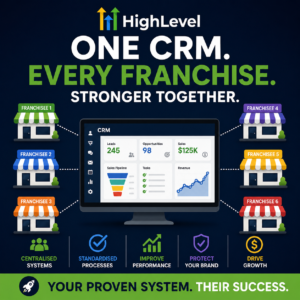
A branded CRM, marketing and sales system in a box that you can give to every franchisee.

You can build the core system centrally, systemise how it is customised for each franchisee, incorporate it into your franchisee onboarding and then continue improving it as the network grows.

I’ve recently been involved in doing exactly this for a UK childcare consultancy franchise.

And one of the biggest things I’ve learned from the project is that there is a significant difference between simply setting up a HighLevel CRM and designing a HighLevel system that could eventually be used by tens or even hundreds of franchisees.

Can HighLevel Be Used as a CRM for Franchises?

Yes.

HighLevel’s Agency structure makes it possible to operate multiple individual sub-accounts from one central Agency account.

For a franchise operation, that potentially allows the franchisor to create the central framework while individual franchisees or locations operate within their own HighLevel sub-accounts.

A franchisee can therefore have their own contacts, opportunities, calendars and day-to-day CRM while following a marketing and sales system designed by the franchisor.

HighLevel snapshots are particularly important here.

A snapshot can package many elements of a HighLevel setup so that they can be deployed into additional sub-accounts. HighLevel itself describes snapshots as a way to standardise proven setups and maintain consistency across multiple accounts and locations.

That is exactly what we want in a franchise.

You don’t want to reinvent your CRM and marketing system every time franchisee number 27 joins.

You want to have already done the hard work.

Don’t Just Give Your Franchisees a CRM

I think this distinction is fundamental.

A CRM by itself isn’t necessarily much of a franchise benefit.

Imagine telling a new franchisee:

“Here’s your CRM login. Good luck.”

They still have to decide how to configure it.

  • What stages should their sales pipeline contain?
  • What happens when somebody completes an enquiry form?
  • Which emails should be sent?
  • When should a salesperson follow up?
  • How should leads be nurtured?
  • What should happen when an appointment is booked?
  • How do they request reviews?
  • Which landing pages should they build?
  • Which forms should they use?
  • How do they know whether their marketing is working?

For a typical small business owner, that’s a lot to work out.

And most franchisees haven’t bought a franchise because they want to become CRM and marketing automation experts.

They have bought into a franchise because they want a proven system.

So why shouldn’t the marketing and sales system be part of that proven system?

That’s the opportunity I see with HighLevel.

Give Every Franchisee a Marketing and Sales System in a Box

Instead of giving franchisees a blank CRM, imagine giving every new franchisee a system that already contains the framework they need.

Depending on the franchise, that could include:

  • CRM and contact management
  • Standard sales pipelines
  • Automated lead follow-up
  • Email campaigns and templates
  • SMS communications
  • Appointment calendars
  • Service Appointments
  • Rentals
  • Events & Ticketing
  • Invoicing
  • Forms and surveys
  • Landing pages and funnels
  • Lead magnets
  • Review generation
  • Missed-call text back
  • Social media tools
  • Lead nurturing
  • Reporting
  • AI functionality
  • Websites or campaign pages
  • Standard workflows and automations

Not every franchise needs every HighLevel feature.

That’s not the point.

The important thing is that the franchisor determines what the proven marketing and sales system should contain.

That system can then become part of the franchise offering.

Don’t simply give your franchisees access to software.
Give them your proven marketing and sales system built inside the software.

A Real Example: Building HighLevel for a Childcare Consultancy Franchise

We’ve recently been working with a childcare consultancy franchise that wanted to provide its network of consultants with exactly this type of system.

Before the project, the individual consultants didn’t have a standard CRM and marketing platform.

The franchisor could see two important reasons for changing that.

The first was operational.

They wanted consultants to have a proper system for managing their marketing, enquiries and sales opportunities.

But there was another reason that I think is particularly interesting.

Franchisee recruitment.

Franchising itself is a competitive marketplace. A prospective franchisee may compare several different opportunities before deciding which franchise to join.

The franchisor recognised that being able to say:

“When you join us, you receive our complete branded CRM, marketing and sales system.”

could become another point of differentiation.

The technology therefore wasn’t simply an internal administrative tool. It became part of the franchise proposition itself.

What Did We Actually Build?

The client had already heard of HighLevel and believed it could provide the underlying technology.

Our job was to help turn HighLevel into their system.

We were involved in the strategic planning, HighLevel architecture and coordination of the master build.

The franchisor brought something equally important to the project: their own intellectual property and expertise.

They supplied the specialist copy for the emails, lead magnets, landing pages, surveys and other marketing materials.

That distinction is important.

HighLevel provides the technology.

We provide the HighLevel, CRM and marketing automation experience.

The franchisor provides the specialist knowledge, processes, content and understanding of its marketplace.

Combining those elements allowed us to build something specifically around how their consultants operate.

The resulting system includes CRM, sales pipelines, workflows, automated emails, forms, surveys, lead magnets, landing pages, calendars and other marketing functionality.

And crucially, it is branded to the franchisor rather than presented to consultants as an unrelated piece of third-party software.

Considering HighLevel for Your Franchise?

If you’re thinking about giving your franchisees a standard CRM, marketing and sales system, let’s discuss what you’re trying to achieve.

Book a Discovery Call with Julian

Build the Master System Once, Then Systemise the Rollout

The objective was never to manually build another CRM from scratch every time a new consultant joined.

We created a master system that could be replicated and then systematically customised for an individual consultant.

This is where HighLevel’s sub-account and snapshot architecture becomes particularly useful.

The master setup provides the framework.

When another consultant joins, the onboarding process becomes one of deploying and configuring an established system rather than inventing another one.

There will still be franchisee-specific information to configure.

But the fundamental marketing and sales architecture has already been decided.

HighLevel has continued developing this functionality too. In August 2026 it introduced the ability to load a snapshot into multiple selected sub-accounts from a central process.

For a growing franchise network, functionality like this makes standardisation across multiple franchisee accounts increasingly practical.

The principle is simple: invest in building the system properly once. Then systemise its deployment.

A Simple Example: The Franchise Sales Pipeline

One of the simplest examples from our childcare consultancy project is the sales pipeline.

Without a structured system, an individual consultant might manage prospects using a spreadsheet, notebook, email inbox or simply their memory.

That may just about work when there are ten opportunities.

It becomes considerably more difficult when there are 100.

Or 500.

  • Who needs following up?
  • Who requested more information?
  • Who has an appointment booked?
  • Who said to call back in three months?
  • Which prospects have gone quiet?
  • Which opportunities are closest to becoming clients?

A properly designed pipeline gives the consultant a structured process for managing those opportunities.

Automation can then support that process.

The objective isn’t to replace the consultant.

It’s to make it much harder for good opportunities to slip between the cracks.

And instead of every franchisee inventing their own sales process, the franchisor provides the process they believe gives their franchisees the best chance of success.

The Franchisee Gets a Working CRM From Day One

Think about this from the perspective of somebody who has just bought a franchise.

They probably have enough to learn already.

They need to understand the product or service. They need to learn the franchisor’s operating procedures. They may need to find premises, recruit staff or develop a local territory. They need to learn how to sell and they need to start marketing.

The last thing many of them need is:

“Now choose a CRM and spend the next three months figuring out how to configure it.”

With the model we’ve been developing, the franchisee instead starts with a working CRM and marketing system from day one.

The pipelines are there. The workflows are there. The forms are there. The marketing assets are there. The follow-up processes are there.

The system has been designed around the business they have just bought into.

That can be a substantial franchisee benefit.

Make CRM Training Part of Franchisee Training

There is another lesson from our childcare consultancy project that I think is particularly important.

Don’t make the CRM a separate technology project.

Make it part of how you train franchisees to run the business.

We’ve trained someone within the franchisor’s organisation to become what I call the CRM Champion.

The CRM Champion understands the system, owns it internally and can onboard new consultants.

Training on the marketing and CRM system is then incorporated into the franchise’s existing onboarding and training programme.

So instead of saying:

“Tuesday afternoon is your HighLevel training.”

the training can be contextual.

  • This is how we deal with a new enquiry.
  • This is how you move an opportunity through the pipeline.
  • This is how you book an appointment.
  • This is how you follow up.
  • This is how you nurture somebody who isn’t ready yet.

In other words, the franchisee isn’t really learning HighLevel.

They’re learning how to operate the franchise’s marketing and sales system.

I think that’s a much better way to approach it.

Central Control or Franchisee Freedom?

This is one of the strategic decisions that needs to be made when designing HighLevel for a franchise.

How much control should the franchisor retain?

There isn’t necessarily one answer for every franchise.

In our childcare consultancy project, the consultants aren’t particularly technically minded.

The system is therefore heavily controlled centrally.

That’s deliberate.

We don’t want every consultant redesigning pipelines, changing important workflows or modifying automation that has been developed as part of the proven franchise system.

The objective is consistency.

Another franchise might take a different approach.

It could provide a standard core system while allowing franchisees greater freedom over local campaigns, calendars, pages or other elements.

HighLevel provides agency-level and sub-account permissions that can help determine what different users can access.

But the important thing is to make these decisions before building the system.

Technology should support the franchise model.

The technology shouldn’t determine it.

HighLevel for Multi-Location Franchises

The same principles can apply where the franchise structure is more complicated than one franchisee equals one location.

One franchisee might own several territories.

Another might operate multiple physical locations.

A larger franchise group could contain company-owned locations alongside independently owned franchise locations.

The precise HighLevel architecture needs to reflect the commercial and operational structure of the franchise.

But the underlying principle remains the same.

You want appropriate separation of local contacts, opportunities and operations while maintaining as much consistency as possible across the wider network.

This is another reason why architecture becomes increasingly important as the franchise grows.

What Happens When You Improve the System?

This is where the model gets particularly interesting.

Suppose you have 30 franchisees.

You discover that a new follow-up process generates more appointments.

Or you create a better email sequence.

Or a new lead magnet performs particularly well.

Or you develop an AI process that saves franchisees several hours each week.

That learning may have originated with one part of the network.

But it can inform improvements to the system used by the wider franchise.

This is one of the major differences between a franchise network operating on a common technology platform and 30 independent businesses all using different systems.

The collective learning can become part of the franchise’s intellectual property.

There is an important technical caveat.

Updating centrally deployed HighLevel assets needs to be managed carefully, particularly if franchisees have been allowed to make local modifications.

That is another reason to decide what is centrally controlled and what franchisees are free to customise before rolling the system out widely.

AI Creates Another Opportunity

I wouldn’t recommend adding AI simply because everybody is talking about AI.

Start with the business process.

But HighLevel’s expanding AI functionality creates another interesting opportunity for franchise networks.

For example, a franchisor could potentially develop an AI agent around a proven process and then deploy that configuration across appropriate franchisee accounts rather than expecting every franchisee to work out how to build their own AI solution.

HighLevel now supports certain Agent Studio and Managed Agent configurations within snapshots.

Again, the value isn’t simply having AI.

The value is developing something centrally that can help franchisees perform a particular process more consistently or efficiently.

A HighLevel Franchise System Is More Like Building Software Than Setting Up a CRM

This is probably the biggest lesson I’ve personally taken from our first major franchise implementation.

It took longer than we anticipated.

In hindsight, that’s understandable.

We weren’t simply setting up somebody’s CRM.

We were creating a system that needed to be repeatable.

Every workflow needed to be considered in terms of the next consultant. Every field, pipeline and automation had to make sense as part of the wider system. The onboarding needed to be repeatable. Customisation needed to be systemised. Training needed to be considered. Permissions and control needed to be considered.

Building a really good HighLevel franchise system is more like building software than setting up a CRM.

That’s something I would encourage any franchisor considering this approach to factor into the project.

There can be considerable work involved upfront.

But you’re not doing that work simply for franchisee number one.

You’re creating an asset that could ultimately support franchisee number 10, 50 or 100.

Having now been through that process ourselves, we also have a much better understanding of what needs to be considered at the beginning of the next franchise project.

Your Marketing and Sales System Becomes a Franchise Asset

What makes a franchise valuable?

It isn’t simply the logo.

A franchisee is buying into a combination of brand, knowledge, processes, training, support and proven ways of doing things.

A well-designed marketing and sales system can become part of that infrastructure.

The franchisor has invested the time and money required to work out:

  • How leads should be captured
  • How enquiries should be followed up
  • What the sales process should look like
  • What communications should be sent
  • How prospects should be nurtured
  • Which marketing assets should be used
  • How appointments should be managed
  • How results should be tracked

The individual franchisee doesn’t have to solve all those problems independently.

This is where I think the question changes.

Instead of asking:

“Which CRM should we tell our franchisees to buy?”

ask:

“What marketing and sales system should we give our franchisees to help them succeed?”

Those are two very different questions.

Your HighLevel System Can Help You Attract Franchisees Too

There’s another potential return on the investment.

The system can help your existing franchisees.

But it can also strengthen your proposition when recruiting new franchisees.

Imagine two similar franchise opportunities.

One says:

“We’ll train you how to run the business and give you our operations manual.”

The other says:

“We’ll train you how to run the business and give you our complete branded marketing and sales platform. Your CRM, sales pipeline, lead follow-up, marketing campaigns, landing pages, appointment system and automation are already built for you.”

Which sounds like the more complete business opportunity?

Obviously, technology alone won’t make a successful franchise.

But in a competitive franchise recruitment market, it can be another tangible reason for somebody to choose your proposition.

This was one of the motivations behind the childcare consultancy system we’ve been building.

Should HighLevel Be Included in the Franchise Fee?

That’s a commercial decision for the franchisor.

In our childcare consultancy example, access to the CRM and marketing system is included within the franchisee fee.

I like the logic behind this.

The CRM isn’t positioned as an optional piece of third-party software.

It’s part of the way the franchise operates.

Depending on the business model, another franchisor might choose to itemise technology separately.

The important point is that HighLevel’s agency architecture gives the franchisor options in how the technology is packaged and delivered.

Planning a HighLevel Franchise System?

A serious franchise implementation can involve much more than creating a few workflows. We can help with strategy, system architecture and implementation.

Book a Discovery Call with Julian

Why Use HighLevel for a Franchise?

There are plenty of CRMs available.

The reason I find HighLevel particularly interesting for the franchise model is the breadth of functionality contained within one platform.

CRM is only one part of it.

HighLevel can provide pipelines, forms, surveys, calendars, workflows, email, SMS, websites, funnels, reputation management, social media tools, courses, communities, AI functionality and considerably more.

A franchise doesn’t necessarily need all of those.

But having so much functionality available within the underlying platform gives the franchisor considerable scope to develop a system around the specific needs of its franchisees.

And the system can evolve.

You might initially launch with CRM, pipeline and basic marketing automation.

Later you might add AI, a customer portal, additional lead-generation funnels or new nurturing campaigns.

You don’t necessarily need to replace the underlying platform every time the franchise’s requirements become more sophisticated.

HighLevel’s Agency Pro plan is currently listed at $497 per month, offers unlimited accounts and provides a potentially interesting underlying framework for an organisation that ultimately wants to manage many fanchisees.

I’ve written separately about HighLevel co-founder Shaun Clark’s statement regarding the scale HighLevel has now reached and its position behind Salesforce in the CRM market.

Read: HighLevel Is Now the World’s Second Largest CRM Behind Salesforce, According to Shaun Clark

For me, the important point isn’t simply the headline ranking.

It’s that we’re no longer talking about a small CRM platform with limited scope.

With HighLevel we’re talking about a substantial platform on which a franchisor can potentially build something much more specialised.

What About Other Software Used by the Franchise?

HighLevel doesn’t necessarily need to replace every piece of software used by a franchise.

A franchise may already require specialist operational systems.

A field-service business, for example, might require job management, scheduling or quoting functionality from specialist field-service software.

An accountancy franchise will have specialist accounting systems.

Other industries may have operational or regulatory requirements that require dedicated software.

The objective shouldn’t be to force every business process into HighLevel simply because HighLevel exists.

Instead, determine what HighLevel should be responsible for and where specialist systems remain appropriate.

Where necessary, APIs, webhooks and integrations can connect systems together.

This is another area where strategic planning before implementation becomes important.

HighLevel for a New Franchise vs an Existing Franchise Network

Building a New Franchise

If you’re currently developing a franchise model, you have an opportunity to design the CRM and marketing system into the franchise from the beginning.

You can decide:

  • What every franchisee receives
  • What the standard sales process is
  • Which marketing assets are included
  • How onboarding works
  • What the franchisor controls
  • What the franchisee controls
  • How technology is incorporated into training
  • How future improvements are rolled out

The system becomes part of the franchise architecture.

Introducing HighLevel to an Existing Franchise

An established network presents a different challenge.

If you already have 20, 50 or 100 franchisees, they may already be using different systems.

Some may have spreadsheets. Some may have their own CRM. Some may have developed their own processes.

Now you’re dealing with migration, adoption, training and change management as well as technology.

That doesn’t mean it can’t be done.

It simply means the implementation needs to be approached differently.

Could Your Business Become a Digital Franchise?

There’s also an interesting development beyond conventional franchising.

I’ve written separately about what I call the Digital Franchise.

The idea is that a successful business can increasingly package not only its knowledge and processes but also much of the technology required to operate the business.

HighLevel can form part of that infrastructure.

A proven business might therefore package its branding, methodology, training, CRM, workflows, pipelines, marketing campaigns, AI and operating processes into a repeatable system.

Read: The Rise of the Digital Franchise: How HighLevel Agencies Are Packaging AI-Powered Business Systems

I’ve also written a follow-up specifically looking at whether an existing business is suitable for this model:

Read: Is Your Business Suitable for Digital Franchising With HighLevel?

This starts to blur some of the traditional boundaries between software, licensing, consulting and franchising.

What If I Want to Build and Sell My Own HighLevel System?

You don’t necessarily need to operate a traditional franchise to use some of these principles.

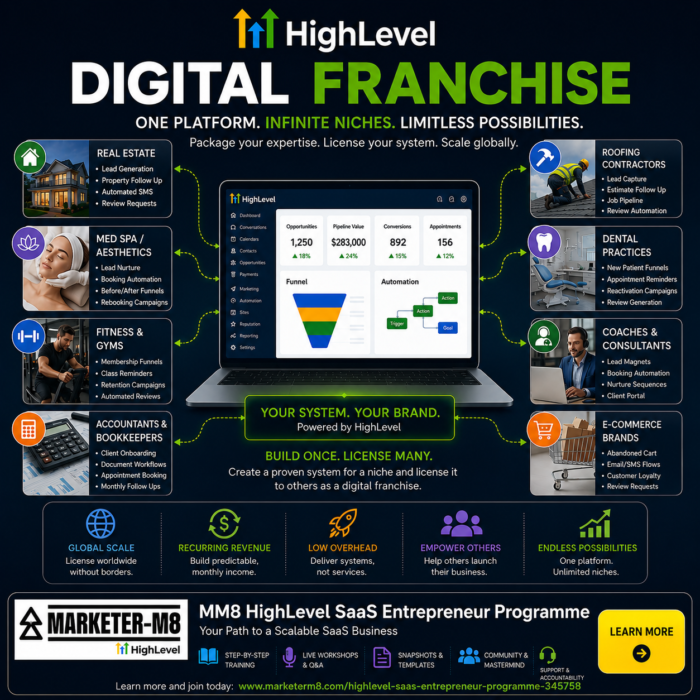
Consultants, agencies and entrepreneurs can use HighLevel’s white-label and agency capabilities to create systems for particular niches and sell access to them on a recurring basis.

This is one of the models we explore through the MarketerM8 HighLevel SaaS Entrepreneur Programme.

Read: HighLevel SaaS Entrepreneur Programme

There is a natural crossover.

One person may want to create a SaaS business selling a marketing system to independent businesses within a niche.

Another may already own a franchise and want to provide essentially the same type of technology as part of their franchise package.

The underlying HighLevel architecture can support both models.

Is the HighLevel SaaS Entrepreneur Programme Free for Franchisors?

The core MarketerM8 HighLevel SaaS Entrepreneur Programme is available without a programme fee to qualifying participants who open their HighLevel Agency account through MarketerM8.

For somebody who wants some guidance getting started, understanding the Agency structure and learning how the model works, that may be all the support they require.

A serious franchise implementation can be very different.

If you need help strategically designing your franchise system, architecting HighLevel, creating the master setup and snapshot, coordinating implementation, migrating existing systems, developing integrations or building bespoke functionality, this can become a substantial project.

We provide this type of advanced strategy and implementation as a paid consultancy service.

We’ll discuss what you’re trying to achieve first and make it clear where the free SaaS Entrepreneur Programme ends and any paid consultancy or implementation work would begin.

Considering Using HighLevel for Your Franchise?

If you’re building a new franchise, already operate a franchise network, or are considering packaging a successful business model into a franchise, HighLevel is worth investigating.

But I wouldn’t start by asking:

“What can HighLevel do?”

I’d start with:

“If we could give every franchisee our ideal marketing and sales system from day one, what would that system look like?”

Then we can determine how HighLevel can be used to build it.

We’ve now been through this process with a consultancy franchise and have first-hand experience of both the opportunities and the amount of work involved in doing it properly.

Considering HighLevel for Your Franchise?

If you’d like to discuss your franchise model and what you’re trying to achieve, book a Discovery Call with me.

Book a Discovery Call with Julian

Frequently Asked Questions About HighLevel for Franchises

Can HighLevel be used as a CRM for franchises?

Yes. HighLevel’s Agency and sub-account structure can be used to provide individual franchisees or locations with their own CRM environment while the franchisor maintains a central framework. This makes it particularly interesting for franchise networks wanting greater consistency across their marketing and sales processes.

Can every franchisee have their own HighLevel account?

A franchisor can create separate HighLevel sub-accounts for individual franchisees or locations. These can contain their own contacts, opportunities, calendars and other appropriate data while operating within the franchisor’s wider Agency structure.

Can I copy the same HighLevel system to every franchisee?

Yes. HighLevel snapshots can package many elements of a sub-account configuration and deploy them into additional sub-accounts. This makes it possible to create a master franchise system rather than rebuilding the CRM for every new franchisee.

Can I update multiple franchisee HighLevel accounts centrally?

HighLevel has functionality for loading snapshots across multiple selected sub-accounts. However, ongoing updates need to be carefully planned, particularly where individual franchisees are allowed to modify centrally supplied assets.

Can a franchisor control HighLevel centrally?

HighLevel provides agency-level controls and user permissions that can support a centrally managed model. The precise structure should be designed around what the franchisor wants franchisees to access and what should remain centrally controlled.

Can HighLevel be branded as our franchise’s own CRM?

HighLevel provides white-label capabilities that can allow an Agency to use its own branding and branded domain. This can help position the CRM and marketing platform as part of the franchisor’s wider system rather than an unrelated software product.

Can each franchisee have their own contacts and sales pipeline?

Yes. Individual sub-accounts can maintain their own contacts and opportunities. A franchisor can therefore provide the standard sales process while individual franchisees manage their own prospects through it.

Can HighLevel route leads to different franchisees or territories?

Potentially. HighLevel workflows and related functionality can automate lead assignment and routing. The appropriate architecture will depend on factors such as geographical territories, services, locations and the franchise’s own rules for allocating leads.

Can HighLevel support multi-location franchises?

Yes. HighLevel’s sub-account architecture can support businesses operating multiple locations. However, the appropriate structure depends on whether locations are independently owned, owned by one franchisee, centrally owned or operate under another arrangement.

Can each franchisee have their own calendar?

Yes. HighLevel calendars can be configured around individual users, teams and locations depending on the requirements of the franchise.

Can HighLevel be used for franchise review generation?

Yes. HighLevel includes reputation-management functionality that can form part of a standard customer follow-up and review-generation process across the franchise.

Can AI be deployed across franchisee accounts?

Potentially. HighLevel’s AI functionality continues to develop, and certain AI configurations can now be included within snapshots. This creates opportunities for franchisors to develop AI-assisted processes centrally and deploy them across appropriate franchisee accounts.

Can HighLevel integrate with our existing franchise software?

Potentially. HighLevel supports integrations, APIs and webhooks that can allow information to pass between systems. Whether a particular integration is practical needs to be assessed individually.

Should franchisees be allowed to change the standard HighLevel system?

That depends on the franchise. In our childcare consultancy implementation, central control is important because the individual consultants aren’t expected to become HighLevel technicians. Another franchise may deliberately allow greater local flexibility. This should be decided before the system is rolled out.

What happens when a franchisee leaves?

This should be considered before implementation and reflected in the franchise’s agreements, data policies and operating procedures. Account access, data, telephone numbers, domains and any migration requirements should ideally be determined before the first franchisee leaves rather than afterwards.

Can HighLevel be included in our franchise fee?

Potentially, yes. How the technology is packaged is a commercial decision for the franchisor. In the childcare consultancy project we’ve been working on, the branded CRM and marketing system is included within the franchisee offering.

How much does HighLevel cost for a franchise network?

The cost depends on the HighLevel plan, communications usage, AI features, additional services and the architecture required. HighLevel currently lists its Agency Pro plan at $497 per month. Franchisors should also budget for implementation and ongoing usage rather than looking only at the headline platform subscription.

Is HighLevel suitable for 50 or 100+ franchisees?

HighLevel’s Agency and sub-account architecture is designed to manage multiple accounts. However, the larger the proposed network, the more important architecture, governance, onboarding, training, support and update management become. Scalability isn’t simply a question of whether the software can create another sub-account.

Is the MarketerM8 HighLevel SaaS Entrepreneur Programme free?

The core programme is available without a programme fee to qualifying participants who establish their HighLevel Agency account through MarketerM8. Bespoke consultancy, advanced strategy, integrations and implementation are separate professional services where required.

Can MarketerM8 help us build our HighLevel franchise system?

Yes. We can help with the strategic planning, HighLevel architecture and implementation of more complex franchise systems. We’ve recently been through this process with a childcare consultancy franchise, giving us first-hand experience of both the opportunities and the practical challenges involved.

How do I get started?

Start by defining what you would ideally like every franchisee to receive as part of your marketing and sales system.

Then book a Discovery Call with Julian Mills to discuss whether HighLevel is suitable and how the system could be structured.

Julian Mills HighLevel Consultant and Marketing Automation Strategist

About the Author

Julian Mills

HighLevel Consultant & Marketing Automation Strategist

Julian Mills helps business owners automate lead generation, sales follow-up, customer communication and business processes using HighLevel and MarketerM8. Since 2009 he has helped businesses implement CRM, marketing automation and AI-powered systems that save time, improve customer experience and generate more sales.

About Julian
Book a Discovery Call
Join a Free HighLevel Workshop
Learn About HighLevel with MarketerM8

HighLevel White-Label CRM Alternatives in the UK: Which Platform Should You Choose?

highlevel_white_label_crm_alternatives_genieai_marketerm8_my_instant_business_notluck_nextlevel_rule_your_jungle_sales_igniter_automagicalcrm_richh_digital_goengage_avantwerk_digitraffic

highlevel white label crm alternatives genieai entrepreneurs circle marketerm8 my instant business notluck nextlevel rule your jungle sales igniter automagicalcrm richh digital goengage avantwerk digitrafficIf you’re searching for GenieAI alternatives, MarketerM8 alternatives, My Instant Business alternatives, NotLuck CRM alternatives or alternatives to another all-in-one CRM platform, there is something important you should understand before making your decision.
You may actually be comparing different versions of the same underlying software: HighLevel.

HighLevel, also widely known as GoHighLevel, allows agencies and consultants to white-label its CRM and marketing platform. An agency can put its own name, branding and domain around HighLevel and offer it to customers as its own platform.

There is nothing unusual or underhand about this. White-labelling is deliberately built into HighLevel’s business model.

It does, however, make comparing CRM systems rather interesting.

A business might compare two or three apparently different CRM platforms without realising that underneath the branding, they may share much of the same HighLevel technology.

And that changes the question you should be asking.

Rather than simply asking:

“Which CRM has the best features?”

you may need to ask:

“Who do I want helping me implement and get the most from HighLevel?”

A Note on Transparency

Before going any further, I should declare an interest.

MarketerM8 is my own HighLevel agency.

I’ve included MarketerM8 in this guide because it is itself a white-label HighLevel platform and therefore belongs in a meaningful comparison of HighLevel providers.

I’m not going to pretend MarketerM8 is proprietary CRM software that I developed from scratch. It isn’t.

It’s HighLevel.

What we provide around HighLevel is where MarketerM8 differs, including implementation, consultancy, training and ongoing UK-based support.

I’ll come back to that later.

What Is a HighLevel White-Label CRM?

HighLevel is an extensive sales, marketing and customer management platform.

Depending on how it is configured, it can provide:

  • CRM and contact management
  • Sales pipelines and opportunities
  • Email marketing
  • SMS marketing
  • WhatsApp
  • Telephone calls
  • Online calendars and appointment booking
  • Forms, surveys and quizzes
  • Websites and sales funnels
  • Marketing automation and workflows
  • Social media management
  • Reputation and review management
  • Payments
  • Courses and communities
  • AI chat
  • AI voice receptionists
  • Automated lead nurturing
  • Mobile apps

HighLevel’s agency model allows another business to take this technology and provide it under its own brand.

The provider can then add its own services, templates, workflows, industry knowledge, training, support and pricing.

That means two businesses could technically be selling access to HighLevel while providing very different customer experiences.

How I Identified These Platforms

I’ve worked with CRM and marketing automation systems since the days of Infusionsoft, now Keap, and have worked extensively with HighLevel since adopting the platform.

That means there are certain features and terminology that immediately make me take a closer look at a CRM.

One feature proves very little.

But when a platform offers a combination such as:

CRM + pipelines + unified conversations + SMS + email + calendars + funnels + forms + workflows + reviews + social media + missed-call text-back + payments + courses + AI + a branded mobile app

…it starts to develop a very distinctive HighLevel fingerprint.

For this article I’ve also looked for stronger evidence, including providers openly mentioning HighLevel or LeadConnector, references in privacy policies and HighLevel’s own websites and awards.

I’ve therefore tried to distinguish between platforms where the HighLevel connection is confirmed and those where the available evidence simply suggests that HighLevel may be the underlying technology.

This is important because I don’t want to claim that a business uses HighLevel where that cannot reasonably be established.

GenieAI by Entrepreneurs Circle Alternative

If you’re searching for GenieAI alternatives or alternatives to GenieAI by Entrepreneurs Circle, it’s worth understanding what you’re actually comparing.

I know Entrepreneurs Circle and GenieAI very well and work closely with them. I would regard them as one of the largest HighLevel agencies in the UK, and in my experience they provide an excellent service.

One of GenieAI’s particular strengths is that you’re getting much more than simply access to HighLevel. Entrepreneurs Circle has built an extensive collection of pre-installed templates and marketing resources around the platform. For businesses already involved with Entrepreneurs Circle, that combination of technology, proven marketing material and the wider Entrepreneurs Circle ecosystem can be particularly valuable.

I should also disclose my own relationship with Entrepreneurs Circle. I’m an Entrepreneurs Circle Certified Marketing Coach and work 1-to-1 with business owners to help them implement the Entrepreneurs Marketing System.

I also co-authored The Entrepreneurs Marketing System with Entrepreneurs Circle founder Nigel Botterill. You can get a copy of The Entrepreneurs Marketing System here if you’d like to learn more about the approach.

So if I’m positive about GenieAI, why include GenieAI alternatives in this guide?

Because the right HighLevel provider depends on what you need.

You might value GenieAI’s extensive templates and Entrepreneurs Circle ecosystem. Alternatively, you might want to use HighLevel directly, work with a different HighLevel agency, or choose a completely different CRM such as HubSpot, Keap, Pipedrive or Zoho.

If you like the underlying HighLevel technology but want a different approach to implementation, pricing, support or training, comparing other HighLevel providers makes perfect sense.

And that’s the purpose of this guide. Not to declare one HighLevel agency universally better than another, but to help you understand the differences between them and choose the provider that’s right for your business.

MarketerM8 Alternative

If you’re searching for MarketerM8 alternatives, it’s only fair that I include my own platform.

MarketerM8 is a white-label HighLevel agency.

We’re not hiding that fact.

Our proposition isn’t that we’ve invented better CRM software than HighLevel.

Our proposition is about helping businesses actually implement HighLevel properly.

My approach is very much Done With You.

Rather than simply giving somebody a login and leaving them with hundreds of HighLevel features to work out, or a bunch of one size fits all templates we help determine what the business actually needs, configure it and train somebody internally to become their CRM Champion.

However, MarketerM8 isn’t necessarily right for everybody.

If you’re technically confident and simply want the software, going directly to HighLevel may make more sense.

If you want an industry-specific system that has already been heavily configured for your particular niche, a specialist HighLevel provider may be a better option.

And if you don’t want HighLevel at all, platforms such as HubSpot, Keap, Pipedrive or Zoho should be considered.

That’s why I think searching for alternatives to MarketerM8 is perfectly sensible.

My Instant Business Alternative

If you’re searching for My Instant Business alternatives, the first thing to consider is whether you’re looking for different technology or simply a different provider.

My Instant Business provides an extensive all-in-one business platform including CRM, websites, funnels, automation, communications, booking and AI functionality.

The combination of features has a strong resemblance to the HighLevel ecosystem.

Based on the publicly available evidence I’ve reviewed, I believe there is strong evidence that HighLevel technology may sit behind the platform, although I haven’t found evidence strong enough to describe this as definitively confirmed.

If you’re looking for an alternative to My Instant Business, I would therefore include HighLevel and other HighLevel providers in your comparison alongside genuinely different CRM products.

More importantly, compare what happens after you subscribe.

Who configures the system?

Who builds your workflows?

Who migrates your data?

Who trains your staff?

And who helps when you know what you want the system to achieve but don’t know how to build it?

Those questions can matter far more than the software logo.

NotLuck CRM Alternative

If you’re searching for NotLuck alternatives or NotLuck CRM alternatives, the HighLevel connection is much easier to identify.

The company openly markets GoHighLevel services in the UK and its published information references LeadConnector, the technology associated with HighLevel.

You should therefore compare both other HighLevel providers and completely different CRM platforms.

If you like HighLevel but want a different service relationship, another HighLevel agency could be the logical alternative.

If HighLevel itself is the problem, changing the branding around it probably isn’t going to solve your problem.

NextLevel CRM Alternative

If you’re searching for NextLevel CRM alternatives, NextLevel takes a refreshingly straightforward approach.

It openly states that its CRM is built on GoHighLevel.

That makes the comparison relatively easy to understand.

You aren’t necessarily searching for alternative technology.

You might actually be searching for an alternative HighLevel provider.

This illustrates something I think is really important about the white-label CRM market.

The platform isn’t necessarily the differentiator.

The implementation around it can be.

Rule Your Jungle CRM Alternative

If you’re searching for Rule Your Jungle alternatives, it’s worth considering the underlying technology as part of your comparison.

Rule Your Jungle provides an all-in-one CRM and marketing platform aimed at helping businesses manage leads, communications and marketing activity.

Its combination of functionality and branded CRM approach has many characteristics associated with HighLevel.

My research suggests a strong likelihood of a HighLevel connection, but I would currently describe this as strong evidence rather than confirmed fact.

I’d therefore include HighLevel providers in the comparison, while also considering alternative CRM ecosystems.

Sales Igniter UK Alternative

If you’re searching for Sales Igniter alternatives, be aware that there are other software products using the Sales Igniter name.

Sales Igniter UK offers a particularly recognisable combination of functionality, including CRM and pipelines, landing pages, surveys and forms, calendars, webchat, messaging, workflows, SMS, email, payments and reviews.

That combination provides strong evidence of HighLevel-style technology.

If you’re considering the UK CRM platform, it may therefore help to search specifically for:

Sales Igniter UK alternative

or

Sales Igniter CRM alternatives UK.

Again, the important comparison is between the underlying technology and the service wrapped around it.

AutomagicalCRM Alternative

If you’re searching for AutomagicalCRM alternatives, its feature set is worth looking at closely.

AutomagicalCRM positions itself as an all-in-one CRM offering lead capture, landing pages, forms, surveys, appointment booking and marketing automation.

Those are familiar characteristics within the HighLevel ecosystem.

Based on the public evidence I’ve reviewed, I consider there to be strong evidence of HighLevel-style underlying technology, although I wouldn’t currently describe the connection as independently confirmed.

HighLevel itself and alternative HighLevel providers are therefore sensible places to start your comparison.

RichH Digital CRM Alternative

If you’re looking for RichH Digital CRM alternatives, its broad feature set creates a particularly strong HighLevel fingerprint.

RichH Digital offers websites and funnels, Stripe payments, calendars, SMS and email, sales pipelines, courses, communities, forms, workflows, reviews and missed-call text-back.

I’d therefore compare the service against other HighLevel providers as well as standalone CRM platforms.

The important consideration is not simply whether another provider has the same features. It’s what expertise and service you’re receiving around those features.

GoEngage Alternative

If you’re searching for GoEngage alternatives, GoEngage provides CRM, email, SMS, social media, automation, WhatsApp, calendars, lead nurturing and AI functionality.

That combination is highly reminiscent of the HighLevel ecosystem.

My current research suggests HighLevel is a probable underlying platform, but I would not present that as confirmed without stronger evidence.

Someone considering a GoEngage alternative should therefore establish whether they’re unhappy with the technology or simply looking for a different implementation and support model.

Avantwerk Alternative

If you’re researching Avantwerk alternatives, its all-in-one offering includes CRM, marketing, appointment booking, AI chat, reputation management, payments, websites and other business tools.

It has many characteristics associated with HighLevel.

I’d therefore compare what you’re receiving beyond the software itself, particularly implementation, automation expertise, support and training.

DigiTraffic CRM Alternative

If you’re searching for DigiTraffic alternatives or DigiTraffic CRM alternatives, the platform offers CRM, website functionality, email and SMS, AI automation, reputation management and lead nurturing as part of its wider digital marketing offering.

Again, there are similarities with the HighLevel ecosystem.

I currently regard this as a probable rather than confirmed HighLevel connection, so buyers should verify the underlying platform directly with the provider if that is important to their decision.

What About I Need Leads?

I Need Leads is interesting because its functionality has several similarities to HighLevel.

However, based on the current information I’ve reviewed, I’m less confident about classifying it as a HighLevel white label than some of the other platforms in this article.

Its technology may have evolved, it may combine several systems, or it may use technology that simply provides similar functionality.

For that reason, I’m deliberately not classifying I Need Leads as a HighLevel white-label platform without stronger evidence.

I think that’s an important distinction.

Similarity isn’t proof.

A Word of Caution: HighLevel Newbies, Dabblers and Disappearing Agencies

There is another side to the HighLevel white-label market that I think prospective customers need to understand.

HighLevel predominantly sells its software through agencies, and its white-label model makes it relatively easy for somebody to launch what appears to be their own CRM platform.

In this guide, I’ve deliberately tried to identify some of the more prominent and established HighLevel white-label agencies in the UK.

But there will be many more that have gone under my radar.

Some will be perfectly good smaller HighLevel specialists. Being a one-person agency isn’t automatically a bad thing. A highly experienced independent HighLevel consultant can potentially provide a much more personal service than a larger organisation.

The issue is experience and longevity.

HighLevel presents a very attractive business opportunity. That inevitably attracts people who see the opportunity to make recurring revenue by reselling software but they may not be the most experienced operators.

Some will launch a HighLevel agency despite having relatively little previous experience of CRM, marketing automation, business processes or marketing itself.

Setting up a HighLevel agency is relatively easy.

Running a good one isn’t.

Once customers start asking for complicated workflows, integrations, email deliverability advice, data migrations, websites, funnels, pipelines, AI, reporting and troubleshooting, the provider needs considerably more knowledge than simply knowing how to create a HighLevel sub-account.

At best, an inexperienced provider may simply be unable to give you the level of support you need.

At worst, they may discover that running a HighLevel agency involves significantly more work than they expected and that finding customers is not as easy as they first thought and so they decide the business isn’t for them.

That’s when things can become much more serious for the customer.

What Happens If Your HighLevel Agency Disappears?

This is a question I don’t think enough businesses ask before signing up:

“What happens to my HighLevel account if your agency closes?”

We’ve seen real examples of why this matters.

In one case, a business had paid an agency to build a new website for them inside HighLevel. Not long afterwards, the agency decided that running a HighLevel agency wasn’t for them and cancelled their agency account.

The client was then left with a website they had paid for, but without normal access to the HighLevel sub-account that controlled it.

That’s an extreme example, but it demonstrates the risk.

HighLevel does have mechanisms that allow client sub-accounts to be transferred between agencies, and many of the important assets can move with the account. However, a transfer normally requires action from the releasing agency, and some integrations and services need to be reconnected afterwards.

So this is something worth discussing before you choose an agency, rather than trying to solve it after something has gone wrong.

Think about how serious the situation could become if HighLevel isn’t just hosting your website.

Your HighLevel account could contain:

  • Your customer database
  • Sales opportunities and pipelines
  • Email and SMS conversations
  • Appointment calendars
  • Forms and surveys
  • Automated workflows
  • Websites and funnels
  • Memberships and courses
  • Telephone numbers
  • Marketing campaigns
  • Reporting
  • Integrations with other business systems

HighLevel can become a central part of a business remarkably quickly.

That makes the stability of the agency providing your account important.

Don’t Just Ask “How Much Does HighLevel Cost?”

A very cheap HighLevel white-label account might look attractive.

But price shouldn’t be the only consideration.

Before putting an important part of your business into somebody else’s HighLevel agency, I’d want to know:

How long have they been working with CRM and marketing automation?

How long have they been using HighLevel?

Do they have established customers?

Can they demonstrate real implementation experience?

Is HighLevel a serious part of their business, or something they’ve recently started experimenting with?

What happens to your account if they stop trading or decide to leave HighLevel?

Will they transfer your sub-account to another HighLevel agency if you need to leave?

And critically:

Who owns and controls the assets you’ve paid to create?

This doesn’t mean you should automatically choose the biggest HighLevel agency you can find.

It means you should choose a provider that gives you confidence they understand the technology, understand business and marketing, and are likely to still be there when you need them.

You’re not simply choosing where to buy a piece of software. You may be choosing who will hold an increasingly important part of your business infrastructure.

HighLevel Direct vs a White-Label HighLevel Agency

So why not simply buy HighLevel directly?

For some businesses, that’s exactly what I’d recommend.

If you’re technically confident, enjoy building automation and have the time to learn the platform, you can set up a HighLevel account directly here.

For transparency, that is my HighLevel affiliate link. If you sign up through it, I may receive an affiliate commission.

Going direct means your relationship is directly with HighLevel rather than accessing the platform through a white-label agency.

But there is an important distinction.

HighLevel gives you the technology. A good HighLevel agency should provide expertise around that technology.

HighLevel is enormous. Having hundreds of features available doesn’t mean your business needs hundreds of features.

Most businesses need somebody to help answer a much more important question:

“What should we actually build?”

That’s where a good HighLevel consultant or white-label provider can earn their money.

The value shouldn’t simply be providing access to the software. It should be helping you turn that software into something useful.

Checklist: Questions to Ask Before Choosing a HighLevel Agency

If you’re comparing MarketerM8, GenieAI, NotLuck, NextLevel CRM or any other HighLevel provider, don’t simply compare the monthly subscription price.

Here are the questions I’d ask.

The Platform

  • Is your platform built on HighLevel?
  • Which HighLevel features are included in my subscription? Is the account restricted?
  • Are any HighLevel features disabled or restricted?
  • Do I get unlimited contacts and users, or have you imposed your own limits?
  • Do I have API access? If so, what level of API access is provided?
  • Can I use HighLevel Marketplace apps and integrations?
  • Can I connect my own Stripe, email, phone and other third-party accounts?

Setup and Implementation

  • Who actually sets up my account?
  • Is implementation included in the monthly fee or charged separately?
  • Will you help migrate my existing contacts and data?
  • Will you build my pipelines, workflows, calendars, forms and automations?
  • Do you understand my business processes, or am I simply being given a standard “one size fits all” template or snapshot?
  • Can you integrate HighLevel with the other software my business already uses?

Expertise

  • How long have you actually worked with HighLevel?
  • How long have you worked with CRM, marketing and marketing automation generally?
  • Can you show examples of real HighLevel implementations you’ve completed?
  • Do you have established HighLevel customers?
  • Do you provide strategic CRM and marketing automation advice, or primarily software support?
  • Who will I be dealing with when I need help?
  • Is that person experienced in HighLevel itself?

Training and Support

Support can vary considerably between HighLevel agencies. If having access to somebody in the UK is important to you, don’t assume that a UK-facing HighLevel provider actually provides its support from the UK.

  • What onboarding and training is included?
  • Will my team receive training?
  • Can you help us develop somebody internally to take ownership of the CRM?
  • Is ongoing support included with my subscription?
  • Is support free, or will I pay an additional support fee?
  • What exactly is covered by support, and what would be charged as consultancy or implementation work?
  • Is support available 24/7?
  • How can I access support: live chat, email, telephone, Zoom or support tickets?
  • What response times should I expect?
  • Is the agency itself based in the UK?
  • Will the people I deal with be working in the UK timezone?
  • Is support actually provided by the agency’s own team, or is it passed through to HighLevel or an outsourced support service?
  • If I have a complicated implementation problem, can I speak to an experienced HighLevel expert rather than simply submitting a support ticket?

For many UK businesses, that last group of questions is particularly important.

I regularly speak to businesses that aren’t necessarily looking for different CRM software. They’re looking for somebody who understands HighLevel and is available during UK business hours.

There’s a big difference between having access to 24/7 technical support and having access to an experienced UK-based HighLevel consultant who understands your business, knows how your account has been built and can help you decide what to do next.

Ideally, establish what you’re getting before you sign up: technical support, strategic advice, implementation help, or a combination of all three.

Costs

  • What is the monthly subscription?
  • Are there setup or onboarding charges?
  • What are the charges for email, SMS and telephone calls?
  • Are usage charges passed through at cost or marked up?
  • What will I pay for AI features?
  • Is WhatsApp included or an additional charge?
  • Are there additional charges for integrations, premium workflows or other HighLevel features?
  • What is a realistic total monthly cost for a business like mine?

Ownership, Stability and Leaving

This is an area I’d pay particular attention to.

  • Who owns my customer data?
  • Can I export my contacts and other data whenever I want?
  • Am I tied into a minimum contract?
  • How established is your HighLevel agency?
  • What happens to my account if you stop trading or cancel your HighLevel agency account?
  • What happens if I decide to leave your agency?
  • Can my HighLevel sub-account be transferred to another HighLevel agency?
  • Will you agree to transfer my sub-account if I decide to move?
  • What happens to my workflows, funnels, websites, forms and automations if I leave?
  • Which integrations or services would need reconnecting following a transfer?
  • Will you cooperate with another HighLevel provider if I decide to move?
  • Are there any charges for leaving or transferring my account?

Perhaps the Most Important Question

There is one question I’d put near the top of the list:

“Apart from giving me access to HighLevel, what value are you adding?”

That’s really what you’re buying from a white-label HighLevel agency.

If the answer is simply a different logo on essentially the same software, you need to decide whether that’s worth paying for.

But if the provider brings industry knowledge, implementation expertise, proven workflows, integrations, consultancy, training and good ongoing support, the white-label model can make a great deal of sense.

The underlying HighLevel technology might be the same.

The expertise wrapped around it can be completely different.

Or Go Direct to HighLevel

After asking those questions, you may conclude that you don’t actually need an agency.

That’s perfectly reasonable.

You can start with HighLevel directly here and build your own system.

Again, for transparency, that’s my HighLevel affiliate link, so I may receive a commission if you subsequently become a paying HighLevel customer.

Going direct doesn’t mean you have no access to technical support. But there is an important distinction between technical platform support and having an experienced consultant who knows your business and helps you decide how HighLevel should actually be implemented.

If, on the other hand, you’re looking at that checklist and thinking:

“I don’t want to work all this out myself. I want somebody who already understands HighLevel to help us decide what to build and then help us implement it.”

That’s where choosing the right HighLevel agency becomes much more important.

What Makes MarketerM8 Different?

As I’ve already made clear, MarketerM8 is my own HighLevel agency.

So you should take that into account when reading my opinion.

MarketerM8 gives businesses access to HighLevel, but the software itself isn’t what I consider our main differentiator.

It’s the experience around it.

I’ve worked in direct response marketing since 1996 and with CRM and marketing automation systems since 2009, initially specialising in Infusionsoft and Keap before moving into HighLevel.

That experience has taught me that buying software rarely solves a business problem by itself.

You need to decide what you’re trying to achieve.

Then you build the technology around that.

That’s why my approach to HighLevel is Done With You.

We typically start by understanding the business, identifying what should be automated and then implementing HighLevel in manageable stages.

For UK businesses, there’s another practical advantage. You’re dealing with people who are based in the UK and working in the same timezone as you.

That’s something prospective customers mention to me surprisingly often. They don’t necessarily need someone sitting at a helpdesk at 3am. They want an experienced person they can speak to during their working day who understands both HighLevel and what they’re trying to achieve with it.

The objective isn’t to build the cleverest HighLevel account possible.

It’s to build one that people actually use.

So Which HighLevel Alternative Should You Choose?

There isn’t one answer.

If you want to configure everything yourself, HighLevel direct may be your best option. As mentioned above, this is my affiliate link.

If you want a pre-configured system designed specifically for your industry, a specialist white-label provider could be an excellent choice.

If you’re already using something such as GenieAI, NotLuck, NextLevel CRM or another HighLevel-based platform and you’re happy with the technology, but not the surrounding service, another HighLevel provider may allow you to stay within a familiar ecosystem.

If you don’t like HighLevel itself, look beyond the HighLevel ecosystem altogether. HubSpot, Keap, Pipedrive, Zoho and other CRM systems approach the problem differently.

And if you want HighLevel combined with hands-on UK consultancy, implementation, training and people working in the UK timezone, that’s exactly where MarketerM8 fits.

One Final Question to Ask

If you’re evaluating any CRM that looks remarkably similar to HighLevel, there’s nothing wrong with asking the provider directly:

“Is your platform built using HighLevel?”

If the answer is yes, that isn’t necessarily a reason not to buy it.

In fact, HighLevel is an extremely capable platform.

But it means you can make a much more informed comparison.

You’re no longer just comparing software.

You’re comparing the people, expertise, implementation, support, stability and value wrapped around it.

And in my experience, that’s usually where the real difference lies.

Julian Mills HighLevel Consultant and Marketing Automation Strategist

About the Author

Julian Mills

HighLevel Consultant & Marketing Automation Strategist

Julian Mills helps business owners automate lead generation, sales follow-up, customer communication and business processes using HighLevel and MarketerM8. Since 2009 he has helped businesses implement CRM, marketing automation and AI-powered systems that save time, improve customer experience and generate more sales.

About Julian
Book a Discovery Call
Join a Free HighLevel Workshop
Learn About HighLevel with MarketerM8

How to Offer CRM Software to Your Members Without Becoming a HighLevel Agency

How to Offer CRM Software to Your Members Without Becoming a HighLevel Agency

How to Offer CRM Software to Your Members Without Becoming a HighLevel AgencyWant to add a recurring CRM software revenue stream to your business, but do not want the hassle of becoming a HighLevel white label agency? There is a simpler way.

If you run a coaching business, consultancy, membership organisation, trade association, franchise network or online community, you may have considered offering CRM or marketing automation software to your members.

It makes perfect sense.

Your members already trust your advice. They come to you for guidance, training and support. Offering them software that helps them implement what you teach can be a natural extension of your existing business.

The problem is that many business owners assume they need to become a HighLevel white label agency and start running a separate software company.

That can mean taking responsibility for customer onboarding, technical support, billing, software updates, platform administration and all the other work involved in managing a SaaS business.

For many business owners, that is not what they want.

They want to add more value to their members and create a new source of recurring revenue, without building another business on top of the one they already have.

Fortunately, there is another option.

Why Becoming a HighLevel Agency Is Not Right for Everyone

HighLevel is a powerful CRM and marketing automation platform.

It is one of the reasons I chose it after spending many years working as an Infusionsoft and Keap consultant.

However, becoming a HighLevel white label agency means taking responsibility for areas such as:

  • Customer onboarding
  • Technical support
  • Customer billing
  • Platform administration
  • Email deliverability
  • DNS configuration
  • Software updates
  • Snapshot maintenance
  • Troubleshooting
  • AI feature updates

If your expertise is coaching, consulting, education or supporting a particular industry, these responsibilities can quickly become a distraction.

Instead of growing your existing business, you can find yourself running a software company as well.

That may be the right opportunity for some entrepreneurs, but it is not the only way to benefit from HighLevel.

The Better Alternative. Launch a Co-Branded CRM Solution

What if you could offer your members a professional CRM solution under your own programme name, without becoming responsible for running the underlying software business?

That is exactly what we help our partners achieve.

Rather than building and managing a software company from scratch, we create a co-branded CRM solution that combines your industry knowledge with the MarketerM8 platform.

For example:

  • Business Growth System by MarketerM8
  • Property Success Sytem by MarketerM8
  • Trades Business System by MarketerM8
  • The Business Automation Platform by MarketerM8

Your members receive a CRM and marketing automation platform designed around the needs of their industry.

You remain the trusted expert who provides the strategy, training, industry knowledge and community.

MarketerM8 provides the software platform, technical support, billing, ongoing management and continued development.

It is a genuine partnership that allows you to offer a valuable new service without taking on the responsibility of running another company.

Create a New Monthly Recurring Revenue Stream

One of the biggest attractions of offering software is the opportunity to build predictable monthly recurring revenue.

Many coaching businesses, consultancies and membership organisations rely heavily on:

  • One-off consulting projects
  • Membership subscriptions
  • Course sales
  • Training programmes
  • Events and workshops

A co-branded CRM adds another revenue stream to your existing business.

Each member who subscribes contributes to your monthly recurring income.

As the number of subscribers grows, so does the value of that income stream.

Most importantly, you do not need to recruit developers, employ technical support staff or become an expert in every part of the HighLevel platform.

We take care of the technical infrastructure while you concentrate on helping your members get results.

Add More Value to Your Existing Membership

A co-branded CRM is not simply another product to sell.

It can become a practical extension of your membership, coaching programme or consultancy.

Your members may already be learning how to improve their marketing, manage enquiries, follow up with prospects or retain customers.

The CRM gives them the tools to put that advice into practice.

Depending on your industry, the platform could include:

  • CRM and contact management
  • Sales pipelines
  • Email marketing
  • SMS and WhatsApp automation
  • Appointment booking
  • Automated follow-up
  • Review requests
  • Missed Call Text Back
  • AI chat assistants
  • AI voice receptionists
  • Customer reactivation campaigns
  • Websites, forms and landing pages

This can make your existing membership more valuable, more practical and harder for competitors to replicate.

Ideal for Membership Organisations, Coaches and Consultants

This partnership model works particularly well for organisations that already have an engaged audience.

Examples include:

  • Business coaches
  • Consultants
  • Membership organisations
  • Trade associations
  • Franchise groups
  • Marketing educators
  • Online course creators
  • Professional bodies
  • Industry experts
  • Business communities

If people already trust your advice, they are often more likely to adopt software that has been recommended and shaped by someone who understands their industry.

Rather than giving members access to a generic CRM, you can offer a solution that reflects the way their businesses actually operate.

Build an Industry-Specific CRM

The biggest opportunity is not simply reselling access to HighLevel.

It is creating a system designed for a particular market.

A Property Investment Community

A property-focused CRM could include:

  • Investor and vendor lead management
  • Property deal pipelines
  • Viewing reminders
  • Automated follow-up
  • AI receptionists
  • Appointment booking

A Business Coaching Organisation

A business coaching system could include:

  • Sales pipelines
  • Lead nurturing
  • Proposal follow-up
  • Client onboarding
  • Appointment calendars
  • Marketing campaigns
  • AI assistants

A Trade Association

A CRM for trades businesses could include:

  • Quote follow-up
  • Missed Call Text Back
  • Review requests
  • Customer reactivation
  • Appointment reminders
  • AI chat and voice support

Your expertise and industry knowledge become the difference.

The software provides the tools that allow your members to apply that knowledge.

How the Revenue Share Works

Under the MarketerM8 co-branded partnership model, you receive 50% of the subscription revenue generated by the customers you introduce.

You continue receiving your share for as long as those customers remain active subscribers.

This gives you the opportunity to create a long-term recurring revenue stream without taking responsibility for the entire software operation.

MarketerM8 manages:

  • The underlying HighLevel platform
  • Customer billing
  • Technical support
  • Platform administration
  • Software updates
  • New feature rollouts
  • Ongoing system development

You can decide how involved you want to be in training, implementation, community support and strategic guidance.

Which Option Is Right for You?

There are two ways to offer HighLevel to your clients, members or subscribers.

Neither option is automatically right or wrong. It depends on the type of business you want to build.

If you want to create and manage a standalone SaaS company, becoming a HighLevel white label agency could be the right choice.

If you want to add a software service and recurring income stream to your existing business, partnering with MarketerM8 may be the simpler route.

Feature HighLevel SaaS Entrepreneur Programme MarketerM8 Co-Branded Partnership
Subscription revenue Keep 100% Receive 50%
Customer billing Managed by you Managed by MarketerM8
Technical support Managed by you Managed by MarketerM8
Platform management Managed by you Managed by MarketerM8
Software updates Managed by you Managed by MarketerM8
Snapshot development Managed by you Developed in partnership
Branding Your own white label brand Co-branded with MarketerM8
Your main focus Building a SaaS business Growing your existing business
Best suited to Entrepreneurs who want to run a software company Coaches, consultants, communities and membership organisations

Option 1. Build Your Own HighLevel SaaS Business

If your ambition is to build a standalone software company, our HighLevel SaaS Entrepreneur Programme is designed to help you get started.

We help you understand how to establish your own HighLevel agency, attract customers, create recurring monthly revenue and build a scalable SaaS business.

Because you are running the software business yourself, you keep 100% of the subscription revenue.

This option offers greater control and potentially greater long-term earning potential. It also comes with greater responsibility.

You will be responsible for customer onboarding, technical support, billing, platform management and growing the SaaS business.

Option 2. Partner with MarketerM8

If your priority is growing your existing business rather than starting another one, our co-branded partnership offers a simpler alternative.

We provide and manage the platform, handle the technical side of the service and continue developing the system behind the scenes.

You introduce your audience to a co-branded CRM solution that has been designed around their needs.

For every active subscription you introduce, you receive 50% of the subscription revenue.

You stay focused on your existing members, clients and community.

We look after the software operation.

Why Partner with MarketerM8?

I have been helping businesses implement CRM and marketing automation systems since 2009.

After spending many years working with Infusionsoft and Keap, I moved to HighLevel because it offers the flexibility needed to create powerful, industry-specific systems.

Today, through MarketerM8, we help coaches, consultants, agencies and membership organisations use HighLevel without unnecessary complexity.

Rather than simply providing access to software, we work with you to create a practical solution that your members will understand, use and value.

Frequently Asked Questions

Do I need to become a HighLevel white label agency?

No. The choice is yours.

If you want to take on the job of setting up and managing your own SaaS business, we can help you get started through our HighLevel SaaS Entrepreneur Programme.

Under that model, you do the work, manage the customers and keep 100% of the subscription revenue.

If you would rather avoid the complexity of running a software company, you can partner with MarketerM8.

You introduce your members to a co-branded CRM solution and receive 50% of the subscription revenue, while we handle the platform management, billing, technical support, software updates and ongoing development.

The right choice depends on whether you want to build a new SaaS business or add a recurring software revenue stream to the business you already operate.

Can I create my own branded programme?

Yes, but the service will be co-branded with MarketerM8.

We can help you create a programme name, identity and industry-specific proposition.

For example, you might offer a service called Business Growth System by MarketerM8.

Your members benefit from your industry expertise while understanding that the software platform and technical service are provided by MarketerM8.

Who provides technical support?

MarketerM8 manages the platform and provides the technical support required to keep the system operating.

You can decide how much strategic guidance, coaching, implementation support or industry training you want to provide to your members.

How much recurring revenue can I earn?

Under the co-branded partnership model, you receive 50% of the subscription revenue for every customer you introduce, for as long as they remain an active subscriber.

The total income depends on the subscription price and the number of active customers you introduce.

Can the CRM be customised for my industry?

Yes.

In fact, creating an industry-specific solution is where much of the value lies.

We can work with you to develop relevant pipelines, workflows, forms, calendars, templates, automations and AI tools based on the needs of your members.

Do I need technical HighLevel knowledge?

No.

You do not need to become a HighLevel technical expert to participate in the co-branded partnership.

Your value comes from understanding your audience, their industry and the business challenges they need to solve.

MarketerM8 provides the platform knowledge and technical expertise.

Ready to Explore the Opportunity?

If you already have an audience, membership or client community, a co-branded CRM could help you add more value while creating a new source of recurring monthly income.

You do not need to build software from scratch.

You do not need to employ a technical support team.

You do not need to become responsible for managing another business.

You bring the audience, industry knowledge and trusted relationship.

MarketerM8 provides the software platform, technical expertise and ongoing support.

Together, we create a system that helps your members achieve better results while adding a valuable new revenue stream to your business.

Book a discovery call to discuss your audience, your industry and whether the HighLevel SaaS Entrepreneur Programme or the MarketerM8 co-branded partnership is the better fit for your goals.

Julian Mills HighLevel Consultant and Marketing Automation Strategist

About the Author

Julian Mills

HighLevel Consultant & Marketing Automation Strategist

Julian Mills helps business owners automate lead generation, sales follow-up, customer communication and business processes using HighLevel and MarketerM8. Since 2009 he has helped businesses implement CRM, marketing automation and AI-powered systems that save time, improve customer experience and generate more sales.

About Julian
Book a Discovery Call
Join a Free HighLevel Workshop
Learn About HighLevel with MarketerM8

Is Your Business Suitable for Digital Franchising With HighLevel?

How to Capture and Follow Up Trade Show Leads with HighLevel A Complete Guide for Exhibitors

digital franchise marketing software highlevel saas

In a recent article, I discussed how HighLevel is increasingly becoming the WordPress of CRM and marketing automation, helping power a new generation of digital franchises, SaaSpreneurs and AI-powered operational systems.

That article explored the bigger market trend and why more entrepreneurs are moving away from traditional service delivery and towards scalable recurring revenue models built around systems, automation and AI.

If you have not read that article yet, I would recommend starting there first: The Rise of the Digital Franchise. How HighLevel Agencies Are Packaging AI-Powered Business Systems.

But this raises an important question:

Could YOUR business or niche actually be suitable for digital franchising?

At MarketerM8, this is a conversation we are increasingly having inside our HighLevel SaaS Entrepreneur Programme.

Many people assume digital franchising only applies to tech startups or software companies.

In reality, many service businesses already have the foundations of a scalable digital franchise model without realising it.

What Makes a Business Suitable for Digital Franchising?

The simplest way to think about digital franchising is this:

Can parts of your expertise, workflow or operational process be packaged into repeatable systems?

If the answer is yes, there may be an opportunity.

Typically, the best digital franchise opportunities involve businesses that:

  • solve repeatable problems
  • onboard clients in similar ways
  • repeatedly answer similar questions
  • rely heavily on communication and follow-up
  • use templates, processes or SOPs
  • have workflows that could be automated
  • could benefit from AI handling repetitive admin

This is why many service-based businesses are actually excellent candidates.

The 7 Signs Your Business Could Become a Digital Franchise

1. You Solve the Same Problem Repeatedly

Many businesses think their service is highly customised.

But often, underneath, the same core problems appear repeatedly.

For example:

  • missed calls
  • poor follow-up
  • inconsistent onboarding
  • weak lead nurturing
  • appointment no-shows
  • manual admin
  • lack of automation

If you repeatedly solve similar operational problems, there may be an opportunity to systemise that solution.

2. Your Business Already Uses Processes or Checklists

If your business already has onboarding documents, templates, checklists, workflows, scripts, email sequences or operational procedures, then you are already part-way towards building a digital franchise model.

Many successful SaaSpreneurs are simply packaging and improving systems they already use internally.

3. Clients Frequently Ask the Same Questions

This is a huge clue.

Repeated questions often indicate opportunities for automation, AI chat, AI voice systems, onboarding sequences, knowledge bases and workflow triggers.

In many cases, repetitive communication can be partially automated using HighLevel workflows and AI tools.

4. Your Niche Relies Heavily on Follow-Up

Some industries depend massively on communication and follow-up.

Examples include:

  • estate agents
  • mortgage brokers
  • recruitment agencies
  • martial arts schools
  • med spas
  • consultants
  • accountants
  • trades businesses

These types of businesses are often ideal for automation-led operational systems.

This is one reason why HighLevel works so well in these industries.

5. You Already Deliver Similar Outcomes to Multiple Clients

This is one of the strongest indicators.

If multiple clients are essentially buying variations of the same solution, there may be an opportunity to standardise, template, automate, duplicate and license rather than rebuilding everything manually each time.

This is where digital franchising starts becoming commercially interesting.

6. AI Could Replace Repetitive Admin in Your Business

AI is dramatically changing what can now be systemised.

For example:

  • AI receptionists
  • AI appointment booking
  • AI lead qualification
  • AI chat
  • AI follow-up
  • AI-generated content
  • AI workflow triggers

Many operational tasks that once required staff can now be partially automated.

That changes the economics of scalability significantly.

7. Your Expertise Could Be Productised

This is perhaps the most important question of all.

Could your expertise become a framework, system, template, repeatable workflow, business-in-a-box or subscription-based operational platform?

If so, you may already have the foundations of a digital franchise.

Industries That Are Especially Suitable

Some industries naturally lend themselves to digital franchising.

Examples include:

  • accountants
  • estate agents
  • mortgage brokers
  • recruitment consultants
  • martial arts schools
  • coaches and consultants
  • trades businesses
  • med spas
  • membership organisations
  • sports clubs
  • marketing agencies

Why?

Because many of these businesses rely heavily on repeatable communication, onboarding, appointments, lead management, client nurturing and operational consistency.

These are exactly the kinds of workflows that platforms like HighLevel are designed to support.

What Could a Digital Franchise Actually Include?

A modern digital franchise might include:

  • a fully configured CRM
  • onboarding workflows
  • AI receptionist systems
  • missed-call text back
  • automated lead nurturing
  • pipeline management
  • appointment booking
  • review generation
  • email campaigns
  • SMS automation
  • reporting dashboards
  • SOPs and training
  • AI chat systems
  • marketing templates

And because HighLevel supports white labelling, snapshots and SaaS Mode, these systems can often be packaged into recurring subscription-style business models.

This is one of the reasons the HighLevel ecosystem is evolving so quickly.

Why HighLevel Makes This Easier

One of the reasons this trend is accelerating is because HighLevel provides much of the operational infrastructure required to build these systems.

For example:

  • snapshots
  • workflows
  • automation
  • white labelling
  • SaaS Mode
  • Voice AI
  • AI Studio
  • calendars
  • CRM systems
  • reporting
  • memberships and communities

This dramatically lowers the technical barrier.

Earlier this year, HighLevel also introduced AI Studio, bringing vibe coding concepts directly into the platform.

Combined with lightweight AI and no-code tools like Lovable.dev, entrepreneurs can now prototype operational systems far faster than before.

This is one of the reasons we are seeing growing interest in digital franchising and SaaSpreneurship.

Learn How to Build Your Own HighLevel SaaS Business

At MarketerM8, we run the HighLevel SaaS Entrepreneur Programme specifically for agency owners, consultants, freelancers, marketers, SaaSpreneurs and entrepreneurs wanting recurring revenue.

The Programme is designed to help people move from simply using HighLevel to building scalable software-style businesses powered by automation, AI and operational systems.

Inside the Programme we help members:

  • set up their HighLevel agency correctly
  • understand SaaS Mode and white labelling
  • onboard their first clients
  • build recurring revenue
  • package repeatable systems
  • stay updated with HighLevel developments
  • attend regular workshops and SaaS Entrepreneur Zoom calls

We also run weekly live HighLevel workshops covering workflows, automation, Voice AI, funnels, calendars, AI tools, CRM setup and SaaS systems.

The goal is not simply to learn software.

It is to help people build scalable operational businesses around it.

Final Thoughts

Not every business is suitable for digital franchising.

But many more businesses are than people initially realise.

If your business relies on repeatable processes, communication, onboarding, operational systems, follow-up, templates, workflows and recurring client problems, then there may already be opportunities to automate, package, systemise, scale and license parts of what you do.

That is one of the biggest shifts currently happening inside the HighLevel ecosystem.

The future is increasingly moving from selling services to packaging systems, automation and operational infrastructure.

And for the right businesses, that creates enormous opportunities.


Written by Julian Mills. HighLevel consultant, marketing strategist and founder of MarketerM8.

Learn more about Julian Mills at julianmills.co.uk.

You can also join our free weekly HighLevel workshops at MarketerM8 Workshops.

What Is a Digital Franchise? How to Turn Your Expertise Into a Repeatable Business System With HighLevel

digital franchise marketing software highlevel saas

Learn what a Digital Franchise is and how to turn your expertise, systems and processes into a repeatable HighLevel-powered business model

For years, franchising has allowed successful businesses to replicate what works.

Build the business. Develop the processes. Create the brand. Train other people. Then give franchisees a proven model to follow.

But what if you could apply some of those same principles to a digitally driven business?

That’s the idea behind what I call a Digital Franchise.

Instead of simply selling your time, consultancy or access to software, you package your knowledge, processes, marketing, sales, training and technology into a repeatable business system that other people can use.

HighLevel can provide much of the technology behind it.

But HighLevel isn’t the real product.

The real product is the business system you build around it.

What Is a Digital Franchise?

My simplest definition is:

A Digital Franchise is a repeatable business system that packages expertise, processes, marketing, sales, training and technology so somebody else can use that system to operate a business or deliver a service.

That doesn’t automatically make it a franchise in the legal sense. I’ll come back to that distinction later.

The important concept is replication.

Imagine you’ve spent ten years working in a particular industry.

You know how to find customers, convert enquiries, price the service, follow up quotations, onboard customers, deliver the work, generate reviews and encourage repeat business.

Traditionally, much of that value lives in your head.

You make money from it by doing the work yourself, employing people or selling consultancy.

A Digital Franchise asks a different question:

Could you package what you know into a system somebody else could use?

A Digital Franchise Is More Than Software

Giving somebody access to a CRM doesn’t give them a business.

Neither does giving them a collection of automations or templates.

A stronger Digital Franchise proposition might combine:

  • industry expertise
  • a defined target market
  • a brand or proposition
  • marketing and sales processes
  • operational procedures
  • training
  • scripts and templates
  • CRM and marketing automation
  • customer onboarding
  • ongoing support
  • AI and other technology where useful

The exact combination will vary.

The objective is the same:

Turn knowledge and processes into a repeatable business system.

From Selling Your Time to Selling a System

Suppose you’re an experienced consultant.

You could continue selling consulting days.

A client hires you. You analyse the business. You give them advice. You finish the project. Then you find another client.

There’s nothing wrong with that. I’ve worked as a consultant for many years myself.

But the model depends heavily on you continuing to do the work.

Now imagine you’ve developed a particularly effective system for one industry.

You understand where their leads come from, how those leads should be followed up, what the sales process looks like, which communications work and how customers should be onboarded.

Instead of repeatedly selling that knowledge one client at a time, could you package the system itself?

That’s the shift:

From repeatedly selling your expertise to building something repeatable from your expertise.

Where Does HighLevel Fit Into a Digital Franchise?

HighLevel provides a broad platform for building CRM, marketing, sales, communication and automation systems.

That makes it particularly interesting for a Digital Franchise because you don’t need to develop the underlying technology from scratch.

But I wouldn’t start by asking:

“Which HighLevel features can I include?”

Start with:

“What does somebody need to successfully operate this business or deliver this service?”

Then use HighLevel where it helps.

Technology should support the business model, not dictate it.

What Types of Businesses Could Become Digital Franchises?

The opportunity isn’t limited to software companies.

In fact, some of the most interesting possibilities may come from experienced people in traditional service industries.

For example:

  • marketing consultants
  • business coaches
  • recruitment consultants
  • accountants
  • property consultants
  • trades businesses
  • training providers
  • HR consultants
  • specialist agencies
  • industry consultants

The question isn’t whether you can turn your profession into software.

It’s:

Do you know how to repeatedly solve a valuable problem?

If you do, there may be something worth packaging.

Is Your Business Suitable for Digital Franchising?

I’ve written a separate article specifically about this:

Is Your Business Suitable for Digital Franchising With HighLevel?

Some of the strongest indicators are:

  1. You repeatedly solve the same problem. Your customers may differ, but the underlying problem is similar.
  2. You already have processes. You use checklists, scripts, templates, documents or established ways of working.
  3. Somebody else could be trained to follow your methodology. If success depends entirely on your personal judgement, replication becomes much harder.
  4. There is a clear market. Systemising something nobody wants doesn’t create a business.
  5. The economics work. There needs to be sufficient value for both you and the person using the system.
  6. Technology can remove repetitive work. Marketing, sales, administration and communications may be partially systemised or automated.
  7. You possess knowledge that takes time to acquire. This could be your biggest advantage.

HighLevel isn’t the scarce resource.

Anyone can buy HighLevel.

Your years of experience may be the scarce resource.

Your Expertise Is the Important Part

This is why I wouldn’t approach Digital Franchising as:

“I’ll build a HighLevel setup and sell copies of it.”

That’s relatively easy for somebody else to imitate.

The stronger proposition is everything surrounding the technology:

Your methodology. Your processes. Your positioning. Your niche expertise. Your marketing. Your training. Your customer journey. Your operating knowledge. Your brand. Your ongoing improvements.

Someone else can buy HighLevel.

They can’t instantly acquire ten or twenty years of your experience.

Could a Consultant or Agency Create a Digital Franchise?

Potentially, yes.

Consultants often possess valuable methodologies, processes and industry knowledge, but traditionally monetise them through time.

Agencies have another advantage.

If you’ve worked with 30 dentists, 50 estate agents or 20 accountants, you should know considerably more about marketing that type of business than somebody starting from scratch.

Look at what keeps repeating.

Do clients have the same problems?

Do you recommend similar solutions?

Do you use similar processes?

Could somebody else be trained in your methodology?

Could the marketing, sales and customer management around it be systemised?

If so, you may have the beginnings of something more scalable than conventional consulting or agency work.

Don’t Build the Whole Thing Before You Have Customers

A Digital Franchise doesn’t have to start big.

In fact, I wouldn’t recommend building an enormous system before proving that people want it.

Start with the problem.

Find a customer.

Solve the problem.

Then solve it again.

Look at what repeats.

Improve it.

Document it.

Systemise it.

Your first customers will probably teach you more about what the system should become than months spent building it in isolation.

What Are You Actually Selling?

You’re not necessarily selling HighLevel.

You’re selling an outcome.

For example:

A complete marketing and enquiry management system for independent accountants.

Or:

A proven lead generation and customer follow-up system for window cleaning businesses.

Or:

A business development system for independent HR consultants.

HighLevel may provide the infrastructure.

But the customer buys what the system helps them achieve.

How Does a Digital Franchise Make Money?

There isn’t one compulsory revenue model.

Depending on what you’ve created, revenue might come from:

  • an initial setup or joining fee
  • recurring software or system access
  • training
  • ongoing support
  • consultancy
  • marketing services
  • membership
  • licensing
  • revenue share

Some businesses may combine several.

But recurring revenue only works when there is recurring value.

Don’t just ask:

“How can I charge every month?”

Ask:

“Why will somebody still want this system in three years?”

Perhaps you continue improving the marketing, adding campaigns, introducing new technology, providing training or developing the underlying business system.

That’s what supports sustainable recurring revenue.

Is a Digital Franchise the Same as a HighLevel SaaS Agency?

Not necessarily.

A HighLevel SaaS agency might sell software access, implementation and related services.

A Digital Franchise goes further by packaging more of the business methodology, processes, training and expertise.

Think of it as a spectrum:

Software → software + service → niche system → business system → potentially a formal franchise.

A HighLevel SaaS agency could gradually move along that spectrum as its proposition becomes more specialised and systemised.

Want to Build a Business Around HighLevel?

If you’re thinking:

“I could build something like this around my expertise.”

then it’s worth understanding the HighLevel SaaS agency model.

At MarketerM8, we run the HighLevel SaaS Entrepreneur Programme for people who want to build their own HighLevel-powered agency, SaaS business or repeatable niche system.

MarketerM8 operates on the HighLevel SaaS Pro plan with 100+ sub-accounts, and we’re currently assisting more than 25 other HighLevel agencies on their own journeys.

I’ve worked with CRM and marketing automation since 2009, and we’ve operated a HighLevel Agency since 2023.

The programme isn’t simply about learning HighLevel. It’s about building a business around it.

Read: HighLevel SaaS Entrepreneur Programme: Build Your Own HighLevel SaaS Agency

What If I Already Operate a Traditional Franchise?

Then you’re approaching the opportunity from the other direction.

You already have the business model, brand and processes.

Your question may be:

Could HighLevel help us provide every franchisee with a proven CRM, marketing and sales system?

We’ve recently been involved in building exactly this type of system for a childcare consultancy franchise.

Rather than each franchisee having to find their own CRM and work out their own marketing processes, the system can become part of what the franchisor provides.

I’ve written a separate guide specifically for this:

Read: HighLevel for Franchises: Build a CRM, Marketing and Sales System for Your Franchisees

So there are two different opportunities.

A Digital Franchise can start with expertise and a repeatable system.

An existing franchise can use HighLevel to strengthen and standardise the systems provided to its franchisees.

HighLevel can potentially support both.

Does a Digital Franchise Have to Become a Formal Franchise?

No.

I’m using the term Digital Franchise to describe the concept of packaging expertise, processes and technology into a repeatable business system.

That doesn’t automatically make the arrangement legally a franchise.

Your model might ultimately operate as a SaaS business, licensing arrangement, membership, agency, consultancy network, reseller model or formal franchise.

Those are separate commercial and legal decisions.

If you’re moving towards a formal franchise model, take appropriate professional franchise and legal advice.

Do I Need HighLevel to Build a Digital Franchise?

No.

The Digital Franchise is the business model, not the software.

But HighLevel is particularly interesting because it combines many of the CRM, marketing, sales, communication and automation capabilities a repeatable business system may require.

Its Agency model also creates an opportunity for entrepreneurs who want to provide those systems to other businesses.

That’s why I see such a strong connection between HighLevel SaaS entrepreneurship and Digital Franchising.

Do I Need MarketerM8 to Get HighLevel?

No.

If you already understand HighLevel, know which plan you need and simply want to open an account, you can go directly to HighLevel.

Go directly to HighLevel

If you’re interested in building a business around HighLevel, however, I’d suggest looking at the MarketerM8 HighLevel SaaS Entrepreneur Programme first.

The core programme is available without a separate programme fee to qualifying users who open their HighLevel Agency account through MarketerM8.

We’re not simply helping you buy software.

We’re helping you think about the business you could build around it.

Why I’m Interested in the Digital Franchise Model

I’ve been involved in direct-response marketing since the 1990s, working with CRM and marketing automation since 2009, and operating a HighLevel Agency since 2023.

One thing I’ve seen repeatedly is that technology changes, but the fundamental business questions don’t.

Who is the customer?

What problem are you solving?

Why should they buy from you?

How do you generate an enquiry?

How do you convert it?

How do you deliver consistently?

How do you retain the customer?

HighLevel can systemise and automate a great deal.

AI will undoubtedly automate even more.

But technology still needs a good business model around it.

That’s why the Digital Franchise concept interests me.

It combines technology with something much harder to replicate: experience, expertise and a proven way of doing things.

From Expert to System Builder

Perhaps this is the biggest mindset shift.

Instead of asking:

“What can I personally do for another client?”

ask:

“What have I learned that I could turn into a system?”

Perhaps you’ve spent 15 years becoming exceptionally good at something.

You already have the processes.

You already have the scripts and templates.

You know how to market the service.

You know what customers want.

You know the mistakes to avoid.

You may be much further towards creating a Digital Franchise than you realise.

The scarce ingredient may not be the technology. It may be what you already know.

How Do I Start Building a Digital Franchise?

Don’t start with HighLevel.

And don’t start by building dozens of automations.

Start with the business.

Ask yourself:

  • What do I know how to do really well?
  • Who would benefit from it?
  • Could somebody else be trained to follow my process?
  • Which parts repeat?
  • Which parts could be systemised or automated?
  • How would somebody using my system make money?
  • Why would they choose my system rather than starting from scratch?

Once those answers begin making commercial sense, you can decide how technology such as HighLevel should support the model.

Could Your Existing Business Be Suitable?

If this article has made you wonder whether your existing expertise, consultancy, agency or business could be packaged into something repeatable, that’s the next question to explore.

Read: Is Your Business Suitable for Digital Franchising With HighLevel?

Or, if you’d rather talk through your idea:

The Bigger Opportunity

HighLevel is important.

AI is important.

Automation is important.

But none of them is the real story.

The bigger opportunity is what these technologies allow experienced people to do with their knowledge.

A consultant can turn a methodology into a system.

An agency can turn years of niche experience into a repeatable proposition.

A service business can package the processes that made it successful.

An entrepreneur can build recurring revenue around solving one particular problem extremely well.

And an established franchisor can use the same technology to strengthen the systems provided to its franchisees.

We’re moving from simply selling time and software towards packaging knowledge, systems, processes and technology into repeatable business models.

For the right entrepreneur, that could create something considerably more valuable than another collection of HighLevel automations.

It could create a business.

Want to Explore the Opportunity?

If you already have expertise, a niche or an established business and want to explore whether it could become a repeatable HighLevel-powered system, book a discovery call.

Book a Discovery Call

Or explore the HighLevel SaaS Entrepreneur Programme if you want to build your own HighLevel-powered business.

Frequently Asked Questions About Digital Franchises

What is a Digital Franchise?

A Digital Franchise is a repeatable business system that packages expertise, processes, marketing, sales, training and technology so other people can use the system to operate a business or deliver a service. It doesn’t automatically mean the arrangement is legally a franchise.

Is a Digital Franchise the same as a traditional franchise?

No. A traditional franchise normally involves a formal franchise agreement, brand and defined franchisor-franchisee relationship. A Digital Franchise can use similar principles of replication and systemisation without necessarily becoming a formal franchise.

Is a Digital Franchise the same as a HighLevel SaaS agency?

Not necessarily. A HighLevel SaaS agency may sell software and related services. A Digital Franchise generally packages more of the underlying expertise, methodology, processes and training.

Do I need HighLevel to create a Digital Franchise?

No. HighLevel is the technology, not the business model. However, its CRM, marketing, sales, automation and Agency capabilities make it particularly useful for creating repeatable digital business systems.

Can consultants and agencies create Digital Franchises?

Potentially. Consultants and agencies often possess valuable methodologies, processes and niche expertise that could be packaged into repeatable systems rather than sold solely through their time.

Is a Digital Franchise passive income?

No. You still need to market, sell, support and improve the system. The opportunity is greater leverage and recurring revenue through making more of your expertise repeatable.

How does a Digital Franchise make money?

Potential revenue models include setup fees, subscriptions, licensing, training, support, consultancy, marketing services, membership and revenue share. The right combination depends on the business model.

What is the difference between a Digital Franchise and selling a HighLevel setup?

The technology is only one component. A stronger Digital Franchise includes the expertise, methodology, processes, training, positioning and support surrounding the technology.

Could my existing business become a Digital Franchise?

Potentially. Businesses that repeatedly solve similar problems, have valuable expertise and can systemise significant parts of their processes are particularly worth exploring.

Read: Is Your Business Suitable for Digital Franchising With HighLevel?

What if I want to build my own HighLevel business?

The MarketerM8 HighLevel SaaS Entrepreneur Programme is designed for people who want to build an agency, SaaS business or repeatable niche system around HighLevel.

Read about the HighLevel SaaS Entrepreneur Programme

What if I already own a franchise?

If you already operate a conventional franchise, HighLevel can potentially provide a standard CRM, marketing and sales system across your franchise network.

Read: HighLevel for Franchises

Can I just sign up for HighLevel directly?

Yes. If you already know what you need and don’t require help developing the business model, you can open an account directly.

Go directly to HighLevel

Can MarketerM8 help me develop a Digital Franchise?

Yes. If you have an existing business, niche, methodology or idea that could potentially become a repeatable HighLevel-powered system, the best starting point is to discuss the business model.

Book a Discovery Call with Julian

Julian Mills HighLevel Consultant and Marketing Automation Strategist

About the Author

Julian Mills

HighLevel Consultant & Marketing Automation Strategist

Julian Mills helps business owners automate lead generation, sales follow-up, customer communication and business processes using HighLevel and MarketerM8. Since 2009 he has helped businesses implement CRM, marketing automation and AI-powered systems that save time, improve customer experience and generate more sales.

About Julian
Book a Discovery Call
Join a Free HighLevel Workshop
Learn About HighLevel with MarketerM8

Why Exit Planning Consultants Are Using HighLevel to Prepare Businesses for Sale

highlevel business sale exit crm marketing automation

highlevel business sale exit crm marketing automation
If you spend time working with small and medium-sized businesses preparing for acquisition, succession, management buyouts, or eventual exit, you will already know this:

Most businesses are far less organised than they appear on the surface.

At first glance, the revenue may look healthy. The business may have a strong reputation, loyal customers, and a solid track record.

But once you start looking behind the scenes, the cracks often appear quickly:

  • Customer data spread across multiple systems
  • Sales processes living inside the owner’s head
  • No visibility of lead follow-up
  • Team communication fragmented across email, WhatsApp, phones, and notebooks
  • Poor reporting
  • Inconsistent onboarding
  • No automation
  • No documented workflows
  • Founder dependency everywhere

For buyers, these are red flags.

And for consultants helping businesses prepare for sale, these operational weaknesses can directly impact valuation, buyer confidence, and deal attractiveness.

This is one of the reasons more consultants are now introducing CRM and marketing automation systems much earlier in the business improvement process.

Increasingly, many are turning to HighLevel as part of that operational infrastructure.

Buyers Want Systems, Not Chaos

One of the biggest misconceptions amongst business owners is that buyers simply purchase revenue.

They do not.

Buyers purchase:

  • Systems
  • Predictability
  • Visibility
  • Transferability
  • Operational maturity
  • Recurring revenue
  • Customer relationships
  • Documented processes

A business that depends entirely on the founder is inherently risky.

If the owner is:

  • Handling all sales
  • Answering all calls
  • Remembering all customer history
  • Manually chasing leads
  • Managing workflows from memory

Then the business becomes difficult to transfer to a new owner.

This is where structured CRM and automation systems become commercially valuable.

They help transform businesses from person-dependent into system-dependent.

That transition can significantly improve scalability, operational efficiency, and buyer confidence.

Why CRM and Automation Are Becoming Part of Exit Planning

Historically, many businesses viewed CRM systems purely as sales tools.

Today, modern CRM and automation platforms have evolved into something much bigger.

They are now:

  • Operational hubs
  • Communications systems
  • Customer intelligence platforms
  • Workflow engines
  • AI infrastructure layers

For consultants helping businesses prepare for growth or exit, this matters enormously.

Because when implemented correctly, these systems create:

  • Consistency
  • Accountability
  • Visibility
  • Documented processes
  • Operational continuity

All of which become valuable during due diligence.

Why HighLevel Fits Particularly Well Into This Space

Many CRM systems are designed primarily for enterprise sales teams.

HighLevel is different.

It combines:

  • CRM
  • Marketing automation
  • Pipelines
  • Communication tools
  • Websites
  • Funnels
  • Calendars
  • Reputation management
  • AI tools
  • Reporting
  • Workflow automation

Inside one connected ecosystem.

For SMEs, that consolidation can be transformational.

Instead of businesses operating across:

  • Spreadsheets
  • Separate email platforms
  • Disconnected calendars
  • Multiple marketing tools
  • Scattered communication apps

They can centralise much of the business operation into one platform.

This creates cleaner systems, better visibility, and far more transferable operational processes.

Why Many Consultants Are Looking Beyond Traditional CRM Platforms

Traditionally, when businesses started looking at CRM and operational systems, the obvious enterprise choices were platforms like Salesforce and HubSpot.

Both are powerful systems and widely used across larger organisations.

However, for many SMEs preparing for growth or sale, these platforms can quickly become:

  • Expensive
  • Complex
  • Fragmented
  • Consultant-heavy
  • Difficult to fully implement internally

It is not uncommon for businesses to invest heavily in CRM software, only to end up using a small percentage of the functionality because the implementation becomes overwhelming.

This is one reason many consultants are now exploring more modern, integrated platforms like HighLevel.

Rather than stitching together multiple systems, HighLevel combines:

  • CRM
  • Marketing automation
  • Pipelines
  • Websites
  • Funnels
  • Calendars
  • Communication tools
  • Reputation management
  • AI functionality
  • Workflow automation

Inside one connected platform.

Importantly, businesses do not necessarily need to make an overnight switch.

HighLevel now includes tools that allow it to work alongside systems such as HubSpot during transition periods, helping businesses gradually centralise operations without immediately disrupting existing workflows.

For businesses ready to fully consolidate systems, HighLevel also offers import and migration tools that can help move contacts, pipelines, workflows, and operational processes directly into the platform.

For consultants helping businesses prepare for sale, this creates an interesting middle ground:

  • Improve operational maturity
  • Centralise systems
  • Reduce fragmentation
  • Introduce automation
  • Improve visibility

Without necessarily forcing clients into complex enterprise-level implementations from day one.

Reducing Founder Dependency

One of the biggest valuation killers in SME acquisitions is founder dependency.

It is extremely common to find businesses where:

  • Customer relationships exist only on the owner’s mobile phone
  • Sales conversations are buried in personal inboxes
  • Staff cannot see communication history
  • No one else understands the sales pipeline
  • Lead follow-up is inconsistent
  • Customer onboarding varies every time

This creates risk for buyers.

HighLevel helps reduce this risk by centralising communication and operational workflows.

For example:

  • Email conversations
  • SMS messages
  • Phone call recordings
  • Facebook messages
  • Instagram messages
  • WhatsApp conversations

Can all be viewed within the Universal Inbox in chronological order.

This creates continuity across teams and reduces reliance on one individual holding all the information.

From an acquisition perspective, this is extremely valuable.

Automation Creates Operational Consistency

Another major challenge in many SMEs is inconsistency.

Without systems:

  • Leads are missed
  • Follow-up varies
  • Onboarding becomes reactive
  • Customer communication depends on staff memory

Automation helps standardise these processes.

Examples include:

  • Automated lead nurturing
  • Missed call text back workflows
  • Appointment reminders
  • Onboarding sequences
  • Review request campaigns
  • Reactivation campaigns
  • Internal task notifications
  • AI-assisted customer communication

These systems help businesses become more process-driven and less reactive.

Again, this improves scalability and operational maturity.

A Modern Example. AI Receptionists and AI-Powered Customer Support

A good modern example of how HighLevel can help organise and systemise a small business is through the introduction of AI-powered phone answering and customer support using Voice AI.

Many small businesses still rely heavily on:

  • Missed calls
  • Voicemail
  • Staff remembering to call people back
  • Fragmented customer communication
  • Handwritten notes
  • Reactive support processes

This creates inefficiency and operational risk.

It also creates founder dependency, where key customer communication only exists inside one person’s phone or memory.

Using HighLevel’s Voice AI tools, businesses can introduce an AI receptionist that answers inbound calls 24/7.

For example, an AI receptionist can:

  • Answer common questions
  • Capture lead information
  • Qualify enquiries
  • Book appointments directly into calendars
  • Route calls to the correct team member
  • Log conversations automatically into the CRM
  • Trigger follow-up workflows
  • Summarise calls for staff review
  • Handle overflow and out-of-hours enquiries

This immediately creates more structure and consistency inside the business.

Instead of enquiries being missed or handled inconsistently, every interaction becomes:

  • Logged
  • Searchable
  • Trackable
  • Visible to the wider team

The same applies to technical support.

A small business can use Voice AI alongside automation workflows to:

  • Categorise support enquiries
  • Answer repetitive questions
  • Route urgent issues
  • Create tickets or tasks
  • Update customer records automatically
  • Maintain communication history centrally

Over time, this creates operational intelligence inside the business rather than relying on individual staff members remembering what happened previously.

From a business sale perspective, this is valuable because buyers can see:

  • Documented communication processes
  • Customer interaction history
  • Response systems
  • Operational workflows
  • Reduced key person dependency
  • Scalable support infrastructure

It demonstrates that the business operates through systems rather than memory.

There can also be a direct financial benefit.

Many SMEs currently use outsourced call answering or telephone handling services that can cost hundreds of pounds per month, particularly once call volumes increase.

In some cases, introducing an AI receptionist through HighLevel can partially or fully replace these services while also providing:

  • CRM integration
  • Automated follow-up
  • Conversation logging
  • Appointment booking
  • Workflow automation
  • AI-supported customer communication

For some businesses, that saving alone can cover a significant portion, or even all, of the monthly HighLevel subscription cost.

For many SMEs, this is one of the first practical examples of AI genuinely improving operational efficiency rather than simply being a marketing buzzword.

AI Is Now Entering the Conversation

Increasingly, consultants are also exploring how AI fits into business infrastructure.

This is another reason HighLevel is gaining attention.

Features such as:

  • AI conversational tools
  • AI chat
  • AI workflow support
  • AI voice systems
  • AI receptionists

Allow businesses to automate and support customer communication at scale.

For many SMEs, this is the first realistic opportunity to introduce AI into day-to-day operations without building expensive custom systems.

This is why many people are now beginning to describe HighLevel as:

The AI Operating System for SMEs.

Not because it replaces every specialist tool, but because it increasingly acts as the central operational layer connecting communication, marketing, automation, and customer management together.

The Opportunity for Exit Planning Consultants and Operational Advisors

There is also a growing opportunity here for:

  • Exit planning consultants
  • EOS implementers
  • Business coaches
  • Operational consultants
  • Fractional COOs
  • M&A advisors

Many understand the importance of systems and operational maturity, but do not necessarily want to become CRM implementation specialists themselves.

That creates a natural partnership opportunity with experienced HighLevel consultants who can implement the technical infrastructure behind the strategic recommendations.

Instead of simply advising businesses to “improve systems”, consultants can now help clients introduce:

  • Structured pipelines
  • Operational dashboards
  • Automation
  • AI-supported communication
  • Documented onboarding
  • Centralised customer management

In practical, measurable ways.

The Future of Sellable Businesses

As AI, automation, and operational visibility become more important, buyers are increasingly expecting businesses to have mature systems already in place.

The days of running growing businesses entirely from spreadsheets, inboxes, and memory are disappearing.

Businesses with:

  • Clean systems
  • Centralised customer data
  • Documented processes
  • Automation
  • Visibility
  • Recurring operational workflows

Are simply becoming more attractive acquisitions.

For consultants helping businesses prepare for growth, succession, or exit, CRM and automation are no longer optional operational tools.

They are becoming part of the value-building process itself.


Written by Julian Mills – HighLevel consultant and marketing strategist.
About Julian Mills

Book a Discovery Call with Julian

Learn more about HighLevel and the MarketerM8 platform at MarketerM8.com.

Join the free weekly HighLevel workshops at MarketerM8 Workshops.

The Hidden HighLevel Rebilling Trap That Can Cost HighLevel White Label Agencies Thousands

is_your_highlevel_agency_unknowingly_losing_money_in-rebilling

is_your_highlevel_agency_unknowingly_losing_money_in-rebilling

Most HighLevel agency owners focus on:

  • Selling sub accounts
  • Recurring revenue
  • White labelling
  • Automation
  • AI tools
  • Client retention

But there is another side to running a SaaS-mode agency that people do not talk about enough:

Hidden billing traps.

And the scary part is that many of these issues remain invisible until the numbers become painful.

Recently, I experienced one of these problems personally when a client generated approximately $2,700 in WhatsApp marketing messaging revenue.

The client was happy.
The system worked perfectly.
Messages were sending exactly as intended.

But when I checked the actual rebilling setup and profit margins, I realised something alarming:

After costs, fees, and VAT, I had effectively made almost nothing.

In fact, I was arguably out of pocket.

That experience made me realise there are actually three separate hidden billing dangers that HighLevel agencies need to understand.


Part 1. The Hidden SaaS Subscription Billing Trap

This is probably the most fundamental billing danger of all.

The client uses the platform.
But they are not actually paying correctly for the SaaS subscription itself.

How This Happens

This can happen surprisingly easily for a sub account when:

  • SaaS mode was not fully configured
  • Stripe integration was incomplete
  • A sub account was manually created outside the SaaS configurator
  • A trial expired but never converted properly
  • Failed payments were missed
  • A “temporary” free account accidentally stayed active
  • Subscription products were not mapped correctly

The result?

The client either:

  • Pays nothing
  • Pays the wrong amount
  • Or continues on old pricing that no longer makes commercial sense

One of the Biggest Dangers. Inconsistent Sub-Account Creation

One thing I have personally found with HighLevel is that there are multiple ways a sub-account can be created.

Some accounts may be created:

  • Manually by staff
  • Automatically through SaaS mode
  • Via snapshots
  • Through onboarding workflows
  • Directly inside Agency View
  • Using different team processes over time

And this is where things can become dangerous.

If you have team members who are not fully experienced with:

  • HighLevel SaaS mode
  • Stripe integration
  • SaaS configurator settings
  • Subscription products
  • Rebilling configuration

Then it becomes very easy to accidentally create a live client sub-account that is not correctly connected to the monthly subscription billing.

The result?

The client happily uses the platform every month while the agency unknowingly absorbs the cost.

And because HighLevel is so flexible, these inconsistencies can quietly creep into agencies over time, especially as teams grow.

My Recommendation. Standardise the Entire Process

My solution to avoid this problem is simple:

Create one standardised way of setting up sub-accounts and do not deviate from it.

In other words:

Create a Standard Operating Procedure (SOP) for new sub-account creation.

That SOP should include:

  • How sub-accounts are created
  • How SaaS subscriptions are attached
  • How Stripe is verified
  • How rebilling is configured
  • How snapshots are applied
  • How onboarding is handled
  • How accounts are tested before going live

The key is consistency.

Because if different staff members create accounts in different ways, eventually billing inconsistencies will appear.

And often you do not discover the problem until months later when reviewing subscriptions, failed payments, or agency costs.

For agencies scaling beyond just one person, having a documented and repeatable setup process becomes essential.

Not just for operational efficiency, but for protecting profitability.

Why This Is Dangerous

Because it is easy to miss.

Agencies get busy:

  • Onboarding clients
  • Building automations
  • Running campaigns
  • Supporting customers

Meanwhile, a sub-account quietly continues costing the agency money every single month.

If you have dozens or hundreds of accounts, even a few incorrectly configured subscriptions can quietly destroy margins over time.

I heard one example of a company with thousands of subscriptions being collected each month. The owner of the company assumed the accounting staff understood the subscription billing system and that they were keeping an eye on it. They were not – and the system broke and was not collecting payments for a year. The first the business owner knew about it was when there was a £750,000 hole in the bank account and the tax man was waiting to get paid. So it is very important to keep and eye on subscription payments coming in.

What Agencies Should Audit

At least monthly, agencies should check:

  • Active SaaS subscriptions
  • Failed payments
  • Trial conversions
  • Legacy pricing
  • Stripe connection status
  • Manual sub-accounts
  • Cancelled accounts still left active

Because recurring revenue only works properly if the recurring billing is actually functioning correctly.


Part 2. The Hidden Rebilling Trap for Agency Usage Costs

This was the issue that triggered this article.

One of our clients had started heavily using WhatsApp marketing messaging inside HighLevel.

Everything appeared fine.

Until I checked the numbers.

The client had generated approximately $2,700 in WhatsApp messaging revenue.

Yet the actual margin I made was tiny – the default 1.05x mark up.

And because I am VAT registered here in the UK, HMRC also takes 20% VAT from the money the client pays me.

So when you combine:

  • HighLevel service usage costs
  • Transaction fees
  • VAT
  • Small rebilling margins

I was effectively making almost nothing.

Possibly even losing money.

The Problem With Rebilling in HighLevel SaaS Mode

This is where many agencies get caught out.

There is often an assumption that when HighLevel introduces new billable services, older sub-accounts automatically inherit the latest rebilling markup settings.

But that does not always happen.

So when HighLevel launches services such as:

  • WhatsApp Messaging
  • Voice AI
  • Workflow AI
  • Conversation AI
  • Email Verification
  • Premium Actions
  • Reviews AI

Older sub-accounts may not automatically have rebilling markups correctly configured.

That means:

  • The agency wallet gets charged
  • The client uses the service
  • But the agency does not fully recover the costs

Why Older Sub-Accounts Become Dangerous

The dangerous accounts are often the older ones.

You assume:

“The SaaS configurator already handled that.”

But older sub-accounts can quietly retain old default rebilling markups (1.05x) from when they were first created.

So clients actively using:

  • WhatsApp
  • SMS
  • AI tools
  • Phone systems
  • Premium workflow actions

May not actually be rebilled the correct markup rate.

And because usage can grow rapidly, the financial leak can become substantial before the agency notices.

The VAT Problem Makes It Worse for UK Agencies

This is particularly painful for UK agencies.

Because even if the client pays you, HMRC still takes 20% VAT from the revenue.

So if your rebilling margins are incorrect, you can end up in the absurd situation where:

  • The client paid you
  • HighLevel charged you
  • HMRC taxed you
  • And you lose money

That is why checking on your rebilling numbers is not just an admin setting.

It is a profitability protection system.

The Bulk Rebilling Tool Saved Me Hours

One feature I found incredibly useful was HighLevel’s Bulk Rebilling Tool.

When I discovered one older account was still using an outdated 1.05x markup instead of the newer 1.5x markup structure, alarm bells started ringing.

Because if one account had outdated settings, there was a good chance many other older sub-accounts did too.

And when you have dozens or hundreds of accounts, manually checking each one becomes unrealistic.

So instead, I used the bulk rebilling functionality.

I selected all sub-accounts and applied the updated 1.5x markup across the board.

That was significantly faster and dramatically reduced the risk of older accounts quietly sitting on outdated rebilling structures.

How to Use the Bulk Rebilling Tool

In the past, fixing this meant painstakingly clicking into Manage Client for every single sub-account to toggle the new feature on. Fortunately, HighLevel introduced a Bulk Rebilling feature to solve exactly this problem.

You can now push rebilling updates for new services to all of your existing sub-accounts at once.

How to Bulk-Enable Rebilling for New Services:

  1. Navigate to the Agency View: Go to your Sub-Accounts tab.

  2. Select Your Clients: Check the boxes next to the sub-accounts you want to update (you can use filters or just click “Select All” for a large batch).

  3. Open Bulk Actions: Click the Bulk Actions menu in the upper-right corner and select Enable Rebilling.
  4. Configure the Markups: A modal will pop up listing all usage-based services (Phone, Email, AI, Premium Triggers, etc.). You can now find the new service that was recently introduced and set your markup slider specifically for that feature.
  5. Confirm: Click Enable Rebilling to push the update.

Note: If a client already has a card on file, the new rebilling rule takes effect immediately. If they don’t have a card on file yet, the markup is saved and will automatically trigger the moment they add one.

That single action can potentially save:

  • Hours of admin
  • Lost revenue
  • Billing inconsistencies
  • Hidden agency costs

Even so, I would still recommend manually spot-checking:

  • High-volume messaging accounts
  • AI-heavy accounts
  • WhatsApp users
  • Large database clients
  • Accounts running large automations

Because those are usually where usage costs escalate fastest.


Part 3. The Hidden SMS Cost Trap Clients Do Not Understand

There is another side to this problem.

Sometimes the agency is not the only one surprised by billing.

Sometimes the client is too.

UK SMS Costs Are Higher Than Many Clients Expect

In the UK, SMS messaging through Twilio and LeadConnector is relatively expensive compared to many other countries.

A typical UK SMS may cost the agency around:

  • £0.04 per text

Now add a reasonable agency markup of 1.5x and the client pays:

  • Around £0.06 per text

That may already feel expensive to some clients.

The problem is that many business owners are psychologically conditioned by:

  • Unlimited personal texts
  • WhatsApp
  • iMessage
  • Messenger apps

So they often think SMS is basically free.

But commercial SMS infrastructure works very differently.

Every message segment is billable.

The 160 Character Rule Most Clients Do Not Know About

A standard SMS message only contains:

  • 160 characters

If the message goes longer than that, it gets split into multiple message segments stitched together.

For example:

  • A short message under 160 characters = 1 segment
  • A 500 character message = approximately 4 segments

So what the client thought was:

  • One £0.06 text

Is actually:

  • Four segments costing around £0.24

Emojis and Special Characters Make It Worse

Now add emojis or special characters into the mix.

This is incredibly common because clients naturally write messages the same way they text friends and family.

But emojis and certain symbols force the message into Unicode encoding.

And Unicode messages only allow:

  • 70 characters per segment

Now that same 500 character message becomes:

  • Approximately 8 segments

So what the client thought cost:

  • £0.06

May actually cost:

  • Around £0.48

And when thousands of texts are being sent through:

  • Campaigns
  • Automations
  • Reminders
  • Reactivation sequences
  • Missed-call text-back workflows

The costs can escalate extremely quickly.

Why Agencies Must Educate Clients Early

This is why agencies should explain upfront:

  • SMS segment billing
  • Character limits
  • Unicode/emojis
  • Message splitting
  • Automation volume
  • Rebilling pricing

Otherwise:

  • Clients get invoice shock
  • Agencies get blamed
  • Support tickets increase
  • Margins disappear
  • Relationships become strained

The irony is that the clients getting the best automation results are often generating the highest messaging costs.


Thinking of Starting a HighLevel White Label Agency?

This is exactly why we created the HighLevel SaaS Entrepreneur Programme.

One of the biggest challenges new agencies face is not the software itself.

It is understanding:

  • How SaaS billing works
  • How rebilling works
  • How to avoid hidden costs
  • How to configure Stripe correctly
  • How to protect agency margins
  • How to standardise onboarding and setup processes

Because as this article demonstrates, small billing mistakes inside HighLevel can quietly become very expensive.

The goal of the programme is to help agency owners avoid these common pitfalls when launching and growing a HighLevel SaaS agency.

You can join the programme for free using our affiliate sign-up link below:

Learn more about the HighLevel SaaS Entrepreneur Programme and sign up here.

Whether you are just getting started or already running a white label agency, the programme is designed to help you build a more profitable and scalable HighLevel business.


Final Thoughts

HighLevel is an incredibly powerful platform.

But SaaS-mode agencies need to understand that there are multiple hidden financial risks operating underneath the surface.

The three biggest are:

  1. SaaS subscriptions not configured correctly
  2. Usage rebilling not configured correctly
  3. Clients not understanding SMS billing mechanics

If ignored, these problems can quietly:

  • Destroy margins
  • Create billing disputes
  • Cause client frustration
  • Turn successful accounts into unprofitable ones

So if you run a HighLevel agency, I would strongly recommend auditing:

  • SaaS subscriptions
  • Rebilling settings
  • SMS markups
  • Older sub-accounts
  • AI usage
  • WhatsApp usage
  • Client messaging behaviour

Because sometimes the most dangerous costs are the ones you do not notice until months later.


Written by Julian Mills. HighLevel consultant and marketing strategist.

Book a Discovery Call with Julian.

Explore MarketerM8 and free weekly HighLevel Workshops.

HighLevel SaaS Entrepreneur Programme: Build Your Own HighLevel SaaS Agency with MarketerM8

Highlevel SaaS Entrepreneur Programme saaspreneur

Build your own HighLevel SaaS agency with MarketerM8. Get guidance, training and support from an experienced agency with 100+ sub-accounts

What if, instead of simply using HighLevel for your own business or clients, you could build a business around HighLevel itself?

That’s the opportunity behind the HighLevel SaaS agency model.

HighLevel allows agencies and entrepreneurs to create client accounts, white label the platform, package its CRM, marketing automation and AI functionality into their own offering, and charge clients an ongoing subscription.

HighLevel provides the technology. You build the business around it.

But there’s an important distinction.

Simply opening a HighLevel Agency account doesn’t give you a business.

You still need to decide who you’re going to sell to, what problem you’re going to solve, how you’ll package your offer, what you’ll charge, how you’ll find clients, how you’ll onboard them and how you’ll support them.

That’s why we created the MarketerM8 HighLevel SaaS Entrepreneur Programme.

It is designed to help people move from:

“I’ve heard I can resell HighLevel.”

to:

“I have my own HighLevel-powered business, my own clients and a model I can develop and scale.”

And if you open a qualifying HighLevel Agency account through MarketerM8, there is currently no separate fee to join the core programme.


Book a Discovery Call with Julian

Can You Really Start Your Own Business With HighLevel?

Yes.

One of the less obvious aspects of HighLevel is that it isn’t simply a CRM that agencies use for their clients.

HighLevel also provides the underlying technology for you to operate your own agency or software business.

Depending on the HighLevel Agency plan and business model you choose, you can create client accounts, package HighLevel functionality into your own proposition and potentially white label the software under your own brand.

This means you don’t need to spend hundreds of thousands of pounds developing a CRM, marketing automation platform, appointment system, funnel builder, reputation-management platform and AI functionality from scratch.

The underlying technology already exists.

Your challenge is to turn that technology into something businesses actually want to buy.

And that’s where I think the real opportunity lies.

What Is a HighLevel SaaSpreneur?

HighLevel uses the term SaaSPRENEUR for entrepreneurs building software businesses using its white-label Agency model.

I’ve written a separate article explaining the terminology in more detail:

Read: What Is a SaaSPRENEUR?

The simplest explanation is:

A HighLevel SaaSpreneur uses HighLevel as the underlying technology for a recurring-revenue business.

Rather than developing the software themselves, they concentrate on the commercial side.

Who is the customer? What problem does the system solve? How should the offer be packaged? How will it be marketed? How will customers be onboarded? What should it cost? How do you retain customers?

HighLevel provides the technology. The SaaSpreneur creates the proposition and builds the business around it.

You Don’t Have to Build a Pure SaaS Business

This is something I think gets overlooked when people first investigate the HighLevel opportunity.

There isn’t one single way to build a business around HighLevel.

I see at least six possible models.

1. Traditional HighLevel Agency

You can run a conventional marketing, CRM or automation agency and use HighLevel as the platform behind the services you provide.

The client may primarily be paying for your expertise, implementation and marketing services rather than access to software.

This is closest to the traditional agency model.

2. Hybrid Agency

This is a model I particularly like.

You provide services, consultancy or implementation while also charging clients an ongoing fee for access to the system.

Instead of completing a project and then starting again looking for the next piece of work, you begin building a base of recurring clients.

The service and software support each other.

3. HighLevel SaaS Agency

Here, the software subscription becomes much more central to the proposition.

You create your own branded proposition and sell ongoing access to clients.

You might still charge for onboarding, implementation or additional services, but you’re deliberately building recurring software revenue.

4. Niche HighLevel SaaS

This is where things become particularly interesting.

Instead of selling:

“Our CRM has pipelines, workflows, calendars and forms.”

You create a system for a particular market.

  • A lead management and patient follow-up system for dentists.
  • A marketing and sales system for accountants.
  • An enquiry and quotation follow-up system for tradespeople.
  • A lead nurturing and booking system for consultants.

The underlying technology may still be HighLevel.

But that’s not necessarily what the customer is buying.

They’re buying a system designed around their type of business.

5. Digital Franchise

You can take the idea further still.

What if you package your knowledge, processes, marketing, automation, CRM and potentially AI into a repeatable business system?

I’ve written about this separately as the Digital Franchise model.

Read: The Rise of the Digital Franchise: How HighLevel Agencies Are Packaging AI-Powered Business Systems

And if you already have a proven business methodology:

Read: Is Your Business Suitable for Digital Franchising With HighLevel?

This moves beyond simply reselling CRM software.

You’re packaging a way of doing business.

6. HighLevel for a Traditional Franchise

We’ve now taken this concept into a conventional franchise environment too.

A franchisor can potentially create a standard CRM, marketing and sales system and provide that system to its franchisees.

Rather than telling every franchisee to find their own CRM and work out their own marketing processes, the system itself can become part of the franchise package.

We’ve recently been involved in building this type of HighLevel system for a childcare consultancy franchise.

Read: HighLevel for Franchises: Build a CRM, Marketing and Sales System for Your Franchisees

All six models use HighLevel.

But they are six quite different businesses.

That’s why I think it’s important to work out the business model before becoming obsessed with the technology.

What Are You Actually Selling?

This may be the most important question in this article.

A weak proposition might be:

“I’ll sell you access to HighLevel.”

But why should a business owner care?

Most business owners don’t wake up in the morning thinking:

“I really need more CRM functionality.”

They have problems.

  • Enquiries aren’t being followed up.
  • Sales opportunities are slipping through the cracks.
  • Nobody calls leads back quickly enough.
  • Appointments are being missed.
  • Past customers are being ignored.
  • Reviews aren’t being requested.
  • Marketing is inconsistent.
  • Staff are spending hours performing repetitive administrative tasks.

A stronger SaaS proposition solves one or more of those problems.

For example, don’t sell a plumber:

CRM + workflows + missed-call text back + reputation management.

Sell them:

A system that makes sure missed calls are followed up, quotations don’t get forgotten and happy customers are asked for reviews.

Same underlying technology.

Very different proposition.

Sell the Outcome, Not the HighLevel Feature

HighLevel has an enormous number of features.

That can actually make it harder to sell.

If you start listing CRM, workflows, funnels, websites, calendars, social media, reviews, SMS, email, courses, communities and AI, the prospect may simply become overwhelmed.

Instead, consider what those features enable you to achieve.

For a dentist:
Enquiry → consultation → reminders → treatment follow-up → review request.

For a consultant:
Lead magnet → nurture → discovery call → sales process → client onboarding.

For a trades business:
Missed call → response → enquiry → quotation → follow-up → job → review.

Now you’re selling a business process.

That’s much easier for the customer to understand.

And once you’ve developed a good solution for one type of customer, you may be able to adapt and reuse much of that knowledge for the next similar customer.

That’s where the leverage starts to appear.

Why Recurring Revenue Changes the Agency Model

I’ve been involved in marketing for many years, and one of the perennial challenges with service businesses is that you can find yourself constantly having to sell the next project.

Complete the project.

Invoice the client.

Then find another project.

A SaaS or hybrid model changes the economics.

If a customer continues using your system, they continue paying for it.

Ten clients paying you monthly becomes a recurring revenue base.

Then 20.

Then 50.

Obviously, customers will leave. You have costs. They need support. You need to continue delivering value.

But you’re building something different from a business entirely dependent upon selling your time.

You’re building monthly recurring revenue.

Is a HighLevel SaaS Agency Passive Income?

No.

And I think it’s important to say that clearly.

There are plenty of online videos that can make SaaS businesses sound like:

“Set it up once, collect subscriptions forever.”

That’s not how I would approach it.

You’ll need to market your business. You’ll need to sell. You’ll need to onboard customers. You’ll need to help people use the system. You’ll need to keep up with HighLevel. You’ll need to manage cancellations. You’ll need to improve your offering.

And sometimes something will go wrong at exactly the wrong moment.

This is a business.

The opportunity isn’t passive income. It’s leverage and recurring revenue.

If you create an effective onboarding process, you can use it repeatedly.

If you create good training, you can reuse it.

If you solve a common problem for one particular market, you can offer that solution to more businesses with the same problem.

Your work can increasingly compound rather than starting completely from scratch with every customer.

Do I Need to Know How to Code?

No.

You can achieve an enormous amount in HighLevel without being a software developer.

As your requirements become more sophisticated, technical knowledge and integrations can certainly become useful.

But you don’t need to become a programmer before starting a HighLevel agency.

In fact, I’d argue that understanding marketing, sales and business processes is often more valuable.

The technology is the tool.

You need to understand what to do with it.

Do I Need to Be a HighLevel Expert Before I Start?

No.

But you do need to become competent enough to support what you sell.

You don’t need to understand every HighLevel feature before getting your first client.

HighLevel is too broad for that to be realistic anyway.

Instead, understand the parts relevant to the solution you’re selling.

You can broaden your expertise as your business develops.

Our weekly HighLevel workshops are designed to help with exactly this.

Which HighLevel Agency Plan Do I Need?

HighLevel offers different Agency plans, and the right one depends on what you’re trying to build.

You don’t automatically need the most expensive plan simply because you want to start an agency.

Read: What Is the Difference Between the HighLevel Starter, Unlimited and Pro SaaS Agency Plans?

If you’re unsure, that’s also something we can discuss before you open the account.

What Does a Real HighLevel SaaS Agency Look Like?

MarketerM8 itself is an example.

We don’t simply teach people how the HighLevel Agency model might work.

We operate it ourselves.

MarketerM8 operates on the HighLevel SaaS Pro plan and now has more than 100 sub-accounts.

Those accounts represent real businesses using HighLevel for CRM, marketing automation, sales processes, communications and other business systems.

Alongside operating our own HighLevel agency, we’re currently assisting more than 25 other HighLevel agencies on their own journey.

Some are at the beginning.

Others already have clients and are working out how to improve their proposition, onboarding, support and recurring revenue model.

That gives us an interesting perspective.

We’re not only learning from our own HighLevel Agency.

We’re seeing the questions, opportunities and challenges that repeatedly arise as other entrepreneurs build theirs.

That’s the experience behind the MarketerM8 HighLevel SaaS Entrepreneur Programme.

What Is the MarketerM8 HighLevel SaaS Entrepreneur Programme?

The MarketerM8 HighLevel SaaS Entrepreneur Programme is designed to help people build their own HighLevel-powered agency or SaaS business.

It isn’t simply HighLevel software training.

The objective is to help you understand the opportunity, establish your Agency account, get started with your own business, onboard your first clients and then continue developing from there.

We’ve structured the programme into four stages.

Stage 1: Foundation

The first stage is understanding what you’re actually getting into.

How does the HighLevel business opportunity work? What could you sell? Which HighLevel plan might you need? Are you building an agency, hybrid business, SaaS proposition or niche system? Who might you sell to?

Before spending weeks configuring software, get clear on the business you’re trying to create.

Stage 2: Ignition

Once you’ve opened your qualifying HighLevel Agency account, we help you get started.

This includes one-to-one support from the MarketerM8 team to help you establish your HighLevel Agency.

We help you get your own business operating within HighLevel and, importantly, assist you with onboarding your first client.

That’s where theory starts becoming a real business.

You can also join our weekly HighLevel workshops to continue developing your practical knowledge.

Programme members can attend our fortnightly SaaS Entrepreneur Zoom calls, giving you somewhere to ask questions, discuss challenges, keep up with important HighLevel developments and meet other people building similar businesses.

Stage 3: Pro

Getting your first client isn’t the end of the journey.

It’s the beginning.

Once you’ve established your Agency and started building a roster of clients, the challenge changes.

How do you improve onboarding? How do you reduce unnecessary support? How do you package your offer? How do you improve retention? Should you specialise in a niche? How do you make the business less dependent on you personally?

At the Pro stage, members can continue attending our weekly HighLevel workshops and fortnightly SaaS Entrepreneur calls.

We also keep members updated as HighLevel continues to evolve.

Stage 4: Ascend Mastermind

As the business develops further, the problems change again.

The Ascend Mastermind is our application-only group for more established HighLevel SaaS entrepreneurs who want to focus on strategic growth.

At this stage, the conversation isn’t simply:

“How do I create this in HighLevel?”

It’s more likely to be:

“How do I build a better business?”

That means positioning, scale, recurring revenue, systems, owner dependence, niche strategy and developing a more valuable business asset.

Ascend brings together committed HighLevel SaaS entrepreneurs who are facing similar challenges and can learn from each other’s experience.


Explore the HighLevel SaaS Entrepreneur Programme

How Much Does the HighLevel SaaS Entrepreneur Programme Cost?

There is currently no separate programme fee when you open a qualifying HighLevel Agency account through one of the MarketerM8 affiliate links.

You’re still paying HighLevel for your HighLevel Agency subscription.

But you’re not paying us an additional membership fee simply to join the core SaaS Entrepreneur Programme.

Why Join HighLevel Through MarketerM8 Rather Than Sign Up Directly?

You can go directly to HighLevel and open an Agency account.

You don’t need MarketerM8’s permission.

But if you’re going to pay HighLevel for the Agency account anyway, why not open it through somebody who will help you get started?

When you join through MarketerM8, our interest isn’t simply in getting you to open the account.

We want you to actually build something with it.

We help you get established.

We assist with your first client.

You can attend the workshops.

You can join the SaaS Entrepreneur calls.

And you become part of a growing group of other people going through the same process.

Remember, MarketerM8 itself has 100+ HighLevel sub-accounts, and we’re already assisting more than 25 other agencies.

We’re travelling the same road. We’re simply further along it.

Is Everything Included for Free?

No, and I want to be clear about this.

The core programme provides guidance, training, group sessions and support designed to help you establish and develop your HighLevel business.

For many entrepreneurs and smaller projects, that may be all the support they require.

But there is a big difference between helping somebody develop their HighLevel business and doing a substantial bespoke project for them.

If you need significant strategy, custom development, complex integrations, migrations or hands-on implementation, that may become a separate paid consultancy or implementation project.

We’ll discuss that with you before any chargeable work begins.

There shouldn’t be any surprises.

Why MarketerM8?

I didn’t arrive at HighLevel because I watched a video about making money from SaaS.

My background is marketing.

I’ve been involved in direct-response marketing since the 1990s, working with CRM and marketing automation since 2009, and operating a HighLevel Agency since 2023.

Before HighLevel, I spent many years working with Infusionsoft and Keap.

What attracted me to HighLevel wasn’t simply the ability to resell software.

It was the breadth of what could be delivered from one platform and the opportunity to build recurring-revenue businesses around it.

Today, MarketerM8 operates on the HighLevel SaaS Pro plan with more than 100 sub-accounts.

We’re also helping more than 25 other HighLevel agencies develop their own businesses.

So we’re not teaching the model purely from theory.

We’re doing it ourselves, and we’re helping other agencies do it too.

UK-Based, But Not UK-Only

MarketerM8 is based in the UK.

That can be particularly useful for UK SaaS entrepreneurs because so much HighLevel information online originates in the United States.

UK businesses have their own considerations around pricing, VAT, communications, GDPR, payments and how services are sold.

But the SaaS Entrepreneur model isn’t restricted to the UK.

HighLevel is an international platform, and the principles of finding a market, solving a business problem, packaging a system and building recurring revenue apply internationally.

Should I Choose a Niche?

You don’t have to.

But there can be significant advantages.

Compare these two propositions:

“We provide an all-in-one CRM and marketing automation platform.”

and:

“We provide a lead follow-up and patient conversion system for independent dental practices.”

The second is much easier to understand.

A niche allows you to learn the common problems in a market.

Your proposition, onboarding, training and marketing can increasingly be built around solving those problems.

Instead of reinventing everything for every client, you begin developing something repeatable.

This doesn’t mean every customer will be identical.

But the more you can standardise without compromising the outcome, the more scalable the business can become.

From Software to a Business System

This is where I think the HighLevel opportunity becomes much bigger than simply reselling software.

You can start by selling access to a system.

Around that you can develop training, processes, onboarding, templates, marketing materials, niche expertise, support, AI, integrations and operating procedures.

Now you’re getting closer to a business system.

That might become a specialist SaaS proposition.

It might eventually develop into a Digital Franchise.

Or the same principles can be used by an established franchisor to provide a proven CRM, marketing and sales system to every franchisee.

Build something that works. Then make as much of it repeatable as makes sense.

Who Is the HighLevel SaaS Entrepreneur Programme For?

  • A marketing consultant who wants to develop recurring revenue
  • An existing agency wanting to add a software proposition
  • A freelancer who wants to build something less dependent on billable hours
  • A HighLevel user considering opening an Agency account
  • An entrepreneur who has identified a niche that needs a better marketing or CRM system
  • A software reseller looking for a white-label platform
  • A consultant who wants to package expertise into a repeatable system
  • An established business considering a Digital Franchise model
  • A franchisor exploring a standard CRM and marketing system for franchisees

You don’t necessarily need to know exactly what the final business will look like before you speak to us.

That’s part of what the Foundation stage is intended to help clarify.

Who Is It Not For?

This programme probably isn’t for you if you’re looking for a get-rich-quick scheme.

It isn’t a magic business in a box where you switch something on and money appears.

HighLevel gives you an extraordinary amount of technology for the investment.

But it doesn’t find your customers for you.

It doesn’t automatically create your proposition.

It doesn’t conduct your sales conversations.

It doesn’t understand your chosen niche better than you do.

And it doesn’t remove the need to provide customers with value.

You’re still building a business.

The advantage is that you’re building that business on top of an established technology platform rather than developing the underlying software yourself.

What Happens When I Get My First Client?

Celebrate.

Then learn.

Your first few customers are likely to teach you more about your business than months of planning.

What questions do they ask? Where do they get confused? What do they actually value? What takes too long during onboarding? What support issues keep appearing? Which outcomes matter most?

That information should feed back into your business.

Your onboarding improves.

Your training improves.

Your proposition improves.

Your pricing may change.

Your understanding of the niche improves.

This is how the business evolves.

How Do You Scale a HighLevel SaaS Agency?

Don’t confuse adding more customers with building a scalable business.

If every new client requires huge amounts of bespoke work, your SaaS business can quickly turn back into a conventional service business.

The aim should be to identify what can sensibly be standardised.

Your niche. Your offer. Your sales process. Your onboarding. Your training. Your support. Your billing. Your customer communications.

The more repeatable these become, the easier it becomes to add customers without increasing workload at exactly the same rate.

That doesn’t mean removing the human element.

It means using systems where systems make sense.

What Could Your HighLevel Business Eventually Become?

That’s one of the things I find most interesting about this model.

You may start with one client.

Then five.

Then a niche begins to emerge.

You improve your onboarding.

You create better training.

You develop your own brand.

You begin adding recurring revenue.

Perhaps you eventually have dozens or hundreds of clients.

Perhaps the business becomes a specialist platform for a particular industry.

Perhaps you build additional services around it.

Perhaps you develop a Digital Franchise.

Perhaps you use the same underlying principles to create the CRM and marketing infrastructure for a conventional franchise network.

You don’t need to know the final destination on day one.

You need to start building something customers value.

Want to Build Your Own HighLevel Agency?

If you’ve been researching HighLevel and wondering whether you could build your own agency, SaaS business or niche-specific system around it, the best first step is to understand the opportunity properly.

You don’t need to start by becoming an expert in every HighLevel feature.

First work out:

Who are you going to help?

What problem are you going to solve?

What will you actually sell?

Then we can look at the HighLevel technology needed to deliver it.


Book a Discovery Call with Julian

Or explore the MarketerM8 HighLevel SaaS Entrepreneur Programme

Frequently Asked Questions About Starting a HighLevel SaaS Agency

Can I resell HighLevel?

Yes. HighLevel’s Agency model allows agencies to provide HighLevel-powered systems and services to their own clients. The precise white-label and SaaS capabilities available depend on the HighLevel Agency plan you choose.

Can I white label HighLevel as my own software?

HighLevel provides white-label capabilities for agencies. The level of white labelling and SaaS functionality depends on your Agency plan and configuration.

What is a HighLevel SaaS agency?

A HighLevel SaaS agency uses HighLevel as the underlying technology for a recurring-revenue software or hybrid service business. Rather than developing a CRM and marketing platform from scratch, the agency builds its proposition on HighLevel.

What is a HighLevel SaaSpreneur?

A SaaSPRENEUR is HighLevel’s term for an entrepreneur building a white-label SaaS business using the HighLevel platform.

Do I need to be a developer to start a HighLevel SaaS agency?

No. You can achieve a great deal with HighLevel without being a developer. Technical knowledge becomes useful for more advanced projects, but it isn’t a prerequisite for starting.

Do I need previous agency experience?

No. Previous marketing, sales, consulting or business experience can help, but you don’t need to have operated an agency before.

Is a HighLevel SaaS agency passive income?

No. A SaaS agency still requires marketing, sales, onboarding, customer support and ongoing development. The attraction is the opportunity to build recurring revenue and increasingly repeatable systems, not passive income.

How much does it cost to start a HighLevel agency?

Your main initial platform cost is the HighLevel Agency plan you choose. You should also allow for the normal costs of running and marketing a business, plus any communications or additional services you use.

Which HighLevel plan should I choose?

That depends on your intended business model. Someone starting with a small number of clients may have different requirements from somebody planning a more automated white-label SaaS proposition.

Do I need HighLevel SaaS Pro to start?

No. MarketerM8 operates on SaaS Pro because of the scale and model of our own Agency, which now has 100+ sub-accounts. That doesn’t mean somebody starting their first HighLevel business automatically needs the same plan.

Can I start a HighLevel agency in the UK?

Yes. MarketerM8 is UK-based and operates its own HighLevel SaaS Agency from the UK.

Can I sell HighLevel internationally?

Potentially, yes. HighLevel is an international platform. You should consider the normal commercial, tax, legal, communications and data requirements of the markets in which you operate.

Should I choose a niche for my HighLevel agency?

You don’t have to, but a niche can make positioning, marketing, onboarding and systemisation considerably easier. Instead of selling generic CRM functionality, you can build a proposition around problems common to a particular industry.

Can I create my own CRM for a particular industry using HighLevel?

Yes. HighLevel can provide the underlying technology while you design the processes, marketing, onboarding and proposition around a particular niche.

Can HighLevel be used to build a Digital Franchise?

Potentially. A repeatable HighLevel system can form part of a broader package containing processes, training, marketing, automation and expertise.

Can HighLevel be used by traditional franchisors?

Yes. A franchisor can potentially use HighLevel to provide franchisees with a standard CRM, marketing and sales system. We’ve recently been involved in building this model for a childcare consultancy franchise.

Read the complete HighLevel for Franchises guide

How much does the MarketerM8 HighLevel SaaS Entrepreneur Programme cost?

There is currently no separate programme fee for qualifying participants who open their HighLevel Agency account through one of the MarketerM8 affiliate links. You remain responsible for your HighLevel subscription and other costs associated with running your business.

Does the free programme include unlimited consultancy and implementation?

No. The core programme includes training, guidance, group sessions and support intended to help you establish and develop your HighLevel business. Substantial bespoke consultancy, development, integrations, migrations or implementation may be separate paid professional services.

How experienced is MarketerM8 with the HighLevel SaaS model?

MarketerM8 has operated as a HighLevel Agency since 2023, runs on the SaaS Pro plan and has more than 100 sub-accounts. We’re also currently assisting more than 25 other HighLevel agencies as they build and develop their own businesses.

What support does MarketerM8 provide?

The programme currently includes support during the early Agency setup process, assistance getting started and onboarding your first client, weekly HighLevel workshops, fortnightly SaaS Entrepreneur calls and ongoing programme support as you develop.

What is the Ascend Mastermind?

Ascend is the application-only advanced stage of the MarketerM8 programme for more established HighLevel SaaS entrepreneurs who want to work on strategic growth alongside other committed SaaS agency owners.

How do I join the HighLevel SaaS Entrepreneur Programme?

Start by learning about the programme and deciding which HighLevel Agency account suits what you’re trying to build.

If you’re unsure, book a Discovery Call before signing up and we can discuss your idea.


Book a Discovery Call with Julian

Julian Mills HighLevel Consultant and Marketing Automation Strategist

About the Author

Julian Mills

HighLevel Consultant & Marketing Automation Strategist

Julian Mills helps business owners automate lead generation, sales follow-up, customer communication and business processes using HighLevel and MarketerM8. Since 2009 he has helped businesses implement CRM, marketing automation and AI-powered systems that save time, improve customer experience and generate more sales.

About Julian
Book a Discovery Call
Join a Free HighLevel Workshop
Learn About HighLevel with MarketerM8