Cal.com and HighLevel Integration. Should You Use Both or Just HighLevel?

cal.com and highlevel integration.

cal.com and highlevel integration.HighLevel has announced a new integration with Cal.com, bringing Cal.com booking triggers and actions directly into HighLevel workflows.

At first glance, this may confuse some users because HighLevel already includes its own calendar and appointment booking system.

So why would somebody connect Cal.com to HighLevel instead of simply using HighLevel calendars on their own?

The answer comes down to flexibility, specialisation, compliance, developer needs, and how your business operates.

What Is Cal.com?

Cal.com is a dedicated scheduling platform designed primarily around appointment booking, availability management, routing, and developer flexibility.

Think of it as a modern alternative to tools like Calendly, SavvyCal, and Acuity Scheduling.

Cal.com focuses heavily on scheduling infrastructure.

Its strengths include:

  • Highly customisable booking flows
  • Team scheduling and round robin routing
  • Open API access
  • Self-hosting options
  • Advanced developer integrations
  • Multiple conferencing integrations
  • Workflow automations
  • Flexible event types
  • Embedded scheduling experiences
  • Enterprise compliance options

The important thing to understand is this:

Cal.com is primarily scheduling infrastructure.

That focus allows it to go very deep into advanced scheduling use cases.

What Is HighLevel?

HighLevel is very different.

HighLevel is not just a scheduling platform.

It is a complete CRM and marketing automation ecosystem that includes calendars as one feature inside a much larger connected business system.

HighLevel combines:

  • CRM
  • Email marketing
  • SMS marketing
  • Pipelines
  • Sales automation
  • Websites
  • Funnels
  • Forms
  • Surveys
  • Reputation management
  • AI tools
  • Memberships
  • Payments
  • Social media scheduling
  • Workflow automation
  • Phone systems
  • AI voice agents
  • Appointment booking

The easiest way to understand the difference is this:

Cal.com is primarily a scheduling platform.

HighLevel is a business operating system that happens to include scheduling.

This distinction matters.

For many businesses, HighLevel calendars are already more than sufficient because they are deeply connected to CRM records, workflows, conversations, pipelines, AI tools, marketing automation, and reporting.

For example:

  • A lead books an appointment
  • The contact is added to the CRM
  • A pipeline opportunity is created
  • SMS reminders are sent
  • Email confirmations are triggered
  • AI voice follow-up can happen
  • No-show sequences can launch automatically
  • Internal notifications can be triggered
  • Sales teams can be assigned

All inside one connected system.

What Has HighLevel Actually Announced?

The new integration allows HighLevel workflows to both react to Cal.com events and control Cal.com bookings directly.

The integration includes:

Triggers: Cal.com to HighLevel

  • Booking Created
  • Booking Rescheduled
  • Booking Cancelled
  • Meeting Ended
  • Out of Office Created/Updated

Actions: HighLevel to Cal.com

  • Create Booking
  • Cancel Booking
  • Reschedule Booking
  • Find Booking

The integration also includes webhook-speed triggers, rich booking payload data, programmatic scheduling, and workflow automation support.

In practical terms, this means you can now use Cal.com as the scheduling engine while still using HighLevel as the CRM and automation engine.

So Which Should You Choose?

This is the key question.

For most small and medium businesses, using only HighLevel will usually make the most sense.

Why?

Because introducing another scheduling platform can create:

  • Extra complexity
  • More integrations
  • Additional costs
  • More moving parts
  • More troubleshooting

If you already use HighLevel calendars successfully, there may be little reason to add Cal.com.

When HighLevel Alone Makes Sense

You Want Simplicity

One login. One CRM. One automation system. One calendar system. One source of truth.

This is a huge operational advantage.

You Want Everything Connected

HighLevel’s real strength comes from its unified ecosystem.

Appointments are not isolated. They are connected directly into pipelines, contacts, workflows, AI, conversations, marketing campaigns, and reporting.

You Are a Typical SME

Most local businesses do not need enterprise-grade scheduling infrastructure.

A dental practice, accountant, consultant, martial arts school, estate agent, or trades business will usually find HighLevel calendars more than capable.

You Want Fewer Monthly Subscriptions

Many businesses are actively trying to reduce their “Frankenstack” of disconnected software tools.

HighLevel’s biggest appeal is often consolidation.

When Cal.com + HighLevel Might Be Better

This is where things get interesting.

There are absolutely scenarios where Cal.com paired with HighLevel becomes very powerful.

HIPAA Compliance and Healthcare Requirements

One of the biggest reasons some organisations may choose Cal.com is compliance.

Cal.com offers HIPAA-compliant enterprise options designed for healthcare and privacy-sensitive industries. This can include features such as:

  • Signed Business Associate Agreements
  • Encrypted scheduling data
  • Audit logging
  • Role-based access control
  • Enterprise security options
  • Privacy-focused scheduling workflows

This can make Cal.com attractive for:

  • Therapists
  • Clinics
  • Telehealth companies
  • Wellness providers
  • Healthcare SaaS platforms

HighLevel also offers HIPAA compliance options, but this is handled differently and may require additional setup or paid upgrades depending on the account configuration.

This highlights an important distinction:

Cal.com specialises in scheduling infrastructure.

HighLevel specialises in CRM, automation, communication, and marketing systems.

Open Source and Self-Hosting

Another major difference is infrastructure control.

Cal.com became well known for its open-source roots and self-hosting capabilities.

Some organisations prefer:

  • Greater ownership of their systems
  • Private cloud deployment
  • Self-hosted infrastructure
  • Reduced vendor lock-in
  • More control over sensitive data

HighLevel is SaaS-only.

Cal.com offers more flexibility for technical teams wanting infrastructure-level control.

Developer-First Architecture

Cal.com is extremely developer friendly.

It is often used as scheduling infrastructure inside:

  • SaaS platforms
  • AI applications
  • Custom client portals
  • Marketplaces
  • Embedded booking systems
  • Internal enterprise applications

Rather than simply acting as a booking page, Cal.com can function more like programmable scheduling infrastructure.

More Advanced Scheduling Logic

Scheduling is Cal.com’s core focus.

As a result, it includes advanced booking capabilities such as:

  • Sophisticated round robin assignment
  • Collective team scheduling
  • Dynamic routing
  • Multi-host booking logic
  • Advanced availability rules
  • Routing forms
  • Team coordination workflows

For many SMEs, HighLevel calendars are more than sufficient.

But larger teams or operationally complex businesses may appreciate the extra scheduling sophistication available in Cal.com.

Better Fit for SaaS and Product Companies

HighLevel is primarily designed for agencies, SMEs, consultants, service businesses, and marketing teams.

Cal.com often appeals more to SaaS founders, product companies, developer teams, technical startups, and infrastructure-focused organisations.

The mindset is slightly different.

HighLevel aims to be a connected business operating system.

Cal.com aims to be highly flexible scheduling infrastructure.

Embedded and White-Label Scheduling Experiences

Cal.com also offers strong embedding and white-label capabilities.

This is useful if you want to:

  • Embed scheduling directly into your own software
  • Create native in-app booking experiences
  • Fully customise the booking flow
  • Maintain tighter UX/UI control

Again, this becomes particularly relevant for SaaS businesses and custom software platforms.

Existing Cal.com Users Can Now Add HighLevel

This integration is also valuable for companies already using Cal.com.

Instead of replacing their scheduling system, they can now connect it directly into HighLevel’s:

  • CRM
  • Pipelines
  • Automation workflows
  • AI systems
  • Marketing campaigns
  • Follow-up sequences

This allows businesses to keep their preferred scheduling infrastructure while using HighLevel as the central automation and customer communication engine.

Enterprise Security and Compliance Positioning

Cal.com also positions itself strongly around enterprise compliance and governance, including areas such as:

  • HIPAA
  • GDPR
  • SAML SSO
  • Audit logging
  • Enterprise security controls

For larger organisations with stricter procurement or IT governance requirements, these features may become an important factor.

The Bigger Trend Here

The really important takeaway is not simply “HighLevel integrates with Cal.com”.

It is what this says about where software is heading.

Increasingly, HighLevel is becoming the central operational hub that connects specialist tools together.

In many ways, HighLevel is evolving into an “AI Operating System” for marketing, sales, customer communication, and automation.

Sometimes that means replacing standalone tools entirely.

Other times it means integrating specialist tools into a central connected ecosystem.

This Cal.com integration is a good example of that strategy.

Rather than forcing users into a single approach, HighLevel is increasingly allowing businesses to combine:

  • Specialist tools
  • AI systems
  • Custom apps
  • External platforms
  • Vibe-coded applications
  • Developer workflows

Into one central automation layer.

That flexibility is becoming increasingly important in the AI era.

Final Thoughts

For most small and medium-sized businesses, HighLevel’s built-in calendar system will likely remain the simplest and smartest option.

It is deeply integrated, powerful, and already capable of handling most appointment booking requirements.

But for organisations needing advanced scheduling infrastructure, enterprise compliance, developer flexibility, self-hosting, embedded booking systems, or complex routing logic, the combination of Cal.com and HighLevel could become extremely powerful.

Rather than viewing this as “Cal.com vs HighLevel”, it may be more accurate to think of it as:

Specialist scheduling infrastructure connected to a complete business automation ecosystem.

And that is increasingly where modern software appears to be heading.


Written by Julian Mills – HighLevel consultant and marketing strategist.

Book a Discovery Call |
Explore MarketerM8 |
Join the free weekly HighLevel workshops
How and Why to Become a HighLevel Affiliate in 2026

why and how to become a highlevel affiliate

why and how to become a highlevel affiliate

The world of software is changing rapidly.

AI tools, automation, Voice AI, chat systems and “vibe coded” applications are transforming the way businesses operate. Small business owners are increasingly looking for connected systems that help them generate leads, automate follow-up, reduce admin, improve customer communication and streamline operations.

At the centre of this shift is HighLevel.

What WordPress became for websites over the last 20 years, HighLevel is increasingly becoming for CRM systems, marketing automation and AI-powered business operations.

And because of that, becoming a HighLevel affiliate in 2026 may represent a much bigger opportunity than simply earning commission from software referrals.

For many people, it is becoming:

  • a consulting business
  • an automation business
  • an AI implementation service
  • or even the foundation of a full recurring revenue SaaS agency

But there is an important catch.

The people succeeding with HighLevel are rarely the people simply dropping affiliate links online.

The successful affiliates are usually the people who genuinely understand:

  • the software
  • automation
  • marketing
  • and the real-world problems small business owners face every day

Sign Up as a HighLevel Affiliate Here.

What Is HighLevel?

HighLevel, also known as GoHighLevel, is an all-in-one CRM and marketing automation platform designed primarily for agencies, consultants and small businesses.

Instead of using a disconnected “Frankenstack” of tools, HighLevel brings everything together into one connected platform.

  • CRM
  • Email marketing
  • SMS marketing
  • WhatsApp messaging
  • Calendars and appointments
  • Sales pipelines
  • Websites and funnels
  • Forms and surveys
  • Memberships and courses
  • Automation workflows
  • Social media scheduling
  • AI tools
  • Voice AI
  • Reputation management

For many businesses, HighLevel replaces multiple standalone systems such as HubSpot, Mailchimp, Calendly, ClickFunnels, Kajabi and Keap.

Increasingly, businesses are not looking for “more software”. They are looking for fewer disconnected systems, connected AI tools, automation, simplicity, better lead follow-up and operational efficiency.

HighLevel Has Grown at Extraordinary Speed

Founded in 2018, HighLevel has rapidly become one of the biggest names in CRM and marketing automation for agencies and small businesses.

The company is now widely considered a “unicorn” SaaS business, with reports placing its valuation at over $1 billion.

Even more impressively, according to BuiltWith, HighLevel is now ranked the #1 marketing automation platform by usage on the web.

That growth has been achieved in a very unusual way.

Unlike traditional software companies, HighLevel’s growth has been driven far more by its affiliate and agency ecosystem than by traditional enterprise advertising and sales models.

If HighLevel Is So Big, Why Haven’t I Heard of It?

This is actually a very good question.

If HighLevel is valued at over $1 billion, ranked the #1 marketing automation platform by BuiltWith and powering huge numbers of businesses, why is it still relatively unknown outside marketing and agency circles?

The answer is simple.

Much of HighLevel’s growth has happened “under the radar” because agencies can completely white label the software as their own.

This means many end users never even realise they are using HighLevel infrastructure.

Instead, they see:

  • their agency’s branding
  • their agency’s logo
  • their agency’s custom domain
  • and what appears to be the agency’s own software platform

This creates a powerful incentive for agencies to join the ecosystem.

For around $497/month on the SaaS Pro plan, an agency can effectively position itself as a software company with:

  • its own branded platform
  • recurring software revenue
  • integrated AI tools
  • automation systems
  • and effectively unlimited software accounts to sell

Traditionally, building a SaaS company would require developers, infrastructure, support teams, hosting, huge investment and years of development.

HighLevel dramatically lowers that barrier.

Agencies can instead focus on solving business problems, onboarding clients, building niche solutions, creating automations and delivering services while HighLevel provides the underlying infrastructure.

And once you become aware of this ecosystem, you start seeing HighLevel everywhere.

Many marketing agencies, AI automation businesses, CRM consultants, lead generation companies, appointment booking systems and white-labelled “business platforms” are often powered by HighLevel behind the scenes.

Sign Up as a HighLevel Affiliate Here.

The Traditional Software Model vs The HighLevel Model

The Traditional Software Model

Software Company
↓
Advertising + Sales Teams
↓
End Users

Traditional software businesses often spend heavily on advertising, outbound sales, enterprise account managers, exhibitions, trade shows and large internal sales departments.

The HighLevel Model

HighLevel
↓
Affiliates
↓
Agencies
↓
Software End Users

HighLevel does not primarily grow by selling directly to end users.

Instead:

  • affiliates recruit agencies
  • agencies serve business owners
  • agencies build solutions using HighLevel
  • agencies onboard and support clients
  • agencies create niche solutions
  • agencies become implementation partners

This creates a decentralised growth engine.

Why the HighLevel Affiliate Model Creates So Much Excitement

When an agency signs up to HighLevel, they typically choose one of three plans:

  • Starter Agency, around $97/month
  • Unlimited Agency, around $297/month
  • SaaS Pro Agency, around $497/month

The affiliate who referred that agency can earn around 40% recurring commission for the lifetime of the account.

But the real “lightbulb moment” is what happens next.

Agencies on the Unlimited or SaaS Pro plans can then create and sell their own sub-accounts to end users.

HighLevel provides the infrastructure
↓
Agency builds a SaaS business on top of it
↓
Agency sells software and services to businesses
↓
Agency keeps the recurring revenue

For example, an agency on SaaS Pro might charge £97/month, £197/month or more for each client sub-account.

So hypothetically:

100 clients paying £97/month = £9,700/month recurring revenue

While the agency still only pays HighLevel its platform subscription fee.

Some agencies now operate at significantly larger scale than this, with hundreds or even thousands of sub-accounts.

Few software affiliate ecosystems operate at this scale while simultaneously allowing agencies to build recurring SaaS businesses on top of the platform.

My Own HighLevel Affiliate Journey

I was first introduced to HighLevel by another affiliate in July 2023.

Like many people, I initially signed up via a two-week free trial using their affiliate link.

At the time, I was already working as a marketing consultant, so admittedly I already had some momentum and an existing audience. But what immediately stood out to me was how different the HighLevel business model was compared to traditional software companies.

Very quickly, I launched my own white-labelled HighLevel agency: MarketerM8.

Initially, I started on the SaaS Pro plan at around $497/month.

By selling sub-accounts at the minimum £97/month level, I reached break-even within roughly the first month.

As the agency grew, I later switched from the monthly SaaS Pro plan to the annual SaaS Pro plan at approximately $4,979/year.

Because I had originally signed up via an affiliate link, the affiliate who introduced me received a commission payout of around $1,988 for that annual upgrade.

That was a real lightbulb moment for me.

I realised HighLevel was not just a software platform. It was an entire ecosystem built around agencies, affiliates, recurring revenue, white-labelled SaaS and business automation.

Since then, I have continued growing the agency while also becoming a HighLevel affiliate myself, helping other agencies and consultants implement similar models.

At the time of writing, I now have over 20 affiliate referrals signed up to HighLevel, generating more than $3,000/month in recurring commissions.

And I am currently 13 SaaS Pro referrals away from qualifying for the HighLevel Tesla reward programme.

Sign Up as a HighLevel Affiliate Here.

Am I Too Late to Become a HighLevel Affiliate?

This is probably one of the most common questions people ask.

And it is understandable.

When people hear that:

  • HighLevel has over 2 million users
  • the company is valued at over $1 billion
  • and it is now ranked the #1 marketing automation platform by BuiltWith

…it is natural to wonder whether the opportunity has already passed.

In my opinion, the answer is no.

In fact, I would argue we are still in the early stages.

Yes, HighLevel already has millions of users.

But in the grand scheme of global business software adoption, that is still a relatively small number.

Especially when you consider the number of small businesses worldwide, the rise of AI automation, the increasing demand for connected systems and the growing frustration businesses have with disconnected software stacks.

This is why I often describe HighLevel as becoming an “AI Operating System” for businesses.

Much like WordPress became the dominant operating system for websites over the last two decades, HighLevel is increasingly becoming the operational backbone for CRM, marketing automation, lead nurturing, AI tools, customer communication, workflows and business operations.

We are still incredibly early in the transition toward AI-powered business infrastructure.

Most small businesses still do not have proper automation, still miss leads, still rely on disconnected tools, still lack AI systems and still have inefficient customer communication processes.

That creates enormous opportunity.

In many ways, the market is not becoming saturated.

The market is just waking up.

And because HighLevel is built around agencies, consultants, educators and implementation partners, there is still huge room for people who understand the software, understand marketing, understand AI and understand small business problems.

The real opportunity is not simply “selling software”.

It is helping businesses modernise the way they operate.

If you would like to explore the opportunity for yourself, you can:

To Succeed as a HighLevel Affiliate, You Need More Than an Affiliate Link

Most SaaS affiliate programmes are relatively simple. Recommend software, earn a commission and move on.

HighLevel is different.

It is an incredibly powerful system, but it can also feel overwhelming to new users.

Businesses rarely buy HighLevel simply because they clicked an affiliate link.

Instead, they buy because somebody explained it properly, demonstrated a use case, solved a business problem, simplified the technology or showed them how AI and automation could improve their business.

Small business owners do not wake up in the morning wanting a CRM.

They want more leads, fewer missed calls, more appointments, faster responses, less admin and more sales.

HighLevel simply becomes the engine behind those outcomes.

This is also why education matters so much.

One of the best ways to understand HighLevel properly is to see how agencies and end users actually use the software in the real world.

You can explore our free workshops here:

MarketerM8 HighLevel Workshops.

The HighLevel Supercharged Affiliate Programme

HighLevel also heavily incentivises affiliate growth.

One of the most talked-about examples is the “Supercharged Affiliate” programme, where affiliates who achieve 50 SaaS Pro sign-ups can qualify for a Tesla car as a reward.

Realistically, most people are not going to achieve those numbers overnight.

But it demonstrates something important.

HighLevel is serious about building a long-term ecosystem of affiliates, educators, consultants, agency owners, implementation partners and automation specialists.

Final Thoughts

Becoming a HighLevel affiliate in 2026 is probably less about “affiliate marketing” in the traditional sense.

The bigger opportunity may actually be becoming a trusted advisor, automation specialist, AI implementation partner or the person helping businesses modernise the way they operate.

Because as AI, automation and connected systems continue to grow, businesses increasingly need guidance, not just software.

If you would like to explore the opportunity for yourself, you can:

Written by Julian Mills – HighLevel consultant and marketing strategist.

Book a Discovery Call with Julian.

Explore MarketerM8 and join our free weekly HighLevel Workshops.

Linear and HighLevel Integration: Connecting Product Development With Marketing Automation

Linear and HighLevel
Linear and HighLevelIf you build software, manage projects, or run a modern SaaS business, there is a good chance you have heard of Linear.
Linear has rapidly become one of the most popular project management and issue tracking tools for startups, developers, and product teams. Meanwhile, HighLevel has become one of the fastest-growing CRM and marketing automation platforms for agencies and growing businesses.

Now the two systems can work together.

HighLevel has introduced a native Linear integration via workflow triggers and actions. This opens up some very interesting opportunities for connecting product development, customer support, marketing automation, CRM workflows, internal operations, and customer communication into one connected system.

What is Linear?

Linear is a modern project management and issue tracking platform built primarily for software teams.

It is designed to help businesses manage:

  • Product roadmaps
  • Feature requests
  • Software bugs
  • Development queues
  • Sprint planning
  • Team collaboration
  • Deployment workflows
  • GitHub-linked development tasks

Linear is often viewed as a cleaner, faster, and more developer-friendly alternative to traditional systems such as Jira, Trello, Asana, and ClickUp.

One of Linear’s biggest strengths is its simplicity and speed. Rather than bloated enterprise project management software, Linear focuses on helping development teams move quickly while keeping communication, prioritisation, and deployment workflows organised.

What is HighLevel?

HighLevel is a CRM and marketing automation platform designed to help businesses centralise customer communication and operational workflows.

HighLevel includes tools for:

  • CRM management
  • Sales pipelines
  • Email marketing
  • SMS marketing
  • Automation workflows
  • Websites and funnels
  • Appointment booking
  • Forms and surveys
  • AI tools
  • Customer conversations
  • Reputation management

HighLevel is increasingly becoming the operational core for many businesses because it brings multiple disconnected tools together into one connected platform.

The HighLevel and Linear Integration

HighLevel now supports native workflow triggers and actions for Linear.

You can read the official HighLevel changelog here: Linear Workflow Actions and Triggers.

This means you can now connect operational development workflows directly into your CRM and marketing automation system.

Traditionally, software development tools and customer communication systems operated separately.

Now businesses can automate workflows between developers, customer support teams, sales teams, marketing departments, CRM systems, and customers.

This creates some extremely practical use cases.

Practical Use Case Examples

1. Automatically Create Linear Issues From HighLevel Support Requests

Imagine a customer submits a support request through a HighLevel form or support funnel.

Instead of manually copying the issue into Linear:

  • HighLevel captures the support request
  • A workflow automatically creates a Linear issue
  • The issue is assigned to the correct project
  • Internal notifications are triggered
  • The customer record is updated inside the CRM

This removes manual admin and ensures development teams receive issues instantly.

2. Feature Request Tracking

Feature requests are one of the hardest things for growing SaaS businesses to manage.

Without proper systems:

  • Requests get lost
  • Teams forget who asked for features
  • Customers never hear back
  • Product planning becomes chaotic

Using HighLevel and Linear together, you could:

  • Capture feature requests through HighLevel forms
  • Automatically create tagged Linear issues
  • Store customer interest in the CRM
  • Add contacts to feature-specific smart lists
  • Trigger follow-up campaigns when features launch

This creates a far more organised product feedback loop.

3. Bug Reporting and Resolution Workflows

A particularly useful application is bug reporting automation.

For example:

  1. Customer reports a bug through HighLevel
  2. Workflow creates a Linear issue
  3. Development team resolves the issue
  4. Linear status changes to “Completed”
  5. HighLevel automatically sends an email update, sends an SMS notification, requests customer feedback, and logs the interaction in the CRM

This dramatically improves customer communication and transparency.

4. Customer Communication After Feature Releases

One of the biggest frustrations customers have with software companies is never hearing back after requesting features.

The Linear integration could help solve this.

Imagine:

  • Customers request a feature
  • Requests are tracked in HighLevel
  • Linear development team builds the feature
  • Once deployed, HighLevel workflows automatically notify everyone who requested it

You could even trigger:

  • Product education emails
  • Webinar invitations
  • Upsell campaigns
  • Customer success sequences
  • Review requests

This transforms development updates into customer engagement opportunities.

5. Internal Team Notifications

The integration is not just useful externally. It can also improve internal operations.

For example, when an issue becomes blocked, you could:

  • Notify management via SMS
  • Send Slack alerts
  • Create escalation tasks
  • Trigger priority workflows

When deployment is completed, you could:

  • Notify support teams
  • Notify sales teams
  • Trigger release announcement campaigns
  • Update internal dashboards

This keeps departments aligned without endless manual communication.

6. SaaS Onboarding Automation

If you run a SaaS business, this integration becomes even more interesting.

Example workflow:

A customer upgrades to a premium plan inside HighLevel.

This could automatically:

  • Create onboarding tasks in Linear
  • Assign setup tasks to developers
  • Trigger implementation checklists
  • Launch onboarding campaigns
  • Notify account managers

This connects operational delivery directly into CRM automation.

Why This Integration Matters

Most businesses still operate using disconnected systems.

For example:

  • Customer support uses one platform
  • Developers use another
  • Marketing runs elsewhere
  • CRM data sits in a separate tool

The result is fragmented communication and inefficient workflows.

The HighLevel and Linear integration helps bridge the gap between product teams, operations, customer support, marketing automation, and CRM management.

This creates a far more connected business infrastructure.

HighLevel Is Becoming More Than Just a CRM

This integration is another sign that HighLevel is evolving beyond traditional CRM functionality.

Businesses increasingly need platforms that connect AI tools, customer communication, internal workflows, operational systems, marketing automation, and third-party applications.

Rather than simply storing customer records, HighLevel is increasingly becoming the operational layer that connects the entire business together.

Final Thoughts

The HighLevel and Linear integration is especially valuable for:

  • SaaS businesses
  • Software companies
  • Agencies with development teams
  • Membership platforms
  • Tech startups
  • Product-led businesses

By connecting development workflows with CRM automation and customer communication, businesses can create faster internal operations, better customer experiences, more organised product management, improved communication, reduced manual admin, and smarter automation workflows.

As businesses continue moving towards more connected operational systems, integrations like this are likely to become increasingly important.

Learn More


Written by Julian Mills – HighLevel consultant and marketing strategist.

Book a Discovery Call with Julian.

Explore MarketerM8 and join our free weekly HighLevel Workshops.

Why & How I Replaced ScoreApp With Lovable.dev and ChatGPT

Why & How I Replaced ScoreApp With Lovable.dev and ChatGPT

Why & How I Replaced ScoreApp With Lovable.dev and ChatGPTAI is changing software faster than most businesses realise.

For years, companies have relied on single-purpose SaaS tools for specific functionalities such as quizzes, assessments, forms, automation and lead generation funnels. But today, AI tools like ChatGPT and Lovable.dev allow businesses to rapidly create custom software themselves.

Recently, I replaced ScoreApp with a custom-built AI-powered quiz application. The first working version took about an hour to create.

The result was not just cheaper. It was more flexible, more tailored to my exact use case and easier to refine over time.

Quick Summary

I replaced ScoreApp with a custom AI-built quiz created using ChatGPT and Lovable.dev. The quiz includes scoring, personalised recommendations, webhook integrations and automated follow-up using HighLevel as the central AI Operating System for marketing automation and CRM.

Can You Replace ScoreApp With AI?

Yes. Tools like ChatGPT and Lovable.dev now allow businesses to rapidly create custom quiz funnels, assessments and lead generation tools without traditional software development.

For many businesses, this means they can now create bespoke tools instead of paying for additional monthly SaaS subscriptions.

That does not necessarily mean every SaaS platform disappears. But it does mean many single-purpose tools are becoming vulnerable to AI-generated alternatives.

What Is Vibe Coding?

Vibe coding is the process of building software conversationally using AI tools rather than writing traditional code manually.

Instead of hiring developers and writing long specifications, you describe what you want, refine the logic conversationally and iteratively improve the software.

That is exactly how this project was built.

Why I Wanted to Replace ScoreApp

I completely understand why ScoreApp became popular.

It solves genuine business problems:

  • Lead generation quizzes
  • Scoring systems
  • Assessments
  • Recommendations
  • Funnels

But increasingly, many businesses are questioning whether they still need separate single-purpose tools for every task.

In my case, I wanted to build a Voice AI Readiness Quiz for my website.

The purpose of the quiz was simple:

  • Ask a series of questions
  • Score the answers
  • Categorise the user
  • Provide recommendations
  • Trigger marketing automation follow-up

Traditionally, this would likely have meant another monthly subscription.

Instead, I decided to build the application myself using AI.

How I Built the Quiz

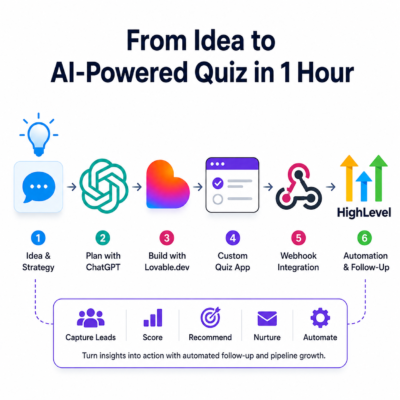
  1. Mapped out the quiz logic in ChatGPT
  2. Created scoring categories and recommendations
  3. Designed the assessment questions
  4. Built the front-end using Lovable.dev
  5. Refined the layout and logic conversationally
  6. Added webhook integrations
  7. Connected the quiz to HighLevel
  8. Tested and refined the user experience

The entire process felt far more conversational than traditional software development.

It started with a simple prompt:

“Can you help me create a ScoreApp style quiz for my website using Lovable.dev?”

From there, the application evolved step by step through conversation and refinement.

The Prompting Process Matters More Than The Coding

One of the biggest shifts AI introduces is that the real value increasingly comes from business logic, customer understanding and prompting rather than traditional programming knowledge.

The first stage was not coding. It was thinking.

I worked through:

  • The quiz structure
  • Result categories
  • Scoring logic
  • Recommendations
  • Customer journeys
  • Business use cases

Very quickly, the quiz became more sophisticated than the original idea.

For example, during the conversational refinement process, the concept of specialist AI routing emerged.

Rather than treating every enquiry the same, the system could eventually route enquiries to specialist AI agents.

An electrical contractor, for example, might eventually have:

  • An EV charger AI agent
  • An emergency call AI
  • A domestic wiring AI
  • A commercial enquiries AI

This is where AI-assisted development becomes powerful.

You are no longer constrained by the fixed structure of a SaaS platform. You can rapidly adapt software around your exact business process.

The Questions Matter More Than The Technology

One of the most important parts of the process was designing the actual assessment questions.

The quiz explored areas such as:

  • Missed calls
  • Lead handling
  • Voicemail follow-up
  • CRM usage
  • Repeat customer questions
  • Urgency of implementation
  • Average customer value

Some example questions included:

  • How many calls does your business miss in a typical week?
  • What percentage of your calls are new enquiries?
  • Would it help if calls were summarised and added to your CRM automatically?
  • How quickly do you want to improve your call handling?

This type of conversational business logic is where AI-generated software becomes extremely effective.

Then Came Lovable.dev

Once the structure and logic were clear, I used Lovable.dev to generate the first working version of the application.

This is where things become genuinely exciting for marketers, agencies, consultants and small businesses marketers.

Instead of:

  • Hiring developers
  • Writing technical specifications
  • Waiting weeks or months
  • Managing expensive development projects

I could simply continue the conversation.

I refined:

  • Layouts
  • Question flow
  • Recommendations
  • Styling
  • Scoring
  • Integrations
  • Calls to action

Because the system was already functional, every iteration became faster.

Lovable.dev vs ScoreApp

ScoreApp is a polished SaaS platform specifically designed for quizzes and assessments.

Lovable.dev is different.

Rather than giving you a fixed platform, Lovable.dev allows you to rapidly create bespoke tools using AI-generated development workflows.

Unlike traditional quiz platforms like ScoreApp, AI-generated tools can be customised around your exact business process.

This creates huge flexibility for businesses willing to experiment.

But Here’s the Important Point Most People Miss

I do not believe vibe coding completely replaces traditional software development.

What it does do is massively accelerate:

  • Prototyping
  • Testing
  • Experimentation
  • Validation
  • Deployment

The first version of an app may not be the final enterprise-grade system.

But it might be:

  • Good enough to launch
  • Good enough to test
  • Good enough to generate leads
  • Good enough to validate the idea

Later, the application can become more robust using tools like Claude Code or more traditional development approaches.

That dramatically changes the economics of software for small businesses.

The Finished Quiz

Here is the final result:

This is not just a static quiz.

The application includes:

  • Scoring
  • Categories
  • Personalised recommendations
  • Webhook integrations
  • Lead routing
  • CRM integration
  • Marketing automation triggers

Where HighLevel Fits In

Although this project was primarily about replacing ScoreApp, HighLevel still plays an important role.

Once somebody completes the quiz:

  • The data is sent via webhook
  • HighLevel captures the lead
  • Automation takes over
  • Follow-up sequences begin
  • Opportunities can be created
  • Workflows can trigger
  • Appointments can be booked

This is why I increasingly describe HighLevel as an AI Operating System.

The AI-generated front-end tools are becoming easier and easier to build.

But businesses still need a central operational layer that connects:

  • CRM
  • Automation
  • Communications
  • Lead nurturing
  • Workflows
  • Pipelines
  • AI systems

That is where HighLevel becomes incredibly powerful.

I wrote more about that concept here:

HighLevel Is Becoming the AI Operating System for Your Marketing and Business

The Bigger Opportunity

I think many business owners still underestimate what is happening here.

The barrier to software creation has dropped dramatically.

You no longer necessarily need:

  • A development agency
  • Months of planning
  • Large budgets
  • Technical expertise

Instead, businesses can increasingly:

  • Build tools themselves
  • Iterate rapidly
  • Test ideas quickly
  • Create bespoke workflows
  • Replace expensive subscriptions
  • Experiment at speed

Most importantly, businesses can increasingly create software that fits their process rather than forcing their business to fit somebody else’s software.

Frequently Asked Questions

Can ChatGPT build a quiz funnel?

ChatGPT can help structure quiz logic, scoring systems, recommendations, workflows and prompting. Then, combined with tools like Lovable.dev, businesses can rapidly build custom quiz funnels and lead generation systems.

What is Lovable.dev used for?

Lovable.dev is an AI-powered application builder that allows users to create websites, tools and applications conversationally using AI-assisted workflows.

Can AI replace SaaS tools?

In some cases, yes. AI-assisted development tools now allow businesses to rapidly create bespoke alternatives to many single-purpose SaaS applications.

How long does it take to build a quiz using AI?

Simple working versions can sometimes be created in hours rather than weeks, especially when using conversational AI development tools.

Do you still need developers?

Sometimes yes. Vibe coding is excellent for rapid prototyping, testing and deployment, but more robust enterprise systems may still benefit from traditional development practices.

Final Thoughts

I do not believe every SaaS tool will disappear overnight.

But I do think many single-purpose tools are going to face increasing pressure from AI-assisted custom development.

The businesses that benefit most will likely be the ones willing to:

  • Experiment
  • Prototype quickly
  • Integrate systems intelligently
  • Embrace AI-assisted workflows early

In my case, replacing ScoreApp with a custom AI-built solution took about an hour.

That would have sounded ridiculous even a couple of years ago.

Now it is becoming normal.

Written by Julian Mills – HighLevel consultant and marketing strategist. About Julian Mills.

Book a Discovery Call with Julian.

Check out HighLevel at HighLevel agency – MarketerM8.com

How Do HighLevel AI Studio and Lovable Compare (as of May 2026)?

how do HighLevel AI Studio and Loveable.dev compare

how do HighLevel AI Studio and Loveable.dev compare

AI “vibe coding” has moved fast. What used to take weeks of development can now be done in minutes with a well-written prompt.

Two platforms leading this shift are HighLevel AI Studio and Lovable. At first glance, they look very similar. You type what you want, the AI builds it. Job done.

But once you dig deeper, they are solving very different problems.

And more importantly, they are not necessarily competing in the way people think.

The headline difference

Lovable is an AI app builder.

HighLevel AI Studio is part of an AI-powered business operating system.

Lovable focuses on generating applications and digital tools. Frontend, backend, user experience, interfaces, and deployment.

HighLevel AI Studio sits inside a complete CRM and marketing platform. Anything you build has the potential to connect with contacts, pipelines, automations, calendars, and messaging.

So while both tools “build” / vibe code, what they build is fundamentally different.

What you can build with Lovable

Lovable is designed for building things such as:

  • SaaS products
  • Web apps
  • Dashboards
  • Client portals
  • Interactive tools
  • Lead generation quizzes

In simple terms, Lovable is trying to replace developers for a large class of applications.

What you can build with HighLevel AI Studio

HighLevel AI Studio is designed for building things inside the HighLevel ecosystem, such as:

  • Funnels and landing pages
  • Lead capture tools
  • Booking systems
  • Marketing assets
  • Internal business tools
  • CRM-connected experiences

The key difference is that HighLevel already includes the CRM, email marketing, SMS, automations, calendars, pipelines, forms, funnels, and follow-up systems.

That means the tool is not just about building something that looks good. It is about building something that can sit inside a working marketing system (AI Operating System).

The mistake most people make

Most comparisons try to pick a winner.

But I do not think that is the right way to look at HighLevel AI Studio and Lovable.

In many cases, it is not a case of choosing one or the other.

In fact, they can complement one another very well.

They are not necessarily competitors. They are complementary

The smarter approach may be to use each tool for what it is best at.

  • Use Lovable to build the front-end experience, app, tool, or quiz.
  • Use HighLevel to manage the CRM, automations, lead nurture, pipeline, email, SMS, and follow-up.

That combination is extremely powerful.

Lovable can build the experience. HighLevel can run the business process behind it.

———————————-
A real-world example

Here is a recent example from my own setup.

I wanted to create an online quiz to capture leads.

I could have used a tool like ScoreApp and paid another monthly subscription.

Instead, I spent about an hour building the quiz in Lovable.

Then I connected it to my HighLevel account via a webhook.

Now the process looks like this:

  1. The quiz is built and hosted using Lovable.
  2. A visitor completes the quiz.
  3. The quiz data is sent into HighLevel via a webhook.
  4. HighLevel creates or updates the contact.
  5. HighLevel then handles the marketing follow-up.

That follow-up could include emails, SMS messages, pipeline updates, internal notifications, appointment booking, lead scoring, or whatever else you want to happen next.

So Lovable handles the interactive quiz experience. HighLevel handles the marketing engine behind it.

Here is the example quiz:

———————————-

Code vs ecosystem

This is where the trade-off becomes clear.

Lovable gives you flexibility

Lovable is better suited when you want to create something more custom, more app-like, or more standalone.

You can build more bespoke experiences and tools that may not be possible inside a standard CRM or funnel builder.

HighLevel gives you the operating system

HighLevel is stronger when you want the thing you build to connect directly into your business systems.

Capturing a lead is only the first step.

The real value comes from what happens afterwards.

  • Does the lead get followed up?
  • Does the sales team get notified?
  • Does the contact enter the correct nurture sequence?
  • Does the opportunity move into the right pipeline?
  • Does the business have visibility of what happened?

HighLevel is rapidly becoming the AI Operating System of choice. That is where HighLevel becomes very powerful.

Ease of use

Lovable is very impressive out of the gate. You can describe what you want, and it can generate a polished interface quickly.

But with more flexibility comes more responsibility.

You may need to think about logic, integrations, data handling, webhooks, deployment, and testing.

HighLevel AI Studio is more constrained, but it lives inside a system that already contains many of the business tools you need.

So Lovable may give you more creative freedom.

HighLevel may give you a faster route to a working business process.

The timing factor

It is also worth remembering that HighLevel AI Studio is very new.

It was only launched in April 2026.

HighLevel have also expressed that AI Studio is expected to evolve rapidly.

So while Lovable may currently be ahead in some areas, especially around app-style building and design flexibility, I would not assume that gap will stay the same for long.

HighLevel already has the advantage of the wider ecosystem.

If AI Studio continues to improve quickly, that makes things very interesting.

Watch out, Lovable.

So which should you use?

The answer depends on what you are trying to achieve.

Use Lovable if:

  • You want to build a standalone app or tool.
  • You need a more custom user experience.
  • You want something that feels more like software than a funnel.
  • You are comfortable connecting it to other systems.

Use HighLevel AI Studio if:

  • You want to build inside your CRM and marketing platform.
  • You care about lead capture, follow-up, automation, and pipelines.
  • You want fewer tools and fewer subscriptions.
  • You want your AI-built assets to connect to your business processes.

Use both if:

  • You want a custom front-end experience connected to a serious CRM.
  • You want to replace standalone tools like quiz builders or calculators.
  • You want to capture leads in creative ways and automate the follow-up.
  • You want Lovable to build the experience and HighLevel to run the system.

The real takeaway

This is not a straight fight.

Lovable is trying to replace developers.

HighLevel is trying to replace your tech stack. It is already the #1 CRM & marketing automate system – with over 2 million users.

And increasingly, the real opportunity is not choosing between them.

It is combining them.

Build the experience with Lovable. Run the system with HighLevel.

That is where I think this space is heading.

Written by Julian Mills – HighLevel consultant and marketing strategist. About Julian Mills.

Would you like to learn more about HighLevel – check out HighLevel agency – MarketerM8

HighLevel Is Becoming the AI Operating System for Your Marketing – and Business

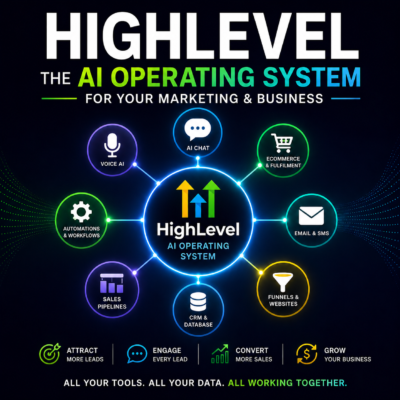
AI Operating System HighLevel

AI Operating System HighLevel
Right now, most business owners are focused on AI tools.

ChatGPT. Voice AI. Automation tools. Quiz builders. Landing page generators.

Every week there’s something new.

And they’re all impressive.

But there’s a bigger question almost nobody is asking:

Where does all of this actually come together?

Because tools on their own don’t build businesses.

Systems do.

The real problem with AI tools

AI has made it incredibly easy to build useful things.

I recently created a “missed call revenue” calculator in under an hour using AI tools. Something that previously would have required a dedicated platform like ScoreApp. (You can try it out below.)

The barrier to building tools has collapsed.

But that creates a new problem.

Because building the tool is no longer the hard part.

What happens next is what matters

When someone interacts with your AI tool:

  • Where is their data stored?
  • What triggers the follow-up?
  • How are they nurtured?
  • How are they tracked?
  • How does it turn into revenue?

This is where most businesses get stuck.

They end up with a collection of clever tools, but no system connecting them.

And without a system, nothing really works together.

This is where an AI Operating System comes in

What’s missing for most businesses isn’t more tools.

It’s a central system that:

  • stores the data
  • connects the tools
  • triggers the actions
  • manages the customer journey

This is what an AI Operating System actually is.

Not another tool.

But the system everything else runs through.

Want to see how this works in practice?
Book a Discovery Call with Julian

HighLevel as the AI Operating System

This is where HighLevel becomes so powerful.

HighLevel isn’t just another marketing tool.

It’s becoming the system that sits at the centre of everything.

It gives you:

  • A central CRM and database
  • Built-in automation and workflows
  • Communication tools, including email, SMS and WhatsApp
  • Pipelines to manage opportunities
  • Funnels and websites for presentation

And most importantly:

A single place where all your data lives and can be acted on.

Think of AI tools differently

Most people see AI tools as the solution.

In reality, they are just:

  • inputs, such as data capture, conversations and interactions
  • interfaces, such as voice, chat, forms and quizzes

They generate activity.

But they don’t create a system.

That only happens when everything connects into one place.

How it actually works

When you connect AI tools into a system like HighLevel:

  • A quiz captures a lead
  • A Voice AI answers a call
  • A chatbot qualifies an enquiry

All of that data flows into one place.

From there:

  • Automations trigger
  • Follow-up happens
  • Leads are nurtured
  • Opportunities are tracked
  • Conversations turn into customers

That is the difference between using AI and building a system powered by AI.

A quick analogy

If this concept feels familiar, it should.

It’s very similar to what WordPress did for websites.

WordPress didn’t win because it did everything itself.

It won because it became the platform everything connected into and it could be easily customised.

Third party plugins extended it.

Themes shaped it.

Everything worked through one core system.

We are now seeing the same shift happen with AI and marketing systems.

A real example

The missed call calculator I built is a simple example.

The tool itself is useful.

But the real value comes from what happens after someone uses it:

  • Their data is captured
  • It is sent into HighLevel via webhook
  • A workflow is triggered
  • Follow-up begins
  • The lead moves into a pipeline

Try it for yourself below:

Without the system, it’s just a calculator.

With the system, it becomes part of a revenue-generating process.

Want to learn how to build this for your business?
Book onto our next AI Employee Workshop

Why this matters now

Single-purpose tools are becoming easier to build.

In many cases, you can now recreate them yourself using AI.

That means their standalone value is decreasing.

But systems are becoming more important, not less.

Because the more tools you use, the more you need something to connect them.

Why not build your own system?

You could build your own setup using databases, APIs and custom integrations.

But for most businesses, that leads to:

  • complexity
  • maintenance
  • higher costs
  • more things to break

And even then, you’re still trying to recreate something that platforms like HighLevel already provide.

The shift that’s happening

We are moving into a world where:

  • tools are easy to build
  • AI is everywhere
  • customisation is expected

But the businesses that win will not be the ones using the most tools.

They will be the ones with the best system.

Final thought

HighLevel is becoming the AI Operating System for your marketing and customer workflows.

Not by replacing every tool.

But by giving you a central customisable system where everything connects, runs, and delivers results.

Ready to see how this could work in your business?
Book a Discovery Call with Julian

Looking to learn more about HighLevel – check out MarketerM8 – HighLevel reseller

Written by Julian Mills – HighLevel consultant and marketing strategist. About Julian Mills.

Alternatives to VoiceGenie.ai. And Where HighLevel Actually Fits

voicegenie.ai compared with HighLevel voice ai

voicegenie.ai compared with HighLevel voice aiIf you’re looking at alternatives to VoiceGenie.ai, you’re probably trying to figure out one thing.
How do I actually use AI to handle calls in my business?

That might be:

  • following up leads instantly
  • calling old enquiries
  • or simply making sure you never miss another call again

Before jumping into tools, it’s important to understand something that most comparison articles miss.

VoiceGenie.ai is not a complete system

VoiceGenie.ai is a specialist calling tool.

That’s not a problem. But it does change how you need to build your setup.

Because calling is only one part of the process.

You still need:

  • somewhere to store your contacts
  • a way to trigger calls
  • pipelines to track leads
  • follow-up automation

In other words, you still need a CRM and marketing system.

That’s where a lot of businesses end up building what I call a Frankenstack. Multiple tools stitched together, all doing different jobs.

Sometimes that works. Often it becomes messy.

What VoiceGenie.ai does well

To be fair, VoiceGenie is very good at what it does.

It’s built for:

  • outbound calling
  • speed-to-lead
  • high-volume campaigns
  • lead reactivation

If your goal is:

Call every lead within seconds of them enquiring

Then tools like VoiceGenie are designed for exactly that.

It’s essentially a call centre in software form.

So what are the alternatives?

The real alternatives fall into two camps:

  1. More specialist calling tools
  2. A complete system that includes calling

Let’s look at both.

1. GoHighLevel

What it is

An all-in-one CRM and marketing automation platform with built-in Voice AI.

This is the key difference.

It’s not just a calling tool. It’s the system that sits underneath your entire marketing and sales process.

Very similar to how WordPress became the go to solution for websites, so HighLevel is becoming the go to system for CRM & marketing automation. It is ranked #1 by Builtwith – based on active users – now at over 2 million.

Where it’s strong

  • Inbound AI receptionist
  • CRM and pipelines
  • Automated follow-up, including email, SMS and workflows
  • Appointment booking
  • Centralised database

Inbound calling. Where things are now

This has improved a lot over the past 12 to 18 months.

You can now:

  • answer calls with AI
  • qualify leads
  • capture details
  • book directly into your calendar

In the real world, this is now at an acceptable to good standard for most SMEs.

And this is not theoretical. This is exactly how I’m using it.

For example:

  • Jenny is my Voice AI demo agent. Call her on 07458 008090 and she will role play how an AI receptionist would answer the phone for your business. She is effectively selling the system by demonstrating it.
  • Bob is my general AI receptionist on 07897 031750. He handles incoming enquiries, answers common questions, takes messages, transfers calls where needed, and books appointments directly into my calendar.

That’s the real shift.

This is no longer just AI answering a phone.

It’s AI handling real business processes.

Outbound calling. The honest view

HighLevel does now have outbound AI calling.

But it’s important to understand where it is right now.

As of May 2026:

  • It is compliance-heavy by design
  • It is not built for aggressive outbound campaigns
  • It has rate limits and restrictions

And crucially for UK businesses:

It is still geographically constrained and not fully available or reliable for use here in the UK.

In practice, that means:

  • Some features are US-first
  • Access can be limited or inconsistent
  • It’s not something you can rely on yet as a core outbound strategy in the UK

What it’s actually good for

Where it does work well:

  • calling warm leads after an enquiry
  • appointment reminders
  • light database reactivation

But not:

  • high-volume outbound campaigns
  • cold calling at scale
  • call-centre style operations

Bottom line

HighLevel is not trying to be just a calling tool.

It’s trying to become:

The core system your business runs on

Voice. Email. SMS. Pipelines. Automation. All working together in one place.

2. Vapi

What it is

A developer-focused voice AI platform.

Best for

  • custom-built solutions
  • agencies with technical capability
  • advanced call logic

Trade-off

You get flexibility. But you lose simplicity.

You will still need:

  • a CRM
  • automation
  • integrations

3. Retell AI

What it is

A specialist AI calling platform, similar to VoiceGenie.

Best for

  • high-quality voice conversations
  • outbound and inbound calling performance

Trade-off

Again, it is a standalone tool.

You still need the rest of your system around it.

4. Air AI

What it is

An AI voice agent focused on sales conversations.

Best for

  • longer, more complex sales calls
  • higher-ticket environments

Trade-off

  • premium pricing
  • still sits outside your core CRM system

So what’s the right approach?

It depends on what you’re trying to build.

If you want a calling engine

Use:

  • VoiceGenie
  • Retell
  • Vapi

And accept that you’ll need:

  • a CRM
  • automation
  • integrations

If you want a complete system

Use HighLevel.

And build everything in one place.

The hybrid approach. Where this gets powerful

In reality, some of the best setups use both.

  • HighLevel = the brain
  • VoiceGenie, or similar = the outbound calling engine

Connected together.

This gives you:

  • centralised data
  • proper automation
  • high-performance calling where needed

Final thoughts

VoiceGenie.ai is a strong tool.

But it is still just one piece of the puzzle.

If you build your business around a single tool like that, you will quickly find yourself adding:

  • more software
  • more integrations
  • more complexity

HighLevel takes a different approach.

It gives you the entire toolbox, with Voice AI built in.

And while outbound calling is not fully there yet as of May 2026, especially here in the UK, it is clearly heading in that direction.

So the real decision is not:

Which tool is better?

It’s:

Do I want a powerful system. Or a collection of tools?

Written by Julian Mills – HighLevel consultant and marketing strategist.
About Julian Mills

Would you like to explore this in greater depth? – feel free to book a discovery call with Julian.

Interested in learning more about HighLevel – check out HighLevel agency – MarketerM8

HighLevel for Football Clubs. How to Add a Marketing and Revenue Engine Without Replacing Your Ticketing System

highlevel for football clubs uk

highlevel for football clubs ukThe problem every football club marketer already knows

If you work in marketing for a football club, you already know this.

Your CRM isn’t really a CRM.

It’s a ticketing system with a database attached.

Yes, it stores fan data.
Yes, you can segment lists.
Yes, you can send emails.

But in reality, your “marketing system” looks like this:

  • Send a broadcast email
  • Maybe segment by past purchases
  • Schedule a campaign
  • Hope it performs

In other words, you’re using it like Mailchimp.

And that’s the limitation.

Marketing has moved on. Your system hasn’t

Modern marketing is not about one-off campaigns.

It’s about:

  • Automated journeys
  • Multi-channel communication
  • Personalisation at scale
  • Capturing leads before they buy
  • Consistent follow-up
  • AI-driven engagement

Your ticketing system was built for operations.

Not for marketing.

And that gap is where opportunities are lost.

Then you discover HighLevel for football clubs

At some point, you come across GoHighLevel.

And it immediately feels different.

People often describe it as:

The “WordPress of CRM systems”

Like WordPress, it’s flexible and designed to do more than one job.

You start to see what’s possible:

  • Landing pages and funnels
  • Automated workflows
  • Email, SMS and WhatsApp
  • Centralised conversations
  • AI handling enquiries and follow-up

And the question becomes obvious.

Can I use HighLevel with our existing ticketing system?

And Yes – that’s exactly how you should approach it.

Replacing your ticketing system is not realistic.

  • Long contracts
  • Stadium integrations
  • Operational dependency

But adding a marketing layer on top of it is.

The smarter approach. Layer HighLevel on top

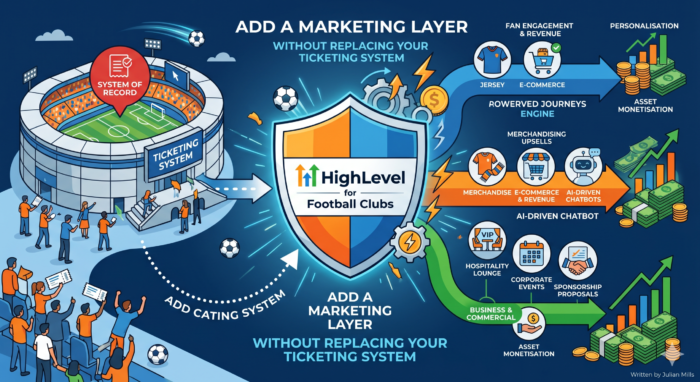
Think of it like this:

  • Your ticketing system is your system of record
  • HighLevel becomes your system for marketing and revenue

Your ticketing platform continues to:

  • Process ticket sales
  • Store fan data
  • Run matchday operations

HighLevel handles:

  • Lead capture
  • Marketing automation
  • Communication
  • Sales pipelines
  • AI engagement
  • Revenue optimisation

How HighLevel for football clubs works in practice

This is simpler than most expect.

1. Sync your data

Using APIs, webhooks or tools like Zapier:

  • Ticket purchase happens
  • Contact is created or updated in HighLevel

Now your fan data becomes usable.

2. Build automated journeys

Instead of one-off campaigns, you create systems.

  • New buyers get onboarding sequences
  • Season ticket holders get renewal journeys
  • Lapsed fans get re-engagement campaigns

Everything runs automatically.

3. Capture fans before they buy

Most clubs don’t do this well.

With HighLevel you can:

  • Build landing pages
  • Run competitions
  • Capture pre-sale interest

You’re building a pipeline, not waiting for transactions.

4. Use AI to handle enquiries

AI agents can:

  • Answer questions
  • Guide fans
  • Capture details
  • Follow up automatically

No more missed opportunities.

And this is where most articles stop

They talk about marketing.

But that’s not the real opportunity.

The real opportunity is revenue.

Turning your club into a revenue engine

Most clubs focus on:

Selling more tickets

But the smarter question is:

How do we maximise revenue from every fan, partner and visitor?

HighLevel allows you to build systems across three key areas.

1. Fan revenue (B2C)

This is your core audience.

Merchandising. Increase average order value

Most clubs sell merchandise.

Few maximise it.

With HighLevel:

  • Abandoned cart recovery
  • Post-purchase upsells
  • Personalised offers
  • Automated campaigns

More revenue from the same audience.

E-commerce. Keep your existing store and make it work harder

Most football clubs already have an online shop.

Typically built on platforms like Shopify or WooCommerce.

And these platforms are good at what they do:

  • Product management
  • Payments
  • Order fulfilment

That part doesn’t need replacing.

The problem is not the shop. It’s the marketing around it

Most club stores rely on:

  • Occasional email promotions
  • Matchday pushes
  • Seasonal campaigns

There’s very little in terms of:

  • Automation
  • Personalisation
  • Follow-up
  • Customer journeys

So revenue is left on the table.

Use HighLevel as the marketing engine for your store

Instead of replacing your e-commerce platform, you connect it to HighLevel.

When a purchase happens:

  • Customer data is synced into HighLevel
  • Behaviour is tracked
  • Automations are triggered

Now your store becomes part of a wider system.

What this looks like in practice

Recover abandoned carts
Automated email and SMS reminders bring back lost sales.

Increase average order value
Follow-up offers, bundles and promotions increase basket size.

Personalise your marketing
Target based on behaviour, not guesswork.

Re-engage past buyers
Bring inactive customers back automatically.

Connect online and offline behaviour

You can link:

  • Match attendance
  • Ticket purchases
  • Merchandise purchases

One fan profile. One system.

Extend beyond digital with direct mail

  • Send printed thank you cards
  • Mail exclusive offers to top customers
  • Re-engage high-value fans with letters

Digital gets attention.
Physical mail gets remembered.

2. Business revenue (B2B)

Sponsorships

Move from spreadsheets to pipelines:

  • Enquiry
  • Proposal
  • Negotiation
  • Closed

With automated follow-up.

Corporate and hospitality sales

  • Capture enquiries
  • Track opportunities
  • Assign to team members
  • Follow up automatically

Conference and meeting room hire

With HighLevel you can:

  • Show availability
  • Take bookings online
  • Automate confirmations
  • Take deposits or payments

Turn bookings into repeat revenue

  • Follow-up campaigns
  • Repeat booking offers
  • Future promotions

3. Asset monetisation

Events beyond matchday

  • Trade shows
  • Networking events
  • Community events

Create, sell and manage everything in one system.

Academy and grassroots programmes

  • Capture enquiries
  • Automate follow-up
  • Fill programmes faster

Multi-channel marketing. Done properly

With HighLevel:

  • Email
  • SMS
  • WhatsApp
  • Live chat

All automated. All connected.

And multi-channel does not just mean digital

You can also send physical direct mail:

  • Postcards
  • Letters
  • Printed offers

Triggered automatically and personalised.

Digital is crowded.
Physical stands out.

The real shift

Most clubs think they have a revenue problem.

They don’t.

They have a systems problem.

They already have:

  • The fans
  • The data
  • The demand

What they don’t have is the system to maximise it.

Final thought

You don’t need to replace your ticketing system.

You need to stop expecting it to do everything.

Your current system is built to sell tickets.

HighLevel is built to grow revenue.

And for marketers inside football clubs who can see that difference.

This is a serious opportunity.

Written by Julian Mills. HighLevel consultant and marketing strategist.
About Julian Mills

Want to learn more about HighLevel – join our free HighLevel workshops

How to Integrate Fathom.ai with HighLevel (And Why It’s Worth Doing)

how_to_Integrate_Fathom_ai_and_HighLevel

how to Integrate Fathom.ai and HighLevelIf you’re using Fathom.ai to record and summarise your calls, and HighLevel to manage your contacts, there’s a gap most people do not realise exists until it starts costing them.

Your calls are full of useful information. But unless that information ends up in your CRM in a structured way, it gets lost.

This is how you fix that.

Why You Would Want to Do This

Every Call Is Logged, Structured and Shared

The main reason I built this is simple.

Every Zoom, Teams or Google Meet call is transcribed, summarised, turned into action points, and logged against the contact in HighLevel.

No manual notes. No guesswork. No chasing your memory.

And importantly, anyone in your team can see exactly what was discussed.

If you’ve ever had to pick up a client conversation halfway through, you’ll know how valuable that is.

Better Follow-Up Without Thinking About It

Most businesses do not have a lead problem. They have a follow-up problem.

This helps solve that.

Instead of notes sitting in random places, action points being forgotten, and promises to follow up slipping through the cracks, you get clear next steps, consistent records, and a proper audit trail inside your CRM.

You can then plug this into automation.

  • Create tasks
  • Move opportunities
  • Trigger follow-ups

Everything Lives in One Place

Instead of information being spread across call recordings, emails and Slack messages, it all sits inside HighLevel.

That means one source of truth, better client history, and easier team collaboration.

It Scales With You

Whether you’re doing a handful of calls a week or running a busy sales team, the process stays the same.

Call happens. Notes created. Stored in CRM.

No extra effort required.

The Integration Setup (Simple Overview)

Here’s the exact setup I use:

Fathom.ai > Pabbly > ChatGPT > HighLevel

What’s happening behind the scenes:

  1. Fathom.ai records and transcribes the call
  2. A webhook sends the data into Pabbly Connect
  3. ChatGPT cleans it up into a summary, action points, and key notes
  4. HighLevel adds it as a note on the contact

Clean. Simple. Reliable.

Why I Don’t Integrate Fathom Directly with HighLevel

You can connect Fathom straight into HighLevel using a webhook.

I chose not to.

Here’s why.

Flexibility Going Forward

By using Pabbly Connect in the middle, I’ve effectively created a control layer.

That gives me options.

If I want to add another tool, change the logic, or extend the workflow, I can do it without rebuilding everything.

A good example of where this is heading is AI-generated proposals.

Call happens. Transcript processed. AI drafts 80 percent of the proposal. I refine the final 20 percent.

That is much easier to build when everything flows through Pabbly.

Cost

I’ve got a lifetime licence for Pabbly Connect. (Which saves a great deal when compared with Zapier)

So this setup costs me nothing extra to run.

That matters.

More Control Over What Goes Into HighLevel

I do not want raw transcripts dumped into my CRM.

I want clean summaries, relevant action points, and structured notes.

Using Pabbly and ChatGPT lets me control that.

Easier to Manage and Fix

If something goes wrong, I can see exactly where, replay the workflow, and tweak individual steps.

That’s much harder with a direct integration.

A Few Practical Tips

Contact Matching

You need to match the call to the correct contact.

Best option. Use email address.

Fallback. Create a new contact if one doesn’t exist.

Transcript Size

Long calls can create very large transcripts.

You may need to trim content, or summarise before sending to ChatGPT.

Small Delay

There will be a delay of a few minutes after the call while Fathom processes the transcript.

That’s normal.

Where This Gets Interesting

Once you’ve got this working, do not stop at notes.

You can build on it.

  • Automatically create tasks
  • Move deals in pipelines
  • Trigger follow-up emails
  • Feed context into AI agents

At that point, you’re not just logging calls. You’re building a proper system.

If you’re interested in the wider role AI can play inside HighLevel, you may also like my post on using ChatGPT and AI tools in practical marketing workflows.

Want to See How This Fits Into a Bigger Setup?

This is exactly the kind of thing I help businesses implement inside HighLevel.

If you want to see HighLevel works, including automation, pipelines and AI, take a look at MarketerM8 (HighLevel Agency).

Final Thought

Most people are already having the conversations that would grow their business.

They’re just not capturing them properly.

This fixes that.

Written by Julian Mills – HighLevel consultant and marketing strategist. About Julian Mills.

Stop Hiring People for Job Roles. Start Building AI Workflows Instead (The New Way to Scale Your Business)

Stop Hiring People for Job Roles. Start Building AI Workflows Instead (The New Way to Scale Your Business)

Stop Hiring People for Job Roles. Start Building AI Workflows Instead (The New Way to Scale Your Business)Introduction

For years, the default way to grow a business has been simple.

You need more done.
You hire more people.

A receptionist.
A salesperson.
A customer service assistant.

But what if that model is already outdated?

What if instead of hiring for job roles, you broke the job down into the individual tasks that actually get results, then automated those tasks using AI and workflows?

That is exactly what is now possible.

And more importantly, it is what smart business owners are already starting to do.

The Problem With Hiring Job Roles

When you hire someone, you are not just paying for the outcome.

You are paying for:

  • time
  • inefficiency
  • training
  • human error
  • inconsistency

And here is the bigger issue.

Most roles are not actually roles.

They are simply a collection of repeatable tasks.

For example, a receptionist is not a role. It is a bundle of tasks:

  • answering calls
  • capturing details
  • responding to common questions
  • booking appointments
  • passing messages

Once you see it like that, everything changes.

The Shift: From Roles to Tasks

This way of thinking is heavily influenced by people like Alex Hormozi, who teaches:

Break the job down into the smallest possible units of work.

And when you combine that with the direct response thinking of Frank Kern:

Focus on outcomes and revenue, not tools.

You get a very powerful model.

Instead of asking:

  • Who should I hire?

You ask:

  • What tasks actually drive results in my business?

Tasks Become Workflows

Once you identify the tasks, the next step is simple.

You turn them into a workflow.

For example:

Trigger:
A new enquiry comes in

Step 1:
Capture contact details

Step 2:
Send a response

Step 3:
Ask qualifying questions

Step 4:
Book an appointment

Step 5:
Send reminders

That is no longer a job role.

That is a system.

And systems scale far better than people.

This Is Where HighLevel Changes the Game

This is exactly where platforms like HighLevel come into their own.

You are no longer limited to:

  • sending emails
  • basic automation

You can now build:

  • full workflows
  • AI-driven conversations
  • automated follow-up systems
  • multi-step customer journeys

And this is where things take a significant step forward.

When you first see the HighLevel Agent Studio, it is worth recognising what it represents.

This is the start of the future for AI business and marketing automation.

Back in 2012, Infusionsoft, now Keap, revolutionised small business marketing automation with Campaign Builder. A visual display to drag and drop automations like send email, waits and tasks onto a canvas – no code required.

For the first time, business owners could visually map out workflows to automate:

  • email campaigns
  • follow-up sequences
  • internal tasks

It changed how small businesses approached marketing.

Fast forward to late 2025, and HighLevel took the next leap forward with Agent Studio.

We are no longer just building workflows that send messages or trigger actions.

We are now building AI agent workflows that can:

  • think in context
  • handle conversations
  • complete multi-step processes
  • work together to achieve an outcome

From Workflows to a Digital Workforce

Agent Studio allows you to assign specific tasks to different AI agents.

Instead of one general system, you can create:

  • an AI receptionist
  • an AI sales assistant
  • an AI customer service agent

Each one handles a specific part of the process.

They can:

  • respond to enquiries
  • ask questions
  • qualify leads
  • book appointments
  • transfer conversations

And most importantly.

They can work together.

This is no longer automation.

This is a digital workforce.

A Real Example: AI Agents Working Together

Let me give you a real-world example of this in action.

Inside my own MarketerM8 / HighLevel setup, I have built a simple but powerful system using AI voice agents.

It is not just one agent.

It is a small team.

Meet Jenny. The VoiceAI Sales Agent

highlevel voice ai inbound demoWhen someone calls in, they are greeted by Jenny.

Jenny’s role is not just to answer the phone.

She:

  • has a short initial conversation
  • understands why the caller is enquiring
  • then does something quite unique

She role plays how an AI voice agent could answer the phone for the caller’s own business.

So instead of explaining AI.

She demonstrates and sells it.

The Handover to VoiceAI Agent Clare. Booking the Appointment

If the caller wants to take things further, Jenny hands the call over to Clare.

Clare’s role is simple:

  • confirm details
  • check availability
  • book a call into my Discovery Call calendar

Each agent does one job well.

And Then There’s Bob. The Website AI Agent

bob the marketerm8 voiceAI receptionistThis is not just limited to phone calls.

I also have Bob, an AI voice agent who lives on my website.

Bob sits on MarketerM8 and acts as a live chat assistant.
Not a plain old text based live chat – this is VoiceAI chat.

Visitors can:

  • ask questions
  • explore how the system works
  • get guidance on the next steps

Head over to www.marketerm8.com and have a chat with Bob

What This Actually Demonstrates

You are not building one tool.

You are building:

  • a workflow
  • made up of tasks
  • handled by specialist AI agents

Just like a real team.

Try This Yourself (Mini Challenge)

Here is something I would encourage you to do.

Do not just read this.

Experience it.

Step 1:
Call Jenny on 07458 008090 and experience the sales demo for yourself.

Step 2:
Go to www.marketerm8.com and have a chat with Bob

Step 3:
Ask yourself:

What tasks in my business could this replace?

Not people.

Tasks.

Because once you start thinking like that, you begin to see opportunities everywhere.

Why Most Businesses Get AI Wrong

Most businesses are:

  • chasing tools
  • over-complicating things
  • focusing on features

AI is not the opportunity.

Solving real business problems with AI is the opportunity.

Start Simple. Then Scale

Start with one area:

  • cut out missed calls (either when the team is too busy or out of office hours)
  • lead follow-up
  • appointment booking

Get that working.

Then build from there.

Want to See How to Build This?

This is exactly what I cover in my live workshops.

Including:

  • HighLevel Foundations
  • Automations and Workflows
  • AI systems and Agent Studio

See the MarketerM8 workshops here

Final Thought

The businesses that win will not have the biggest teams.

They will have the best systems.

Stop hiring people.

Start building workflows.

Written by Julian Mills. HighLevel consultant and marketing strategist.