

EU AI Act Article 50 Is Now in Force: What HighLevel Businesses Using AI Chatbots and Voice AI Need to Know

EU AI Act Article 50 transparency rules for businesses using AI chatbots, Voice AI and platforms such as HighLevel

EU AI Act Article 50 transparency rules for businesses using AI chatbots, Voice AI and platforms such as HighLevelTime fo writing: 20 August 2026

If you are using an AI chatbot, AI receptionist, Voice AI or an AI agent to communicate with customers, there is an important new rule you need to be aware of.

Article 50 of the EU AI Act became applicable on 2 August 2026.

And one of the main requirements is actually pretty straightforward:

If someone is interacting directly with AI, they should know they are interacting with AI.

You can read the actual legislation here:

EU AI Act – Article 50 on EUR-Lex

The European Commission has also published detailed guidance explaining how Article 50 should work in practice:

European Commission – Article 50 Transparency Guidelines

So what does this actually mean for a normal business using AI?

The days of pretending your AI bot is a human may be over

This is probably the biggest practical takeaway.

A lot of effort has gone into making AI agents sound as human as possible.

That’s understandable.

We don’t want customers talking to something that sounds like an old-fashioned automated phone system.

But there is a big difference between making an AI sound natural and making someone believe it is a human being.

For example, imagine you have an AI chatbot called Sarah.

A customer starts a conversation and Sarah says:

“Hi, I’m Sarah. How can I help?”

The customer could quite reasonably assume Sarah is sitting at a desk somewhere.

Instead, something as simple as this makes the position clear:

“Hi, I’m Sarah, ABC Ltd’s AI assistant. How can I help?”

You haven’t ruined the conversation.

You’ve simply told the customer what they are interacting with.

This could be particularly important with Voice AI

This is where I think businesses need to pay particular attention.

AI voices have become incredibly realistic.

With platforms such as HighLevel you can now have an AI receptionist answer the phone, qualify enquiries, answer questions, book appointments and even transfer calls.

Imagine phoning a heating company and hearing:

“Good morning, ABC Heating, Sarah speaking. How can I help?”

If Sarah isn’t actually a person, the caller could understandably believe they are speaking to a receptionist.

A simple change fixes that:

“Good morning, ABC Heating. You’re speaking with our AI receptionist. How can I help?”

That’s hardly going to destroy the customer experience.

In fact, I think businesses could turn it into a positive.

“I’m ABC Heating’s AI receptionist. I’m available 24/7 and can answer questions, book appointments or get one of the team to call you back.”

Now AI is part of the benefit rather than something you’re trying to hide.

What about website chat?

The same principle applies.

If someone opens a website chat and an AI immediately starts answering their questions, make it clear that it is an AI assistant.

You don’t need a frightening legal disclaimer.

Something like:

“Hi, I’m our AI assistant. How can I help?”

may be all that’s needed to make the nature of the interaction clear.

The important thing is that the customer shouldn’t have to spend ten minutes chatting before eventually asking:

“Hang on. Are you a bot?”

Don’t rely on the customer asking

I’ve seen AI prompts which include instructions along the lines of:

“If someone asks whether you’re an AI, tell them you are.”

That’s sensible.

I would definitely have that instruction in the prompt.

But Article 50 isn’t really about admitting you’re AI when somebody catches you out.

The person should be informed that they are interacting with AI from the start of the AI interaction.

So I’d do both.

Make the AI status clear at the beginning and make sure your prompt prevents the AI from subsequently pretending to be human.

SMS and WhatsApp get more interesting

This is an area I think businesses using AI for lead follow-up and database reactivation need to look at.

Imagine you send a normal automated SMS:

“Hi John, are you still looking for a new boiler?”

John replies:

“Yes.”

An AI agent then takes over the conversation.

The important point isn’t necessarily whether AI wrote the original SMS.

The question is when John starts interacting directly with AI.

At that point I’d want the AI to make its position clear.

For example:

“Thanks John. I’m ABC Heating’s AI assistant. I can ask you a few questions and arrange for someone from the team to contact you.”

That’s transparent without making the conversation clunky.

What about HighLevel users?

This is one reason Article 50 caught my attention.

GoHighLevel has been rapidly expanding its AI capabilities.

Businesses can now potentially have AI involved with:

  • Website chat
  • SMS
  • WhatsApp
  • Lead qualification
  • Appointment booking
  • Database reactivation
  • Voice AI
  • AI receptionists
  • Automated follow-up

So if you’re using HighLevel AI, I’d spend ten minutes looking at your setup from the customer’s perspective.

At what point does AI take over the conversation?

Does the customer know?

Could they reasonably think they’re talking to one of your employees?

And try this one:

Ask your AI agent if it is a real person.

You might be surprised by the answer.

If you’ve previously prompted the AI to stay in character at all costs, this is definitely worth testing.

Does this affect UK businesses?

Potentially.

Don’t simply assume:

“We’re not in the EU anymore, so this doesn’t apply to us.”

The EU AI Act can have application beyond businesses physically established within the EU.

If your AI systems are being used in the EU or interacting with EU customers, you should establish whether the legislation applies to your particular circumstances.

This could therefore be relevant to UK businesses selling into Europe and UK agencies building AI systems for European clients.

What about AI-written blog posts?

This is another area where I think we’re going to see some misleading headlines.

Article 50 does not simply mean that every piece of content created with the help of ChatGPT now needs a big:

“THIS WAS WRITTEN BY AI”

warning at the top.

There are separate rules covering AI-generated and manipulated content, including certain text published to inform the public about matters of public interest.

But there is an important exception where the AI-generated text has been subject to human review or editorial control and somebody takes editorial responsibility for it.

That’s an important distinction.

If you ask AI to automatically create 100 news articles and publish them without anybody checking them, that’s one thing.

If you use AI to help research and draft an article, then read it, fact-check it, change it, add your own experience and decide what gets published, that’s very different.

The European Commission’s Article 50 guidance specifically addresses this distinction.

Article 50 isn’t just about chatbots

There is more to Article 50 than conversational AI.

It also contains transparency requirements relating to things including:

  • AI-generated and manipulated content
  • Deepfake images, audio and video
  • Certain AI-generated text on matters of public interest
  • Emotion recognition
  • Biometric categorisation

There are also requirements concerning machine-readable identification of AI-generated or manipulated content.

So this isn’t simply the “AI chatbot law.”

But for the average business experimenting with AI right now, customer-facing conversational AI is probably the obvious place to start checking.

Five things I would do now

If you’re already using AI to communicate with customers, I’d do these five things.

1. Find every place AI talks directly to customers

Check your website, SMS, WhatsApp, social messaging and telephone systems.

2. Check the start of the AI conversation

Is it clear that the customer is now interacting with AI?

3. Review your AI prompts

Look for instructions telling the AI to pretend to be human, stay in character or avoid revealing that it is AI.

4. Test your AI

Talk to it yourself.

Ask:

  • “Are you a real person?”
  • “Are you a bot?”
  • “Are you AI?”

See what happens.

5. Check whether you have EU customers

Particularly if you’re a UK business, don’t dismiss this simply because Brexit happened.

I don’t think this is necessarily bad news for AI

Some businesses are going to worry that telling customers they’re interacting with AI will reduce conversions.

I’m not convinced.

If I contact a company at 10pm and an AI assistant immediately answers my question, I don’t particularly care that it’s AI.

What I don’t want is an AI deliberately trying to convince me that somebody called Sarah is sitting in the office at 10pm replying to me.

There is an opportunity here to make AI a benefit:

“I’m our AI assistant, so I’m available 24/7.”

That’s a pretty good customer proposition.

Human-like is fine. Pretending to be human isn’t.

That’s probably my biggest takeaway from Article 50.

AI conversations should absolutely feel natural.

They should understand context, ask intelligent questions and communicate in normal language.

But there is no reason they need to deceive someone into believing they’re human.

For businesses using HighLevel Conversation AI, Voice AI or other AI agents, now would be a very good time to test exactly what your customers experience.

The change required could be as simple as adding three words:

“I’m an AI assistant.”

And that seems a pretty small price to pay for being transparent with your customers.

Further reading

Read Article 50 of the EU AI Act on EUR-Lex

Read the European Commission’s Article 50 transparency guidance

This article is intended as a practical overview rather than legal advice. If AI is a significant part of your business or you operate extensively within the EU, you should take appropriate professional advice.

Julian Mills HighLevel Consultant and Marketing Automation Strategist

About the Author

Julian Mills

HighLevel Consultant & Marketing Automation Strategist

Julian Mills helps business owners automate lead generation, sales follow-up, customer communication and business processes using HighLevel and MarketerM8. Since 2009 he has helped businesses implement CRM, marketing automation and AI-powered systems that save time, improve customer experience and generate more sales.

About Julian
Book a Discovery Call
Join a Free HighLevel Workshop
Learn About HighLevel with MarketerM8
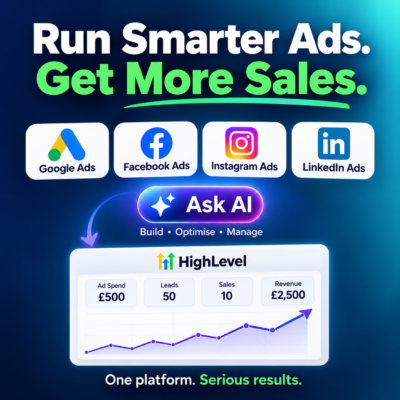
Want to Run Your Own Google, Facebook or LinkedIn Ads? AI Just Made It Much Easier

Want to Run Your Own Google, Facebook or LinkedIn Ads AI Just Made It Much Easier HighLevel

Want to Run Your Own Google, Facebook or LinkedIn Ads AI Just Made It Much Easier HighLevel

Running your own online advertising sounds simple.

You want more customers, so you advertise your business on Google, Facebook, Instagram or LinkedIn.

Then you actually open the advertising platform.

Campaign objectives. Audiences. Ad groups. Keywords. Placements. Conversion tracking. Pixels. Bidding strategies.

It can quickly become complicated.

That’s one reason so many small businesses hand their advertising over to an agency.

But things are changing.

HighLevel already has an Ad Manager that lets you create and manage Google, Facebook, Instagram and LinkedIn advertising from one place.

Now AI is being built into it too.

And that could make running your own advertising considerably easier.

What Is HighLevel Ad Manager?

HighLevel is primarily a CRM and marketing automation platform.

But built into the system is an Ad Manager that connects to:

  • Google Ads
  • Facebook Ads
  • Instagram Ads
  • LinkedIn Ads

Rather than continually jumping between different advertising platforms, you can create campaigns and monitor results from inside HighLevel.

Your adverts still run through Google, Meta or LinkedIn and you still pay those platforms for the advertising.

HighLevel simply gives you an easier place to manage everything.

Now You Can Ask AI to Help Build the Campaign

This is the latest development that makes Ad Manager particularly interesting.

HighLevel’s Ask AI can now help you build and manage advertising campaigns.

Instead of starting with dozens of settings, you can describe what you are trying to achieve.

For example:

“Create a Google Search campaign promoting our emergency plumbing service within 20 miles of Manchester.”

Or:

“Create a Facebook lead generation campaign for our free home energy survey.”

AI can then help put the campaign together.

You review it before it goes live.

At the moment this AI campaign-building capability is focused on Google and Meta advertising.

HighLevel Ad Manager already supports LinkedIn advertising too. As of August 2026, the equivalent AI support for LinkedIn is still on the way.

Does That Mean Anyone Can Run Their Own Ads?

Potentially.

It certainly removes a lot of the technical barriers.

You don’t necessarily need to understand every button and setting inside Google Ads or Meta Ads Manager just to get started.

But AI doesn’t make advertising foolproof.

You still need a good offer, the right audience, a sensible budget and effective follow-up.

The AI can help you build the campaign.

It can’t make people buy something they don’t want.

And this brings us to what I think is actually the most interesting part of HighLevel Ad Manager.

A Real Example: A UK Cleaning Company

I recently worked with a cleaning company here in the UK.

We wanted to try some Facebook advertising.

Within about an hour we had their first Facebook ads live.

That was impressive in itself.

But it wasn’t the thing that struck me most.

What really impressed me was how everything connected together.

Someone responded to the Facebook advert.

HighLevel automatically created the contact.

A new Sales Opportunity appeared in the pipeline.

Emails went out automatically.

Text messages went out automatically.

WhatsApp follow-up started automatically.

The enquiry wasn’t simply sitting inside Facebook waiting for somebody to notice it.

The whole follow-up process was already happening.

And then there was another important part.

We could follow what happened to the lead after Facebook had generated it.

A Lead Isn’t a Sale

Most advertising reports concentrate heavily on leads.

You spend £500.

You generate 25 enquiries.

Therefore your Cost Per Lead is £20.

Useful information.

But an enquiry isn’t a sale.

For many advertising agencies, generating the enquiry is effectively where their responsibility ends.

From a business owner’s perspective, that’s only half the story.

I want to know:

How many of those enquiries actually became customers?

Because one campaign might generate lots of cheap leads that never buy anything.

Another might generate fewer, more expensive leads that turn into excellent customers.

If we’re only measuring Cost Per Lead, we could easily make the wrong decision.

What If the Customer Buys Offline?

This is particularly important for service businesses.

Imagine someone clicks your Facebook advert and makes an enquiry.

Your team calls them.

Perhaps they visit your showroom, shop or office.

Or perhaps you visit them at their home.

Eventually they buy.

That’s an offline sale, but the journey started with an online advert.

HighLevel lets us connect the advertising activity with what subsequently happens inside the CRM.

When that Sales Opportunity eventually becomes a sale, we can go much further than:

“Facebook generated a lead.”

We can start saying:

“Facebook generated a customer.”

That’s much more useful information.

What If the Customer Buys Online?

The same principle applies if you’re selling online.

HighLevel has its own built-in ecommerce functionality for selling products and services online.

And because the ecommerce functionality and Ad Manager sit within HighLevel, ecommerce sales can be connected directly with your advertising reporting.

So the journey could be:

Facebook Ad → HighLevel Store → Purchase

or:

Google Ad → HighLevel Store → Purchase

Now we’re not simply looking at how many people clicked an advert.

We can connect advertising spend with the sales and revenue being generated.

Online or Offline. The Number I Really Want Is Cost Per Sale

Whether the customer buys through an online store, over the phone or face-to-face, the important question is:

How much did it cost us to acquire that customer?

Imagine two Facebook campaigns.

Campaign A

Ad spend: £1,000
Leads: 50
Cost per lead: £20
Sales: 2

Cost per sale: £500

Campaign B

Ad spend: £1,000
Leads: 25
Cost per lead: £40
Sales: 5

Cost per sale: £200

If we only looked at Cost Per Lead, Campaign A looks twice as good.

But it isn’t.

Campaign B is producing customers for less than half the cost.

That’s why I want to see:

  • Total Ad Spend
  • Cost Per Click
  • Cost Per Lead / Enquiry
  • Number of Sales
  • Revenue Generated
  • Cost Per Sale / Customer Acquisition Cost

That’s when advertising reporting becomes genuinely useful.

And We Can Feed Conversion Information Back to Facebook

There’s another clever part to this.

With the appropriate conversion tracking configured, HighLevel can send conversion events back to Meta.

So rather than Facebook simply knowing:

“This person filled in a form.”

we can feed information further through the customer journey.

Facebook can potentially learn which leads actually progress and convert.

That matters because the more useful information we can give the advertising platform about the results we actually want, the better information its algorithms have to work with.

We don’t just want Facebook to find us people who fill in forms.

We want it to help us find customers.

Google Advertising Can Work the Same Way

The same principle applies to Google Ads.

Someone searches for the product or service you offer.

They click your advert.

They make an enquiry.

HighLevel captures the lead and starts the follow-up.

HighLevel also supports Google offline conversions, including events further down the sales process.

Again, we’re going beyond simply measuring clicks and enquiries.

We’re connecting advertising to what actually happens inside the business.

What About LinkedIn?

HighLevel Ad Manager also supports LinkedIn.

This can be particularly useful for B2B companies because LinkedIn allows you to target people using professional criteria such as industry, job role, seniority and company size.

For example:

Managing Directors of UK manufacturing businesses

or:

HR Directors working for companies with more than 100 employees.

HighLevel lets you manage LinkedIn alongside Google and Meta from the same advertising dashboard.

As of August 2026, the Ask AI campaign-building functionality hasn’t yet caught up with LinkedIn.

But it is coming.

Do You Still Need an Advertising Agency?

Sometimes.

If you’re spending tens of thousands of pounds every month on PPC, you may still want a specialist managing it.

But plenty of businesses aren’t doing anything like that.

Perhaps you want to spend £500 promoting a local service.

Run a Facebook campaign for an event.

Advertise a webinar.

Promote a new product.

Test an offer.

Historically your options were often:

Learn Google or Facebook Ads yourself.

Or:

Pay someone else to do it.

AI is creating another option.

Get AI to help you do it yourself.

For many smaller businesses, that could be very attractive.

Advertising Is Only the Start

This is why I think HighLevel Ad Manager is more interesting than simply finding an easier piece of software for creating ads.

The advert is only the start of the process.

Think about the complete journey:


Advert
↓
Lead
↓
CRM
↓
Email + SMS + WhatsApp Follow-Up
↓
Sales Opportunity
↓
Online or Offline Sale
↓
Revenue
↓
Conversion Data

That’s the bigger picture.

Advertising + CRM + Automation + Ecommerce + Sales

all connected together.

For the cleaning company, that was what really struck me.

It wasn’t simply:

“Great, we’ve created a Facebook advert.”

It was:

“We’ve created an entire lead generation, follow-up and sales tracking system.”

And we had the first ads running in about an hour.

The Bit I Think Matters Most

AI helping you create an advert is useful.

But I don’t think that’s the biggest story here.

The real benefit is being able to connect the advertising with what happens next.

Generate the lead.

Follow it up automatically.

Track it through the pipeline.

Record when it becomes a sale.

Or, if you’re selling online, connect the advertising directly with your ecommerce sales.

Then you can start answering the question that really matters:

How much did it cost me to acquire a customer?

That’s a much more useful question than:

How many clicks did my advert get?

Frequently Asked Questions

Can I use AI to create Google Ads?

Yes. HighLevel Ask AI can help create and manage Google advertising campaigns from within HighLevel Ad Manager.

Can AI create Facebook and Instagram ads?

Yes. Ask AI can also help with Meta campaigns covering Facebook and Instagram.

Does HighLevel Ad Manager work with LinkedIn?

Yes. HighLevel Ad Manager supports LinkedIn Ads.

As of August 2026, AI campaign creation for LinkedIn is still on the way.

Can I manage Google, Facebook and LinkedIn Ads in one place?

Yes. HighLevel Ad Manager brings Google, Facebook, Instagram and LinkedIn advertising together into one dashboard.

Do I Still Need Google Ads, Meta and LinkedIn Advertising Accounts?

Yes.

HighLevel Ad Manager doesn’t replace the underlying advertising platforms.

You still need to set up the appropriate advertising accounts with Google, Meta for Facebook and Instagram, or LinkedIn.

You then connect those accounts to HighLevel Ad Manager.

Your adverts still run on the respective advertising platforms and Google, Meta or LinkedIn will charge your credit or debit card directly for your advertising spend.

HighLevel simply gives you one place to create, manage and monitor those advertising campaigns.

So, for example, if you decide to spend £500 on Facebook advertising, that advertising spend is paid to Meta. You can then use HighLevel to help create the campaign, manage it, capture and follow up the leads and track what happens through to the eventual sale.

Can HighLevel Track Whether an Advertising Lead Becomes a Sale?

Yes, with the appropriate tracking configured.

That sale might happen online through HighLevel’s ecommerce functionality or offline after the lead has progressed through your sales pipeline.

This means you can go beyond Cost Per Lead and start looking at Cost Per Sale.

Can HighLevel Track Ecommerce Sales From Advertising?

HighLevel has ecommerce functionality built into the same platform as its CRM and Ad Manager, allowing online sales and advertising performance to be connected rather than treated as completely separate systems.

Can Conversions Be Sent Back to Facebook?

Yes. HighLevel supports Meta Conversion API workflow actions that can send conversion events back to Meta.

This means advertising platforms can receive information about events further through the customer journey rather than only the initial enquiry.

Can I Run Google or Facebook Ads Myself?

Yes.

You don’t have to employ an advertising agency.

There is still a learning curve and you still need a sensible marketing strategy, but AI and tools such as HighLevel Ad Manager are making the technical side considerably easier.

Want to See HighLevel Ad Manager in Action?

If you’ve wanted to try Google, Facebook, Instagram or LinkedIn advertising but have been put off by the complexity, HighLevel Ad Manager is worth a look.

AI is now making campaign creation easier.

But for me, the real advantage is what happens after someone responds.

The lead enters your CRM.

The follow-up starts.

The opportunity enters your sales pipeline.

The customer buys online or offline.

And ultimately you can measure the number that really matters:

How much did it cost to win the customer?

We cover this in Workshop #11: Ecommerce & Ad Manager, part of our regular series of live HighLevel workshops at MarketerM8.

We’ll look at how HighLevel’s ecommerce and advertising tools work, how they connect with the rest of HighLevel and how you can start putting them to use in your own business.

Join our next E-commerce and Ad Manager Workshop.


Would you like to discuss your requirements in detail and explore your options with HighLevel and the Ad Manager?  –Book a Discovery Call with Julian

Would you like to learn more about HighLevel – check out the HighLevel Agency – MarketerM8

Julian Mills HighLevel Consultant and Marketing Automation Strategist

About the Author

Julian Mills

HighLevel Consultant & Marketing Automation Strategist

Julian Mills helps business owners automate lead generation, sales follow-up, customer communication and business processes using HighLevel and MarketerM8. Since 2009 he has helped businesses implement CRM, marketing automation and AI-powered systems that save time, improve customer experience and generate more sales.

About Julian
Book a Discovery Call
Join a Free HighLevel Workshop
Learn About HighLevel with MarketerM8

🚨 STOP PRESS – WhatsApp Calling Now Available in HighLevel. Web & Mobile

Stop press highlevel news and updates
Stop press highlevel news and updatesPublished: 26 June 2026
Category: HighLevel News
Reading time: 2 minutes

In Brief: HighLevel has launched WhatsApp voice calling on both its web platform and mobile app, allowing businesses to make and receive WhatsApp calls directly from within HighLevel.

HighLevel has officially rolled out WhatsApp voice calling across both its web platform and mobile app.

While WhatsApp messaging has been integrated with HighLevel for some time, this latest update takes customer communication a step further. You can now make and receive WhatsApp voice calls without leaving HighLevel, whether you’re sat at your desk or out meeting clients.

For businesses already using WhatsApp Business, this is another significant step towards managing every customer conversation from one platform.

What Has Changed?

HighLevel users can now:

  • Make and receive WhatsApp voice calls directly from HighLevel.
  • Use the feature on both the desktop and mobile apps.
  • Continue customer conversations without switching between different applications.
  • Keep WhatsApp communications alongside your existing customer interactions inside your CRM.

The mobile app support is particularly welcome, allowing sales teams, consultants and service businesses to stay connected wherever they are.

Why It Matters

WhatsApp has become one of the world’s most popular business communication channels.

Many businesses already use it for customer enquiries, appointment reminders, marketing campaigns and automated conversations. Adding voice calling creates a much more natural customer journey, allowing businesses to move seamlessly from messaging into a live conversation whenever it’s needed.

It also means less app switching, a smoother customer experience and another reason to keep your customer communications centred around HighLevel.

Julian Mills’ View

Over at MarketerM8 we’re seeing more and more clients switch on the WhatsApp integration, and it’s easy to see why.

For many businesses, WhatsApp has become a more cost-effective way to engage with prospects and customers than traditional SMS. It also opens up opportunities to automate conversations, appointment reminders and customer support, all from within HighLevel.

Now, with WhatsApp voice calling available on the mobile app, the experience takes another step forward. Whether you’re in the office or on the move, you can continue conversations with customers and prospects from almost anywhere in the world using an internet connection, while keeping your communications managed through HighLevel.

For me, this isn’t just another feature update. It’s another reason why HighLevel is becoming the central hub for sales, marketing and customer communication.

Find Out More

You can read the official HighLevel announcement for full details of the new WhatsApp Calling feature here:
WhatsApp Calling is Now Generally Available. Web & Mobile

If you’d like to learn how to use WhatsApp messaging, automation and voice calling to improve your marketing and customer communications, take a look at the MarketerM8 Advanced Marketing Workshop, where we regularly cover the latest HighLevel features and best practices.