Alternatives to VoiceGenie.ai. And Where HighLevel Actually Fits

voicegenie.ai compared with HighLevel voice ai

voicegenie.ai compared with HighLevel voice aiIf you’re looking at alternatives to VoiceGenie.ai, you’re probably trying to figure out one thing.

How do I actually use AI to handle calls in my business?

That might be:

  • following up leads instantly
  • calling old enquiries
  • or simply making sure you never miss another call again

Before jumping into tools, it’s important to understand something that most comparison articles miss.

VoiceGenie.ai is not a complete system

VoiceGenie.ai is a specialist calling tool.

That’s not a problem. But it does change how you need to build your setup.

Because calling is only one part of the process.

You still need:

  • somewhere to store your contacts
  • a way to trigger calls
  • pipelines to track leads
  • follow-up automation

In other words, you still need a CRM and marketing system.

That’s where a lot of businesses end up building what I call a Frankenstack. Multiple tools stitched together, all doing different jobs.

Sometimes that works. Often it becomes messy.

What VoiceGenie.ai does well

To be fair, VoiceGenie is very good at what it does.

It’s built for:

  • outbound calling
  • speed-to-lead
  • high-volume campaigns
  • lead reactivation

If your goal is:

Call every lead within seconds of them enquiring

Then tools like VoiceGenie are designed for exactly that.

It’s essentially a call centre in software form.

So what are the alternatives?

The real alternatives fall into two camps:

  1. More specialist calling tools
  2. A complete system that includes calling

Let’s look at both.

1. GoHighLevel

What it is

An all-in-one CRM and marketing automation platform with built-in Voice AI.

This is the key difference.

It’s not just a calling tool. It’s the system that sits underneath your entire marketing and sales process.

Very similar to how WordPress became the go to solution for websites, so HighLevel is becoming the go to system for CRM & marketing automation. It is ranked #1 by Builtwith – based on active users – now at over 2 million.

Where it’s strong

  • Inbound AI receptionist
  • CRM and pipelines
  • Automated follow-up, including email, SMS and workflows
  • Appointment booking
  • Centralised database

Inbound calling. Where things are now

This has improved a lot over the past 12 to 18 months.

You can now:

  • answer calls with AI
  • qualify leads
  • capture details
  • book directly into your calendar

In the real world, this is now at an acceptable to good standard for most SMEs.

And this is not theoretical. This is exactly how I’m using it.

For example:

  • Jenny is my Voice AI demo agent. Call her on 07458 008090 and she will role play how an AI receptionist would answer the phone for your business. She is effectively selling the system by demonstrating it.
  • Bob is my general AI receptionist on 07897 031750. He handles incoming enquiries, answers common questions, takes messages, transfers calls where needed, and books appointments directly into my calendar.

That’s the real shift.

This is no longer just AI answering a phone.

It’s AI handling real business processes.

Outbound calling. The honest view

HighLevel does now have outbound AI calling.

But it’s important to understand where it is right now.

As of May 2026:

  • It is compliance-heavy by design
  • It is not built for aggressive outbound campaigns
  • It has rate limits and restrictions

And crucially for UK businesses:

It is still geographically constrained and not fully available or reliable for use here in the UK.

In practice, that means:

  • Some features are US-first
  • Access can be limited or inconsistent
  • It’s not something you can rely on yet as a core outbound strategy in the UK

What it’s actually good for

Where it does work well:

  • calling warm leads after an enquiry
  • appointment reminders
  • light database reactivation

But not:

  • high-volume outbound campaigns
  • cold calling at scale
  • call-centre style operations

Bottom line

HighLevel is not trying to be just a calling tool.

It’s trying to become:

The core system your business runs on

Voice. Email. SMS. Pipelines. Automation. All working together in one place.

2. Vapi

What it is

A developer-focused voice AI platform.

Best for

  • custom-built solutions
  • agencies with technical capability
  • advanced call logic

Trade-off

You get flexibility. But you lose simplicity.

You will still need:

  • a CRM
  • automation
  • integrations

3. Retell AI

What it is

A specialist AI calling platform, similar to VoiceGenie.

Best for

  • high-quality voice conversations
  • outbound and inbound calling performance

Trade-off

Again, it is a standalone tool.

You still need the rest of your system around it.

4. Air AI

What it is

An AI voice agent focused on sales conversations.

Best for

  • longer, more complex sales calls
  • higher-ticket environments

Trade-off

  • premium pricing
  • still sits outside your core CRM system

So what’s the right approach?

It depends on what you’re trying to build.

If you want a calling engine

Use:

  • VoiceGenie
  • Retell
  • Vapi

And accept that you’ll need:

  • a CRM
  • automation
  • integrations

If you want a complete system

Use HighLevel.

And build everything in one place.

The hybrid approach. Where this gets powerful

In reality, some of the best setups use both.

  • HighLevel = the brain
  • VoiceGenie, or similar = the outbound calling engine

Connected together.

This gives you:

  • centralised data
  • proper automation
  • high-performance calling where needed

Final thoughts

VoiceGenie.ai is a strong tool.

But it is still just one piece of the puzzle.

If you build your business around a single tool like that, you will quickly find yourself adding:

  • more software
  • more integrations
  • more complexity

HighLevel takes a different approach.

It gives you the entire toolbox, with Voice AI built in.

And while outbound calling is not fully there yet as of May 2026, especially here in the UK, it is clearly heading in that direction.

So the real decision is not:

Which tool is better?

It’s:

Do I want a powerful system. Or a collection of tools?

Written by Julian Mills – HighLevel consultant and marketing strategist.
About Julian Mills

Would you like to explore this in greater depth? – feel free to book a discovery call with Julian.

Interested in learning more about HighLevel – check out HighLevel agency – MarketerM8

7 Practical Tips for Editing Images with ChatGPT (April 2026 Update)

7 practical Chatgpt image editing tips

7 practical Chatgpt image editing tipsOne of the most common questions I get is how to properly edit images inside ChatGPT rather than just generating them once and starting again.

If you are using ChatGPT for image creation but not properly using the editing capabilities, you are leaving a lot on the table.

Most people treat it as a one-shot image generator.

That is not where the value is.

The real advantage comes from iteration. Refining, adjusting, and improving images step by step until they are usable in a real business context.

Free vs Paid ChatGPT. This Changes How Far You Can Go

As of April 2026, both Free and Plus users can generate and edit images.

But the experience is very different.

  • Free plan: very limited daily images, basic editing, slower, less consistent.
  • Plus plan: higher limits, faster processing, and significantly more control.

In practical terms, Free users can experiment, but Plus users can properly iterate.

That matters because most of what follows depends on being able to test, refine and improve your image several times.

If you are using this for marketing, content, or client work, the Plus plan is the realistic option.

1. Lock in Your Brand Colours from the Start

At the beginning of your conversation, tell ChatGPT your brand hex codes and instruct it to use them for all image edits.

For example:

Use these brand colours in all image edits in this conversation: #xxxxxx, #xxxxxx, #xxxxxx.

ChatGPT will then apply those colours consistently across that session.

You can also store this in ChatGPT’s memory so you do not have to repeat it every time.

For example:

Remember that my brand colours are #xxxxxx, #xxxxxx, #xxxxxx and use them when creating or editing images.

If memory is enabled, ChatGPT can retain this and apply it in future conversations.

That said, do not rely on it completely. If consistency really matters, it is still good practice to restate your colours at the start of a new project or chat.

2. Edit Specific Elements Using the Paintbrush (In-Painting) Tool

This is one of the most powerful features in ChatGPT image editing, and it is surprisingly easy to miss.

I will be honest. I completely overlooked this for a while because I did not realise it was there.

I was regenerating entire images when I only needed to change one small part. And often ChatGPT would make changes to parts of the image I was already happy with – which is really annoying.

When you generate or upload an image, click into the image and look for the edit option. This opens a paintbrush-style selection tool.

You can then highlight a specific area of the image and tell ChatGPT exactly what to change.

For example:

  • Select a shirt and say, “Change this to black.”
  • Select the background and say, “Make this a sunset.”
  • Select an object and say, “Replace this with a laptop.”

This is called in-painting, and it gives you much more precise control.

Where to find it:

  • Click on the generated image.
  • Look for an Edit or Select option.
  • Use the brush to highlight the area you want to change.
  • Enter your instruction.

If you are not using this, you are making image editing much harder than it needs to be.

3. Remove Anything That Should Not Be There

You do not need to accept unwanted elements.

If something is in the image that should not be there, remove it. Again, using the in-painting tool to select the required parts of the image.

Examples:

  • Remove the person in the background.
  • Remove the logo.
  • Remove the object on the table.

This is useful for cleaning up AI-generated images, reusing visuals in different contexts, and producing cleaner marketing assets.

Free users can attempt this, but results are less reliable. Plus users usually get more accurate removals because they have better tools and more room to iterate.

4. Expand, Crop and Change the Aspect Ratio

You are not limited to the original shape or framing of an image.

ChatGPT allows you to expand an image, crop it, and change the aspect ratio depending on where you want to use it.

This is essential if you are creating assets for websites, ads and social media.

Resize and Crop Images. The Quick Win Most People Miss

This is one of the simplest but most useful tricks.

You can ask ChatGPT to resize an image to an exact size and intelligently crop it so the important part stays in focus.

For example:

Resize this image to 300×300 pixels. Don’t stretch it. Crop it intelligently and keep the focus on the subject.

This works because ChatGPT understands what the key subject is and keeps it centred, rather than just chopping the image randomly.

I tested this on a head shot and it got it spot on in seconds. No Photoshop, no fiddling.

If you want a full walkthrough, I’ve covered it here:

Resize and crop your images with ChatGPT. Step-by-step

Change the Aspect Ratio

You can also reshape images for different platforms.

  • Turn a square image into a landscape 16:9 banner.
  • Convert an image into a vertical 9:16 format.
  • Adapt an image for social media, ads or website headers.

Simply prompt:

  • “Make this a 16:9 image.”
  • “Convert this into a vertical 9:16 format.”
  • “Make this a square 1:1 image.”

Expand the Image

If you need more space, you can extend the image beyond its original frame.

  • Expand the background.
  • Add more context around the subject.
  • Create space for text or design elements.

This allows you to create one strong base image and adapt it across multiple uses without starting again.

5. Change the Perspective of the Same Scene

You can instruct ChatGPT to show the same scene from a different angle.

Examples:

  • Show this from above.
  • Show this from the side.
  • Create a wider shot.

This works well for objects, environments and landscapes.

It is less reliable with people, but improving.

Free users are limited in how many variations they can test. Plus users can explore multiple options and select what works.

6. Reverse Engineer the Style of Any Image

Instead of guessing how to create a certain look, reverse engineer it.

Upload an image and ask:

Describe the prompt that would recreate this image.

ChatGPT will break it down into style, lighting, composition, colour palette and overall look.

This gives you the underlying structure behind the image.

You can then reuse and adapt that structure to create new visuals with the same style.

You can also refine it further:

  • Make it more cinematic.
  • Add a retro look.
  • Make it cleaner and more modern.

This is how you move from random outputs to controlled creative direction.

7. Give Feedback Like You Would to a Designer

Most people either accept the result or regenerate it.

That is not how you get quality.

Treat ChatGPT like a designer and give clear, specific feedback.

Examples:

  • Increase colour intensity.
  • Improve contrast.
  • Soften the lighting.
  • Make the subject stand out more.

Small adjustments lead to significantly better outputs.

This is where the biggest gap between Free and Plus shows. Free users have limited refinements. Plus users have enough iterations to get to a strong final result.

Quality comes from refinement, not the first attempt.

Want to Go Deeper on Cropping and Resizing?

If you specifically want to resize and crop images quickly without distortion, I’ve broken that down step-by-step here:

ChatGPT trick. Resize and crop your images with AI

FAQs About ChatGPT Image Editing

Can ChatGPT crop images?

Yes. You can ask ChatGPT to crop images to specific dimensions while keeping the main subject in focus. It can intelligently centre and resize images without distortion.

Can you change aspect ratio in ChatGPT?

Yes. You can convert images into formats like 1:1, 16:9 or 9:16 using simple prompts or the built-in editing tools.

Do you need ChatGPT Plus for image editing?

No, but the Free plan has limits. ChatGPT Plus allows faster editing, more iterations and better control over image refinements.

Can ChatGPT edit parts of an image?

Yes. Using the paintbrush selection tool, you can highlight specific areas and tell ChatGPT exactly what to change.

Final Thoughts

The difference between average and high-quality AI images is not the initial prompt.

It is the refinement process.

And more importantly, how many times you can iterate.

That is why the Free vs Paid distinction matters.

  • Free: suitable for testing and experimentation.
  • Plus: required for consistent, high-quality output.

If you use ChatGPT as a refinement tool rather than a generator, you will get stronger branding, more consistent visuals, better quality assets and less time wasted starting again.

Most businesses are still using this at a basic level.

Those who learn how to control and refine outputs will have a clear advantage.

If you are interested in using AI tools within HighLevel (the #1 CRM & Marketing automation platform join us on our next MarketerM8 AI Employee Workshop where we cover marketing automation, AI and real-world implementation.

Written by Julian Mills – HighLevel consultant and marketing strategist. About Julian Mills.

How to Be Your Own AI Architect (Without Being “Technical”)

How to Be Your Own AI Architect
How to Be Your Own AI ArchitectThere’s a shift happening right now.

Not just in marketing. Not just in software. In how businesses are built.

And the people who understand this early will have a serious advantage.

Because instead of buying tools, hiring developers, or waiting months for solutions, they will design their own.

That’s what it means to become your own AI Architect.

Why You Should Become Your Own AI Architect

Most business owners are still using AI like a toy.

They ask it to write a social post. Maybe an email. Occasionally a bit of code.

Useful. But surface-level.

Being an AI Architect is different.

It means using AI to design systems that actually run parts of your business.

Here’s why that matters.

1. Speed

What used to take weeks can now be done in hours.

2. Cost Savings

No need to rely on developers or expensive integrations for every small task.

3. Custom Fit

You build systems around your business. Not the other way round.

4. Control

You can adapt and improve instantly without waiting on someone else.

5. Competitive Advantage

Most people are still “using tools”. AI Architects are building systems.

The Wrong Way Most People Use AI

This is where most people go wrong.

They say:

“Make me a thing”

  • Make me a chatbot
  • Build me a funnel
  • Create me an automation

And what they get is something that:

  • doesn’t quite fit
  • breaks easily
  • never gets fully used

Because there was no thinking behind it.

No outcome. No structure. No plan.

AI is powerful. But it needs direction.

The Right Way to Think Like an AI Architect

This is where everything changes.

It’s not about being technical.

It’s about thinking properly. Structured thinking, outcome-driven thinking, with a bit of creativity.

Here’s the process.

Step 1. Start With the Outcome

Before you touch AI, get clear on this:

What do you actually want to achieve?

Not:

  • “I want an integration”

But:

  • “I want my CRM to automatically update when a patient books surgery”

Clarity here is everything.

If you get this wrong, everything downstream breaks.

Step 2. Let AI Map the Steps

Now bring AI in.

Not to build. To think.

“Here is the outcome I want. Break this down into the exact steps required to achieve it.”

Now AI becomes a strategist.

It will outline:

  • inputs
  • triggers
  • actions
  • dependencies

You are no longer guessing. You are working from a plan.

Step 3. Let AI Interview You

This is the part most people skip.

Ask AI:

“Interview me about my current tech stack so you can design this properly.”

It will ask things like:

  • What CRM are you using?
  • What booking system do you use?
  • Do you have API access?
  • What integrations already exist?

This ensures the solution fits what you already have.

Step 4. Generate a Custom Plan

Now you have:

  • the outcome
  • the steps
  • your existing tools

Next:

“Create a detailed implementation plan using my current setup.”

Now AI starts acting like a proper architect.

You’ll get:

  • system flow
  • tool usage
  • logic paths
  • edge cases

Step 5. Build the Blueprint

Now you go deeper.

Turn the plan into a build-ready blueprint.

This should include:

  • exact prompts
  • workflow logic
  • trigger conditions
  • messages and scripts
  • fallback scenarios

You’re not just building something.

You’re designing a system.

Step 6. Let AI Build It

Now, and only now, you execute.

Because you are no longer guessing.

You are following a blueprint.

AI can now:

  • write workflows
  • generate code (if needed)
  • structure the integration
  • create the messaging

This is where speed really kicks in.

A Real Example. Private Surgeon, No Tech Background

Let me show you what this looks like in the real world.

I have a client who is a private surgeon.

Not technical. Not a developer. Just focused on running his practice.

He uses Semble to manage patient bookings and surgeries.

He also uses HighLevel as his CRM.

His outcome was simple:

“When a patient books surgery in Semble, I want the opportunity in HighLevel to automatically update to ‘Won’.”

Simple outcome.

But traditionally, not a simple task.

The “Old Way”

We explored the usual routes.

Semble offered to build the integration.

Cost was around £800.

Problem. Their developers were too busy.

We then looked at freelancer platforms like PeoplePerHour.

Slow progress. Back and forth. No real momentum.

We could have got there.

Eventually.

The AI Architect Approach

Instead, we tried something different.

I had recently tested Lovable.dev on a small project.

So I told him:

“Just tell it what you want. Treat it like ChatGPT. Let it figure it out.”

No technical spec.

No developer brief.

Just the outcome.

The Result

Later that evening, I got a message.

He’d done it.

In 15 minutes.

He had created an API connection between Semble and HighLevel.

No coding background.

No developer.

No £800 bill.

Just clear thinking and the right approach.

What Actually Happened Here

This wasn’t luck.

This was the AI Architect method in action.

He:

  1. Defined the outcome
  2. Let AI interpret the problem
  3. Allowed AI to map and build the solution

That’s it.

The Extra Step Most People Forget

Once you’ve built something like this, there’s one more step most people completely overlook.

Get AI to document it.

“Document everything you just built in a clear, structured way so I can understand, reuse and improve it.”

This is where things level up again.

Because AI will now create:

  • a system manual
  • step-by-step instructions
  • an explanation of how everything works
  • the logic behind the decisions

You’re not just left with something that works.

You now have something you understand.

Something you can reuse.

Something you can improve.

And if you ever need to hand it over in the future, you’re not starting from scratch.

Without this step, you’ll forget how it works in 30 days.

With it, you’ve created a proper business asset.

Final Thoughts

You don’t need to be technical to do this.

You don’t need to learn coding.

You just need to think differently.

Most people use AI to do tasks.

AI Architects use AI to design systems.

And as you’ve just seen, that can turn a problem that costs £800 and weeks of waiting into a 15-minute solution.

Written by Julian Mills – HighLevel consultant and marketing strategist. About Julian Mills.

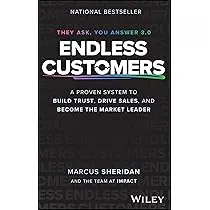
Book Review. Endless Customers by Marcus Sheridan

endless customers by marcus sheridan

endless customers by marcus sheridanEndless Customers is the latest evolution of Marcus Sheridan’s well-known “They Ask, You Answer” philosophy. Positioned as “They Ask, You Answer 3.0”, this book builds on the original framework rather than replacing it.
And that matters.

Because the core principles from They Ask, You Answer were never the issue. They are timeless. Businesses that answer their customers’ questions honestly and thoroughly will always win trust, visibility, and ultimately sales.

What Endless Customers does brilliantly is acknowledge that while the principles haven’t changed, the environment absolutely has.

The launch of ChatGPT in November 2022 marked a genuine shift in how people search, learn, and buy. We are no longer just optimising for search engines like Google. We are now optimising for AI-driven discovery across platforms like Perplexity and large language models.

This is where Sheridan’s update hits the mark.

He doesn’t abandon the original methodology. Instead, he reframes it for a world where AI tools are often the first touchpoint between a prospect and your business. The message is simple but powerful. If you want to be found in an AI-first world, you still need to be the best teacher in your space.

The Timeless Bit Still Wins

The foundation remains unchanged:

  • Answer the questions your customers are actually asking
  • Be transparent, even when it feels uncomfortable
  • Create content that builds trust before the sale

This still works. In fact, it works even better now.

The AI Shift. And Why This Book Matters Now

Where this book really earns its place is in how it adapts those ideas to today’s landscape.

AI doesn’t just rank content. It interprets it, summarises it, and recommends it.

That means:

  • Depth beats fluff
  • Clarity beats cleverness
  • Authority beats volume

In other words, the businesses that truly embrace “They Ask, You Answer” are the ones AI tools will surface.

A Real-World Observation

This is not just theory.

I first noticed the shift when enquiries started coming in saying they had found me on ChatGPT and Perplexity. That was the first signal that something had changed.

Then came the more interesting data point.

In November 2026, direct traffic to my website overtook organic search for the first time. A bit of digging, including using ChatGPT itself, suggested that this “direct” traffic was actually being driven by AI tools referencing my site.

And when people searched in those tools, I was consistently showing up.

That is They Ask, You Answer in action. Just through a different channel.

Who This Book Is For

If you have never read They Ask, You Answer, this is the place to start. It gives you the full framework, updated for how people actually behave today.

If you have read the original, this will refresh your thinking and, more importantly, show you how to apply it properly in an AI-driven world.

Final Thoughts

Endless Customers doesn’t reinvent the philosophy. It reinforces it.

But it also does something more important. It translates a proven marketing approach into the reality of AI search, AI discovery, and AI-driven decision making.

Traditional SEO is not dead. Far from it. But the game has clearly moved on. We are no longer just creating content for search engines. We are creating content that AI tools interpret, trust, and recommend.

And that is a different standard altogether.

The takeaway is simple.

The businesses that win in this new landscape will not be the ones chasing algorithms. They will be the ones who genuinely answer their customers’ questions better than anyone else.

Those who recognise this shift and adapt will thrive.

Those who don’t will get left behind.


Written by Julian Mills – HighLevel consultant and marketing strategist. About Julian Mills

HighLevel for Football Clubs. How to Add a Marketing and Revenue Engine Without Replacing Your Ticketing System

highlevel for football clubs uk

highlevel for football clubs ukThe problem every football club marketer already knows

If you work in marketing for a football club, you already know this.

Your CRM isn’t really a CRM.

It’s a ticketing system with a database attached.

Yes, it stores fan data.
Yes, you can segment lists.
Yes, you can send emails.

But in reality, your “marketing system” looks like this:

  • Send a broadcast email
  • Maybe segment by past purchases
  • Schedule a campaign
  • Hope it performs

In other words, you’re using it like Mailchimp.

And that’s the limitation.

Marketing has moved on. Your system hasn’t

Modern marketing is not about one-off campaigns.

It’s about:

  • Automated journeys
  • Multi-channel communication
  • Personalisation at scale
  • Capturing leads before they buy
  • Consistent follow-up
  • AI-driven engagement

Your ticketing system was built for operations.

Not for marketing.

And that gap is where opportunities are lost.

Then you discover HighLevel for football clubs

At some point, you come across GoHighLevel.

And it immediately feels different.

People often describe it as:

The “WordPress of CRM systems”

Like WordPress, it’s flexible and designed to do more than one job.

You start to see what’s possible:

  • Landing pages and funnels
  • Automated workflows
  • Email, SMS and WhatsApp
  • Centralised conversations
  • AI handling enquiries and follow-up

And the question becomes obvious.

Can I use HighLevel with our existing ticketing system?

And Yes – that’s exactly how you should approach it.

Replacing your ticketing system is not realistic.

  • Long contracts
  • Stadium integrations
  • Operational dependency

But adding a marketing layer on top of it is.

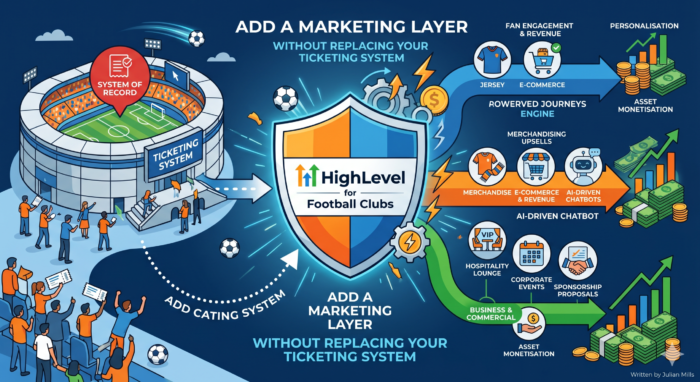
The smarter approach. Layer HighLevel on top

Think of it like this:

  • Your ticketing system is your system of record
  • HighLevel becomes your system for marketing and revenue

Your ticketing platform continues to:

  • Process ticket sales
  • Store fan data
  • Run matchday operations

HighLevel handles:

  • Lead capture
  • Marketing automation
  • Communication
  • Sales pipelines
  • AI engagement
  • Revenue optimisation

How HighLevel for football clubs works in practice

This is simpler than most expect.

1. Sync your data

Using APIs, webhooks or tools like Zapier:

  • Ticket purchase happens
  • Contact is created or updated in HighLevel

Now your fan data becomes usable.

2. Build automated journeys

Instead of one-off campaigns, you create systems.

  • New buyers get onboarding sequences
  • Season ticket holders get renewal journeys
  • Lapsed fans get re-engagement campaigns

Everything runs automatically.

3. Capture fans before they buy

Most clubs don’t do this well.

With HighLevel you can:

  • Build landing pages
  • Run competitions
  • Capture pre-sale interest

You’re building a pipeline, not waiting for transactions.

4. Use AI to handle enquiries

AI agents can:

  • Answer questions
  • Guide fans
  • Capture details
  • Follow up automatically

No more missed opportunities.

And this is where most articles stop

They talk about marketing.

But that’s not the real opportunity.

The real opportunity is revenue.

Turning your club into a revenue engine

Most clubs focus on:

Selling more tickets

But the smarter question is:

How do we maximise revenue from every fan, partner and visitor?

HighLevel allows you to build systems across three key areas.

1. Fan revenue (B2C)

This is your core audience.

Merchandising. Increase average order value

Most clubs sell merchandise.

Few maximise it.

With HighLevel:

  • Abandoned cart recovery
  • Post-purchase upsells
  • Personalised offers
  • Automated campaigns

More revenue from the same audience.

E-commerce. Keep your existing store and make it work harder

Most football clubs already have an online shop.

Typically built on platforms like Shopify or WooCommerce.

And these platforms are good at what they do:

  • Product management
  • Payments
  • Order fulfilment

That part doesn’t need replacing.

The problem is not the shop. It’s the marketing around it

Most club stores rely on:

  • Occasional email promotions
  • Matchday pushes
  • Seasonal campaigns

There’s very little in terms of:

  • Automation
  • Personalisation
  • Follow-up
  • Customer journeys

So revenue is left on the table.

Use HighLevel as the marketing engine for your store

Instead of replacing your e-commerce platform, you connect it to HighLevel.

When a purchase happens:

  • Customer data is synced into HighLevel
  • Behaviour is tracked
  • Automations are triggered

Now your store becomes part of a wider system.

What this looks like in practice

Recover abandoned carts
Automated email and SMS reminders bring back lost sales.

Increase average order value
Follow-up offers, bundles and promotions increase basket size.

Personalise your marketing
Target based on behaviour, not guesswork.

Re-engage past buyers
Bring inactive customers back automatically.

Connect online and offline behaviour

You can link:

  • Match attendance
  • Ticket purchases
  • Merchandise purchases

One fan profile. One system.

Extend beyond digital with direct mail

  • Send printed thank you cards
  • Mail exclusive offers to top customers
  • Re-engage high-value fans with letters

Digital gets attention.
Physical mail gets remembered.

2. Business revenue (B2B)

Sponsorships

Move from spreadsheets to pipelines:

  • Enquiry
  • Proposal
  • Negotiation
  • Closed

With automated follow-up.

Corporate and hospitality sales

  • Capture enquiries
  • Track opportunities
  • Assign to team members
  • Follow up automatically

Conference and meeting room hire

With HighLevel you can:

  • Show availability
  • Take bookings online
  • Automate confirmations
  • Take deposits or payments

Turn bookings into repeat revenue

  • Follow-up campaigns
  • Repeat booking offers
  • Future promotions

3. Asset monetisation

Events beyond matchday

  • Trade shows
  • Networking events
  • Community events

Create, sell and manage everything in one system.

Academy and grassroots programmes

  • Capture enquiries
  • Automate follow-up
  • Fill programmes faster

Multi-channel marketing. Done properly

With HighLevel:

  • Email
  • SMS
  • WhatsApp
  • Live chat

All automated. All connected.

And multi-channel does not just mean digital

You can also send physical direct mail:

  • Postcards
  • Letters
  • Printed offers

Triggered automatically and personalised.

Digital is crowded.
Physical stands out.

The real shift

Most clubs think they have a revenue problem.

They don’t.

They have a systems problem.

They already have:

  • The fans
  • The data
  • The demand

What they don’t have is the system to maximise it.

Final thought

You don’t need to replace your ticketing system.

You need to stop expecting it to do everything.

Your current system is built to sell tickets.

HighLevel is built to grow revenue.

And for marketers inside football clubs who can see that difference.

This is a serious opportunity.

Written by Julian Mills. HighLevel consultant and marketing strategist.
About Julian Mills

Want to learn more about HighLevel – join our free HighLevel workshops

How to Integrate Fathom.ai with HighLevel (And Why It’s Worth Doing)

how_to_Integrate_Fathom_ai_and_HighLevel

how to Integrate Fathom.ai and HighLevelIf you’re using Fathom.ai to record and summarise your calls, and HighLevel to manage your contacts, there’s a gap most people do not realise exists until it starts costing them.

Your calls are full of useful information. But unless that information ends up in your CRM in a structured way, it gets lost.

This is how you fix that.

Why You Would Want to Do This

Every Call Is Logged, Structured and Shared

The main reason I built this is simple.

Every Zoom, Teams or Google Meet call is transcribed, summarised, turned into action points, and logged against the contact in HighLevel.

No manual notes. No guesswork. No chasing your memory.

And importantly, anyone in your team can see exactly what was discussed.

If you’ve ever had to pick up a client conversation halfway through, you’ll know how valuable that is.

Better Follow-Up Without Thinking About It

Most businesses do not have a lead problem. They have a follow-up problem.

This helps solve that.

Instead of notes sitting in random places, action points being forgotten, and promises to follow up slipping through the cracks, you get clear next steps, consistent records, and a proper audit trail inside your CRM.

You can then plug this into automation.

  • Create tasks
  • Move opportunities
  • Trigger follow-ups

Everything Lives in One Place

Instead of information being spread across call recordings, emails and Slack messages, it all sits inside HighLevel.

That means one source of truth, better client history, and easier team collaboration.

It Scales With You

Whether you’re doing a handful of calls a week or running a busy sales team, the process stays the same.

Call happens. Notes created. Stored in CRM.

No extra effort required.

The Integration Setup (Simple Overview)

Here’s the exact setup I use:

Fathom.ai > Pabbly > ChatGPT > HighLevel

What’s happening behind the scenes:

  1. Fathom.ai records and transcribes the call
  2. A webhook sends the data into Pabbly Connect
  3. ChatGPT cleans it up into a summary, action points, and key notes
  4. HighLevel adds it as a note on the contact

Clean. Simple. Reliable.

Why I Don’t Integrate Fathom Directly with HighLevel

You can connect Fathom straight into HighLevel using a webhook.

I chose not to.

Here’s why.

Flexibility Going Forward

By using Pabbly Connect in the middle, I’ve effectively created a control layer.

That gives me options.

If I want to add another tool, change the logic, or extend the workflow, I can do it without rebuilding everything.

A good example of where this is heading is AI-generated proposals.

Call happens. Transcript processed. AI drafts 80 percent of the proposal. I refine the final 20 percent.

That is much easier to build when everything flows through Pabbly.

Cost

I’ve got a lifetime licence for Pabbly Connect. (Which saves a great deal when compared with Zapier)

So this setup costs me nothing extra to run.

That matters.

More Control Over What Goes Into HighLevel

I do not want raw transcripts dumped into my CRM.

I want clean summaries, relevant action points, and structured notes.

Using Pabbly and ChatGPT lets me control that.

Easier to Manage and Fix

If something goes wrong, I can see exactly where, replay the workflow, and tweak individual steps.

That’s much harder with a direct integration.

A Few Practical Tips

Contact Matching

You need to match the call to the correct contact.

Best option. Use email address.

Fallback. Create a new contact if one doesn’t exist.

Transcript Size

Long calls can create very large transcripts.

You may need to trim content, or summarise before sending to ChatGPT.

Small Delay

There will be a delay of a few minutes after the call while Fathom processes the transcript.

That’s normal.

Where This Gets Interesting

Once you’ve got this working, do not stop at notes.

You can build on it.

  • Automatically create tasks
  • Move deals in pipelines
  • Trigger follow-up emails
  • Feed context into AI agents

At that point, you’re not just logging calls. You’re building a proper system.

If you’re interested in the wider role AI can play inside HighLevel, you may also like my post on using ChatGPT and AI tools in practical marketing workflows.

Want to See How This Fits Into a Bigger Setup?

This is exactly the kind of thing I help businesses implement inside HighLevel.

If you want to see HighLevel works, including automation, pipelines and AI, take a look at MarketerM8 (HighLevel Agency).

Final Thought

Most people are already having the conversations that would grow their business.

They’re just not capturing them properly.

This fixes that.

Written by Julian Mills – HighLevel consultant and marketing strategist. About Julian Mills.

Stop Hiring People for Job Roles. Start Building AI Workflows Instead (The New Way to Scale Your Business)

Stop Hiring People for Job Roles. Start Building AI Workflows Instead (The New Way to Scale Your Business)

Stop Hiring People for Job Roles. Start Building AI Workflows Instead (The New Way to Scale Your Business)Introduction

For years, the default way to grow a business has been simple.

You need more done.
You hire more people.

A receptionist.
A salesperson.
A customer service assistant.

But what if that model is already outdated?

What if instead of hiring for job roles, you broke the job down into the individual tasks that actually get results, then automated those tasks using AI and workflows?

That is exactly what is now possible.

And more importantly, it is what smart business owners are already starting to do.

The Problem With Hiring Job Roles

When you hire someone, you are not just paying for the outcome.

You are paying for:

  • time
  • inefficiency
  • training
  • human error
  • inconsistency

And here is the bigger issue.

Most roles are not actually roles.

They are simply a collection of repeatable tasks.

For example, a receptionist is not a role. It is a bundle of tasks:

  • answering calls
  • capturing details
  • responding to common questions
  • booking appointments
  • passing messages

Once you see it like that, everything changes.

The Shift: From Roles to Tasks

This way of thinking is heavily influenced by people like Alex Hormozi, who teaches:

Break the job down into the smallest possible units of work.

And when you combine that with the direct response thinking of Frank Kern:

Focus on outcomes and revenue, not tools.

You get a very powerful model.

Instead of asking:

  • Who should I hire?

You ask:

  • What tasks actually drive results in my business?

Tasks Become Workflows

Once you identify the tasks, the next step is simple.

You turn them into a workflow.

For example:

Trigger:
A new enquiry comes in

Step 1:
Capture contact details

Step 2:
Send a response

Step 3:
Ask qualifying questions

Step 4:
Book an appointment

Step 5:
Send reminders

That is no longer a job role.

That is a system.

And systems scale far better than people.

This Is Where HighLevel Changes the Game

This is exactly where platforms like HighLevel come into their own.

You are no longer limited to:

  • sending emails
  • basic automation

You can now build:

  • full workflows
  • AI-driven conversations
  • automated follow-up systems
  • multi-step customer journeys

And this is where things take a significant step forward.

When you first see the HighLevel Agent Studio, it is worth recognising what it represents.

This is the start of the future for AI business and marketing automation.

Back in 2012, Infusionsoft, now Keap, revolutionised small business marketing automation with Campaign Builder. A visual display to drag and drop automations like send email, waits and tasks onto a canvas – no code required.

For the first time, business owners could visually map out workflows to automate:

  • email campaigns
  • follow-up sequences
  • internal tasks

It changed how small businesses approached marketing.

Fast forward to late 2025, and HighLevel took the next leap forward with Agent Studio.

We are no longer just building workflows that send messages or trigger actions.

We are now building AI agent workflows that can:

  • think in context
  • handle conversations
  • complete multi-step processes
  • work together to achieve an outcome

From Workflows to a Digital Workforce

Agent Studio allows you to assign specific tasks to different AI agents.

Instead of one general system, you can create:

  • an AI receptionist
  • an AI sales assistant
  • an AI customer service agent

Each one handles a specific part of the process.

They can:

  • respond to enquiries
  • ask questions
  • qualify leads
  • book appointments
  • transfer conversations

And most importantly.

They can work together.

This is no longer automation.

This is a digital workforce.

A Real Example: AI Agents Working Together

Let me give you a real-world example of this in action.

Inside my own MarketerM8 / HighLevel setup, I have built a simple but powerful system using AI voice agents.

It is not just one agent.

It is a small team.

Meet Jenny. The VoiceAI Sales Agent

highlevel voice ai inbound demoWhen someone calls in, they are greeted by Jenny.

Jenny’s role is not just to answer the phone.

She:

  • has a short initial conversation
  • understands why the caller is enquiring
  • then does something quite unique

She role plays how an AI voice agent could answer the phone for the caller’s own business.

So instead of explaining AI.

She demonstrates and sells it.

The Handover to VoiceAI Agent Clare. Booking the Appointment

If the caller wants to take things further, Jenny hands the call over to Clare.

Clare’s role is simple:

  • confirm details
  • check availability
  • book a call into my Discovery Call calendar

Each agent does one job well.

And Then There’s Bob. The Website AI Agent

bob the marketerm8 voiceAI receptionistThis is not just limited to phone calls.

I also have Bob, an AI voice agent who lives on my website.

Bob sits on MarketerM8 and acts as a live chat assistant.
Not a plain old text based live chat – this is VoiceAI chat.

Visitors can:

  • ask questions
  • explore how the system works
  • get guidance on the next steps

Head over to www.marketerm8.com and have a chat with Bob

What This Actually Demonstrates

You are not building one tool.

You are building:

  • a workflow
  • made up of tasks
  • handled by specialist AI agents

Just like a real team.

Try This Yourself (Mini Challenge)

Here is something I would encourage you to do.

Do not just read this.

Experience it.

Step 1:
Call Jenny on 07458 008090 and experience the sales demo for yourself.

Step 2:
Go to www.marketerm8.com and have a chat with Bob

Step 3:
Ask yourself:

What tasks in my business could this replace?

Not people.

Tasks.

Because once you start thinking like that, you begin to see opportunities everywhere.

Why Most Businesses Get AI Wrong

Most businesses are:

  • chasing tools
  • over-complicating things
  • focusing on features

AI is not the opportunity.

Solving real business problems with AI is the opportunity.

Start Simple. Then Scale

Start with one area:

  • cut out missed calls (either when the team is too busy or out of office hours)
  • lead follow-up
  • appointment booking

Get that working.

Then build from there.

Want to See How to Build This?

This is exactly what I cover in my live workshops.

Including:

  • HighLevel Foundations
  • Automations and Workflows
  • AI systems and Agent Studio

See the MarketerM8 workshops here

Final Thought

The businesses that win will not have the biggest teams.

They will have the best systems.

Stop hiring people.

Start building workflows.

Written by Julian Mills. HighLevel consultant and marketing strategist.

The Best Way to Take Orders Online Using Simple Web Forms? Jotform vs HighLevel.

using simpel webforms to tak orders. how does highlevel and jotform compare

using simpel webforms to tak orders. how does highlevel and jotform compare

Taking orders online should be simple.

But in reality, it often is not.

You either end up with clunky checkout systems, or you are forced to send customers away from your website just to complete a purchase. Both create friction. And friction costs sales.

Recently, I rebuilt how I take orders for my book – The Entrepreneurs Marketing System using a much simpler approach. A simple web form, embedded directly on my website.

That is what led me to compare Jotform and HighLevel.

So which one is actually the best way to take orders online?

A Simpler Way to Take Orders Online

Instead of sending people off-site to complete a purchase, I now use an embedded web form on my WordPress website.

That form is connected directly to a product inside HighLevel (MarketerM8).

The result is simple.

The customer stays on the page.
They complete the form.
They make the payment.
Done.

No redirects. No confusion. No unnecessary steps.

Why This Matters for Conversion

This is not just about making things look nicer.

It directly impacts your conversion rate.

A simpler checkout works because:

  • fewer clicks means fewer drop-offs
  • staying on one page builds trust
  • the buying experience feels consistent
  • you reduce decision fatigue

In short, the easier it is to buy, the more people will buy.

Jotform vs HighLevel. Can They Both Take Payments?

To be fair, yes. Both platforms can handle payments.

Jotform allows you to create payment forms using integrations like Stripe and PayPal.

If your only goal is to collect a payment through a form, Jotform does the job well.

But this is where the comparison starts to shift.

If you are exploring forms, surveys and quizzes properly, and how they connect to your wider marketing, this is something I cover inside my HighLevel Forms, Surveys and Quizzes workshop.

Because once you zoom out and look at the bigger picture, this is not just about forms anymore.

Forms Are Not Just Forms Anymore

This is the key mindset shift.

A form is not just a way to collect information or take a payment.

It is the entry point into your entire marketing and sales system.

With the right setup, a simple form can:

  • capture and segment leads automatically
  • trigger personalised follow-up sequences
  • route opportunities into pipelines
  • qualify prospects before you speak to them

That is where the difference between a form builder and a full platform becomes very clear.

The Real Difference. Forms vs Full Sales System

Jotform is excellent at what it does.

But it is still a form tool.

It handles the transaction, and then you need to figure out everything that happens next.

With HighLevel through MarketerM8, that next step is already built in.

When someone places an order, I can:

  • add them straight into my CRM
  • apply tags automatically
  • trigger confirmation emails
  • start follow-up sequences
  • invite them into future campaigns
  • track their journey long term

So instead of a one-off transaction, it becomes part of a complete customer journey.

The Pricing Perspective

This is where people often look first.

Jotform pricing can make sense if you only need forms.

But once you start adding:

  • email marketing
  • CRM
  • automation tools
  • SMS follow-up
  • pipelines

You quickly end up stacking multiple tools.

HighLevel, on the other hand, bundles all of this into one system.

That is why I often describe it as the WordPress of CRM and marketing systems.

At that point, it stops being a pricing comparison.

It becomes a systems comparison.

The Bigger Lesson

When you compare Jotform and HighLevel, you are not really comparing like-for-like.

You are comparing:

  • a form builder
  • a full marketing and sales system

If all you need is a form, Jotform is a solid option.

If you want to take orders, automate follow-up, manage customers, and build long-term relationships, you need something more connected.

That is why I made the switch.

Simpler checkout.
Better experience.
Fewer tools.
More control.

Want to See How This Works in Practice?

If you want to see exactly how to build this kind of setup, including forms, surveys and quizzes that feed directly into your CRM and automation, you can register for one of our free live workshops here:

View upcoming MarketerM8 workshops

Written by Julian Mills – HighLevel consultant and marketing strategist. About Julian Mills.

How to Turn Networking Into Sales Using HighLevel and AI Powered Smart Follow-Up

How HighLevel can turn Networking into new business opportunities

How HighLevel can turn Networking into new business opportunities

If you enjoy networking, you’re already ahead of most business owners.

You show up.
You have conversations.
You build relationships.

That’s the hard part.

But here’s the reality.

That’s not where most of the value comes from.

The Bit Most People Get Wrong

I’ve seen this over and over again.

Someone goes to a networking event. Could be BNI, the Federation of Small Businesses, a local Chamber, or groups like 4Networking or Entrepreneurs Circle.

They have a great morning.

Good conversations. A few solid one-to-ones lined up. A handful of business cards.

They leave thinking:

“I’ll follow up next week.”

Here’s what actually happens.

Next week comes.
You’re busy.
You can’t quite remember who’s who.
And the moment has gone.

It’s not a motivation problem.

It’s a systems problem.

The Hidden Cost of “I’ll Follow Up Later”

Most networkers rely on:

  • A stack of business cards
  • Notes scribbled somewhere
  • Memory

That works, until it doesn’t.

Because the real value in networking is not the first conversation.

It’s what happens after it.

Or more accurately.

What doesn’t happen.

Capture the Contact Properly

This is where HighLevel starts to make a difference.

Instead of putting business cards in your pocket and dealing with them later, you deal with them there and then.

Using the mobile app, you can:

  • Scan the business card
  • Instantly capture the contact details
  • Add notes while the conversation is still fresh

But here’s where it gets more interesting.

HighLevel uses AI, powered by ChatGPT, to help structure and enhance that data.

So instead of just storing a contact, you can start building context around it straight away.

Now Think About This

You’ve just had a good conversation with someone.

They walk away.

What normally happens?

Nothing.

Maybe a call a few days later. Maybe not.

Now compare that to this.

The HighLevel Way With AI Doing the Heavy Lifting

You scan the card.
You tag the contact.
And the system takes over.

  • A message goes out while they still remember you
  • A follow-up email lands the next day
  • They’re added to your pipeline
  • You get a reminder to follow up

But it doesn’t stop there.

Using AI, you can:

  • Generate personalised follow-up messages in seconds
  • Adjust tone and style depending on the contact
  • Draft emails based on your notes from the conversation

So instead of staring at a blank screen thinking “what do I say?”, the system gives you a starting point.

A Quick Trade Show Example

If you’ve ever manned a trade show stand, you’ll know this one.

End of the day.

You’ve got a nice stack of business cards.

You go home thinking you’ve had a productive day.

Then the next day you start calling.

And it’s painful.

  • People don’t answer unknown numbers
  • They don’t remember you
  • You spend days chasing

It’s not their fault.

You were just one of many conversations that day.

Now imagine doing it differently.

You’re at the stand. You speak to someone. They hand you their card.

You scan it immediately.

AI helps you draft a quick follow-up based on your notes.

They get a message while the conversation is still fresh.

You follow up the next day with something useful.

Or better still.

You book a call there and then, straight into your calendar, with reminders sent automatically.

That’s a completely different experience.

This Is Where It Gets Interesting

Most people stop at “capture and follow-up”.

But this is where HighLevel really comes into its own.

Turn Your Contacts Into a Warm Audience

Instead of one-off follow-ups, you stay visible.

Not in an annoying way.

In a consistent, helpful way.

AI can even help here by:

  • Suggesting content ideas
  • Drafting emails for your newsletter
  • Repurposing your thoughts into useful updates

You’re not chasing.

You’re building familiarity.

Segment Your Network Properly

Not everyone you meet is the same.

Some are:

  • Potential clients
  • Referral partners
  • Just good connections

HighLevel lets you organise this properly.

And with AI layered on top, you can tailor communication faster without writing everything from scratch.

Never Rely on Memory Again

You know those conversations where you say:

“I’ll drop them a message in a month.”

And then forget.

That’s gone.

You can build in:

  • 30 day follow-ups
  • 60 day check-ins
  • Longer-term nurture

And when those moments come around, AI can help you quickly craft the message.

Use SMS and WhatsApp With a Personal Touch

Networking is personal.

So your follow-up should be too.

A simple message like:

“Hi John, good to meet you this morning.”

Will get read.

AI helps you scale that without losing the human feel.

Or Skip Business Cards Completely

Here’s something else I’m seeing more of.

People not using business cards at all.

Instead:

  • You create a simple page
  • Generate a QR code
  • People enter their details directly

Now combine that with AI-driven follow-up.

You’ve got:

  • Accurate data
  • Instant engagement
  • Personalised communication from the start

The Big Shift

Here’s what this really comes down to.

Most people treat networking like a series of conversations.

HighLevel turns it into a system.

And AI makes that system faster, smarter, and easier to maintain.

So instead of:

Meeting people and hoping something happens

You move to:

Meeting people, structured follow-up, AI-assisted communication, measurable results

Final Thought

If you’re already good at networking, this is a big opportunity.

Because you don’t need more conversations.

You need to get more value from the ones you’re already having.

HighLevel gives you the system.

AI helps you run it consistently.

Want to See How This Could Work for You?

If you’d like to map this out for your business, we can keep it simple.

We’ll look at how you currently network, where things are dropping off, and build a system around it.

Book a discovery call and let’s turn your networking into something that actually drives consistent business.

Written by Julian Mills – HighLevel consultant and marketing strategist. About Julian Mills.

Internal Influencers, AI Search and Building Your Own Media Company

If you follow Ryan Deiss, you will have heard the phrase:

“Every business is now a media company.”

Over the past 12 months, I have seen this play out first-hand. More and more of my clients are now finding me through AI search tools like ChatGPT and Perplexity rather than Google.

At the same time, the idea of internal influencers has become increasingly important. Not external influencers, but the people inside your business who create content, build trust and drive conversations.

What is interesting is this. I did not set out to follow this model.

But looking back over the last 15 years, it is exactly what I have been doing.

SEO has changed. AI search is now the front door

Over the past 12 to 18 months, something has shifted quite dramatically.

New clients are no longer just finding me through Google.

They are finding me through:

  • ChatGPT
  • Perplexity
  • AI-powered search tools

And importantly, these are not beginners. These are business owners who are already thinking differently. They are often ahead of the curve, and that works in my favour.

This changes the game.

Because AI search does not work like traditional SEO.

It is not just ranking pages. It is:

  • analysing content across the web
  • identifying expertise
  • deciding who to mention

That last point is the key.

AI search does not want generic content

There is a growing problem.

A lot of businesses are now using AI to generate content at scale. Agencies especially are guilty of this.

The process looks like this:

  • prompt ChatGPT
  • generate article
  • publish

It is quick. It is easy. It keeps the client or boss happy.

But the issue is simple.

AI already knows that content.

So why would it cite you in its summary?

AI search is not looking for:

  • recycled knowledge (thin content)
  • generic “top 10 tips”
  • surface-level summaries

It is looking for:

  • real experience
  • opinions
  • nuance
  • practical insight

In short, it is looking for what AI cannot create on its own.

The 10-80-10 rule for content

This is the framework I use, and it works.

  • First 10% – your ideas, your experience, your angle
  • Middle 80% – let AI do the heavy lifting and build the draft
  • Final 10% – refine, inject personality, add real-world insight

Most people skip the first and last 10% because that is the hard part. Afer all AI is supposed to make life easy – right?

But it is that 20% that makes the difference.

That is why their content gets ignored. All they are doing is creating AI slop.

The value is not in producing more content. It is in producing better input and better refinement.

How to create content that AI search will actually pick up

One of the obvious follow-on questions from all of this is:

What should you actually be creating?

Here are a few principles that have worked for me.

1. Start with “They Ask, You Answer”

Knowledge CentreIf you have not already read They Ask, You Answer by Marcus Sheridan, I would strongly recommend it.

It was written before AI search became mainstream, but the principles are timeless and still hold true.

The core idea is simple.

Answer the questions your customers are already asking.

This is exactly the kind of content AI search is looking for.

2. Consistency beats cleverness

Everyone eventually develops their own style and system for creating content.

But the only way you get there is through consistency.

This is a long play. Not a quick win.

The people who win are the ones who keep showing up, keep documenting and keep refining.

3. Document what you actually do

Instead of trying to “create content”, just document what you are already doing.

For example, I regularly:

  • listen to questions prospects and customers ask
  • look at new HighLevel updates
  • test tools, tricks, tips and hacks
  • watch videos from other experts in my niche

And then I document them.

Sometimes I even create content purely for myself and my team.

If I solve a problem and think I will need this again in the future, I turn it into a blog post.

Here is a real example of that in action:

How to Save & Test a HighLevel Webhook Trigger

If I needed it (repeatedly), chances are others do too. And so does AI search.

Internal influencers. You have probably already got them

This is where the idea of internal influencers really lands.

We have all seen how prominent influencers who are paid huge sums have been used to drive sales.

But with so much artificial content being created, trust is dropping.

This opens the door for internal influencers.

These are the people inside your business who understand your customers and how you solve their problems.

The content is not perfect. It is real, relevant and valuable to the reader or viewer. And that is why it works.

My experience with this

For me, this started over 15 years ago.

I have been publishing:

  • tips
  • tactics
  • real-world marketing insights

Originally around Keap software, and since 2023 on HighLevel software.

I did not realise at the time that I was building a body of work that AI search would later rely on.

Why personal branding matters more than ever

Instead of hiding behind a company name, I built everything around julianmills.co.uk.

When AI cites a named person, it builds authority. They become the expert

And the more it happens, the more it compounds.

As an aside – who would be the Internal Influencer in your business or maybe you have a team. But what happens when that
person leaves the business – or worse still they become so valuable as an internal influencer that they get poached by a competitor!!
So be sure that the content they create is on channels that you (the boss) own and control.

Turning a personal brand into a flywheel

My personal brand attracts attention, builds trust and generates opportunities.

Then feeds into MarketerM8.com

This is the real asset.

Proving expertise. Not claiming it

AI search is constantly asking:

“Who is the real expert here?”

And it answers that by looking for signals across the internet.

Workshops as a credibility engine

workshop marketing with highlevel book julian millsWe run a 13-week rolling series of HighLevel workshops.

  • repeat four times per year
  • are promoted across multiple channels
  • are consistently updated

We also set them up on Eventbrite as a recurring series.

This reinforces expertise signals across the web.

Becoming a media company

Running workshops creates ongoing video content.

We use that to build out a YouTube presence.

Without forcing it, we have become a media company- admittedly with a very niche audience.

Final thought

Do not try to out-produce AI.

You will not win.

Instead:

  • focus on real experience
  • share what you actually do
  • build your own voice
  • show up consistently

Written by Julian Mills – HighLevel consultant and marketing strategist.
About Julian Mills