Blog

Why Are My SMS Messages So Expensive in HighLevel?

why are my highlevel sms text costs so high

why are my highlevel sms text costs so highI was recently asked by a new MarketerM8 subscriber why his text message sending costs were so high.

He thought MarketerM8 was charging a hefty premium. Some of his messages were costing over 25p, not the roughly 6p you would expect for a standard 160 character SMS segment.

That didn’t sound right.

So I dug into it to understand exactly what was going on. Once I worked it out, it became clear this is something a lot of users misunderstand. That is why I have put this post together, to explain what is really happening with HighLevel SMS costs.

What Is a 160 Character SMS Segment?

A standard SMS message allows up to 160 characters.

If your message goes over that limit, it does not stay as one message. It gets split into multiple segments, and you are charged for each segment.

For example:

  • 1-160 characters = 1 SMS segment
  • 161-306 characters = 2 segments
  • 307-459 characters = 3 segments

So a slightly longer message can instantly double or triple your cost.

It is also worth noting that on your personal mobile phone, especially if you are on an unlimited text tariff, you never really notice this happening.

You can send a long message, well over 160 characters, and it arrives as one seamless message on the recipient’s phone. Behind the scenes, your network is stitching multiple segments together to deliver that single message experience.

Because you are not being charged per segment in that context, it is completely invisible.

But in platforms like HighLevel, where you are paying per segment, that invisible behaviour suddenly becomes very visible in your costs.

Why HighLevel Messages Often Cost More

There are a few common reasons your SMS costs are higher than expected:

1. It’s About Segments, Not Messages

Even slightly longer texts can push you into multiple segments. This is the biggest reason costs creep up.

2. Unicode Reduces Your Character Limit

If your message contains certain characters, it switches from standard SMS (GSM-7) to Unicode.

When that happens:

  • Standard SMS = 160 characters per segment
  • Unicode SMS = 70 characters per segment

So your cost per message can more than double.

3. What Actually Triggers Unicode

Unicode is triggered by the characters used, not the tools you use.

Common triggers include:

  • Emojis
  • Smart quotes
  • Special characters like é, £, €
  • Non-standard symbols

4. Do Merge Fields Increase SMS Costs?

This is a common misunderstanding.

Using merge fields like:

  • {{contact.first_name}}
  • {{contact.email}}

does NOT automatically increase your SMS cost or turn your message into Unicode.

However, the data inside the merge field can.

Example:

Hi {{contact.first_name}}, your appointment is booked.

If the name is:

  • John = standard SMS = 160 characters per segment

But if the name is:

  • José
  • Chloë

Now your message includes special characters. The entire message becomes Unicode. That means 70 characters per segment.

5. Hidden Characters from Copy and Paste

One of the biggest silent cost drivers.

If you copy text from Word, websites, or emails, you may accidentally include:

  • Curly quotes
  • Hidden symbols
  • Non-standard spaces

These can trigger Unicode without you realising.

6. Longer Marketing Messages

It is easy to write longer messages when you are:

  • Promoting offers
  • Sending reminders
  • Explaining next steps

But every extra sentence increases the chance of hitting another segment.

How to Reduce SMS Costs in HighLevel

A few simple tweaks can make a big difference:

  • Keep messages short and direct
  • Avoid emojis unless necessary
  • Use plain text instead of smart punctuation
  • Be cautious with merge field data (names with accents, etc.)
  • Avoid copy and paste from formatted sources
  • Test messages before sending

A Couple Of Simple But Powerful Tips

Link to a webpage /funnel page

This is one of the best tips I picked up from a client years ago is this.

If you have a longer or more complex message to get across, do not try to squeeze everything into the SMS.

Keep your text message within 160 characters and use it to drive a click.

Then send the reader to a dedicated landing page where you have unlimited space to explain your offer properly.

You reduce your SMS costs and improve your marketing at the same time.

Use Shorter Links to Save Characters

Another simple win. Keep your links as short as possible.

Long URLs can quickly eat into your character count and push you into another segment.

In HighLevel, you already have a built-in way to handle this:

Settings > Domains & URL Redirects > URL Redirects

Strictly speaking, this is not a traditional URL shortener like Bit.ly. But it does allow you to create shorter, cleaner, branded links using your own domain.

That is actually a big advantage.

Using your own domain looks more trustworthy and can help with deliverability. Spam filters can sometimes flag public link shorteners like Bit.ly, because they are commonly used to mask suspicious links.

So by shortening your links inside HighLevel, you are not only reducing character count. You are also keeping your messages cleaner, more professional, and less likely to run into filtering issues.

Keep an Eye on Your Billing

Another very practical habit.

Keep a regular eye on your itemised billing and look for messages that are costing more than expected.

In HighLevel, you can do this here:

Settings > Billing > Wallet & Transactions > Detailed Transactions

This allows you to quickly scan through and spot any texts that are costing more than they should.

If you want to go deeper, export the transactions and review them in Excel or Google Sheets. That way you can:

  • Sort by cost
  • Identify patterns
  • Spot problem messages quickly

This is often the fastest way to diagnose what is really driving your SMS costs.

Final Thought

HighLevel is not overcharging you. It is simply passing on telecom pricing based on how SMS actually works.

Once you understand segments and Unicode, you can control your costs far more effectively.

And importantly. It is not the merge fields causing the cost increase. It is the characters that sometimes come with them.


Written by Julian Mills – HighLevel consultant and marketing strategist.
About Julian Mills

Looking to get started with HighLevel – check out my HighLevel agency MarketerM8.com

Why Your HighLevel Sub Account Has Restricted Tools & Features (And How To Fix It)

why is my highlevel account restricted and missing tools and features

why is my highlevel account restricted and missing tools and features

Have you ever watched a HighLevel demonstration on YouTube, seen an exciting new feature announced, or spoken to another HighLevel user, only to discover that the same feature isn’t available in your account?

It’s frustrating, particularly when you’re paying for HighLevel and expect to have access to its capabilities.

But here’s something many business owners don’t realise.

Not all HighLevel sub-accounts have access to the same features.

Two businesses could both be using HighLevel, yet see different menus, have different tools available and encounter different restrictions.

There are several reasons for this, and the introduction of HighLevel’s new Founder Plan in October 2026 has made understanding these differences even more important.

I’m Julian Mills, a UK-based HighLevel consultant. Through MarketerM8, we support more than 100 HighLevel sub-accounts.

In this article, I’ll explain why features may be missing from your HighLevel account, how to identify the cause and what you can do to gain access to additional functionality.

First, understand how HighLevel sub-accounts work

HighLevel operates differently from many traditional CRM systems.

Most businesses use HighLevel through a sub-account provided by a HighLevel agency.

A sub-account is your business’s own CRM and marketing environment, containing your contacts, opportunities, workflows, calendars, communications and other business information.

The agency providing that account manages the underlying HighLevel subscription.

This distinction matters because the capabilities available to your business can depend on the agency providing your account, the package you’ve purchased and the permissions applied to it.

For example, an agency might offer a basic CRM package with email marketing and sales pipelines, alongside a more advanced package with additional integrations and specialist business tools.

Both packages use HighLevel, but the features available to customers can be different.

So, if a feature is missing, it doesn’t necessarily mean HighLevel itself lacks that capability.

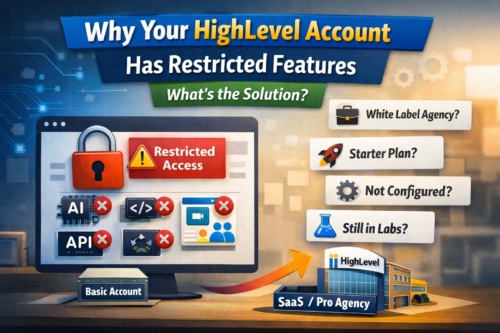
The five main reasons HighLevel features may be missing

1. Your HighLevel agency has restricted certain features

This is one of the first things to investigate.

HighLevel allows agencies to control which tools their customers can access.

An agency might restrict features because:

  • They aren’t included in your subscription.
  • They require a more advanced package.
  • The agency doesn’t provide support for them.
  • They involve additional charges.
  • The agency has chosen to simplify the interface for its customers.

HighLevel has expanded these controls significantly, allowing agencies to manage access to more than 80 platform features.

That means an agency can provide one customer with a relatively simple CRM while offering another customer a much broader collection of marketing and business management tools.

What should you do?

Contact your HighLevel provider and ask whether the missing feature is included in your subscription and whether it can be enabled.

It may simply be a matter of changing your package or account permissions.

2. Your agency’s HighLevel subscription doesn’t include the feature

This is a different issue.

Even if your agency wants to enable a particular feature, it may not have access to it through its own HighLevel subscription.

HighLevel has three main agency subscription tiers:

  • Starter
  • Unlimited
  • Founder (previously called the SaaS / Pro plan)

These are subscriptions for agencies that provide and manage HighLevel accounts. They shouldn’t be confused with the subscription packages that an agency offers its customers.

The important point is that certain advanced features are associated with the Founder Plan.

An agency operating on a lower subscription may not be able to provide those features to its clients.

For example, if you want access to HighLevel’s newer Project Management or Loyalty & Rewards capabilities, you’ll need to establish whether your provider can offer them.

You don’t necessarily need to purchase your own HighLevel agency subscription.

You may simply need a sub-account from an agency that has the appropriate access.

3. Your individual user permissions are restricting access

Sometimes the feature is available to your business, but your particular user login doesn’t have permission to access it.

For example, your account administrator may have restricted access to:

  • Workflows and automation.
  • Financial information.
  • Contact exports.
  • Account settings.
  • Particular reporting tools.
  • Certain integrations.

This is perfectly normal.

A salesperson may not need access to the same tools as a marketing manager or system administrator.

Before assuming your HighLevel subscription is restricted, ask your account administrator to check your user permissions.

A useful test: Can another administrator in your business see the missing feature?

If they can, the problem may be with your user permissions rather than the subscription.

4. The feature hasn’t been configured correctly

Not every missing or non-functioning tool is the result of a subscription restriction.

HighLevel is a substantial platform, and some capabilities require additional configuration.

For example:

Email marketing: Your sending domain may need to be configured and authenticated before you can send campaigns successfully.

Telephone and SMS: Your telephone number, messaging service or relevant regulatory registration may need attention.

WhatsApp: You need the appropriate integration, business account setup and messaging configuration.

AI tools: The relevant AI service may need to be enabled or configured, and additional charges may apply.

Workflow automation: A workflow may exist but be unpublished, missing a trigger or waiting for a condition that hasn’t been met.

Integrations: An external application may need authentication, API credentials or additional permissions.

These are configuration issues rather than evidence that your account is on the wrong subscription.

And that’s an important distinction.

You could spend money upgrading your subscription and still have exactly the same problem if the real cause is incorrect setup.

5. The feature is new, in Labs or still being rolled out

HighLevel develops quickly.

New capabilities are announced frequently, sometimes before they’re available to every customer.

You might see a demonstration from a HighLevel event, a video from an early-access user or an announcement in the official changelog.

But when you log in, the feature isn’t there.

There are several possible explanations:

  • It’s available only to selected early-access users.
  • It needs to be enabled through Labs.
  • HighLevel is releasing it gradually.
  • It’s limited to certain subscriptions.
  • It’s been announced but isn’t generally available yet.

This is particularly relevant to the newer Founder features.

Don’t assume that a feature demonstrated at a HighLevel event is immediately available in every Founder-hosted sub-account.

Before making business plans around a new tool, check its actual availability.

You can follow developments through the official HighLevel changelog.

What changed with the HighLevel Founder Plan in 2026?

In October 2026, HighLevel renamed its Agency Pro subscription to the Founder Plan.

This wasn’t simply a change of name.

HighLevel also introduced a collection of additional capabilities, some available now and others being released progressively.

The Founder Plan is aimed at agencies, consultants and service providers who want to offer more sophisticated solutions to their customers.

For businesses using HighLevel through an agency, the interesting development is that some of these additional capabilities can be made available within their sub-accounts.

Which advanced features can a Founder agency offer?

Depending on availability, configuration and the relevant permissions, these include:

Feature What it does
HighLevel Industries Specialist tools for businesses such as restaurants and field service companies.
Custom Navigation Tailor the menus and interface to different business requirements.
Workflow Maps Visualise connected automations and troubleshoot complex workflows.
Project Management Organise projects, tasks, responsibilities and deadlines.
Online and Offline Events Manage event registrations, ticket sales, QR codes and attendee check-ins.
Customer Support Ticketing Track, assign and resolve customer support requests.
Meeting Rooms Host video meetings within HighLevel.
Loyalty & Rewards Create customer loyalty programmes and encourage repeat business.
User Reports Monitor team activity and individual performance.
Advanced API Access Connect HighLevel with other applications and build sophisticated integrations.

These capabilities could make a significant difference to how businesses use HighLevel.

For example, a company that currently pays separately for a project management system, event ticketing software and customer support software may find opportunities to consolidate some of these functions.

A field service company may benefit from HighLevel’s emerging industry-specific capabilities.

A business with more complex operational requirements may benefit from advanced API integrations.

The important point is that your existing HighLevel account may not automatically have access to all these tools.

And some newly announced features may still be in development or undergoing a phased rollout.

Not every Founder feature is intended for your sub-account

There’s another distinction worth understanding.

Some Founder capabilities are designed for the agency itself rather than the businesses using its sub-accounts.

For example, HighLevel offers agency-level tools for SaaS account provisioning, rebilling, client onboarding and managing multiple customer accounts.

These help an agency operate its business.

They aren’t necessarily tools that should appear inside your own CRM.

So when you see a list of Founder Plan features, it’s important to ask:

Is this a feature I can use within my business’s sub-account, or is it a tool for the agency managing that account?

This can prevent a lot of confusion.

How to check why your HighLevel account is restricted

Before spending money or moving your account, I’d recommend working through the following checklist.

  1. Identify the exact missing feature. Write down what you’re trying to access and where you’ve seen it demonstrated.
  2. Check your user permissions. Ask an administrator whether the feature is available to other users.
  3. Check the configuration. Does the feature need an integration, activation, domain setup or additional service?
  4. Check its release status. Is it generally available, in Labs or still coming soon?
  5. Ask your agency about its availability. Does your current subscription include the feature?
  6. Ask whether your agency can enable it. If not, find out whether that’s because of its own HighLevel subscription or a restriction on your package.

Only once you know the cause should you decide what to do next.

In some cases, the solution will be a simple settings change.

In others, you may need a different subscription or provider.

How MarketerM8 can help you access more HighLevel features

At MarketerM8, we operate as a HighLevel Founder agency.

This means we’re able to provide eligible customers with access to advanced HIghLevel functionality through their own HighLevel sub-accounts, without requiring them to purchase an agency subscription.

We offer three packages for businesses using HighLevel.

Starter Professional Premium
Monthly subscription £97 + VAT £197 + VAT £297 + VAT
Contact records Unlimited Unlimited Unlimited
Team members Unlimited Unlimited Unlimited
Core HighLevel features Included Included Included
Free onboarding programme Included Included Included
24/7 technical support Included Included Included
Advanced HighLevel (Founder)
features
Not included Included Included
Dedicated account manager No No Yes
Bespoke onboarding No No Included
Monthly account management Optional Optional 1 hour

Subject to feature availability, rollout and account configuration.

Starter: £97 per month

Our Starter package is designed for businesses that need the core HighLevel CRM, marketing and automation functionality.

It provides a Lite version of HighLevel, with functionality comparable to that available through HighLevel’s Starter agency subscription.

It includes unlimited contacts, unlimited team members, onboarding and technical support.

For many businesses, this is all they need.

Professional: £197 per month

Professional is our most popular package.

It includes everything in Starter, plus access to eligible advanced features available through our Founder agency subscription.

This is particularly interesting if you’ve discovered that your current HighLevel provider cannot offer tools such as Project Management, Workflow Maps, advanced API access or other Founder functionality.

Premium: £297 per month

Premium includes everything in Professional, plus:

  • A dedicated MarketerM8 account manager.
  • Bespoke onboarding.
  • One hour of account management each month.
  • Assistance with advanced marketing campaigns.

It’s designed for businesses that want additional guidance and support in making effective use of HighLevel.

Compare the latest MarketerM8 HighLevel subscription packages

Can you move an existing HighLevel sub-account to MarketerM8?

Potentially, yes.

HighLevel supports the transfer of sub-accounts between agencies, subject to the applicable transfer requirements.

That means you may be able to move your existing account rather than start again with a completely empty CRM.

This is important if you’ve already invested time in building:

  • Contact databases.
  • Sales pipelines.
  • Marketing workflows.
  • Websites and funnels.
  • Forms and surveys.
  • Appointment calendars.
  • Email campaigns.

However, don’t assume that every integration, subscription, telephone number or third-party service will transfer automatically.

There can be dependencies involving billing, domains, communications services, external integrations and agency-controlled assets.

Before moving, I’d recommend reviewing the account and identifying anything that might need to be reconnected or reconfigured.

At MarketerM8, we can discuss your existing setup and help establish whether a transfer is appropriate.

If you need more involved migration, integration or implementation assistance, we also offer pay-as-you-go consulting at £150 + VAT per hour.

Could upgrading actually save your business money?

It’s easy to focus on the difference between a £97 and £197 monthly subscription.

But sometimes the more important question is what the additional functionality could save you.

Imagine you’re currently paying separately for a CRM, project management software, an events platform and customer support ticketing.

If an upgraded HighLevel sub-account allows you to replace even one or two of those applications, the potential subscription savings could outweigh the additional monthly cost.

Of course, that depends on your actual requirements and whether the relevant HighLevel tools are suitable.

We’ve created a calculator to help businesses assess the bigger picture.

Try the Free HighLevel Software Savings Calculator

The aim isn’t to buy more features simply because they’re available.

It’s to build a more effective business system at a sensible overall cost.

Frequently asked questions

Why are features missing from my HighLevel account?

The most common reasons are agency restrictions, user permissions, unavailable subscription features, incomplete configuration or a feature that hasn’t been released to your account yet.

Does every HighLevel sub-account have the same features?

No. The features available can depend on the agency’s subscription, the package provided to you, user permissions and whether particular tools have been enabled.

Can my HighLevel agency restrict what I can see?

Yes. HighLevel gives agencies controls over the features and modules available to their customers.

Does the HighLevel Founder Plan unlock every feature?

It provides access to additional advanced capabilities, but not every feature is necessarily available immediately. Some tools are agency-level, while others are subject to rollout and configuration.

Can I access Founder features without purchasing my own Founder agency subscription?

Yes. An eligible Founder agency can provide supported advanced functionality through your business’s sub-account.

MarketerM8 offers this through its Professional and Premium packages.

Is advanced API access available with MarketerM8?

Yes. Advanced API access is included in the eligible Founder functionality offered through MarketerM8 Professional and Premium, subject to configuration and the specific integration requirements.

Can I transfer my existing HighLevel account to another agency?

HighLevel supports sub-account transfers, subject to its transfer process and applicable conditions. It’s important to check integrations, billing, telephone services and other dependencies before moving.

Will I lose my contacts and automations if I transfer?

A supported sub-account transfer can preserve substantial parts of the existing account, including its CRM data and workflows. However, some services and integrations may require additional attention. Always confirm the transfer arrangements before proceeding.

How much does it cost to access advanced HighLevel features through MarketerM8?

MarketerM8 Professional costs £197 per month plus VAT and includes access to eligible Founder features. Premium costs £297 per month plus VAT and adds dedicated account management and additional assistance.

What if the feature I need is still in development?

Check HighLevel’s official release information and ask your provider about availability. It may be better to wait for the release than make a subscription change based on an unreleased capability.

The bottom line: Find out what’s restricting your account before upgrading

If your HighLevel sub-account appears to be missing features, don’t immediately assume you need to buy a more expensive subscription.

First, identify why the feature isn’t available.

It could be a simple permission setting, an incomplete configuration or a feature that’s still being released.

But it could also be a genuine restriction imposed by your provider’s HighLevel subscription.

The introduction of the Founder Plan has made this distinction particularly important because it brings a growing collection of advanced tools that may not be available through every agency.

At MarketerM8, we can help you understand your options and decide whether your existing account can be improved or whether moving to a Founder-hosted sub-account makes sense.

For a fuller explanation of subscription costs, see my article GoHighLevel Pricing UK: What Does HighLevel Really Cost?.

If you’re interested in becoming a HighLevel white-label reseller rather than simply using the software for your own business, you can also read my HighLevel Starter vs Unlimited vs Founder Plan comparison.

Need help with your restricted HighLevel account?

If you’re unsure why features are missing, or you’re considering moving your account to MarketerM8, book a free 20-minute discovery call.

We can discuss your existing setup, the functionality you need and the options available.

Book Your Free 20-Minute Discovery Call

You can also explore our free live HighLevel training workshops.

Julian Mills HighLevel Consultant and Marketing Automation Strategist

About the Author

Julian Mills

HighLevel Consultant & Marketing Automation Strategist

Julian Mills helps business owners automate lead generation, sales follow-up, customer communication and business processes using HighLevel and MarketerM8. Since 2009 he has helped businesses implement CRM, marketing automation and AI-powered systems that save time, improve customer experience and generate more sales.

About Julian
Book a Discovery Call
Join a Free HighLevel Workshop
Learn About HighLevel with MarketerM8

How to Integrate Pabau with HighLevel to Capture, Nurture and Convert More Aesthetic Clinic Leads

integrating Pabau with HighLevel for aesthetic clinics

integrate highlevel and pabau for beauty clinics

If you run an aesthetics clinic and use Pabau to manage your patients, appointments, and treatment history, you are already ahead when it comes to clinic operations.

But there is a gap I see time and time again.

Pabau is excellent at managing patients. It is not designed to capture, nurture, and convert new leads.

And that gap is where revenue is being lost.

Recently, I have been working with an aesthetics clinic in London to map out exactly how to solve this. The objective was simple:

Make sure every new enquiry is captured, followed up properly, and converted into a booked appointment inside Pabau.

The Real Problem. Leads Are Coming In, But Not Being Managed Properly

Most clinics rely on a mix of:

  • Google Ads
  • Facebook / Instagram Ads
  • Instagram DMs
  • Facebook messages
  • Website enquiries
  • WhatsApp
  • Phone calls

The issue is not lead generation.

The issue is what happens next.

In many clinics:

  • Responses are delayed
  • Follow-up is inconsistent
  • There is no structured pipeline
  • Staff are busy with treatments

And the result is predictable:

Leads go cold or go to a competitor who replies faster.

The Solution. HighLevel for Front-End. Pabau for Clinic Management

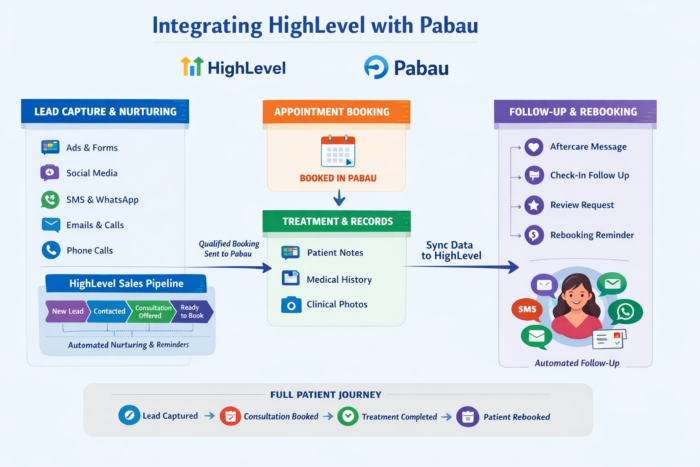
integrating Pabau with HighLevel for aesthetic clinics

The system we designed separates responsibilities clearly:

  • HighLevel handles lead capture, communication, follow-up, and conversion
  • Pabau remains the system of record for patients and appointments

Think of it like this:

  • HighLevel = Marketing and sales engine
  • Pabau = Patient and clinic management

When connected properly, you create a seamless journey from enquiry to treatment.

The Missing Piece. Sales Pipelines and Opportunities

Inside HighLevel, every new lead becomes an opportunity and is placed into a pipeline.

A typical pipeline for an aesthetics clinic might look like:

  1. New Enquiry
  2. Attempted Contact
  3. Engaged Conversation
  4. Consultation Offered
  5. Consultation Booked
  6. Attended Consultation
  7. Treatment Booked / Won
  8. Lost / No Response

This gives you visibility and control over every enquiry.

You can see:

  • Where leads are
  • Who needs follow-up
  • Where revenue is getting stuck

Moving Leads Through the Pipeline Automatically

We do not just track leads. We actively move them forward.

  • New enquiry. Added to pipeline
  • No response. Automated follow-up
  • Lead replies. Moved to the next stage
  • Staff interaction. Triggers next step
  • Booking link sent. Tracked
  • Consultation booked. Updated automatically

Tasks, reminders, and follow-ups can all be automated.

No lead gets forgotten.

Communicating Across Every Channel Automatically

This is where HighLevel becomes a real advantage.

Instead of relying on one or two communication methods, you can manage and automate conversations across multiple channels from one place:

  • Email
  • SMS
  • Phone calls
  • WhatsApp
  • Facebook Messenger
  • Instagram messages

All conversations are centralised, tracked, and tied to the contact record.

So whether a lead replies via Instagram or text, your team sees everything in one timeline.

Going One Step Further. Direct Mail Automation

Most clinics completely overlook this.

With HighLevel, you can even trigger physical direct mail as part of your follow-up using a UK mailing house such as Stannp.

For example:

  • New high-value lead. Send a personalised postcard
  • Consultation no-show. Send a re-engagement letter
  • Past patient. Send a treatment reminder card

This works particularly well for:

  • High-ticket treatments
  • Premium clinics
  • Re-engagement campaigns

It cuts through the noise in a way digital alone often cannot.

How HighLevel and Pabau Work Together

There is no native integration, so we connect the two using:

  • Zapier
  • Webhooks
  • API connections

The key principle is simple:

Nurture leads in HighLevel first. Only send qualified bookings into Pabau.

Practical Integration Examples

1. Lead Capture into HighLevel First

All enquiries go into HighLevel first:

  • Website forms
  • Ads
  • Social messages

This allows instant response and structured follow-up.

2. Consultation Booking Sent to Pabau

  • The lead books via a HighLevel calendar
  • Or a staff member books manually after a conversation

Then:

  • Zapier sends the data to Pabau
  • The appointment is created
  • The patient record is created or updated

3. Pipeline-Based Qualification Before Pabau

Only serious leads are pushed into Pabau.

This keeps your clinic management system clean and efficient, while HighLevel does the work of nurturing and converting enquiries.

4. Pabau Events Trigger HighLevel Automation

When something happens in Pabau, such as:

  • Appointment booked
  • Treatment completed

We can trigger automation back in HighLevel.

Extending Beyond the Booking. Treatment-Specific Follow-Up

Most clinics stop after the appointment.

That is where they lose long-term revenue.

The real value is in what happens after the treatment.

Example. Botox Patient Follow-Up Journey

Once a Botox treatment is completed in Pabau, we can trigger a workflow in HighLevel.

Day 0. Aftercare

  • Immediate SMS or WhatsApp message
  • Clear aftercare instructions
  • Reassurance about what to expect over the next few days

Day 2 to 3. Check-In

  • Automated message asking how they are doing
  • Opportunity for the patient to reply
  • Conversation managed centrally inside HighLevel

Day 10 to 14. Results and Review

  • Check satisfaction
  • Request a review
  • Suggest next steps where appropriate

Month 2. Re-Engagement

  • Educational content
  • Reminder about how long results typically last

Month 3. Rebooking Prompt

  • Direct booking link
  • Staff alerted if there is no response

The Full Patient Journey

When everything is connected properly, the system looks like this:

  1. Lead captured in HighLevel
  2. Nurtured through the pipeline
  3. Consultation booked
  4. Appointment sent to Pabau
  5. Treatment completed
  6. Automated aftercare triggered
  7. Follow-ups and review requests sent
  8. Rebooking reminders delivered
  9. The patient returns without manual chasing

Why This Matters

This approach:

  • Increases conversion rates
  • Improves patient experience
  • Reduces admin time
  • Drives repeat revenue

Most clinics focus on getting the first booking.

The real growth comes from what happens after.

Final Thoughts

Pabau manages patients brilliantly.

HighLevel ensures you consistently turn enquiries into those patients.

When combined properly, you are not just managing a clinic.

You are running a structured, automated growth system.

Want Help Integrating Pabau with HighLevel?

If you are using Pabau and want to build a complete system for lead capture, pipelines, communication, follow-up, and treatment-specific automation, book a discovery call and let’s map out what this could look like for your clinic.

Written by Julian Mills – HighLevel consultant and marketing strategist.

What Is MarTech? Is HighLevel a good example of MarTech?

What is MarTech - highlevel is an ideal example of MarTech

What is MarTech - highlevel is an ideal example of MarTechYou may have started hearing the term MarTech appearing more often in business and marketing conversations. The word is simply a shortened version of marketing technology, and it refers to the software tools businesses use to plan, run, automate, and measure their marketing.


Put simply, MarTech is the technology that powers modern marketing.

Today’s businesses rely on software to capture leads, communicate with prospects, nurture relationships, and track marketing performance. MarTech tools make this possible by bringing these activities into organised digital systems.

What Counts as MarTech?

MarTech covers a wide range of platforms designed to help businesses manage their marketing activities more efficiently.

Common examples include:

  • Customer Relationship Management (CRM) systems
  • Email marketing platforms
  • Marketing automation software
  • Website and funnel builders
  • Social media scheduling tools
  • Reputation management and review systems
  • Analytics and reporting platforms
  • AI-driven marketing assistants

These tools allow businesses to reach customers more effectively while automating many of the tasks that once had to be done manually.

Why MarTech Matters

Not long ago, many businesses managed their marketing using spreadsheets, disconnected tools, and manual follow-up processes.

MarTech platforms bring everything together into a more structured system.

With the right MarTech in place, businesses can:

  • Capture enquiries automatically
  • Track where leads come from
  • Follow up with prospects using automated messages
  • Nurture relationships with existing customers
  • Measure the performance of marketing campaigns

This allows even small businesses to operate with the same level of organisation and automation that larger companies have relied on for years.

HighLevel as a Modern MarTech Platform

Highlevel #1 for Marketing Automation Builtwith Oct 2025A good example of a modern MarTech platform is HighLevel.

Rather than using multiple separate tools, HighLevel brings many marketing functions into one system, including:

  • CRM and contact management
  • Email and SMS marketing
  • Website and funnel building
  • Marketing automation workflows
  • Reputation and review management
  • Social media planning
  • Reporting and analytics

By combining these tools into a single platform, businesses can manage much of their marketing activity from one place instead of juggling several different systems.

AI Agents and the Next Stage of MarTech

Another area where HighLevel is pushing MarTech forward is through its use of built-in artificial intelligence.

One example is Voice AI, which can intelligently answer incoming phone calls, speak with callers, capture information, and even book appointments automatically. It can also make outbound calls for tasks such as lead follow-up or appointment reminders.

For many businesses, this effectively provides an AI receptionist that works around the clock.

And the Future? Agent Studio and AI Virtual Assistants

HighLevel goes even further with the introduction of Agent Studio.

Agent Studio allows users to build their own AI-powered virtual assistants inside the platform without needing to write code. These assistants can access CRM data, respond to enquiries, trigger automations, and perform a wide range of routine tasks.

For example, an AI assistant could:

  • Respond to new lead enquiries
  • Qualify prospects by asking questions
  • Update CRM records automatically
  • Create and send personalised video to new leads
  • Trigger marketing workflows
  • Generate follow-up messages or emails
  • Route enquiries to the correct team member

In effect, businesses can now design AI assistants that operate inside their marketing system and help run parts of the business automatically.

A New Direction for MarTech

The MarTech landscape continues to evolve rapidly. While thousands of marketing tools exist, the trend is moving towards fewer platforms that do far more.

Solutions like HighLevel demonstrate how marketing technology is evolving. Instead of simply providing tools, modern MarTech platforms are beginning to provide intelligent systems that help businesses automate and manage large parts of their marketing operation.

With innovations like Voice AI and Agent Studio, businesses can now go beyond automation and start building AI-powered virtual assistants that support their marketing and customer communication.


Learn more about HighLevel

> If you would like to learn more about HighLevel – visit MarketerM8 – a HighLevel Agency

> Book a 1-2-1 Discovery Call with Julian


Written by Julian Mills – HighLevel consultant and marketing strategist. About Julian Mills.

I’ll Be Attending the HighLevel Manchester Hangout – 9th March 2026

julian mills highlevel manchester consultant

julian mills highlevel manchester consultantIf you are a HighLevel user based in the North West, there is a great opportunity to connect with other users locally.

The team at GoHighLevel are visiting Manchester and hosting a community meetup for HighLevel users in the area. I will be attending and it would be great to meet other agency owners, consultants, and business users who are building their marketing systems on the platform.

HighLevel are in town because they are also sponsoring The BIG Festoon, which is taking place in Manchester on 11-12 March. The event brings together entrepreneurs, marketers, and business leaders for two days of talks, networking, and personal and business development.

You can find out more about the event here:
https://www.thebigfestoon.co.uk/

If you’re a HighLevel user in the Manchester area, you are very welcome to join the community meetup and come along to say hello.

Register for the HighLevel Manchester hangout here:
https://www.gohighlevel.com/manchester-hangout

I look forward to catching up with more of the local Manchester HighLevel community.

Written by Julian Mills – HighLevel consultant and marketing strategist.
About Julian Mills

Daymond John Aligns With HighLevel. What This Means for AI-Powered Business Systems

daymond john joins the HighLevel bandwagon

daymond john joins the HighLevel bandwagonHighLevel continues to gain momentum in the marketing technology world, and a recent announcement adds another well-known entrepreneur to the story.


Shark Tank investor and FUBU founder Daymond John has publicly aligned with HighLevel to support its vision of AI-powered business building.

At first glance this might look like a typical celebrity endorsement. But if you look beyond the headline, the announcement highlights a much bigger trend in the way modern businesses are using technology.

For entrepreneurs, agencies and consultants building marketing systems today, it reinforces an important shift.

Businesses do not need more tools.
They need better systems.

Why Daymond John Is Interested in HighLevel

According to the announcement, Daymond John was attracted to HighLevel because of its focus on practical business infrastructure rather than hype around new technology.

That distinction matters.

Over the past decade, many businesses have built complicated stacks of marketing software:

  • email marketing platforms
  • CRM systems
  • landing page builders
  • SMS tools
  • social media schedulers
  • multiple AI applications

Highlevel #1 for Marketing Automation Builtwith Oct 2025Each tool solves a small problem. But when combined together they often create complexity rather than efficiency. We call this Multi System Chaos.

HighLevel was originally designed to solve this issue by combining these functions into one platform.

Today, HighLevel is ranked the #1 marketing automation system and powers more than one million businesses worldwide, managing leads, marketing automation, communication and workflows from a single platform.

AI Should Strengthen Systems, Not Replace Them

Another theme behind the announcement is HighLevel’s approach to artificial intelligence.

There is a huge amount of noise around AI right now. Many businesses feel pressure to adopt it quickly because they fear falling behind.

HighLevel’s philosophy is slightly different.

Instead of positioning AI as a replacement for people, the platform integrates AI directly into existing business workflows.

Examples inside HighLevel include:

  • AI conversation tools that respond instantly to new leads
  • VoiceAI can answer inbound calls – and even make outbound calls.
  • automated follow-up sequences across SMS, email and WhatsApp
  • AI-generated marketing content
  • workflow automation that moves leads through sales pipelines automatically

When these tools are implemented correctly, they remove repetitive tasks while allowing the business owner to stay in control of the strategy.

Why This Matters for Agencies

HighLevel is not just a CRM platform. It was originally built specifically for marketing agencies.

One of its most powerful features is the white-label SaaS model, which allows agencies to run their own software platform powered by HighLevel’s infrastructure. Check our HighLevel SaaS Entrepreneur Programme where help new agencies to get started and then grow.

This means agencies can provide clients with:

  • CRM systems
  • marketing automation
  • communication tools
  • funnels and websites
  • AI features

All under their own brand.

The alignment with Daymond John reinforces the broader vision HighLevel has been promoting recently.

The company is positioning itself not just as a marketing automation tool, but as a complete operating system for modern businesses.

A Wider Shift in Business Software

This announcement also reflects a broader trend across the software industry.

For years, businesses built their technology stacks by combining dozens of specialist tools.

Today the trend is moving towards consolidation.

Entrepreneurs increasingly want:

  • fewer platforms
  • clearer data
  • simpler systems
  • automation that works across the entire customer journey

Platforms like HighLevel are designed to replace many separate tools with one integrated system.

Whether every business adopts this approach remains to be seen. But the demand for simpler, unified systems is growing rapidly.

My Perspective Working With HighLevel Users

Working with businesses implementing HighLevel in the UK, I see the same issue again and again.

Most companies are not struggling because they lack marketing tools.

They struggle because their systems do not communicate with each other.

Leads fall through the cracks.
Follow-ups are inconsistent.
Customer data is spread across multiple platforms.

When these processes are consolidated into a single system, everything becomes easier to manage.

That is where platforms like HighLevel can make a significant difference.

If you are new to the platform, you may find this guide useful:
How to set up your HighLevel marketing system

And if you are already using the platform but need help optimising it, this article explains the support options available:
UK HighLevel Support

Final Thoughts

Celebrity partnerships can sometimes feel superficial.

But occasionally they highlight a genuine shift in the market.

In this case, the message is clear.

The future of business technology is not about collecting more apps. It is about building smarter systems powered by intelligent automation.

Platforms like HighLevel are betting that the next generation of entrepreneurs will build their businesses around integrated operating systems rather than fragmented technology stacks.

Based on what I see working with businesses every week, that trend is already well underway.

Written by Julian Mills – HighLevel consultant and marketing strategist.
About Julian Mills.

How to AI Search Optimise Your Website: 11 Practical Tips That Help AI Recommend Your Business

How to Optimise Your Website for AI Search 11 Practical Tips That Help AI Recommend Your Business

How to AI Search Optimise Your Website for AI Search 11 Practical Tips That Help AI Recommend Your BusinessA practical guide to Answer Engine Optimisation, Generative Search, and being discovered by AI

Artificial intelligence is rapidly changing how people find businesses online, no longer is Google Search the go to place for information – we now have AI Search. Consultants such as Julian Mills, who work daily with marketing automation, CRM systems, and real-world client websites, are already seeing the shift in behaviour and the power of AI Search Optimisation. Instead of scrolling through pages of traditional search results, many users now ask tools like ChatGPT, Gemini, Copilot, or Perplexity for direct answers.

This shift is often described using different names such as:

  • AI search
  • Generative search
  • AI-powered search
  • Answer engine optimisation (AEO)
  • Generative engine optimisation (GEO)

For simplicity, and because it is the most widely understood phrase, this guide will use the term AI search to describe the whole category.

If you want your website to remain visible as this change accelerates, you need to optimise not just for search engines, but for AI systems that summarise, recommend, and reference trusted sources.

Here is how to think about AI Search Optimisation it properly.


1. Create genuinely original, experience-based content

Simply publishing raw AI-generated text (AI Slop) is one of the fastest ways to be ignored by AI search systems. If the information already exists everywhere, there is no reason for an AI to reference your page.

  • Use AI as a starting point, not the finished product
  • Add personal insight, real experience, and case studies
  • Share outcomes, lessons learned, and practical results

AI models prioritise new value and authentic expertise. That is what earns citations. Isn’t it funny that as humans we want to use AI to generate content – yet what the AI wants is real content and insights from humans.

2. Answer real customer questions and use them to shape your content

The foundation of AI visibility is simple. Answer the exact questions your customers are already asking.

These questions appear every day in:

  • Sales calls
  • Support emails
  • Discovery meetings
  • Common objections during the buying process

If a prospect or customer asks it, many others are probably already asking AI the same thing.

Turn recurring questions into clear, helpful articles written in plain English. Keep explanations direct and useful. Focus on solving the problem before trying to sell anything.

This philosophy closely mirrors the approach taught in They Ask, You Answer by Marcus Sheridan, which remains one of the most practical mindsets for modern content creation. I would definitely recommend that your read this book – here is a non affiliate link to Amazon for They Ask, You Answer.
By consistently publishing content based on real customer conversations, you create material that is naturally aligned with how people search in AI tools.

3. Build topical authority, not isolated articles

AI systems look for trusted sources, not random blog posts.

  • Create a strong pillar article on a core topic
  • Publish supporting articles that explore sub-topics in depth
  • Link everything together logically
  • Think about you personal brand – become the expert in your field that AI Searches can reference. Rather than rely on a bog standard (boring) corporate website.

Over time, this signals that your website is a reliable authority, increasing the likelihood of AI referencing your content.

4. Use structure that AI can easily extract

AI tools favour content that is simple to interpret and summarise.

  • One clear H1 stating the topic
  • Logical H2 and H3 subheadings based on real questions
  • Bullet points, numbered steps, and short summaries

Well-structured content is far more likely to appear in AI-generated answers.

5. Optimise for meaning, not just keywords

Traditional SEO focused heavily on exact phrases. AI search focuses on context and understanding.

  • Write naturally using related terminology and synonyms
  • Explain who the content is for
  • Clarify the problems and situations the reader faces

Clarity beats keyword density every time.

6. Add concise FAQ sections

FAQ blocks are extremely valuable for AI visibility because they present:

  • Clear questions
  • Complete, self-contained answers
  • Easy-to-quote information

Keep answers short, accurate, and helpful. This increases the chance of being included in AI summaries.

7. Demonstrate real expertise and authorship

AI systems try to identify who created the knowledge they reference.

  • Naturally mention your name in the introduction
  • Include a short author bio at the end
  • Link to an About page showing credentials and experience
  • Share proof such as case studies or measurable results

Clear authorship improves trust and attribution.

8. Keep content fresh and evolving

AI systems prefer information that is maintained, updated, and expanded with new thinking.

  1. Revisit older articles regularly
  2. Use AI to identify gaps or updates
  3. Inject your latest experience and results
  4. Republish with meaningful improvements

Fresh insight signals ongoing authority.

9. Strengthen technical accessibility

Even the best content fails if AI systems cannot easily read it.

  • Fast loading speeds
  • Mobile-friendly design
  • Clean HTML structure
  • Proper indexing and crawlability
  • Structured data such as FAQ or Article schema

10. Study and Learn the “They Ask, You Answer” mindset

they ask you answer marcus sheridan AI Search OptimisationFocus on transparency, usefulness, and honest answers to real customer concerns. This mindset aligns perfectly with how AI systems evaluate trustworthy content. I would definitely recommend that your read this book – here is a non affiliate link to Amazon for They Ask, You Answer.
11. Always optimise for humans first

This is the simplest and most important rule.

  • If readers trust the advice, AI will too
  • If someone bookmarks or shares the page, it signals real value
  • Helpful content earns citations, summaries, and visibility

The future of website visibility is AI-driven

Search is no longer just about blue links on Google. It is about being the trusted source behind the answer.

Businesses that publish original insight, demonstrate genuine expertise, answer real customer questions, and maintain high-quality structured content will become the sources AI systems rely on.

Those that rely on recycled, generic content will slowly disappear from visibility.


Written by Julian Mills – HighLevel consultant and marketing strategist.
About Julian Mills

Stop Guessing Your Marketing. Deploy The Ask Method Inside HighLevel

the ask method and highlevel with julian mills

The Ask Method Explained. And Why HighLevel Is the Perfect Tool to Deploy It

the ask method and highlevel with julian millsIf you want better leads, higher conversions, and marketing that actually feels relevant to your audience, there is one principle that sits above almost everything else.

Stop guessing. Start asking.

That simple idea is the foundation of The Ask Method by Ryan Levesque, a strategy built around discovering what your market truly wants and then shaping your marketing, messaging, and offers around real customer insight.

In this article, we will:

  • Clearly explain how the Ask Method works
  • Break down the four core surveys behind the strategy
  • Show why HighLevel is the ideal platform to run it
  • Explain how Julian Mills helps businesses implement this in the real world

What is the Ask Method?

The Ask Method is a survey-driven marketing system.

Instead of building products and campaigns based on assumptions, you:

  1. Ask your audience about their problems, goals, and frustrations
  2. Segment people based on their answers
  3. Deliver personalised messaging and offers that match each segment

When done properly, this leads to:

  • Higher engagement
  • Better product-market fit
  • Increased sales without aggressive selling
  • Marketing that feels personal rather than generic

At its core, the Ask Method turns your business into a continuous customer insight engine.

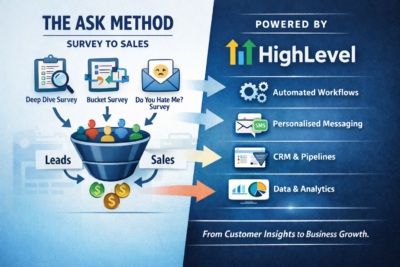
The four surveys that power the Ask Method

1. Deep Dive Survey. Understanding the real problem

The Deep Dive Survey is the research foundation. It uncovers:

  • The true problems customers are trying to solve
  • Emotional motivations behind buying decisions
  • Barriers stopping success
  • The exact language prospects use to describe their situation

This insight shapes your offer, your messaging, your positioning, and often your pricing. Without this step, most marketing is simply educated guessing.

2. Micro-Commitment Bucket Survey. Real-time segmentation

Once you understand the market, the next step is sorting leads into meaningful groups.

The Micro-Commitment Bucket Survey:

  • Uses short, quick questions after opt-in
  • Places each lead into a specific segment or “bucket”
  • Triggers personalised follow-up based on their answers

This is where conversions rise sharply, because prospects only see messages that match their situation.

3. The “Do You Hate Me?” Survey. Re-engaging cold leads

Every business has inactive subscribers. Instead of ignoring them, this survey:

  • Light-heartedly asks why they stopped engaging
  • Reveals hidden objections or changing priorities
  • Identifies people worth re-engaging
  • Cleans your list intelligently

This protects deliverability and often recovers lost revenue.

4. Pivot Survey. Finding the next growth opportunity

Markets evolve, offers stall, and growth slows. The Pivot Survey helps you:

  • Discover what customers want next
  • Validate new ideas before building them
  • Identify adjacent problems worth solving
  • Make confident strategic decisions

It replaces guesswork with evidence-based direction.

Why HighLevel is the ideal platform for the Ask Method

Understanding the Ask Method is powerful. Deploying it correctly is where real results happen.

This is where HighLevel becomes essential.

Surveys, forms, and quizzes in one system

HighLevel allows you to build:

  • Long-form research surveys
  • Short segmentation quizzes
  • One-click re-engagement questions
  • Validation polls for new offers

All responses flow directly into your CRM, so you are not stitching together multiple tools or losing data along the way.

Real-time segmentation with tags and custom fields

Every answer can automatically:

  • Apply tags
  • Populate custom fields
  • Trigger workflows
  • Start personalised email or SMS nurture

This turns the Micro-Commitment Bucket Survey into fully automated personalisation at scale.

Automation that closes the loop

HighLevel workflows allow you to:

  • Re-engage inactive contacts
  • Route leads to the correct pipeline stage
  • Trigger follow-ups based on survey answers
  • Track outcomes by segment

The Ask Method stops being theory and becomes a living system inside your CRM.

Data-driven decision making

Because everything lives in one platform, you can see:

  • Which problems appear most often
  • Which segments convert fastest
  • Which new ideas gain real demand
  • Where future revenue will come from

This is exactly what the Pivot Survey is designed to reveal.

Where most businesses get stuck

Reading the book is easy. Implementing the system properly is not.

Common challenges include:

  • Designing the right survey questions
  • Structuring meaningful segments
  • Building the automation logic
  • Connecting surveys to revenue tracking
  • Turning insight into profitable offers

This is the gap between knowledge and execution.

Why businesses work with Julian Mills

This is where Julian Mills fits in.

Julian is a UK-based HighLevel consultant and marketing automation strategist who specialises in:

  • Translating proven marketing frameworks into real systems
  • Building Ask Method style segmentation inside HighLevel
  • Creating automated nurture and conversion journeys
  • Turning customer insight into measurable revenue

Rather than generic CRM setup, the focus is on strategy first, automation second, growth always.

The result is not just better software usage. It is a smarter marketing engine built around your customers.

Woudl you like to learn more. Book a Discovery Call with Julian.

Final thoughts

The Ask Method delivers a simple but powerful truth.

Your customers will tell you exactly how to sell to them. If you build the system to listen.

HighLevel provides the technical platform to capture, segment, automate, and act on that insight. Julian Mills provides the strategic expertise to implement it correctly and profitably.

Together, this creates marketing that feels natural, personal, and effective.

Looking for Bucket.io software or what happened with The Ask Method. Check out this blog post.

Get a copy of The Ask Method by Ryan Levesque at Amazon (this is not an affiliate link).


Written by Julian Mills – HighLevel consultant and marketing strategist.

Nigel Botterill and Entrepreneurs Circle on Channel 5 show “Rich House, Poor House”.

rich house poor house nigel botterill entrepreneurs circle

rich house poor house nigel botterill entrepreneurs circleIf you’re at a loose end this Sunday evening (8th Feb 2026 at 9pm (UK time)), you may want to tune into Channel 5.

Or watch this at a later date on “catch up”. Here is the link:  Series 12, Episode 1. 

Channel 5 is airing a new episode of Rich House, Poor House featuring Nigel Botterill, founder of Entrepreneurs Circle, and his wife Sue. They swap homes with a couple in Lincoln, and we also get a look inside the new EC head office and meet some of the team behind the organisation.

If you’ve been on my list a while, you’ll know I’m a big fan of Entrepreneurs Circle. I’ve been a member and EC Marketing Coach since 2021, and it’s the only business organisation I subscribe to because the support and insight genuinely help me grow as a professional business owner.

It’s already being talked about as a strong episode, with a twist at the end. So if you’re in the mood for something inspiring and entertaining, it might be worth catching.

If you do watch it and it sparks your interest in Entrepreneurs Circle membership, just reply to this email and I’ll happily give you the low-down.

And if you decide to jump in, I’d really appreciate you using my affiliate link. It includes a free month to try it out: https://entrepreneurscircle.org/join/?ref=rjm1

Enjoy the show if you catch it, and let me know what you think.

Julian

The Ask. What’s The Best Survey Funnel Software Bucket.io Alternative for Ryan Levesque’s Ask Method (HighLevel)

Ask Ryan levesque bucket.io funnel survey software
Ask Ryan levesque bucket.io funnel survey softwareIf you’ve read Ask by Ryan Levesque, you’ll know the core idea is simple.Stop guessing what your market wants. Ask them.

The Ask Method is built around surveys, segmentation, and personalised follow-up. It remains one of the most practical frameworks for turning audience insights into higher conversions.

But there’s one issue many readers face today.

What Happened to Survey Funnel Software – Bucket.io?

Throughout the book, Ryan frequently references his own platform, Survey Funnel Software – Bucket.io, as the tool used to implement the methodology.

However, many people searching for it now discover that:

  • it’s no longer widely available
  • the product has changed over time
  • the Ask Method ecosystem has been acquired and absorbed into other tools (such as ScoreApp)

This leaves a common question.

What software can I use today to implement The Ask Method properly?

The Answer. HighLevel Is a Complete Ask Method Platform

The biggest takeaway I had from reading Ask is that the methodology does not depend on one specific tool.

In fact, HighLevel (also known as GoHighLevel) can be used to implement the Ask Method fully, often more effectively than the original software.

HighLevel provides everything needed to build a complete survey funnel system, including:

  • survey and form creation
  • segmentation and tagging
  • automated follow-up campaigns
  • appointment booking
  • CRM pipeline tracking
  • nurture workflows

If you’re looking for a Survey Funnel Software alternative, HighLevel is one of the most powerful options available.

How HighLevel Supports the Ask Method Step by Step

Ryan’s framework breaks down into three stages.

HighLevel maps onto these perfectly.

1. Ask. Build the Survey Funnel

HighLevel allows you to create surveys, forms, and quizzes that capture the exact insights Ryan teaches.

You can ask questions such as:

  • What is your biggest challenge right now?
  • What would you fix instantly if you could?
  • What are you trying to achieve in the next 90 days?

This is the foundation of any Ask Method funnel.

2. Segment. Create Buyer Buckets Automatically

One of the most valuable parts of the book is learning how to analyse open-ended responses and identify 3 to 5 core buyer buckets.

HighLevel makes segmentation simple through:

  • tags
  • custom fields
  • smart lists
  • workflow triggers

For example:

  • Bucket 1: Beginners needing guidance
  • Bucket 2: DIY marketers wanting templates
  • Bucket 3: Business owners ready for done-for-you support

Each segment can receive a completely different follow-up journey.

3. Sell. Automate the Follow-Up and Booking Process

This is where HighLevel goes beyond traditional survey tools.

Once someone completes your Ask Method survey, HighLevel can automatically:

  • send personalised email sequences
  • trigger SMS reminders
  • assign sales tasks
  • move leads through pipelines
  • invite them to book a call

This turns the Ask Method into a full marketing automation system, not just a survey.

Why HighLevel Is the Best Alternative to Survey Funnel Software – Bucket.io

Most survey platforms stop at collecting answers.

HighLevel continues the process all the way through to conversion.

With HighLevel you can run:

  • the survey
  • the segmentation
  • the nurture
  • the sales pipeline
  • the booking system
  • the automation

All in one platform.

That makes it one of the most complete Ask Method software solutions available today.

Final Thoughts. Ask Method Software Has Evolved

Ryan Levesque’s Ask is still highly relevant.

The surveys, the buyer buckets, and the segmentation strategy are timeless.

The tools have simply moved on.

If you’re searching for:

  • Bucket.io Survey Funnel Software alternative
  • software to implement The Ask Method
  • an alternative to Scoreapp
  • a platform to build survey funnels like Ryan Levesque teaches

HighLevel is an excellent modern solution.

It doesn’t just replace Survey Funnel Software.

It expands on it.

Want Help Building Your Ask Method Funnel in HighLevel?

If you’d like support setting up an Ask Method style survey funnel inside HighLevel, including segmentation workflows and automated follow-up, I can help. You can book a Discovery Call Here.

Written by Julian Mills – HighLevel consultant and marketing strategist.
About Julian Mills.