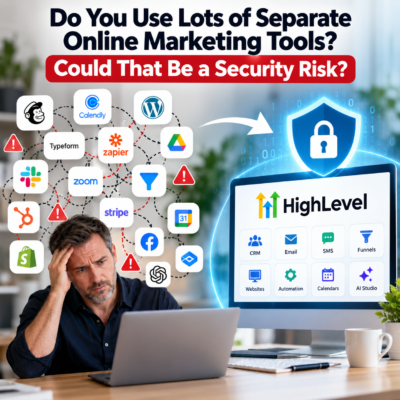
There has been a trend in business software over the past decade that I think is worth questioning.
Every time we need to do something new, we add another piece of software.
Need email marketing? Add an email platform.
Need online appointments? Add a calendar system.
Need forms? Add a form builder.
Need a sales pipeline? Add a CRM.
| Did you find this content useful? |
|---|
| Sign up for my free Marketing Hints, Tips and Hacks email newsletter every Tuesday at 11am. => Sign up here <= |
Need social media scheduling, reviews, courses, funnels, automation or AI? There is an app for each of those too.
Before long, a business can have a collection of different systems all connected together with APIs, webhooks, Zapier, Make and various other integrations.
It can work extremely well.
But there is another question that I think businesses increasingly need to consider:
What does this do to your data security?
Every additional system is another system you have to secure
Using lots of different software platforms does not automatically make your business insecure.
But it does increase the number of things you have to manage.
Every additional platform can potentially mean:
- another username and password
- another set of user permissions
- another company processing your customer data
- another API or integration
- another database containing some of your information
- another account that needs closing when a member of staff leaves
It can also mean customer data moving between multiple systems.
A prospect fills in a form. Their details are passed to your CRM. The CRM talks to an automation platform, which triggers an email system and perhaps updates another application used for reporting.
None of those individual systems necessarily has a security problem.
The issue is that the overall architecture becomes more complicated.
And complexity matters when it comes to security.
This is an overlooked benefit of HighLevel
One of the things I increasingly like about HighLevel is consolidation.
HighLevel now effectively provides more than 22 different business, sales and marketing tools within one platform.
Instead of stitching together separate systems for CRM, email marketing, SMS, calendars, funnels, websites, forms, surveys, pipelines, reputation management, social media, courses, communities, automation and increasingly AI, much of it can operate within the same ecosystem.
That’s normally discussed as a cost or convenience benefit.
Instead of paying for lots of different software subscriptions, you have one platform. Instead of your team learning numerous systems, they can become proficient in one.
But there is another potential benefit:
Data security and data governance can become simpler.
You potentially have fewer suppliers processing your data, fewer integrations to maintain and fewer places where customer information needs to be transferred.
That doesn’t make HighLevel immune from cyber attacks. No software platform can sensibly make that claim.
It simply means there may be fewer moving parts to manage.
But how secure is HighLevel itself?
Of course, if we’re talking about consolidating more customer data and business processes into HighLevel, there’s an obvious question:
How secure is HighLevel itself?
HighLevel has invested significantly in security and achieved SOC 2 Type II certification in 2026, an independent assessment of how its security controls operate over time.
Its published security measures include AES-256 encryption for stored data, TLS encryption for data in transit, two-factor authentication, user permissions, audit logs, security monitoring, vulnerability scanning and penetration testing. HighLevel also holds ISO/IEC 27001 certification, the internationally recognised standard for information security management.
At MarketerM8, we add our own security precautions too.
For example, we enforce a four-hour inactivity timeout on our HighLevel accounts. If you’ve been inactive for four hours, HighLevel automatically logs you out.
We do occasionally have clients complain about this. They would understandably prefer to stay permanently logged in rather than having to enter their details again.
And I completely understand why. It can be a little inconvenient.
But we have to explain that the inconvenience is deliberate. It’s there for their security.
If somebody walks away from a computer while still logged in, or a device falls into the wrong hands, we don’t want an authenticated HighLevel session sitting there indefinitely.
It’s a small example of an important distinction:
HighLevel is responsible for securing the platform. We’re responsible for how we configure and use it.
The slightly scary thing about AI-built software
This whole subject has become considerably more important because of AI.
Tools such as Lovable and Claude Code have made software development incredibly accessible.
I’m not a software developer, but today I can describe a tool I want in plain English and potentially have a working application within an hour.
That’s an amazing feeling.
“I’ve just built my own software!”
And connecting that new application to your CRM is becoming increasingly easy too.
Give the AI access to an API, explain what you want to happen and you can have information flowing backwards and forwards remarkably quickly.
But there is a question the excitement can make very easy to forget:
Who thought about security?
Traditionally, if you commissioned a professional developer to build an application that accessed your customer database, you would expect security to form part of the development process.
- Who should be allowed to access the application?
- What information should each user be able to see?
- Where are API keys stored?
- Could somebody manipulate a request to retrieve another customer’s information?
- Does the application really need access to your entire CRM database?
- What gets logged?
- Where is data stored?
- What happens if somebody discovers a vulnerability?
With AI-assisted development, a business owner can go from an idea to a working application extraordinarily quickly, without necessarily knowing that these are questions they should even be asking.
The AI may have written perfectly functional code.
Functional doesn’t necessarily mean secure.
The one-hour software developer
We’re entering a world where somebody who has never written a line of code can create an application over their lunch break and connect it to a CRM containing thousands of customer records.
That’s incredibly exciting.
It’s also something we should treat with respect.
The barrier to creating software has collapsed.
The barrier to understanding application security hasn’t.
You might not know what authentication, authorisation, API scopes, server-side secrets, database permissions or input validation mean.
Your application doesn’t care.
The moment you connect it to real customer data, those things matter.
This doesn’t mean businesses shouldn’t use Lovable, Claude Code or other AI development tools.
Quite the opposite.
I think they’re going to enable businesses to create incredibly useful applications that previously would have been too expensive or time-consuming to develop.
But the fact that we can create something in an hour shouldn’t lead us to assume that it’s ready to be connected to sensitive customer information an hour later.
This is where HighLevel AI Studio gets interesting
HighLevel has now added another possibility.
AI Studio increasingly allows us to create our own websites, applications and online tools from prompts within the HighLevel ecosystem.
Imagine that my business needs:
- a customer portal
- a quotation calculator
- an assessment tool
- a lead qualification application
- a reporting dashboard
- a specialist booking tool
- something completely specific to the way that business operates
Previously, I might have looked for another SaaS product or used something such as Lovable to create it and then connected that application to HighLevel.
That can be a perfectly good solution.
But now there is another question worth asking:
Can I build it in HighLevel AI Studio instead?
If the application primarily exists to work with information already inside HighLevel, that raises an interesting security and data governance question:
Why take that data outside HighLevel if I don’t need to?
AI Studio now supports server-side functionality, APIs and secure storage for sensitive credentials, making it possible to build significantly more sophisticated applications within the platform than was previously possible.
That doesn’t automatically make an AI Studio application secure.
Nor does it make an application created with Lovable or Claude Code insecure.
Security still depends on what you build and how you build it.
But there is an architectural difference.
If I build externally, I may be introducing another application, another supplier, another API connection and potentially another database that needs access to my CRM data.
If I can achieve the same result within the existing HighLevel environment, I may be able to avoid some of those additional moving parts.
From 22 tools to “tool number 23”
This is where I think HighLevel’s direction becomes really interesting.
I’ve talked previously about HighLevel effectively replacing more than 22 separate sales and marketing tools.
But what happens when somebody says:
“That’s great, but our business needs this very specific little application…”
Previously, that might have meant introducing software product number 23.
Another subscription.
Another supplier.
Another integration.
Another set of permissions.
Another system that potentially needs access to your data.
Increasingly, my first question is going to be:
Can we build tool number 23 in HighLevel AI Studio instead?
If the answer is yes, the benefit could be considerably greater than simply reducing your software bill.
We may also have avoided another external system that needs access to our customer data.
There is a trade-off
There is, of course, a counterargument to putting more functionality into one platform.
If you consolidate more of your business into HighLevel, securing access to HighLevel becomes even more important.
Strong passwords, two-factor authentication, sensible user permissions and promptly removing access when somebody leaves become essential.
There is also no point trying to recreate specialist software inside HighLevel simply because you can.
Sometimes an established external application will be the better solution.
My approach would therefore be:
HighLevel first. External when necessary.
If the functionality revolves around data and processes already living inside HighLevel, first ask whether it can sensibly be built there.
If it can, great.
If it can’t, use the right external application and integrate it properly.
How many companies really need access to your customer data?
For me, that’s the bigger question.
The case for consolidating technology isn’t just about reducing your software bill.
It’s about simplifying the technology your team has to learn and manage.
It’s about reducing integrations.
And potentially, it’s about reducing the number of different companies, applications and databases that need access to your customer information.
AI development makes this question even more important.
We are rapidly reaching the point where almost anyone can say:
“I need a little application that does this.”
And an hour later, they can have one.
That’s extraordinary.
But before connecting that new creation to thousands of customer records, perhaps there should be a second question:
Do I actually need to give another application access to this data?
HighLevel already brings more than 22 sales and marketing tools together.
Now AI Studio introduces another possibility.
When your business needs something that isn’t already there, perhaps you don’t automatically need to go shopping for software product number 23.
And perhaps you don’t automatically need to build it somewhere else and connect it to your CRM either.
Perhaps you can build tool number 23 inside HighLevel instead.
Frequently Asked Questions
Is HighLevel secure?
HighLevel has a range of security controls designed to protect customer data, including encryption for data at rest and in transit, two-factor authentication, user permissions, audit logs, security monitoring, vulnerability scanning and penetration testing.
HighLevel achieved SOC 2 Type II certification in 2026 and also holds ISO/IEC 27001 certification.
However, security is a shared responsibility. HighLevel can secure the underlying platform, but businesses still need to manage passwords, user permissions, account access and the applications and integrations they connect to it.
Is HighLevel SOC 2 compliant?
Yes. HighLevel announced that it had achieved SOC 2 Type II certification in March 2026.
SOC 2 Type II involves independent assessment of security controls and how effectively those controls operate over a period of time.
Is HighLevel GDPR compliant in the UK?
HighLevel is designed to support businesses complying with both EU GDPR and UK GDPR.
HighLevel has a Data Processing Agreement covering UK GDPR, supports data access and deletion requests, and participates in mechanisms designed to provide appropriate safeguards for transfers of personal information from the UK to the United States.
However, simply using HighLevel does not automatically make your business GDPR compliant. As the business collecting and using customer information, you remain responsible for ensuring that you have an appropriate lawful basis for processing it and that you use the data appropriately.
If you’re considering using HighLevel in the UK through MarketerM8, this is an important distinction to understand.
Where does HighLevel store UK customer data?
HighLevel’s core product infrastructure is hosted in the United States, not the UK. HighLevel uses major cloud infrastructure providers including Google Cloud Platform and Amazon Web Services.
That does not by itself prevent a UK business from using HighLevel under UK GDPR. Personal data can be transferred internationally where appropriate legal safeguards are in place.
UK businesses should therefore not assume that their HighLevel contact database is physically stored on servers in the UK.
Is HighLevel AI Studio secure?
HighLevel AI Studio provides security-related capabilities including server-side functions and secure storage for secrets such as API keys and access tokens.
However, using AI Studio does not automatically make an application secure. Security still depends on how the application is designed, what information it can access and how authentication, permissions and sensitive data are handled.
Is it safer to build an application in HighLevel AI Studio than Lovable?
Not necessarily. An application built properly using Lovable or another development platform can be secure.
The potential advantage of AI Studio arises when the application primarily needs to work with data already held inside HighLevel.
Building within the same ecosystem may mean you don’t need to introduce another external application, supplier, database or API connection with access to your CRM data.
Why take customer data outside HighLevel if you don’t need to?
Are AI-built applications secure?
They can be, but the fact that an AI tool can create a working application doesn’t mean that application is automatically secure.
Tools such as Lovable and Claude Code have dramatically reduced the technical knowledge required to create software. A business owner can potentially create an application and connect it to their CRM without understanding authentication, API permissions, server-side secrets or database security.
The barrier to creating software has collapsed. The barrier to understanding application security hasn’t.
Does using lots of different software increase your cyber-security risk?
Not automatically, but every additional system can increase the number of things your business needs to secure and manage.
Another SaaS product can mean another supplier, login, set of permissions, integration, API credential and potentially another location where customer data is processed or stored.
Consolidating systems can therefore reduce complexity and the number of potential points of failure, provided the platform you consolidate onto has appropriate security controls.
Why does MarketerM8 automatically log HighLevel users out after four hours?
At MarketerM8, we enforce HighLevel’s four-hour inactivity timeout as an additional security precaution.
We occasionally have clients ask why they can’t simply remain logged in permanently. We understand that logging in again can be inconvenient, but the timeout reduces the risk of an unattended logged-in computer or device providing continued access to a client’s HighLevel account.
It’s a small inconvenience that we believe is worthwhile for the additional protection it provides.
If you need help setting up, securing or getting more from your HighLevel account, you can also see my HighLevel Support UK guide.

About the Author
Julian Mills
HighLevel Consultant & Marketing Automation Strategist
Julian Mills helps business owners automate lead generation, sales follow-up, customer communication and business processes using HighLevel and MarketerM8. Since 2009 he has helped businesses implement CRM, marketing automation and AI-powered systems that save time, improve customer experience and generate more sales.
About Julian
Book a Discovery Call
Join a Free HighLevel Workshop
Learn About HighLevel with MarketerM8