Workflows are where HighLevel really starts to earn its keep.
Instead of relying on somebody remembering to send an email, follow up a lead, move an opportunity, notify a colleague or perform another repetitive task, HighLevel can potentially do it automatically.
At its simplest, a HighLevel workflow follows a very straightforward principle:
Something happens → HighLevel automatically does something else.
For example:
Website enquiry received → Send acknowledgement → Create opportunity → Notify salesperson → Start follow-up
Once you understand that basic principle, you can start building increasingly sophisticated automations around the way your business actually works.
| Did you find this content useful? |
|---|
| Sign up for my free Marketing Hints, Tips and Hacks email newsletter every Tuesday at 11am. => Sign up here <= |
But there’s an important warning.
Automating a bad process doesn’t make it a good process. It simply makes the bad process happen automatically.
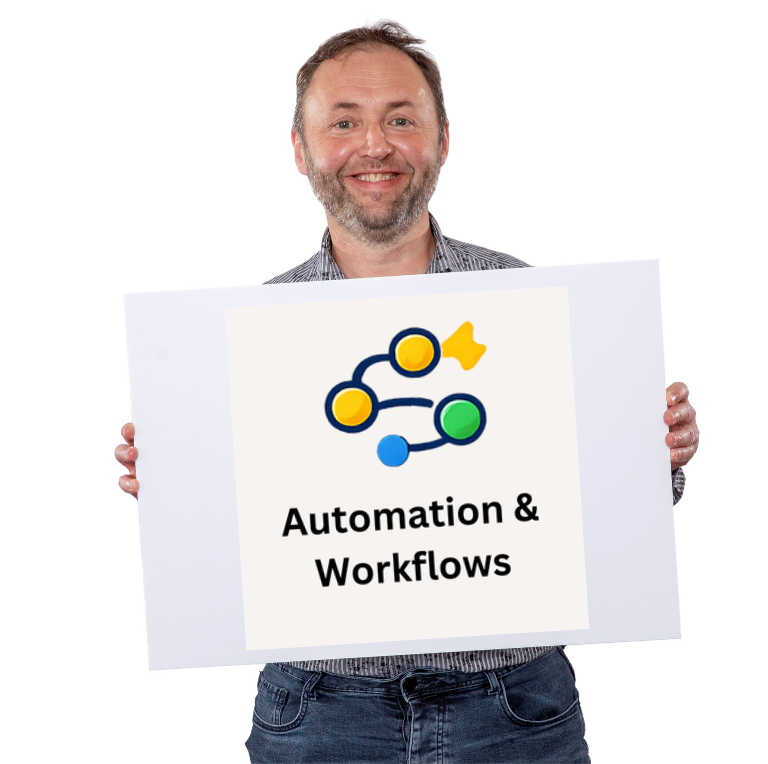
That’s why our free HighLevel Automation & Workflows training workshop isn’t simply about learning which buttons to click.
We’ll look at how HighLevel workflows work, but we’ll also look at what you should automate, why you should automate it and when you shouldn’t automate it at all.
The workshop is part of MarketerM8’s rolling programme of 13 free live HighLevel training workshops.
 |
Want to Automate More With HighLevel? Join our free live HighLevel Automation & Workflows workshop and learn how triggers, actions, conditions and automation can turn repetitive processes into workflows.
|
What Is a Workflow in GoHighLevel?
A HighLevel workflow is a series of automated actions that can take place when something happens.
The event that starts the workflow is generally referred to as a trigger.
What HighLevel subsequently does is controlled by the actions inside the workflow.
So the basic structure is:
Trigger → Action → Action → Action
For example:
Form submitted → Send email → Create opportunity → Notify salesperson
That simple concept is the foundation of much of HighLevel’s automation functionality.
You can explore HighLevel’s official Getting Started with Workflows guide alongside our live training.
What Can You Automate With HighLevel Workflows?
This is where the possibilities become enormous.
HighLevel workflows can potentially help automate activities across marketing, sales, customer service and internal administration.
Examples include:
- responding to new enquiries;
- lead follow-up;
- email nurture sequences;
- SMS follow-up;
- appointment confirmations;
- appointment reminders;
- no-show follow-up;
- creating sales opportunities;
- updating opportunities;
- assigning leads to team members;
- sending internal notifications;
- creating tasks;
- customer onboarding;
- review requests;
- reactivation campaigns;
- database management;
- and much more.
The question therefore isn’t usually:
“Can HighLevel automate something?”
The more useful question is:
“Should we automate it, and what should the process actually be?”
Start With the Process, Not the Workflow Builder
This is probably the most important lesson I can give anyone learning HighLevel workflows.
Don’t start by opening the workflow builder.
Start by mapping what you want to happen.
For example:
New enquiry arrives → Acknowledge within seconds → Tell salesperson → Add to sales pipeline → Follow up if salesperson hasn’t made contact
Now we have a process.
We can then ask which parts should be handled by HighLevel.
That is considerably easier than dragging actions into a workflow and hoping they eventually form a sensible business process.
Process first. Automation second. HighLevel third.
Understanding HighLevel Workflow Triggers
A trigger tells HighLevel when the workflow should start.
There are many different events that might cause automation to begin.
Depending on the process, that could be something such as:
- a form being submitted;
- a contact being created;
- an appointment being booked;
- an opportunity changing;
- a particular customer action occurring;
- a tag being added;
- or another event within your HighLevel setup.
Choosing the correct trigger matters.
If the wrong people enter the workflow, even perfectly configured actions can produce the wrong result.
Understanding HighLevel Workflow Actions
Once somebody or something enters a workflow, actions determine what HighLevel should do.
For example, HighLevel might:
- send an email;
- send an SMS;
- wait for a period of time;
- create or update an opportunity;
- assign a user;
- add or remove a tag;
- create a task;
- send an internal notification;
- update contact information;
- or move the workflow down a different path.
By combining actions, relatively simple automations can become complete customer journeys.
HighLevel Workflows Don’t Have to Be Linear
A real customer journey rarely follows one perfectly straight line.
Some people respond.
Some don’t.
Some book.
Some cancel.
Some buy.
Some aren’t suitable prospects in the first place.
That’s why HighLevel workflows can use conditions and branching logic to make different things happen depending on circumstances.
Using If/Else Conditions in HighLevel Workflows
An If/Else condition allows a workflow to ask a question and send contacts down different paths depending on the answer.
Conceptually:
Has the prospect booked an appointment?
YES → Send appointment information
NO → Continue follow-up
Or:
Is this person already a customer?
YES → Customer journey
NO → Prospect journey
This allows workflows to become much more intelligent than simply sending everybody exactly the same sequence.
Use Wait Steps to Control Timing
Good automation isn’t simply about what happens.
Timing matters too.
Sometimes an action should happen immediately.
Sometimes it should happen an hour later.
Sometimes tomorrow.
Sometimes only after another event occurs.
HighLevel workflows allow you to build waiting periods and timing logic into your automation.
This becomes particularly important for lead nurture, appointment communication and longer customer journeys.
HighLevel Workflows Can Automate Lead Follow-Up
This is one of the most obvious uses of HighLevel automation.
A prospect submits an enquiry at 8:37pm.
Nobody in your office is working.
That doesn’t mean the prospect has to hear nothing until tomorrow morning.
HighLevel could potentially:
Receive enquiry → Send immediate acknowledgement → Create sales opportunity → Notify salesperson → Start appropriate follow-up
The automation isn’t necessarily replacing the salesperson.
It’s making sure the salesperson has a better chance of having the right conversation at the right time.
HighLevel Workflows and Sales Pipelines
Workflows become particularly useful when combined with HighLevel Sales Pipelines & Opportunities.
For example, a workflow might automatically create an opportunity when a new enquiry arrives.
Another event might move the opportunity to a different stage.
A salesperson might be assigned.
A task might be created.
Follow-up might be triggered.
That means your CRM can start reflecting what is actually happening without relying entirely on manual data entry.
HighLevel Workflows and Calendars
Calendars and workflows are another powerful combination.
For example:
Appointment booked → Send confirmation → Notify team → Wait → Send reminder → Appointment takes place → Trigger follow-up
You can also design different processes for cancellations, rescheduling and no-shows.
This turns the calendar from a simple booking tool into part of an automated customer journey.
HighLevel Workflows and Email Marketing
Email marketing doesn’t have to mean manually sending a campaign to a list.
Workflows allow email to be triggered by what a contact does or where they are in their journey.
For example:
- someone downloads a guide;
- a prospect makes an enquiry;
- a customer purchases something;
- an appointment is booked;
- a lead reaches a particular point in your sales process;
- or an existing customer needs further information.
This is where CRM data and email marketing start working together.
Automate Internal Tasks as Well as Customer Communication
HighLevel automation isn’t only about sending messages to customers.
Some of the most useful workflows happen behind the scenes.
For example:
- notify a salesperson about a hot lead;
- assign a new enquiry to somebody;
- create a follow-up task;
- update a contact record;
- move an opportunity;
- notify a manager about something important;
- or organise contacts automatically.
These automations may be invisible to the customer, but they can make your business considerably more consistent.
HighLevel Workflows Can Extend Beyond HighLevel
Your business probably doesn’t operate entirely inside HighLevel.
You may have accounting software, specialist industry applications, internal systems or other platforms.
Depending on the systems involved, workflows can potentially exchange information with external applications using integrations, webhooks and APIs.
This is where HighLevel automation can start becoming part of a much wider business automation strategy.
But again, complexity should have a purpose.
Don’t build a complicated integration because it’s technically impressive.
Build it because it solves a worthwhile business problem.
AI Is Making HighLevel Workflows Even More Powerful
Automation traditionally follows rules.
If X happens, do Y.
AI introduces the ability to work with information that isn’t always perfectly structured.
That can potentially allow workflows to interpret, classify, summarise or generate information as part of a process.
For example, AI might help analyse information submitted by a prospect and use that information within a wider automated process.
This opens up some fascinating possibilities.
But my advice remains the same.
Don’t add AI because AI sounds exciting.
First understand the process.
Then decide whether ordinary automation, AI, human judgement or a combination of all three provides the best solution.
Don’t Build Monster Workflows Unless You Need Them
It’s very easy to become impressed by enormous HighLevel workflows.
Hundreds of actions.
Branches everywhere.
Complex logic.
That can sometimes be necessary.
But complexity isn’t a measure of quality.
A five-step workflow that reliably solves an important business problem can be considerably more valuable than a 150-step automation nobody understands.
Start simple.
Test it.
Understand it.
Then add complexity when there’s a genuine reason to do so.
Test Your HighLevel Workflows Before Relying on Them
Automation can save enormous amounts of time.
It can also make mistakes at scale if you configure it incorrectly.
So test your workflows.
Ask:
- Who enters the workflow?
- Who shouldn’t enter it?
- What happens at each step?
- What happens if information is missing?
- What happens if somebody responds?
- What happens if they book?
- What happens if they become a customer?
- Can somebody accidentally enter twice?
- Is there a clear way for them to leave when appropriate?
Don’t assume an automation works simply because it looks right on the screen.
Automation Training Backed by Real Marketing Experience
This is where my background becomes particularly relevant.
I’ve worked hands-on in direct marketing since 1996 and with CRM and marketing automation since 2009.
Since 2009, I’ve helped hundreds of businesses improve, automate and systemise their marketing.
I’m also a Certified Entrepreneurs Circle Marketing Coach and have helped Entrepreneurs Circle GenieAI subscribers implement AI and marketing automation within their businesses.
Through my own HighLevel agency, MarketerM8, I’ve personally onboarded more than 100 HighLevel users.
So when we’re looking at a workflow, I’m wearing several hats.
- What is the marketing objective?
- What should the business process be?
- What should HighLevel automate?
- Where should a human remain involved?
- And how do we make the whole thing manageable?
That’s very different from simply learning how to drag actions into the HighLevel workflow builder.
What Will You Learn in the HighLevel Automation & Workflows Workshop?
This free live workshop is designed to help you understand the fundamentals of HighLevel workflows and how to apply them to real business processes.
We’ll explore areas such as:
- what HighLevel workflows are;
- workflow triggers;
- workflow actions;
- wait steps and timing;
- If/Else conditions;
- branching logic;
- automated email and SMS;
- lead follow-up;
- internal notifications;
- tasks and assignments;
- sales pipeline automation;
- calendar and appointment automation;
- database automation;
- using workflows with external systems;
- the growing role of AI in automation;
- testing workflows;
- and common HighLevel workflow mistakes to avoid.
The objective isn’t to build the biggest workflow.
It’s to understand how to create useful, reliable automation that improves the way your business works.
|
Learn HighLevel Workflows Live Join Julian Mills for this free live HighLevel workflow training workshop and learn how triggers, actions, conditions and automation work together.
|
Automation & Workflows Is Part of Our Free HighLevel Training Programme
The Automation & Workflows workshop is part of MarketerM8’s rolling programme of 13 free live HighLevel training workshops.
The programme is designed to help you learn HighLevel one practical area at a time.
If you’re completely new to HighLevel, start with our HighLevel Foundations for Beginners workshop.
Understanding Calendars & Appointments and Sales Pipelines & Opportunities is also particularly useful because workflows can automate processes around both.
You can then continue into database management, forms, websites, social media, ecommerce, advertising and AI.
Do I Need to Be a MarketerM8 Customer?
No.
You don’t need to be a MarketerM8 subscriber to attend our free live HighLevel training workshops.
You can attend whether you’re already using HighLevel, considering the platform or simply want to understand more about what HighLevel automation can do.
What If I Need Help Building My Own HighLevel Workflows?
A live workshop can teach you how workflows work.
But your own automation requirements may be unique to your business.
Perhaps you need help:
- mapping a business process before automating it;
- building lead follow-up;
- creating nurture sequences;
- automating appointments and reminders;
- automating sales pipelines;
- building customer onboarding;
- creating internal notifications and tasks;
- using If/Else logic;
- integrating HighLevel with another system;
- using AI within a workflow;
- fixing an existing automation;
- or training your team.
That’s where I can provide remote HighLevel training and Done-With-You implementation.
For larger projects and teams, on-site HighLevel training and implementation is also available throughout the UK and internationally.
If you’re experiencing a technical problem rather than needing automation consulting or training, take a look at my guide to HighLevel support in the UK.
Frequently Asked Questions About HighLevel Workflows & Automation
What Is a Workflow in GoHighLevel?
A HighLevel workflow is an automated sequence of actions that can begin when a particular event occurs.
That starting event is generally called a trigger.
The workflow can then perform actions such as sending messages, waiting, updating information, creating opportunities, notifying users or following different paths depending on conditions.
What Is a HighLevel Workflow Trigger?
A trigger determines when a workflow should start.
For example, a workflow might begin when somebody submits a form, books an appointment or meets another defined condition.
Choosing the correct trigger is important because it determines who or what enters your automation.
What Is a HighLevel Workflow Action?
An action is something HighLevel does after the workflow has been triggered.
Actions can include sending communications, waiting, updating information, creating opportunities, assigning users, sending internal notifications and many other activities.
What Can I Automate With GoHighLevel?
HighLevel can automate many repetitive processes across marketing, sales and customer service.
Common examples include lead follow-up, appointment reminders, email nurture, sales pipeline updates, customer onboarding, review requests and internal notifications.
The best starting point is an existing repetitive process that consumes time or is frequently forgotten.
Can HighLevel Automatically Follow Up Leads?
Yes.
A workflow can respond when a new lead enters HighLevel and perform appropriate follow-up actions.
This can be particularly valuable when enquiries arrive outside normal working hours or when salespeople are busy.
Can HighLevel Workflows Send Emails?
Yes.
Email can be used as an action within HighLevel workflows.
This means emails can be sent automatically based on events rather than every email having to be sent as a manually scheduled campaign.
Can HighLevel Workflows Send SMS Messages?
Yes, where SMS is configured for the account.
SMS can be incorporated into automated customer journeys alongside email and other actions.
Use the communication channel that makes sense for the message rather than automatically sending everything through every available channel.
What Is If/Else in a HighLevel Workflow?
If/Else allows a workflow to follow different paths depending on whether a condition is true or false.
For example:
Has the prospect booked? YES → Appointment journey. NO → Continue follow-up.
This makes it possible to create more responsive workflows rather than treating every contact identically.
Can HighLevel Workflows Wait Before Sending Something?
Yes.
Wait steps can be used to control when subsequent actions take place.
This allows you to build appropriate timing into nurture sequences, reminders and other automated processes.
Can HighLevel Workflows Update Sales Pipelines?
Yes.
Workflows can work with HighLevel opportunities and pipelines.
This can help create opportunities, update information and support processes as leads move through your sales journey.
Can HighLevel Workflows Automate Appointments?
Yes.
Calendars and workflows work particularly well together.
You can build automation around bookings, confirmations, reminders, cancellations, rescheduling, no-shows and post-appointment follow-up.
Can HighLevel Workflows Assign Leads to Salespeople?
HighLevel automation can be used as part of lead assignment and internal sales processes.
This can help make sure new opportunities reach the appropriate person rather than sitting unnoticed in the CRM.
Can HighLevel Workflows Create Tasks?
Yes.
Automation doesn’t have to replace human activity.
Sometimes the correct automated action is simply to create a task telling a person what they need to do next.
Can HighLevel Workflows Send Internal Notifications?
Yes.
Internal notifications can be extremely useful for alerting team members when something requires their attention.
For example, HighLevel might automatically notify a salesperson when a new qualified enquiry arrives.
Can HighLevel Workflows Integrate With Other Software?
Potentially, yes.
Depending on the application and your HighLevel setup, integrations, webhooks and APIs can allow HighLevel workflows to exchange information with external systems.
More complex integrations should be designed carefully so that you understand what happens if either system changes or something fails.
Can AI Be Used in HighLevel Workflows?
HighLevel increasingly provides AI functionality that can be incorporated into wider automation processes.
AI can be useful where a process requires interpreting or generating information rather than simply following fixed rules.
However, AI should be used because it improves the process, not simply because it’s available.
How Complicated Should a HighLevel Workflow Be?
Only as complicated as necessary.
Complexity isn’t a sign of a good workflow.
Start with the simplest automation that reliably solves the problem, test it thoroughly and add complexity only where it produces a worthwhile benefit.
Should I Build One Big HighLevel Workflow or Several Smaller Ones?
It depends on the process.
In many situations, smaller, clearly defined workflows can be easier to understand, test and maintain than one enormous automation.
The important thing is to design a structure that remains understandable as your business and automation evolve.
How Do I Test a HighLevel Workflow?
Testing should involve more than checking whether the workflow looks correct.
Use realistic test contacts and scenarios to make sure the correct people enter, actions happen in the expected order, conditions behave correctly and contacts leave or change paths when they should.
Can HighLevel Workflows Replace Manual Processes?
Sometimes.
But not every manual process should be completely automated.
The best solution may combine automation with human judgement.
HighLevel might collect information, update records and create a task, while a person makes the final decision.
Is the HighLevel Automation & Workflows Workshop Free?
Yes.
The Automation & Workflows workshop is part of MarketerM8’s programme of free live HighLevel training workshops.
There’s no charge to attend the live workshop.
Do I Need to Be a MarketerM8 Customer to Attend?
No.
You can attend our free HighLevel training workshops without being a MarketerM8 subscriber.
Can I Ask Questions During the HighLevel Workflow Workshop?
Yes.
That’s one of the advantages of live HighLevel training.
You can see workflows being explained and ask questions about the automation concepts we’re covering.
What Should I Learn After HighLevel Workflows?
That depends on what you want to automate.
If your workflows depend heavily on contact information and segmentation, HighLevel Database Management is a useful next subject.
If you want to capture information that triggers workflows, Forms, Surveys & Quizzes is particularly relevant.
And if you want to explore more advanced automation possibilities, our HighLevel AI workshop will show you how AI is becoming part of the platform.
You can explore all the subjects in our free HighLevel training programme.
Ready to Start Automating With HighLevel?
Don’t start by asking:
“What workflows can I build?”
Start by asking:
“What repetitive processes in our business could be made faster, more consistent or more reliable?”
Then map the process.
Decide what should be automated.
Decide where people should remain involved.
And only then build the workflow.
Understand the process → Decide what to automate → Build it in HighLevel → Test it → Improve it
That’s exactly what our Automation & Workflows workshop is designed to help you understand.
|
Ready to Put HighLevel to Work? Join our free live HighLevel Automation & Workflows workshop and learn how to turn repetitive marketing, sales and customer processes into useful automation.
|

About the Author
Julian Mills
HighLevel Consultant & Marketing Automation Strategist
Julian Mills helps business owners automate lead generation, sales follow-up, customer communication and business processes using HighLevel and MarketerM8. Since 2009 he has helped businesses implement CRM, marketing automation and AI-powered systems that save time, improve customer experience and generate more sales.
About Julian
Book a Discovery Call
Join a Free HighLevel Workshop
Learn About HighLevel with MarketerM8