 For years, business automation has largely been about telling software exactly what to do, step by step.
Now that’s changing.
With AI Managed Agents, we can increasingly give software a job to complete and let it work out how to achieve the result.
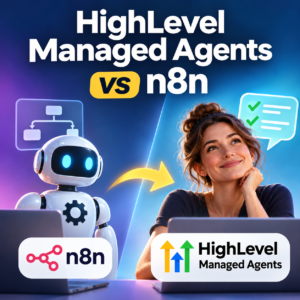
Think of it as the difference between programming a robot and delegating a job to a human assistant.
HighLevel’s new Managed Agents are part of this evolution. And with HighLevel now offering an importer for existing n8n workflows, businesses have an interesting opportunity to rethink how they automate their operations.
But are Managed Agents actually better than n8n? And does importing an existing workflow automatically make it more intelligent?
Let’s explore.
| Did you find this content useful? |
|---|
| Sign up for my free Marketing Hints, Tips and Hacks email newsletter every Tuesday at 11am. => Sign up here <= |
Traditional automation: The robot that follows instructions
Many business owners will be familiar with Zapier.
Zapier connects different software applications and automates tasks between them.
For example, when somebody completes a website enquiry form, an automation might:
- Add the person’s details to your CRM.
- Send an acknowledgement email.
- Create an opportunity in your sales pipeline.
- Assign the opportunity to a salesperson.
- Create a follow-up task.
Every step is planned in advance.
It’s like programming a robot. You tell it what to do, and it follows those instructions.
Assuming everything works correctly, it repeats the process consistently.
But what happens when something unexpected occurs?
Perhaps the customer’s information is incomplete. An external application returns an error. Or the enquiry doesn’t fit the rules you’ve programmed.
Unless you’ve anticipated that situation and built in suitable error handling, the automation may stop or produce an undesirable result.
Where does n8n fit in?
n8n works on a similar principle to Zapier, but provides extensive flexibility for more sophisticated automations.
It uses a visual workflow builder where you connect individual steps, called nodes.
These can perform actions, process information, make decisions, call APIs and communicate with other applications.
n8n is particularly useful for complex integrations and processes involving several different software systems.
It can also be self-hosted, giving businesses greater control over their infrastructure.
Importantly, n8n now supports AI agents too. It isn’t limited to traditional rule-based automation.
However, for this comparison, we’re looking primarily at conventional n8n workflows where the steps and decision paths are defined in advance.
HighLevel Managed Agents: More like a human assistant
HighLevel Managed Agents take a different approach.
Instead of programming every individual step, you describe the job you want completed.
Think of it as writing a job description for a new employee.
For inspiration, see my 10 practical HighLevel Managed Agent ideas for small businesses.
Whenever a new sales enquiry arrives, research the prospect, check their CRM history, identify what they’re interested in and prepare an appropriate follow-up for the salesperson.
You give the agent an objective, instructions and access to appropriate tools.
It can then interpret information, make decisions and work towards the outcome.
Rather than following one fixed route, it may be able to adapt its approach depending on what it discovers.
That’s the exciting difference.
Can Managed Agents self-heal?
To an extent, yes.
Imagine an agent is researching a prospective customer but can’t find useful information using its first search.
Rather than simply stopping, it might try another search or use a different source.
If an external application returns an unexpected response, it may be able to interpret the problem and attempt an alternative approach.
This is sometimes described as self-healing.
But we shouldn’t overstate it.
An agent cannot necessarily repair broken integrations, fix incorrect credentials or overcome a software outage.
Its ability to recover depends on its instructions, permissions and available tools.
Conventional workflows can also include retries and alternative paths. The difference is that an AI agent may be able to choose an alternative without every possibility being programmed in advance.
The downside: AI can hallucinate
There’s a trade-off.
Traditional automation generally follows predictable rules.
AI agents have more freedom to interpret information and make decisions, but they can also get things wrong.
They might misunderstand an instruction, make an incorrect assumption or invent information.
Imagine asking an agent to research a prospect and prepare a personalised email.
It might produce an excellent message. But what if it incorrectly identifies the prospect’s industry or invents something about their business?
If the agent sends that email without approval, the mistake could reach the customer.
That’s why I think we need to treat AI agents much like new employees.
Give them clear instructions, sensible permissions and appropriate supervision.
Test their work before allowing them to make important decisions independently.
Sometimes you want an intelligent assistant who can adapt. Other times you want a robot that follows the same rules every time.
Neither approach is universally better.
HighLevel Managed Agents vs n8n: The key differences
| Traditional n8n workflows | HighLevel Managed Agents |
|---|---|
| Follow predefined steps | Work towards an objective |
| Explicit rules and conditions | AI interprets information |
| Predictable execution | Greater flexibility |
| Require configured error handling | May adapt to unexpected situations |
| Excellent for complex integrations | Useful for AI-led business tasks |
| Often require technical knowledge | Can be configured in natural language |
| Can include AI capabilities | AI reasoning is central |
Remember, n8n also supports AI agents, while HighLevel has conventional rule-based workflows.
So we’re comparing two approaches to automation, not suggesting that everything built in n8n is robotic.
A practical example: Handling a new sales enquiry
Let’s imagine you run a company installing windows, doors and conservatories.
A potential customer completes an enquiry form on your website.
They write:
I’m looking at replacing the windows in our house, but we’re also thinking about building an extension next year. Not sure whether to do everything together or in stages. Can somebody advise?
How might the two approaches handle this?
Using a traditional n8n workflow
We could build an automation that:
- Creates or updates the customer’s CRM record.
- Adds a tag based on their selected enquiry type.
- Sends a standard acknowledgement email.
- Creates an opportunity in the sales pipeline.
- Notifies a salesperson to follow up.
This is perfectly sensible automation.
It ensures the enquiry is recorded, acknowledged and passed to the appropriate person.
But unless we’ve included additional rules or AI steps, the workflow won’t necessarily understand the customer’s wider situation.
It simply follows the process we’ve programmed.
Using a HighLevel Managed Agent
Now imagine giving a Managed Agent this instruction:
Review each new enquiry, identify the customer’s requirements, check their CRM history and prepare an appropriate response. Flag enquiries requiring specialist advice.
The agent might recognise that:
- The customer wants replacement windows.
- They’re also considering an extension.
- The timing of both projects may be important.
- This could be a larger opportunity than a straightforward window replacement.
- The customer would benefit from speaking to an experienced salesperson.
It could then update the CRM, create an opportunity and prepare a personalised response.
For example:
Thanks for getting in touch. I see you’re considering replacing your windows but may also be planning an extension. It could be worth discussing both projects together before deciding on the timing. I’ll arrange for one of our team to contact you.
The agent could also create a task explaining the customer’s circumstances to the salesperson.
All of this depends on the tools, permissions and instructions we’ve configured.
What if something goes wrong?
Suppose the agent searches for the customer in the CRM but doesn’t find a matching record.
A traditional workflow might follow a predefined alternative route.
A Managed Agent might try searching by telephone number instead of email address.
That flexibility could be useful.
But what if it finds somebody with a similar name and incorrectly assumes they’re the same customer?
This is where we need safeguards.
For example, we could instruct the agent not to merge records or use information from an uncertain match without human approval.
Which would I choose?
For predictable administrative tasks such as creating contacts, sending acknowledgements and adding opportunities, conventional HighLevel workflows may already be perfectly adequate.
I wouldn’t replace reliable automation simply because AI is available.
But where the business needs to understand a customer’s circumstances and decide on the appropriate response, a Managed Agent becomes much more interesting.
The best solution may be to combine both approaches.
Use conventional automation for predictable tasks and AI agents where interpretation and judgement add value.
HighLevel can now import n8n workflows
In October 2026, HighLevel introduced its n8n Workflow Importer, initially released in beta.
This allows businesses to export an existing n8n workflow and ask HighLevel to convert it into a Managed Agent.
If you want to try it yourself, see my step-by-step guide to importing n8n workflows into HighLevel.
The process is straightforward:
- Export your n8n workflow as a JSON file.
- Open HighLevel’s Managed Agents area in Agent Studio.
- Select the n8n import option.
- Upload the JSON file.
- Review the proposed conversion.
- Reconnect integrations, configure any missing elements and test the agent.
HighLevel attempts to interpret the existing workflow’s triggers, actions and decision logic.
For example, an n8n condition that says “If the prospect is in the UK, do this; otherwise, do that” may become a natural-language instruction for the Managed Agent.
Supported integrations can be mapped to available HighLevel tools and connections.
However, this isn’t guaranteed to be a perfect conversion.
Some elements may need adapting, while others may not be supported.
And converting a fixed rule into an AI instruction can introduce differences in behaviour.
For that reason, I’d recommend thoroughly testing an imported agent before switching off the original n8n workflow.
You can read the official HighLevel n8n importer documentation for more details.
The bigger opportunity: Don’t just import. Improve.
Let’s return to our windows and conservatories example.
Suppose we’ve already built a traditional enquiry-handling workflow in n8n.
It captures enquiries, updates the CRM, sends acknowledgements and creates tasks.
We could use HighLevel’s importer to convert that workflow into a Managed Agent.
But here’s the important point.
Importing an existing workflow doesn’t automatically make it an intelligent assistant.
If the original workflow simply adds tags and sends emails, we shouldn’t assume the imported agent will suddenly start understanding complex enquiries or making sophisticated sales decisions.
That additional intelligence needs to be designed into the agent.
And this is where I see the real opportunity.
Rather than simply copying the old process, we could ask:
If we were designing this process today, with an intelligent assistant available, would we do it differently?
Perhaps we could give the agent access to product information, previous customer conversations and frequently asked questions.
It could then potentially:
- Identify enquiries involving multiple services.
- Recognise customers who need specialist advice.
- Prepare personalised responses.
- Highlight important details for salespeople.
- Suggest appropriate next steps.
We’d still need to test the agent and establish safeguards.
But we’d be moving beyond simply automating administrative tasks.
We’d be starting to delegate some of the thinking involved in handling a sales enquiry.
That’s a much more interesting opportunity than simply transferring workflows from one platform to another.
Does this mean businesses can stop using n8n?
Not necessarily.
I see three possibilities.
1. Move some automations into HighLevel
If you’re already using HighLevel for your CRM and marketing, Managed Agents may allow you to bring some existing n8n processes directly into the platform.
This could simplify your setup and reduce the number of separate systems you maintain.
2. Continue using n8n
For complex integrations, specialist applications, extensive data processing or processes requiring very precise logic, n8n may remain the better choice.
Its own AI capabilities also make it suitable for more advanced agentic automation.
3. Use both together
This may be the most interesting approach for some businesses.
n8n could handle specialist integrations and data processing, while HighLevel Managed Agents interpret information, make decisions and perform CRM-related tasks.
There’s no rule saying you have to choose one or the other.
The objective should always be to build the most reliable and effective system for the business.
Will AI agents eventually replace traditional automation?
I suspect AI agents will take over an increasing proportion of tasks that currently require complicated, manually constructed workflows.
As AI technology improves, agents should become better at understanding instructions, using tools and recovering from unexpected situations.
I also expect advanced automation to become more accessible to business owners without programming skills.
But I don’t think traditional automation will disappear.
There will always be processes where you want an exact set of instructions followed in a predictable way.
And despite the progress in AI, hallucinations and incorrect decisions remain real risks.
The future is likely to involve a combination of both approaches.
My view: Think of Managed Agents as digital employees
I’ve worked with marketing automation since 2009, and one of the biggest challenges has always been translating a business owner’s requirements into a series of technical instructions.
The business owner knows what they want to achieve, but traditional automation needs to be told exactly how to achieve it.
AI Managed Agents have the potential to change that relationship.
Instead of asking, “How do we programme all the steps?”, we can increasingly ask, “What job do we want this digital assistant to do?”
That doesn’t remove the need for planning, testing or supervision.
In fact, the more responsibility we give AI agents, the more important it becomes to establish sensible safeguards.
But it opens up exciting possibilities, particularly for smaller businesses that don’t have their own technical teams.
The real opportunity isn’t simply replacing n8n workflows with HighLevel Managed Agents. It’s using AI to rethink how business processes work.
For years, we’ve been telling software exactly what to do.
Now we’re increasingly able to tell it what we want to achieve.
The robot isn’t disappearing. But we’re increasingly able to give it a brain.
Explore HighLevel Managed Agents Further
Want to take the next step? These three guides explore practical applications, building your first agent and converting existing n8n workflows.
- 10 Practical HighLevel Managed Agent Ideas for Small Businesses. Explore practical uses for AI agents in lead qualification, customer follow-up, CRM management and everyday business tasks.
- How to Build Your First HighLevel Managed Agent. Learn how to configure your first agent, provide instructions and tools, and test it before putting it to work.
- How to Import n8n Workflows into HighLevel Managed Agents. A step-by-step guide to the new importer, including conversion checks, reconnecting integrations and testing.
Want to explore Managed Agents in your business?
If you’re already using HighLevel, or you’re considering moving to it, Managed Agents could open up new possibilities for automating sales, marketing and everyday business processes.
And if you’ve already invested in n8n automations, the new importer is worth investigating before you spend time rebuilding those processes manually.
At MarketerM8, we help businesses get more from HighLevel, from initial setup and training through to advanced automation and AI implementation.
I’m a UK-based HighLevel consultant with over 25 years’ experience in direct-response marketing, and I’ve been working with marketing automation since 2009.
Book a free 20-minute discovery call
You can also explore our HighLevel workshops and training.
Frequently Asked Questions
Is HighLevel Managed Agents the same as n8n?
No. n8n is a general-purpose automation platform that also supports AI agents. HighLevel Managed Agents use AI reasoning, natural-language instructions and connected tools to complete tasks, particularly within the HighLevel ecosystem.
Are Managed Agents better than traditional workflows?
For some tasks, yes. They offer greater flexibility when interpreting information and dealing with unexpected situations. However, conventional workflows can be more predictable and are often preferable for tasks requiring exact execution.
Can Managed Agents fix themselves when something goes wrong?
They may be able to recognise certain errors and try alternative approaches, depending on their configuration and available tools. But they cannot automatically fix every problem.
Can HighLevel import existing n8n workflows?
Yes. HighLevel introduced an n8n Workflow Importer in beta in October 2026. It analyses exported n8n workflows and attempts to convert them into Managed Agents. Some elements may require manual configuration or may not be supported.
Do I need coding skills to create a Managed Agent?
Not necessarily. Managed Agents can be configured using natural-language instructions, although complex integrations may still require technical expertise.
Can I continue using n8n alongside HighLevel?
Yes. The two platforms can complement each other, with n8n handling specialist integrations and HighLevel managing CRM-related activities and AI-led business tasks.

About the Author
Julian Mills
HighLevel Consultant & Marketing Automation Strategist
Julian Mills helps business owners automate lead generation, sales follow-up, customer communication and business processes using HighLevel and MarketerM8. Since 2009 he has helped businesses implement CRM, marketing automation and AI-powered systems that save time, improve customer experience and generate more sales.
About Julian
Book a Discovery Call
Join a Free HighLevel Workshop
Learn About HighLevel with MarketerM8