Blog

HighLevel for Franchises: Build a CRM, Marketing and Sales System for Your Franchisees

Discover how HighLevel helps franchisors give every franchisee a proven CRM, marketing and sales system that can scale across the network

Discover how HighLevel helps franchisors give every franchisee a proven CRM, marketing and sales system that can scale across the networkIf you run a franchise, one of your biggest challenges is ensuring that every franchisee follows the systems that helped make the original business successful.

You can give franchisees your brand, operations manuals, training and marketing materials. But what happens when they start generating enquiries?

How are those leads captured? How quickly are they followed up? Where are sales opportunities managed? Who remembers to call a prospect again next Tuesday? What happens to somebody who enquires today but isn’t ready to buy for another six months?

And, perhaps most importantly, are all your franchisees following the same proven marketing and sales process?

This is where I think HighLevel can be particularly powerful for franchises.

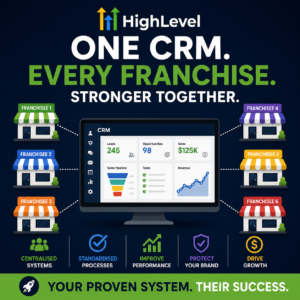
A branded CRM, marketing and sales system in a box that you can give to every franchisee.

You can build the core system centrally, systemise how it is customised for each franchisee, incorporate it into your franchisee onboarding and then continue improving it as the network grows.

I’ve recently been involved in doing exactly this for a UK childcare consultancy franchise.

And one of the biggest things I’ve learned from the project is that there is a significant difference between simply setting up a HighLevel CRM and designing a HighLevel system that could eventually be used by tens or even hundreds of franchisees.

Can HighLevel Be Used as a CRM for Franchises?

Yes.

HighLevel’s Agency structure makes it possible to operate multiple individual sub-accounts from one central Agency account.

For a franchise operation, that potentially allows the franchisor to create the central framework while individual franchisees or locations operate within their own HighLevel sub-accounts.

A franchisee can therefore have their own contacts, opportunities, calendars and day-to-day CRM while following a marketing and sales system designed by the franchisor.

HighLevel snapshots are particularly important here.

A snapshot can package many elements of a HighLevel setup so that they can be deployed into additional sub-accounts. HighLevel itself describes snapshots as a way to standardise proven setups and maintain consistency across multiple accounts and locations.

That is exactly what we want in a franchise.

You don’t want to reinvent your CRM and marketing system every time franchisee number 27 joins.

You want to have already done the hard work.

Don’t Just Give Your Franchisees a CRM

I think this distinction is fundamental.

A CRM by itself isn’t necessarily much of a franchise benefit.

Imagine telling a new franchisee:

“Here’s your CRM login. Good luck.”

They still have to decide how to configure it.

  • What stages should their sales pipeline contain?
  • What happens when somebody completes an enquiry form?
  • Which emails should be sent?
  • When should a salesperson follow up?
  • How should leads be nurtured?
  • What should happen when an appointment is booked?
  • How do they request reviews?
  • Which landing pages should they build?
  • Which forms should they use?
  • How do they know whether their marketing is working?

For a typical small business owner, that’s a lot to work out.

And most franchisees haven’t bought a franchise because they want to become CRM and marketing automation experts.

They have bought into a franchise because they want a proven system.

So why shouldn’t the marketing and sales system be part of that proven system?

That’s the opportunity I see with HighLevel.

Give Every Franchisee a Marketing and Sales System in a Box

Instead of giving franchisees a blank CRM, imagine giving every new franchisee a system that already contains the framework they need.

Depending on the franchise, that could include:

  • CRM and contact management
  • Standard sales pipelines
  • Automated lead follow-up
  • Email campaigns and templates
  • SMS communications
  • Appointment calendars
  • Service Appointments
  • Rentals
  • Events & Ticketing
  • Invoicing
  • Forms and surveys
  • Landing pages and funnels
  • Lead magnets
  • Review generation
  • Missed-call text back
  • Social media tools
  • Lead nurturing
  • Reporting
  • AI functionality
  • Websites or campaign pages
  • Standard workflows and automations

Not every franchise needs every HighLevel feature.

That’s not the point.

The important thing is that the franchisor determines what the proven marketing and sales system should contain.

That system can then become part of the franchise offering.

Don’t simply give your franchisees access to software.
Give them your proven marketing and sales system built inside the software.

NEW FOR 2026: HighLevel Industries Could Transform Franchise Operations

Until recently, one of the biggest attractions of HighLevel for franchisors was the ability to give every franchisee a standard CRM, marketing and sales system.

But the introduction of HighLevel Industries, announced at the October 2026 LevelUp event in Dallas, takes this idea a stage further.

HighLevel is developing industry-specific operational tools alongside its established CRM and marketing features. For a franchise network, that could mean providing franchisees with more of the software they need to deliver the service, not just win customers.

Imagine giving every franchisee not just your marketing system, but a standardised system for running their day-to-day operations too.

Let’s look at three examples of types of franchise that could benefit.

1. Field Services: Imagine a Cleaning Franchise

Suppose you operate a cleaning franchise with 50 franchisees around the UK. Each franchisee has their own territory, customers and cleaning teams.

They may currently need separate systems for marketing, quoting, scheduling cleaners, managing jobs and collecting payments. HighLevel’s new Field Services functionality is designed to bring more of those activities together.

For example, each cleaning franchisee could potentially use HighLevel to:

  • Capture cleaning enquiries. Record requests for domestic, commercial, end-of-tenancy or specialist cleaning in the CRM.
  • Prepare estimates. Quote for one-off cleaning jobs and ongoing cleaning contracts.
  • Manage jobs. Keep customer addresses, property details, agreed work, job notes and status updates together.
  • Schedule cleaning teams. Allocate jobs to available cleaners and manage appointments.
  • Plan routes. Reduce unnecessary travel between customers using route-planning capabilities.
  • Use standard checklists. Help cleaners follow the franchise’s established procedures and quality standards.
  • Record time and progress. Track work carried out and update the job status.
  • Communicate with customers. Send booking confirmations, reminders and relevant job notifications.
  • Invoice and collect payment. Connect the completed work to the billing process.
  • Generate reviews and repeat business. Trigger follow-up communications and review requests after a cleaning visit.

Now consider this from the franchisor’s perspective.

You could develop standard services, processes, checklists and customer communications centrally, then use them as the foundation for each new franchisee’s system.

Instead of asking every franchisee to choose and configure several different software applications, you could provide a business system designed around how your cleaning franchise operates.

And because HighLevel also includes CRM and marketing automation, the customer relationship could be managed from the initial enquiry through to job completion, payment, reviews and repeat bookings.

That’s much more than simply giving every franchisee a CRM.

2. Restaurants and Takeaways: A Franchise-Wide Hospitality System

The next example is a restaurant or takeaway franchise operating across several locations.

Each location needs to attract customers, manage orders, encourage repeat visits and maintain the brand’s standards.

HighLevel’s emerging restaurant-specific tools are intended to support capabilities such as:

  • Digital menus, including options and modifiers
  • Online ordering for collection and delivery
  • Table reservations
  • Restaurant floor plans and table management
  • QR-code ordering
  • Customer communications
  • Marketing campaigns and loyalty activity

Imagine combining those tools with the CRM and marketing automation already available in HighLevel.

A takeaway franchise could capture customer details from online orders, promote seasonal offers and encourage customers to order again.

A restaurant franchise could link reservations to reminders, feedback requests and loyalty campaigns.

And the franchisor could create standard marketing assets and customer communication processes for the wider network.

Again, the attraction is the opportunity to give each location a more complete business system rather than leaving it to assemble unrelated software tools.

Important: Restaurant-specific capabilities are emerging. Confirm the release status, payments, ordering, delivery and point-of-sale requirements before replacing established hospitality software.

3. Consultants and Coaches: Delivering the Service, Not Just Selling It

The third industry is Business Coaching, which is particularly relevant to consultancy and coaching franchises.

Our childcare consultancy franchise project already demonstrates the benefit of giving each consultant a standard marketing and sales system. But imagine extending that system into how the consultancy service itself is delivered.

The coaching-focused direction of HighLevel could bring together activities such as:

  • Capturing enquiries and booking discovery calls
  • Selling coaching or consultancy programmes
  • Scheduling client sessions
  • Managing programme delivery and client follow-up
  • Providing online courses and training materials
  • Hosting branded client communities
  • Tracking client progress
  • Supporting sessions with recordings and AI-generated summaries, where available

The franchisor could supply the programme structure, training content, supporting resources and proven client journey.

Each consultant could then concentrate on delivering the service while working within a consistent business framework.

The franchisor develops the proven system. The franchisee uses that system to operate the business.

Some of these tools already exist in HighLevel, while the new industry-specific experience is being developed. Check the availability and precise scope of the coaching package before treating it as a complete operational solution.

And More Industries Are Planned for 2027

HighLevel has outlined plans to expand Industries into many more sectors during 2027, with a further 27 industries discussed as part of its roadmap.

That could eventually create opportunities for franchise networks in many other markets that currently depend on separate specialist business-management software.

Of course, a roadmap is not a guarantee of release dates or final functionality. A franchisor should assess each industry package as it becomes available.

But the direction is significant. HighLevel is evolving from a CRM and marketing automation platform into a system that could support more of the operational processes required to run a business.

For franchises, where repeatable systems and consistent processes are fundamental, that’s particularly interesting.

Don’t just give your franchisees a CRM. Give them a proven business system.

A Real Example: Building HighLevel for a Childcare Consultancy Franchise

We’ve recently been working with a childcare consultancy franchise that wanted to provide its network of consultants with exactly this type of system.

Before the project, the individual consultants didn’t have a standard CRM and marketing platform.

The franchisor could see two important reasons for changing that.

The first was operational.

They wanted consultants to have a proper system for managing their marketing, enquiries and sales opportunities.

But there was another reason that I think is particularly interesting.

Franchisee recruitment.

Franchising itself is a competitive marketplace. A prospective franchisee may compare several different opportunities before deciding which franchise to join.

The franchisor recognised that being able to say:

“When you join us, you receive our complete branded CRM, marketing and sales system.”

could become another point of differentiation.

The technology therefore wasn’t simply an internal administrative tool. It became part of the franchise proposition itself.

What Did We Actually Build?

The client had already heard of HighLevel and believed it could provide the underlying technology.

Our job was to help turn HighLevel into their system.

We were involved in the strategic planning, HighLevel architecture and coordination of the master build.

The franchisor brought something equally important to the project: their own intellectual property and expertise.

They supplied the specialist copy for the emails, lead magnets, landing pages, surveys and other marketing materials.

That distinction is important.

HighLevel provides the technology.

We provide the HighLevel, CRM and marketing automation experience.

The franchisor provides the specialist knowledge, processes, content and understanding of its marketplace.

Combining those elements allowed us to build something specifically around how their consultants operate.

The resulting system includes CRM, sales pipelines, workflows, automated emails, forms, surveys, lead magnets, landing pages, calendars and other marketing functionality.

And crucially, it is branded to the franchisor rather than presented to consultants as an unrelated piece of third-party software.

Considering HighLevel for Your Franchise?

If you’re thinking about giving your franchisees a standard CRM, marketing and sales system, let’s discuss what you’re trying to achieve.

Book a Discovery Call with Julian

Build the Master System Once, Then Systemise the Rollout

The objective was never to manually build another CRM from scratch every time a new consultant joined.

We created a master system that could be replicated and then systematically customised for an individual consultant.

This is where HighLevel’s sub-account and snapshot architecture becomes particularly useful.

The master setup provides the framework.

When another consultant joins, the onboarding process becomes one of deploying and configuring an established system rather than inventing another one.

There will still be franchisee-specific information to configure.

But the fundamental marketing and sales architecture has already been decided.

HighLevel has continued developing this functionality too. In August 2026 it introduced the ability to load a snapshot into multiple selected sub-accounts from a central process.

For a growing franchise network, functionality like this makes standardisation across multiple franchisee accounts increasingly practical.

The principle is simple: invest in building the system properly once. Then systemise its deployment.

A Simple Example: The Franchise Sales Pipeline

One of the simplest examples from our childcare consultancy project is the sales pipeline.

Without a structured system, an individual consultant might manage prospects using a spreadsheet, notebook, email inbox or simply their memory.

That may just about work when there are ten opportunities.

It becomes considerably more difficult when there are 100.

Or 500.

  • Who needs following up?
  • Who requested more information?
  • Who has an appointment booked?
  • Who said to call back in three months?
  • Which prospects have gone quiet?
  • Which opportunities are closest to becoming clients?

A properly designed pipeline gives the consultant a structured process for managing those opportunities.

Automation can then support that process.

The objective isn’t to replace the consultant.

It’s to make it much harder for good opportunities to slip between the cracks.

And instead of every franchisee inventing their own sales process, the franchisor provides the process they believe gives their franchisees the best chance of success.

The Franchisee Gets a Working CRM From Day One

Think about this from the perspective of somebody who has just bought a franchise.

They probably have enough to learn already.

They need to understand the product or service. They need to learn the franchisor’s operating procedures. They may need to find premises, recruit staff or develop a local territory. They need to learn how to sell and they need to start marketing.

The last thing many of them need is:

“Now choose a CRM and spend the next three months figuring out how to configure it.”

With the model we’ve been developing, the franchisee instead starts with a working CRM and marketing system from day one.

The pipelines are there. The workflows are there. The forms are there. The marketing assets are there. The follow-up processes are there.

The system has been designed around the business they have just bought into.

That can be a substantial franchisee benefit.

Make CRM Training Part of Franchisee Training

There is another lesson from our childcare consultancy project that I think is particularly important.

Don’t make the CRM a separate technology project.

Make it part of how you train franchisees to run the business.

We’ve trained someone within the franchisor’s organisation to become what I call the CRM Champion.

The CRM Champion understands the system, owns it internally and can onboard new consultants.

Training on the marketing and CRM system is then incorporated into the franchise’s existing onboarding and training programme.

So instead of saying:

“Tuesday afternoon is your HighLevel training.”

the training can be contextual.

  • This is how we deal with a new enquiry.
  • This is how you move an opportunity through the pipeline.
  • This is how you book an appointment.
  • This is how you follow up.
  • This is how you nurture somebody who isn’t ready yet.

In other words, the franchisee isn’t really learning HighLevel.

They’re learning how to operate the franchise’s marketing and sales system.

I think that’s a much better way to approach it.

Central Control or Franchisee Freedom?

This is one of the strategic decisions that needs to be made when designing HighLevel for a franchise.

How much control should the franchisor retain?

There isn’t necessarily one answer for every franchise.

In our childcare consultancy project, the consultants aren’t particularly technically minded.

The system is therefore heavily controlled centrally.

That’s deliberate.

We don’t want every consultant redesigning pipelines, changing important workflows or modifying automation that has been developed as part of the proven franchise system.

The objective is consistency.

Another franchise might take a different approach.

It could provide a standard core system while allowing franchisees greater freedom over local campaigns, calendars, pages or other elements.

HighLevel provides agency-level and sub-account permissions that can help determine what different users can access.

But the important thing is to make these decisions before building the system.

Technology should support the franchise model.

The technology shouldn’t determine it.

HighLevel for Multi-Location Franchises

The same principles can apply where the franchise structure is more complicated than one franchisee equals one location.

One franchisee might own several territories.

Another might operate multiple physical locations.

A larger franchise group could contain company-owned locations alongside independently owned franchise locations.

The precise HighLevel architecture needs to reflect the commercial and operational structure of the franchise.

But the underlying principle remains the same.

You want appropriate separation of local contacts, opportunities and operations while maintaining as much consistency as possible across the wider network.

This is another reason why architecture becomes increasingly important as the franchise grows.

What Happens When You Improve the System?

This is where the model gets particularly interesting.

Suppose you have 30 franchisees.

You discover that a new follow-up process generates more appointments.

Or you create a better email sequence.

Or a new lead magnet performs particularly well.

Or you develop an AI process that saves franchisees several hours each week.

That learning may have originated with one part of the network.

But it can inform improvements to the system used by the wider franchise.

This is one of the major differences between a franchise network operating on a common technology platform and 30 independent businesses all using different systems.

The collective learning can become part of the franchise’s intellectual property.

There is an important technical caveat.

Updating centrally deployed HighLevel assets needs to be managed carefully, particularly if franchisees have been allowed to make local modifications.

That is another reason to decide what is centrally controlled and what franchisees are free to customise before rolling the system out widely.

AI Creates Another Opportunity

I wouldn’t recommend adding AI simply because everybody is talking about AI.

Start with the business process.

But HighLevel’s expanding AI functionality creates another interesting opportunity for franchise networks.

For example, a franchisor could potentially develop an AI agent around a proven process and then deploy that configuration across appropriate franchisee accounts rather than expecting every franchisee to work out how to build their own AI solution.

HighLevel now supports certain Agent Studio and Managed Agent configurations within snapshots.

Again, the value isn’t simply having AI.

The value is developing something centrally that can help franchisees perform a particular process more consistently or efficiently.

A HighLevel Franchise System Is More Like Building Software Than Setting Up a CRM

This is probably the biggest lesson I’ve personally taken from our first major franchise implementation.

It took longer than we anticipated.

In hindsight, that’s understandable.

We weren’t simply setting up somebody’s CRM.

We were creating a system that needed to be repeatable.

Every workflow needed to be considered in terms of the next consultant. Every field, pipeline and automation had to make sense as part of the wider system. The onboarding needed to be repeatable. Customisation needed to be systemised. Training needed to be considered. Permissions and control needed to be considered.

Building a really good HighLevel franchise system is more like building software than setting up a CRM.

That’s something I would encourage any franchisor considering this approach to factor into the project.

There can be considerable work involved upfront.

But you’re not doing that work simply for franchisee number one.

You’re creating an asset that could ultimately support franchisee number 10, 50 or 100.

Having now been through that process ourselves, we also have a much better understanding of what needs to be considered at the beginning of the next franchise project.

Your Marketing and Sales System Becomes a Franchise Asset

What makes a franchise valuable?

It isn’t simply the logo.

A franchisee is buying into a combination of brand, knowledge, processes, training, support and proven ways of doing things.

A well-designed marketing and sales system can become part of that infrastructure.

The franchisor has invested the time and money required to work out:

  • How leads should be captured
  • How enquiries should be followed up
  • What the sales process should look like
  • What communications should be sent
  • How prospects should be nurtured
  • Which marketing assets should be used
  • How appointments should be managed
  • How results should be tracked

The individual franchisee doesn’t have to solve all those problems independently.

This is where I think the question changes.

Instead of asking:

“Which CRM should we tell our franchisees to buy?”

ask:

“What marketing and sales system should we give our franchisees to help them succeed?”

Those are two very different questions.

Your HighLevel System Can Help You Attract Franchisees Too

There’s another potential return on the investment.

The system can help your existing franchisees.

But it can also strengthen your proposition when recruiting new franchisees.

Imagine two similar franchise opportunities.

One says:

“We’ll train you how to run the business and give you our operations manual.”

The other says:

“We’ll train you how to run the business and give you our complete branded marketing and sales platform. Your CRM, sales pipeline, lead follow-up, marketing campaigns, landing pages, appointment system and automation are already built for you.”

Which sounds like the more complete business opportunity?

Obviously, technology alone won’t make a successful franchise.

But in a competitive franchise recruitment market, it can be another tangible reason for somebody to choose your proposition.

This was one of the motivations behind the childcare consultancy system we’ve been building.

Should HighLevel Be Included in the Franchise Fee?

That’s a commercial decision for the franchisor.

In our childcare consultancy example, access to the CRM and marketing system is included within the franchisee fee.

I like the logic behind this.

The CRM isn’t positioned as an optional piece of third-party software.

It’s part of the way the franchise operates.

Depending on the business model, another franchisor might choose to itemise technology separately.

The important point is that HighLevel’s agency architecture gives the franchisor options in how the technology is packaged and delivered.

Planning a HighLevel Franchise System?

A serious franchise implementation can involve much more than creating a few workflows. We can help with strategy, system architecture and implementation.

Book a Discovery Call with Julian

Why Use HighLevel for a Franchise?

There are plenty of CRMs available.

The reason I find HighLevel particularly interesting for the franchise model is the breadth of functionality contained within one platform.

CRM is only one part of it.

HighLevel can provide pipelines, forms, surveys, calendars, workflows, email, SMS, websites, funnels, reputation management, social media tools, courses, communities, AI functionality and considerably more.

A franchise doesn’t necessarily need all of those.

But having so much functionality available within the underlying platform gives the franchisor considerable scope to develop a system around the specific needs of its franchisees.

And the system can evolve.

You might initially launch with CRM, pipeline and basic marketing automation.

Later you might add AI, a customer portal, additional lead-generation funnels or new nurturing campaigns.

You don’t necessarily need to replace the underlying platform every time the franchise’s requirements become more sophisticated.

HighLevel’s former Agency Pro subscription was renamed the Founder Plan in October 2026. It provides an agency-level framework for managing multiple sub-accounts, alongside access to additional advanced functionality, including emerging Industries capabilities. For a franchisor managing dozens or even hundreds of franchisees, this is an interesting foundation on which to build a standardised business system. For an overview of the agency tiers, see my HighLevel Starter, Unlimited and Founder Plan comparison.

I’ve written separately about HighLevel co-founder Shaun Clark’s statement regarding the scale HighLevel has now reached and its position behind Salesforce in the CRM market.

Read: HighLevel Is Now the World’s Second Largest CRM Behind Salesforce, According to Shaun Clark

For me, the important point isn’t simply the headline ranking.

It’s that we’re no longer talking about a small CRM platform with limited scope.

With HighLevel we’re talking about a substantial platform on which a franchisor can potentially build something much more specialised.

What About Other Software Used by the Franchise?

Historically, HighLevel has been strongest as a CRM and marketing automation platform, with specialist operational software handling functions such as field-service scheduling, job management and restaurant ordering.

The introduction of HighLevel Industries is beginning to change that.

For example, its new Field Services functionality is designed to handle jobs, estimates, scheduling, dispatch, route optimisation and invoicing. Its restaurant-specific tools are intended to support ordering, menus and reservations.

That means some franchise networks may eventually be able to consolidate more of their operational software into HighLevel.

However, I wouldn’t recommend abandoning a proven specialist system simply because a new HighLevel feature has been announced.

An accountancy franchise, for example, may still need dedicated accounting and compliance software. Other sectors have their own specialist or regulatory requirements.

First, establish whether the new HighLevel functionality is available, mature enough and genuinely suitable for the franchise’s operational requirements.

Where specialist software remains the better choice, HighLevel can still provide the CRM and marketing automation layer, with APIs, webhooks and integrations connecting the systems where appropriate.

This is another reason why strategic planning before implementation matters.

HighLevel for a New Franchise vs an Existing Franchise Network

Building a New Franchise

If you’re currently developing a franchise model, you have an opportunity to design the CRM and marketing system into the franchise from the beginning.

You can decide:

  • What every franchisee receives
  • What the standard sales process is
  • Which marketing assets are included
  • How onboarding works
  • What the franchisor controls
  • What the franchisee controls
  • How technology is incorporated into training
  • How future improvements are rolled out

The system becomes part of the franchise architecture.

Introducing HighLevel to an Existing Franchise

An established network presents a different challenge.

If you already have 20, 50 or 100 franchisees, they may already be using different systems.

Some may have spreadsheets. Some may have their own CRM. Some may have developed their own processes.

Now you’re dealing with migration, adoption, training and change management as well as technology.

That doesn’t mean it can’t be done.

It simply means the implementation needs to be approached differently.

Could Your Business Become a Digital Franchise?

There’s also an interesting development beyond conventional franchising.

I’ve written separately about what I call the Digital Franchise.

The idea is that a successful business can increasingly package not only its knowledge and processes but also much of the technology required to operate the business.

HighLevel can form part of that infrastructure.

A proven business might therefore package its branding, methodology, training, CRM, workflows, pipelines, marketing campaigns, AI and operating processes into a repeatable system.

Read: The Rise of the Digital Franchise: How HighLevel Agencies Are Packaging AI-Powered Business Systems

I’ve also written a follow-up specifically looking at whether an existing business is suitable for this model:

Read: Is Your Business Suitable for Digital Franchising With HighLevel?

This starts to blur some of the traditional boundaries between software, licensing, consulting and franchising.

What If I Want to Build and Sell My Own HighLevel System?

You don’t necessarily need to operate a traditional franchise to use some of these principles.

Consultants, agencies and entrepreneurs can use HighLevel’s white-label and agency capabilities to create systems for particular niches and sell access to them on a recurring basis.

This is one of the models we explore through the MarketerM8 HighLevel SaaS Entrepreneur Programme.

Read: HighLevel SaaS Entrepreneur Programme

There is a natural crossover.

One person may want to create a SaaS business selling a marketing system to independent businesses within a niche.

Another may already own a franchise and want to provide essentially the same type of technology as part of their franchise package.

The underlying HighLevel architecture can support both models.

Is the HighLevel SaaS Entrepreneur Programme Free for Franchisors?

The core MarketerM8 HighLevel SaaS Entrepreneur Programme is available without a programme fee to qualifying participants who open their HighLevel Agency account through MarketerM8.

For somebody who wants some guidance getting started, understanding the Agency structure and learning how the model works, that may be all the support they require.

A serious franchise implementation can be very different.

If you need help strategically designing your franchise system, architecting HighLevel, creating the master setup and snapshot, coordinating implementation, migrating existing systems, developing integrations or building bespoke functionality, this can become a substantial project.

We provide this type of advanced strategy and implementation as a paid consultancy service.

We’ll discuss what you’re trying to achieve first and make it clear where the free SaaS Entrepreneur Programme ends and any paid consultancy or implementation work would begin.

Considering Using HighLevel for Your Franchise?

If you’re building a new franchise, already operate a franchise network, or are considering packaging a successful business model into a franchise, HighLevel is worth investigating.

But I wouldn’t start by asking:

“What can HighLevel do?”

I’d start with:

“If we could give every franchisee our ideal marketing and sales system from day one, what would that system look like?”

Then we can determine how HighLevel can be used to build it.

We’ve now been through this process with a consultancy franchise and have first-hand experience of both the opportunities and the amount of work involved in doing it properly.

Considering HighLevel for Your Franchise?

If you’d like to discuss your franchise model and what you’re trying to achieve, book a Discovery Call with me.

Book a Discovery Call with Julian

Frequently Asked Questions About HighLevel for Franchises

Can HighLevel be used as a CRM for franchises?

Yes. HighLevel’s Agency and sub-account structure can be used to provide individual franchisees or locations with their own CRM environment while the franchisor maintains a central framework. This makes it particularly interesting for franchise networks wanting greater consistency across their marketing and sales processes.

Can every franchisee have their own HighLevel account?

A franchisor can create separate HighLevel sub-accounts for individual franchisees or locations. These can contain their own contacts, opportunities, calendars and other appropriate data while operating within the franchisor’s wider Agency structure.

Can I copy the same HighLevel system to every franchisee?

Yes. HighLevel snapshots can package many elements of a sub-account configuration and deploy them into additional sub-accounts. This makes it possible to create a master franchise system rather than rebuilding the CRM for every new franchisee.

Can I update multiple franchisee HighLevel accounts centrally?

HighLevel has functionality for loading snapshots across multiple selected sub-accounts. However, ongoing updates need to be carefully planned, particularly where individual franchisees are allowed to modify centrally supplied assets.

Can a franchisor control HighLevel centrally?

HighLevel provides agency-level controls and user permissions that can support a centrally managed model. The precise structure should be designed around what the franchisor wants franchisees to access and what should remain centrally controlled.

Can HighLevel be branded as our franchise’s own CRM?

HighLevel provides white-label capabilities that can allow an Agency to use its own branding and branded domain. This can help position the CRM and marketing platform as part of the franchisor’s wider system rather than an unrelated software product.

Can each franchisee have their own contacts and sales pipeline?

Yes. Individual sub-accounts can maintain their own contacts and opportunities. A franchisor can therefore provide the standard sales process while individual franchisees manage their own prospects through it.

Can HighLevel route leads to different franchisees or territories?

Potentially. HighLevel workflows and related functionality can automate lead assignment and routing. The appropriate architecture will depend on factors such as geographical territories, services, locations and the franchise’s own rules for allocating leads.

Can HighLevel support multi-location franchises?

Yes. HighLevel’s sub-account architecture can support businesses operating multiple locations. However, the appropriate structure depends on whether locations are independently owned, owned by one franchisee, centrally owned or operate under another arrangement.

Can each franchisee have their own calendar?

Yes. HighLevel calendars can be configured around individual users, teams and locations depending on the requirements of the franchise.

Can HighLevel be used for franchise review generation?

Yes. HighLevel includes reputation-management functionality that can form part of a standard customer follow-up and review-generation process across the franchise.

Can AI be deployed across franchisee accounts?

Potentially. HighLevel’s AI functionality continues to develop, and certain AI configurations can now be included within snapshots. This creates opportunities for franchisors to develop AI-assisted processes centrally and deploy them across appropriate franchisee accounts.

Can HighLevel integrate with our existing franchise software?

Potentially. HighLevel supports integrations, APIs and webhooks that can allow information to pass between systems. Whether a particular integration is practical needs to be assessed individually.

Should franchisees be allowed to change the standard HighLevel system?

That depends on the franchise. In our childcare consultancy implementation, central control is important because the individual consultants aren’t expected to become HighLevel technicians. Another franchise may deliberately allow greater local flexibility. This should be decided before the system is rolled out.

What happens when a franchisee leaves?

This should be considered before implementation and reflected in the franchise’s agreements, data policies and operating procedures. Account access, data, telephone numbers, domains and any migration requirements should ideally be determined before the first franchisee leaves rather than afterwards.

Can HighLevel be included in our franchise fee?

Potentially, yes. How the technology is packaged is a commercial decision for the franchisor. In the childcare consultancy project we’ve been working on, the branded CRM and marketing system is included within the franchisee offering.

How much does HighLevel cost for a franchise network?

The cost depends on the HighLevel agency subscription, communications usage, AI features, additional services and the architecture required. The former Agency Pro plan is now called the Founder Plan. Franchisors should check current agency pricing and budget for implementation, franchisee onboarding, support and ongoing usage rather than looking only at the headline platform subscription.

Is HighLevel suitable for 50 or 100+ franchisees?

HighLevel’s Agency and sub-account architecture is designed to manage multiple accounts. However, the larger the proposed network, the more important architecture, governance, onboarding, training, support and update management become. Scalability isn’t simply a question of whether the software can create another sub-account.

Is the MarketerM8 HighLevel SaaS Entrepreneur Programme free?

The core programme is available without a programme fee to qualifying participants who establish their HighLevel Agency account through MarketerM8. Bespoke consultancy, advanced strategy, integrations and implementation are separate professional services where required.

Can MarketerM8 help us build our HighLevel franchise system?

Yes. We can help with the strategic planning, HighLevel architecture and implementation of more complex franchise systems. We’ve recently been through this process with a childcare consultancy franchise, giving us first-hand experience of both the opportunities and the practical challenges involved.

How do I get started?

Start by defining what you would ideally like every franchisee to receive as part of your marketing and sales system.

Then book a Discovery Call with Julian Mills to discuss whether HighLevel is suitable and how the system could be structured.

Julian Mills HighLevel Consultant and Marketing Automation Strategist

About the Author

Julian Mills

HighLevel Consultant & Marketing Automation Strategist

Julian Mills helps business owners automate lead generation, sales follow-up, customer communication and business processes using HighLevel and MarketerM8. Since 2009 he has helped businesses implement CRM, marketing automation and AI-powered systems that save time, improve customer experience and generate more sales.

About Julian
Book a Discovery Call
Join a Free HighLevel Workshop
Learn About HighLevel with MarketerM8

HighLevel for Cleaning Companies: CRM, Marketing, Automation, Field Service and AI

Discover how cleaning companies use HighLevel for CRM, marketing, automation, AI and sales, with FieldTask for managing jobs in the field

Discover how cleaning companies use HighLevel for CRM, marketing, automation, AI and sales, with FieldTask for managing jobs in the fieldIf you run a cleaning company, you probably didn’t start the business because you wanted to spend your evenings chasing enquiries, updating spreadsheets, sending appointment reminders and trying to remember which quotations need following up.

But as a cleaning business grows, marketing and administration can quickly become almost as complicated as doing the cleaning itself.

You need to generate enquiries, respond quickly, keep track of prospects, follow up quotations, communicate with customers, ask for reviews and encourage previous customers to use you again.

Then there is the operational side of the business. Jobs need scheduling, cleaners need organising and customers need to know when somebody is arriving.

This is where HighLevel can be particularly useful for cleaning companies.

HighLevel can provide the marketing, CRM, sales and communications engine for the business. If you also need field service management, an application such as FieldTask can extend HighLevel into the operational side of running your cleaning company.

I’ve worked with cleaning businesses at very different stages of development, from a startup through to established cleaning companies using HighLevel as part of much more sophisticated business systems.

So rather than looking at what HighLevel could theoretically do for a cleaning company, let’s look at how it can actually be used.

What Can a Cleaning Company Use HighLevel For?

HighLevel brings together many of the systems a cleaning business might otherwise have to purchase separately.

For example, a cleaning company can use HighLevel for:

  • Websites and landing pages
  • Enquiry forms
  • CRM and contact management
  • Sales pipelines
  • Quote follow-up
  • Email marketing
  • SMS
  • WhatsApp
  • Appointment booking
  • Automated reminders
  • Facebook and Google advertising
  • Review requests
  • Customer reactivation campaigns
  • Workflows and marketing automation
  • Recruitment campaigns
  • Voice AI and other AI tools

This means an enquiry can come into the business and automatically become a contact in the CRM.

That prospect can enter a sales pipeline, receive appropriate follow-up and move through the sales process.

Once they become a customer, HighLevel can continue to manage communications, reminders, review requests and future marketing.

Could HighLevel Work for Your Cleaning Company?

If you’re considering HighLevel, let’s look at how your enquiries, sales, customer communication and field service currently work.

Book a Discovery Call with Julian

Is HighLevel Cleaning Business Management Software?

Not really.

HighLevel is extremely strong at marketing, sales, CRM, communications and automation.

It isn’t primarily designed as field service management software.

If you have cleaners or technicians travelling to customers, you may also need functionality such as job scheduling, dispatching, work orders, staff management, timesheets and tracking what happens in the field.

This is where FieldTask becomes interesting.

HighLevel + FieldTask for Cleaning Companies

FieldTask is a field service management application designed specifically to work with HighLevel.

Rather than having one system for your marketing and another completely disconnected system for running jobs, FieldTask extends what you can do with HighLevel into field service management.

HighLevel can handle:

Marketing β†’ Enquiry β†’ CRM β†’ Sales Pipeline β†’ Follow-up β†’ Customer

FieldTask can then help with:

Job β†’ Scheduling β†’ Dispatch β†’ Field Staff β†’ Work Completed β†’ Invoice

FieldTask includes capabilities for managing jobs and work orders, scheduling and dispatching work, field teams, timesheets, invoicing and other aspects of service delivery.

More importantly, it has been designed to work with HighLevel.

Contacts, appointments, jobs, estimates, invoices and other information can remain connected between the marketing and operational sides of the business.

For a smaller cleaning company, sole trader or growing cleaning business, HighLevel + FieldTask can therefore provide a very interesting combination.

HighLevel attracts, converts and communicates with the customer.

FieldTask helps manage the work once somebody needs to go out and deliver the cleaning service.

A few years ago, this sort of joined-up CRM, marketing automation and field service technology was much more likely to be the preserve of larger businesses with substantial software and implementation budgets.

Today, a small cleaning company can start putting together remarkably sophisticated systems without needing enterprise-level budgets.

What If I Already Use ServiceM8 or Another Field Service System?

Keep using it if it works for you.

I’m not an advocate of replacing perfectly good software simply because something new has appeared.

In fact, I’ve worked with cleaning companies that were already using ServiceM8 when HighLevel was introduced.

The important question is what each piece of software needs to do.

If you’re already successfully using ServiceM8, Jobber or another field service management application, HighLevel can potentially become the marketing, CRM and communications layer around your existing system.

If you’re starting from scratch, or particularly want field service management designed to work closely with HighLevel, I would also look at FieldTask.

The right solution depends on the complexity of the business.

Example 1: Using HighLevel From the Startup Stage

One cleaning business I work with started using HighLevel right at the beginning of its journey.

The owner was already using field service software to help with service delivery, but he needed something else.

He needed to market the business.

We worked with him to build the company’s website inside HighLevel and put the marketing and sales infrastructure around the new business.

Leads come from several sources, including referrals, social media and Facebook advertising.

Social media has been particularly useful, with the owner creating videos featuring happy customers and sharing them through channels such as TikTok.

We’ve also used HighLevel’s Ad Manager for Facebook advertising.

When somebody makes an enquiry, the opportunity can be managed through a HighLevel sales pipeline, providing a structured process for following up potential customers.

This is a good example of why HighLevel and field service software solve different problems.

The field service system was already helping manage service delivery.

HighLevel was introduced to help market and grow the business.

From Finding Customers to Finding Staff

More recently, the challenge has changed.

The owner has become busy delivering cleaning jobs and simply doesn’t always have enough time to work on the marketing.

This is a problem I see in many owner-managed businesses.

Having marketing software doesn’t mean the marketing magically happens.

The business therefore upgraded to our MarketerM8 Professional plan, which includes an hour of hands-on HighLevel assistance each month with Atticus.

Interestingly, one of the latest projects hasn’t been about finding customers at all.

It has been about finding staff.

Atticus has been helping create a recruitment campaign and a dedicated recruitment pipeline within HighLevel.

Candidates can therefore be managed through a process in much the same way as sales opportunities.

It’s a useful reminder that CRM and automation aren’t only about customers.

As a cleaning business grows, recruitment can become just as important as lead generation.

Example 2: An Established Cleaning Company Moving From CRM to HighLevel and AI

Another cleaning company I’ve worked with is a well-established specialist cleaning business.

My relationship with the business goes back to around 2020.

The owner had previously purchased Infusionsoft twice but had failed to successfully implement it.

That wasn’t necessarily a software problem.

Buying a CRM doesn’t automatically give you a CRM strategy.

When I became involved, we approached things differently.

We looked strategically at the company’s business processes and customer journey, then implemented Infusionsoft around those processes and trained the staff to use it.

The system covered areas including lead capture, sales follow-up, customer nurture, reminders, reactivation, review generation, email marketing and pipeline management.

The important part wasn’t simply building automations.

It was helping the people within the business understand and use the system.

Moving From Infusionsoft to HighLevel

In 2023, I introduced the owner to HighLevel.

He subsequently took HighLevel on himself and became sufficiently involved with the platform that he established his own HighLevel agency.

There’s an interesting reason for that.

He also operates a coaching programme for other businesses within his sector and wants to be able to provide his coaching clients with a CRM alongside the coaching itself.

That’s quite a progression.

From twice purchasing Infusionsoft without successfully implementing it, he went on to embrace CRM and marketing automation to the point where he could incorporate HighLevel into his own offering.

More recently, I’ve been helping the business explore the next stage of HighLevel.

We’re now working on HighLevel Voice AI and using AI inside workflows to help manage and process data.

Example 3: HighLevel as Part of a More Sophisticated Cleaning Business

A third cleaning company I work with demonstrates another approach entirely.

The business was originally using Keap.

One of the initial requirements was to move to a modern marketing system that could handle areas such as email and WhatsApp marketing.

HighLevel became that platform.

As the cleaning company grew, however, its requirements became considerably more sophisticated.

The owner wanted the marketing system integrated into bespoke software developed for managing service delivery, data and reporting.

The result isn’t simply a HighLevel account connected to a field service application.

There is custom development involved.

HighLevel handles areas including marketing, CRM, sales pipelines, email, SMS, WhatsApp, follow-up and customer communications.

A specialist field service platform handles elements of service delivery.

And bespoke software acts as the central brain, coordinating and reporting information across the different systems.

HighLevel is therefore an important part of the overall technology stack without pretending to be the entire technology stack.

Voice AI is also part of the direction we’re now exploring.

This demonstrates what can happen as a cleaning company becomes more sophisticated.

You don’t necessarily throw HighLevel away as the business grows. Instead, it can become one component within a much larger integrated system.

Already Using Several Systems?

HighLevel does not necessarily have to replace them. We can look at how your CRM, marketing, field service and existing software could work together.

Book a 20-Minute Discovery Call

Using WhatsApp in a Cleaning Business

WhatsApp can be particularly useful for service businesses.

Customers are already familiar with it and it can provide a convenient way to communicate about appointments, quotations and ongoing work.

HighLevel can incorporate WhatsApp into automated workflows.

Depending on your setup and the appropriate WhatsApp permissions and templates, you could use workflows to help with:

  • Following up enquiries
  • Appointment communication
  • Quote follow-up
  • Customer updates
  • Reactivation campaigns
  • Asking customers for information
  • Sending booking information

WhatsApp doesn’t need to sit in isolation.

A response can trigger other actions within a HighLevel workflow, update CRM information or affect where somebody sits within a process.

Can a Cleaning Company Use HighLevel Voice AI?

This is one of the areas I’m currently exploring with cleaning businesses.

Think about the practical problem.

A potential customer calls a cleaning company at 11:30 in the morning.

Where is the business owner?

Quite possibly in somebody’s house, driving between jobs or actually cleaning.

Answering every call isn’t always practical.

HighLevel Voice AI opens up the possibility of an AI agent answering calls and dealing with appropriate initial enquiries.

Depending on how the system is configured, an AI agent could potentially collect information, answer common questions, help with booking and trigger subsequent workflows.

We’re already working with Voice AI within an established specialist cleaning business, and it is also part of the direction we’re exploring with another growing cleaning company.

I don’t believe AI should simply be introduced because “AI” is fashionable.

There needs to be a business problem worth solving.

For cleaning companies, answering the telephone when everybody is busy delivering the service is a very real problem.

Using HighLevel for Cleaning Company Sales Pipelines

One of the simplest but most valuable HighLevel features for a cleaning business can be the sales pipeline.

An enquiry isn’t the same thing as a customer.

Depending on the business, a simple pipeline might look something like:

New Enquiry β†’ Contacted β†’ Quote/Survey Required β†’ Quote Sent β†’ Follow-up β†’ Won/Lost

The exact stages should reflect how your business actually sells.

The important thing is visibility.

Instead of enquiries disappearing into email inboxes, WhatsApp conversations, notebooks and somebody’s memory, you have a central view of potential business.

Automations can then support the process.

For example, HighLevel could create follow-up tasks, send appropriate communications or trigger workflows when an opportunity reaches a particular stage.

I’ve used exactly this approach with cleaning businesses.

Facebook Advertising for Cleaning Companies

HighLevel also includes Ad Manager functionality for Meta and Google advertising.

We’ve used HighLevel Ad Manager for Facebook campaigns within the cleaning sector.

The interesting thing isn’t simply being able to launch an advert.

It’s what happens after somebody responds to it.

An advertising lead can enter the same CRM, sales pipeline and follow-up processes used for enquiries from other sources.

For a smaller cleaning company, having advertising and the CRM sitting much closer together can simplify the journey between generating a lead and actually following it up.

Reviews and Customer Reactivation

Cleaning companies have another valuable marketing asset.

Existing customers.

Once you’ve successfully cleaned somebody’s carpet, windows, office, property or upholstery, you have an established relationship.

HighLevel can help businesses create processes for requesting reviews and staying in touch with customers.

It can also be used for reactivation campaigns.

That could mean contacting appropriate previous customers when they may be ready to use the service again, rather than continually spending money acquiring completely new customers.

The exact frequency and messaging will depend on the cleaning service.

A commercial cleaning contract is obviously very different from an occasional carpet clean.

That’s why the automation should be built around the customer journey, rather than simply installing generic workflow templates.

Systemise Your Cleaning Business Before You Automate Everything

There’s a bigger lesson behind all of this.

HighLevel shouldn’t be used simply to automate a bad or undefined process.

First ask:

  • What should happen when somebody enquires?
  • Who follows up the quotation?
  • When should they follow up?
  • What happens when the customer says yes?
  • How do we communicate before the job?
  • What happens after the job?
  • When do we request a review?
  • When should we contact that customer again?

Once you’ve established the answers, HighLevel can help turn those processes into repeatable systems.

That reduces the business’s dependence on somebody remembering what needs to happen next.

It can also create something much more valuable.

A proven, repeatable way of marketing and selling your cleaning services.

Could HighLevel Help You Franchise Your Cleaning Business?

If your cleaning business reaches the point where you’ve developed a proven model, you may eventually consider opening additional locations or franchising it.

This is where the systems you’ve already built can become particularly valuable.

A franchisee doesn’t just need your brand and instructions on how to deliver the cleaning service.

They also need to know how to find and convert customers.

HighLevel gives you the potential to turn the marketing and sales processes you’ve developed into a system that can be provided to each franchisee.

That could include your:

  • Sales pipeline
  • Enquiry forms
  • Workflows and automations
  • Email and SMS templates
  • WhatsApp processes
  • Review campaigns
  • Reactivation campaigns
  • Websites and landing pages
  • Advertising processes
  • Reporting

In other words, instead of simply giving franchisees a marketing manual, you can potentially give them your proven marketing and sales system in a box.

Each franchisee can have their own HighLevel account while the core system is based on the processes you’ve already developed and tested in the original business.

If field service management is also part of the model, something such as FieldTask can provide the operational layer alongside HighLevel.

Interested in Using HighLevel for a Franchise Operation?

HighLevel’s agency structure makes it particularly interesting for this type of model because individual franchisees can operate within their own sub-accounts.

If you’re considering using HighLevel as the CRM and marketing platform behind a franchise operation, I’ve created the HighLevel SaaS Entrepreneur Programme to help people understand how to build and manage this type of HighLevel setup.

Find out more about the HighLevel SaaS Entrepreneur Programme here.

Which HighLevel Setup Is Right for a Cleaning Company?

There isn’t one answer.

The cleaning businesses I’ve worked with demonstrate that.

For a startup or smaller cleaning company, HighLevel could provide the website, CRM, marketing, pipeline and automation. Add FieldTask if you want closely integrated field service management.

For a cleaning company already using field service software, you don’t necessarily need to replace it. HighLevel can potentially sit alongside your existing system and handle the marketing and customer relationship side.

For a larger or more sophisticated operation, HighLevel can become part of a wider technology architecture involving specialist operational systems, APIs, webhooks and bespoke software.

And if you eventually want to replicate your successful cleaning-business model across multiple locations or franchisees, the systems you’ve built in HighLevel can potentially form part of that expansion.

The technology should fit the business. Not the other way around.

Want to Explore HighLevel for Your Cleaning Company?

We can look at how you currently generate enquiries, manage sales, communicate with customers and deliver the work, then decide where HighLevel, FieldTask, AI and your existing systems should fit.

Book a Discovery Call with Julian Mills

Frequently Asked Questions About HighLevel for Cleaning Companies

Is HighLevel good for cleaning companies?

It can be. HighLevel is particularly strong for cleaning companies that need CRM, lead management, sales pipelines, email, SMS, WhatsApp, marketing automation, websites, advertising, reviews and increasingly AI.

For managing cleaners and jobs in the field, you may want to combine HighLevel with a field service application such as FieldTask.

Can HighLevel manage cleaning jobs?

HighLevel isn’t primarily a field service management platform.

FieldTask can add field service functionality while integrating with HighLevel, allowing HighLevel to concentrate on marketing, sales, CRM and customer communications.

Does FieldTask integrate with HighLevel?

Yes. FieldTask has been specifically designed to work with HighLevel.

You can read more in my guide: FieldTask for HighLevel: What It Is, How It Works and How to Get It.

Can HighLevel replace ServiceM8 for a cleaning company?

That isn’t automatically what I’d recommend.

If you’re already successfully using ServiceM8 or another field service platform, you may be better off keeping it and integrating your systems where appropriate.

If you’re choosing a new field service platform and want something designed specifically around HighLevel, FieldTask is worth investigating.

Can cleaning companies use WhatsApp in HighLevel?

Yes. HighLevel supports WhatsApp and can incorporate WhatsApp messaging and responses into workflows.

This can be useful for enquiries, appointment communications, follow-up and marketing, subject to the relevant WhatsApp Business messaging rules and permissions.

Can HighLevel help a cleaning company get reviews?

Yes. Review requests can form part of automated customer workflows. For example, once a job has been completed, an appropriate workflow could ask the customer to leave a review.

Can HighLevel be used to recruit cleaners?

Yes. We’re already using HighLevel this way with a cleaning company.

A recruitment campaign and recruitment pipeline can capture applicants, manage follow-up and move prospective employees through a structured recruitment process.

Can HighLevel AI answer calls for a cleaning company?

HighLevel offers Voice AI, which can be configured to handle telephone conversations and trigger other actions.

We’re currently working with Voice AI within cleaning businesses, particularly around the challenge of dealing with incoming calls while owners and staff are busy delivering services.

Can I give each cleaning franchisee their own HighLevel CRM?

Yes. HighLevel’s agency model allows individual sub-accounts to be created.

This means a franchisor can potentially develop a proven marketing and sales system centrally and provide a version of that system to each franchisee.

If you’re interested in exploring this type of model, take a look at the HighLevel SaaS Entrepreneur Programme.

Want to Explore HighLevel for Your Cleaning Company?

The most important lesson from the cleaning businesses I’ve worked with is that there isn’t a standard HighLevel setup that every cleaning company should buy.

A startup may need a website, advertising and a sales pipeline.

An established business may need better CRM processes, staff training and AI.

A larger cleaning operation may need HighLevel integrated with specialist field service software and bespoke systems.

And a business with ambitions to expand geographically or franchise may eventually want to turn its proven marketing processes into a system that can be replicated elsewhere.

Your business may need something completely different.

If you’re running a cleaning company and considering HighLevel, or you’re already using HighLevel but aren’t getting enough from it, book a discovery call with me.

We can look at what you’re currently using, how you generate and manage enquiries, how you deliver the service and where HighLevel, FieldTask, AI or your existing systems could fit.

The objective isn’t to squeeze your cleaning company into HighLevel.

It’s to build the right system around the way your cleaning business actually works.

Book a 20-Minute Discovery Call

Julian Mills HighLevel Consultant and Marketing Automation Strategist

About the Author

Julian Mills

HighLevel Consultant & Marketing Automation Strategist

Julian Mills helps business owners automate lead generation, sales follow-up, customer communication and business processes using HighLevel and MarketerM8. Since 2009 he has helped businesses implement CRM, marketing automation and AI-powered systems that save time, improve customer experience and generate more sales.

About Julian
Book a Discovery Call
Join a Free HighLevel Workshop
Learn About HighLevel with MarketerM8

HighLevel for Carpet and Flooring Companies: Marketing, CRM, Sales, Payments and Field Service

Discover how carpet and flooring companies can use HighLevel and FieldTask for CRM, marketing, appointments, payments and field service.

Discover how carpet and flooring companies can use HighLevel and FieldTask for CRM, marketing, appointments, payments and field service.Running a carpet or flooring company involves much more than fitting floors.

You need to generate enquiries, answer calls, arrange measuring appointments, prepare quotations, follow them up, take deposits, schedule jobs, keep customers informed, collect final payments and generate reviews.

For a larger nationwide flooring company, building systems around all of that might once have meant investing in expensive CRM, marketing automation, call handling, payment and field service software.

For a smaller flooring company or sole trader, that kind of technology could easily have felt out of reach.

That is changing.

Today, a small independent flooring business can have access to marketing and CRM technology that only a few years ago would largely have been the preserve of businesses with substantial IT and marketing budgets.

One combination I think is particularly interesting is HighLevel plus FieldTask.

HighLevel can manage the marketing, enquiries, CRM, appointments, follow-up, sales, customer communication and payments.

FieldTask can then manage the operational side of sending people out into the field and completing the flooring job.

That gives you two specialist systems working together rather than trying to force one piece of software to do absolutely everything.

The Typical Customer Journey for a Flooring Company

Think about what happens when somebody decides they need new flooring.

They might find you on Google, see an advert on Facebook, receive a recommendation or already know your business.

Google, Facebook or Referral

↓

Website Enquiry or Phone Call

↓

Initial Conversation

↓

Home Measuring Appointment

↓

Quote

↓

Follow-Up

↓

Customer Accepts

↓

Deposit or Payment

↓

Job Scheduled

↓

Flooring Delivered and Fitter Assigned

↓

Installation

↓

Final Payment

↓

Review Request

↓

Future Marketing and Referrals

There are really two sides to this process.

The first is winning and managing the customer.

The second is delivering the job.

That is why I like the idea of using HighLevel and FieldTask together.

HighLevel manages the customer.

FieldTask manages the job.

HighLevel as the Marketing and CRM System for a Flooring Company

HighLevel is particularly strong at the front end of the customer journey.

Through MarketerM8, it can become the central marketing, sales and CRM platform for a carpet or flooring business.

Rather than having enquiries spread across email inboxes, spreadsheets, phones, Facebook messages and different apps, you can bring much more of the customer journey together around a central CRM record.

Generate Enquiries Through Your Website and Landing Pages

Your flooring website should do more than show photographs of previous installations.

It should generate enquiries.

You might create dedicated pages for services such as:

  • Carpet fitting
  • Luxury vinyl tile
  • Laminate flooring
  • Hardwood flooring
  • Commercial flooring
  • Vinyl flooring
  • Floor restoration
  • Home measuring and fitting

Someone searching for a particular flooring service can arrive on the relevant page, complete a form or make contact and have their enquiry added directly to HighLevel.

That means the sales process can start immediately.

Bring Flooring Leads Into One CRM

Not every flooring enquiry will come through your website.

A prospective customer might contact you through telephone, website forms, Facebook, Instagram, Google Ads, Facebook Lead Ads, WhatsApp or email.

HighLevel can bring much of this activity together around the customer’s contact record.

That is important because one of the biggest problems I see in small businesses is not necessarily generating too few leads.

It is failing to properly follow up the leads they already have.

I call this the leaky bucket problem.

I explain this in more detail in How HighLevel Fixes the Leaky Bucket That’s Costing Your Business Leads, Sales and Revenue.

What Happens When You Miss a Call?

Missed calls are particularly relevant for flooring businesses.

If you are measuring someone’s house, talking to a customer in the showroom, unloading flooring or actually fitting a floor, you may not be able to answer your phone.

Unfortunately, the person calling may simply move down the Google results and ring the next flooring company.

HighLevel can automatically respond to a missed call.

Customer Calls

↓

Nobody Answers

↓

HighLevel Automatically Sends an SMS

↓

Customer Replies

↓

Conversation Continues Inside Your CRM

You can go further too.

HighLevel can be used with AI voice technology to answer calls, gather information and potentially book appointments.

I have written more about this in Looking for a Small Business Phone System? Why HighLevel Could Replace Your Office Phones and CRM.

Book and Manage Home Measuring Appointments

For many carpet and flooring companies, the measuring appointment is one of the most important parts of the sales process.

The customer has made an enquiry. The next objective is to get somebody into the property, understand what they want, measure the rooms and gather the information required to prepare a quotation.

HighLevel can help manage that process.

The customer can be booked into a calendar for a home measuring appointment, with that appointment attached to their contact record.

You can then automate much of the administration around it.

New Flooring Enquiry

↓

Measuring Appointment Booked

↓

Confirmation Sent

↓

Automatic Reminder

↓

Estimator Visits the Property

↓

Measurements and Notes Recorded

↓

Quote Prepared

↓

Opportunity Moves to Quote Sent

You could have different calendars for different estimators, salespeople, showrooms or geographical areas.

The person carrying out the appointment can also access the customer’s information through the HighLevel mobile app while away from the office.

At this stage, you are still trying to win the business, so it makes sense for the measuring appointment to remain part of the HighLevel sales process.

Once the customer accepts the quote and places the order, the operational side of the job can begin.

Keep Customers Updated by Text and WhatsApp

HighLevel can also help you keep the customer informed throughout the process using SMS and WhatsApp.

For example, you could automatically send measuring appointment confirmations, appointment reminders, quote follow-ups, deposit confirmations, fitting date confirmations, job updates, completion messages and review requests.

Customers can reply too, with the conversation kept against their contact record.

For a small flooring business, this can make the whole customer experience feel considerably more organised and professional without somebody in the office having to manually send every message.

You can read more about using WhatsApp with HighLevel in HighLevel: The Ultimate WhatsApp Marketing Automation Software Tool for Businesses.

Manage Every Flooring Opportunity Through a Sales Pipeline

Once somebody makes an enquiry, you need to know what happens next.

A flooring company’s HighLevel pipeline might contain stages such as:

  • New Enquiry
  • Contacted
  • Measuring Appointment Booked
  • Measured
  • Quote Sent
  • Quote Follow-Up
  • Accepted
  • Deposit Paid
  • Job Booked
  • Completed
  • Final Payment

At any point, you can see which potential jobs are moving forward and which ones need attention.

This is much better than relying on somebody remembering which customers need chasing.

Automatically Follow Up Flooring Quotes

Quote follow-up is an obvious opportunity for automation.

Imagine you send somebody a Β£3,500 quotation.

They say, “Thanks. We’ll have a think about it.”

Then the phone rings. Another customer arrives. A fitter has a problem.

Before long, three days have turned into three weeks and nobody has followed up the quotation.

HighLevel can help prevent that.

Moving an opportunity into Quote Sent could automatically trigger a sequence.

Perhaps the customer receives a friendly email after a couple of days. A few days later, an SMS asks whether they have any questions.

If they still have not responded, HighLevel can create a task reminding the salesperson to call them.

The automation does not have to replace the salesperson. It simply makes sure the salesperson does not forget.

Take Deposits and Payments Through HighLevel

Once the customer says yes, HighLevel can also help you collect the money.

That might be a deposit when the flooring is ordered, full payment in advance, an outstanding balance or a separate fitting fee.

The payment can become part of the same customer journey.

Customer Accepts Quotation

↓

Order Confirmed

↓

Deposit Collected

↓

Payment Recorded

↓

Opportunity Updated

↓

Confirmation Sent

↓

Job Moves Into Operations

Turn Your Phone Into a Card Payment Terminal

This is a HighLevel feature that I think could be particularly useful for flooring companies.

HighLevel’s mobile Point of Sale functionality supports Tap to Pay on compatible phones and payment setups.

That means you may not necessarily need to carry a separate SumUp-style card machine just to collect face-to-face payments.

Take a Deposit During the Measuring Appointment

Imagine you have measured the rooms, discussed the options and the customer decides to proceed.

Instead of saying, “I’ll email you a payment link when I get back to the office”, you may be able to collect the deposit immediately.

The customer simply taps their compatible contactless card or mobile wallet against your phone.

Take Payments in the Showroom

The same principle can work in a flooring showroom.

Your compatible phone effectively becomes the card terminal.

Let the Fitter Collect the Final Payment

This could be even more useful at the end of the job.

Suppose the installation is complete and there is still a fitting fee or outstanding balance to pay.

The customer checks the work and is happy.

The fitter can potentially collect the money on their phone before leaving.

Job Completed

↓

Customer Checks the Work

↓

Fitter Opens HighLevel

↓

Customer Taps Their Card on the Phone

↓

Payment Recorded

↓

Customer Marked as Paid

↓

Review Process Begins

For smaller flooring companies and sole traders, that is particularly attractive.

It means one less piece of hardware and potentially one less separate system to manage.

Then What Happens to the Actual Flooring Job?

This is where I think businesses should be pragmatic.

HighLevel is extremely capable at CRM, marketing, communications, automation, appointments, sales and payments.

But that does not mean I would try to force HighLevel to become specialist field service software as well.

Once the flooring has been sold, you may need to manage:

  • Jobs and work orders
  • Fitters and other operatives
  • Installation dates
  • Scheduling
  • Routes and locations
  • Time on site
  • Job notes
  • Photographs
  • Forms
  • Customer signatures
  • Job progress
  • Job completion

That is a different requirement.

This is where specialist field service software becomes useful.

HighLevel Plus Field Service Software

One option would be to connect HighLevel to an established field service platform such as ServiceM8.

HighLevel could handle the marketing and sales.

ServiceM8 could handle the job.

You would then need to make sure the relevant information moves correctly between the two systems.

There is, however, another option that I think is particularly interesting if you are already using HighLevel.

FieldTask: Field Service Software Built Around HighLevel

FieldTask is a specialist field service application designed specifically to work with HighLevel.

That distinction matters.

Rather than taking an unrelated field service platform and trying to connect it to your CRM afterwards, FieldTask has been designed around the HighLevel ecosystem.

For a flooring business, HighLevel could therefore manage:

Marketing + Leads + CRM + Measuring Appointments + Quotes + Follow-Up + Sales + Payments

while FieldTask manages:

Jobs + Scheduling + Fitters + Field Operations + Completion

Once the flooring order has been placed, the job can move into FieldTask for the operational work.

If you want to explore this part in more detail, read my full guide: FieldTask for HighLevel: What It Is, How It Works and How to Get It.

For smaller carpet and flooring companies, I think this combination could be particularly powerful.

HighLevel manages the customer.

FieldTask manages the job.

Big-Business Marketing and CRM Without the Big-Business Infrastructure

This is perhaps the bigger opportunity for an independent flooring company.

Not very long ago, sophisticated CRM and marketing automation was predominantly associated with larger organisations.

A nationwide flooring chain could invest in enterprise CRM software, marketing automation, call tracking, sophisticated follow-up systems, dedicated customer service systems and expensive integrations.

The independent carpet shop or sole trader often could not.

Their competitive advantage had to come from their personal service, reputation and expertise rather than their technology.

Platforms such as HighLevel are changing that.

Today, a small flooring company can potentially have:

  • A central CRM
  • Automated lead follow-up
  • Email marketing
  • SMS
  • WhatsApp
  • Sales pipelines
  • Online calendars
  • Appointment reminders
  • Websites and landing pages
  • Phone systems
  • AI call answering
  • Review management
  • Automated workflows
  • Online payments
  • Mobile Tap to Pay

Then, with an application such as FieldTask, you can add specialist field service capabilities around the same ecosystem.

That gives a small flooring company a level of marketing and operational infrastructure that would have required a considerably larger technology budget only a few years ago.

HighLevel Is Now Playing in a Very Different League

There is another reason small businesses should perhaps take HighLevel seriously.

HighLevel co-founder and CEO Shaun Clark has said that HighLevel is now the second-largest CRM in the world, behind Salesforce, and that the company is growing at more than 50% year-on-year.

Those are Shaun Clark’s own figures rather than independently verified CRM market-share figures, so I think that distinction is important.

But the scale HighLevel has reached is significant.

I have looked at Shaun’s comments and what they potentially mean for small businesses in more detail in HighLevel Is Now the World’s Second-Largest CRM, Behind Salesforce, Says CEO Shaun Clark.

The interesting part for a smaller flooring company is not really the league table.

It is that a business with only a handful of employees, or even a sole trader, can now access a CRM and marketing platform operating at enormous scale without taking on a traditional enterprise CRM implementation.

You can gain much of the marketing and automation capability associated with much bigger businesses without needing a Salesforce-sized budget.

That potentially helps level the playing field between an independent flooring company and the nationwide chains competing for the same customer.

Automatically Turn Completed Flooring Jobs Into Reviews

When the installation is complete, the marketing process should not stop.

Reviews are extremely important for local flooring businesses.

A customer choosing between several carpet fitters or flooring companies is likely to look at the experiences of previous customers.

HighLevel can help automate that process.

Once the job is complete, the customer could automatically receive a message asking how everything went and inviting them to leave a review.

The business that consistently asks happy customers for reviews has an advantage over the competitor that simply hopes somebody remembers to leave one.

Your Existing Customers Are an Asset Too

There is another often-overlooked benefit of having customers in a proper CRM.

Someone who bought carpet from you three years ago may now want another room flooring, LVT in the kitchen, flooring for a rental property, flooring for a new house or commercial flooring for their business.

They may also know friends or family who need a flooring company.

Because the customer remains in HighLevel, you can continue communicating with them through email, SMS and WhatsApp.

You can run occasional customer campaigns, promote additional services, ask for referrals and stay front of mind.

The customer is not simply an invoice from three years ago. They are part of your marketing database.

HighLevel Does Not Have to Do Everything

This is the wider principle.

I increasingly see HighLevel becoming the central system around which a business can operate.

That does not mean every specialist business application needs to be replaced by HighLevel.

Sometimes the better approach is to use HighLevel for the things HighLevel does extremely well and add specialist applications where the business genuinely needs specialist functionality.

I explore this wider idea in HighLevel Is No Longer Just a Marketing Platform: Is It Becoming a Business Operations Platform?.

For a carpet or flooring business, that could mean:

HighLevel = Marketing + CRM + Appointments + Communications + Sales + Payments

FieldTask = Field Service + Jobs + Fitters + Operations

The result is a connected system that can support the whole customer journey.

Is HighLevel Suitable for a Carpet or Flooring Company?

It can be an excellent fit, particularly for an independent flooring company, growing small business or sole trader that wants to become more organised and professional without buying a collection of disconnected systems.

But I would not recommend buying HighLevel simply because it has lots of features.

Start with how your business actually works.

How do enquiries arrive?

Who follows them up?

How do you arrange measuring appointments?

How do you prepare and follow up quotations?

How do customers pay deposits?

When does a sale become an operational job?

How do you schedule fitters?

How do you keep the customer informed?

How do you collect the final payment?

How do you generate reviews, referrals and repeat business?

Once those processes are clear, we can decide what should happen inside HighLevel and where an application such as FieldTask should take over.

That is how we approach HighLevel implementations at MarketerM8.

Frequently Asked Questions About HighLevel for Carpet and Flooring Companies

Is HighLevel suitable for carpet and flooring companies?

Yes. HighLevel can manage marketing, leads, CRM, measuring appointments, sales pipelines, quote follow-up, SMS and WhatsApp communication, payments and customer reviews.

For the operational side of the business, specialist field service software such as FieldTask can then manage fitters, scheduling and jobs in the field.

What is the best CRM for a small flooring company?

There is no single best CRM for every flooring company, but HighLevel is particularly worth considering if you want CRM and marketing automation in the same platform.

Rather than simply storing customer details, HighLevel can help generate enquiries, automate follow-up, manage appointments, communicate with customers and collect payments.

Can sole trader carpet fitters use HighLevel?

Yes. HighLevel can be particularly useful for sole traders and small flooring businesses because automation can handle tasks that might otherwise require additional administration or marketing staff.

For example, it can automatically respond to missed calls, send appointment reminders, follow up quotations and request customer reviews.

Can HighLevel manage flooring measuring appointments?

Yes. HighLevel includes calendars that can be used to book home measuring appointments.

Confirmations and reminders can be sent automatically, and the appointment remains connected to the customer’s CRM record and sales opportunity.

Can HighLevel automatically follow up flooring quotations?

Yes. HighLevel workflows can automatically follow up customers after a quotation has been sent using email, SMS and other actions.

It can also create tasks reminding a salesperson to personally contact a prospect who has not responded.

Can a flooring company communicate with customers by SMS and WhatsApp through HighLevel?

Yes. HighLevel supports customer communication through channels including SMS and WhatsApp.

A flooring company could use these for measuring appointment reminders, quote follow-up, fitting confirmations, job updates and review requests.

Read more in my guide to HighLevel WhatsApp marketing and automation.

Can a flooring company take card payments through HighLevel?

Yes. HighLevel supports online and mobile payment functionality.

Depending on the phone, payment provider and configuration, its mobile Point of Sale functionality can also support Tap to Pay, allowing customers to make contactless payments using a compatible smartphone.

Could a carpet fitter take payment on their phone after completing a job?

Potentially, yes. With a compatible HighLevel Tap to Pay setup, a fitter could collect an outstanding balance or fitting fee using their smartphone rather than carrying a separate SumUp-style card terminal.

Does HighLevel manage flooring fitters and field service jobs?

HighLevel can manage the customer, sales and communication side of the process, but for specialist field service requirements I would consider adding dedicated field service software.

FieldTask is particularly interesting because it has been designed specifically to work with HighLevel and can manage jobs, operatives, scheduling and other field service activities.

What is FieldTask for HighLevel?

FieldTask is field service management software designed to work with HighLevel.

It extends HighLevel into field operations by adding functionality for jobs, operatives, scheduling, routes, photographs, forms, signatures and job completion.

Read my full guide: FieldTask for HighLevel: What It Is, How It Works and How to Get It.

Can HighLevel work with ServiceM8?

HighLevel and ServiceM8 can potentially be connected so that HighLevel handles marketing, CRM and sales while ServiceM8 handles field service operations.

However, FieldTask is particularly worth considering for HighLevel users because it has been specifically designed around the HighLevel ecosystem.

Is HighLevel suitable for an independent flooring company competing with national chains?

Potentially, yes. One of HighLevel’s attractions for smaller businesses is access to CRM, marketing automation, SMS, WhatsApp, sales pipelines, online booking, payments, review management and other technology that historically required multiple systems and much larger budgets.

Combined with specialist software such as FieldTask, it can give a small flooring company or sole trader a sophisticated marketing and operational setup without traditional enterprise-level infrastructure.

Can I use HighLevel for a carpet or flooring franchise and give franchisees a branded CRM and marketing automation system?

Yes. This is one of the more interesting ways HighLevel can be used by a carpet or flooring franchisor.

Rather than every franchisee choosing their own CRM, email marketing platform, forms, calendars and follow-up systems, the franchisor can create a standard HighLevel setup and then roll that out across multiple franchise locations.

That could include branded pipelines, enquiry forms, calendars, automated follow-up, missed-call text back, review requests, email campaigns, SMS, WhatsApp and other marketing automation.

Each franchisee can then operate from their own HighLevel account while the franchisor maintains much greater consistency across the network.

HighLevel snapshots can also be used to package a proven CRM and marketing setup so it can be deployed repeatedly to new franchisees as the network grows.

This can be particularly useful for a carpet or flooring franchise that wants to give smaller local operators access to the same marketing systems, processes and branding across every location.

I explain this model in more detail in How to Build a HighLevel Snapshot SaaS-Style That Can Scale to Hundreds of Clients.

Is HighLevel cheaper than Salesforce for a flooring company?

They are very different propositions, so I would not compare them purely on subscription price.

Salesforce is a major enterprise CRM platform, whereas HighLevel combines CRM with marketing, communications, automation, websites, calendars and payments.

HighLevel co-founder and CEO Shaun Clark has said that HighLevel is now the world’s second-largest CRM behind Salesforce. For a small flooring company or sole trader, the more important point is that HighLevel provides access to sophisticated CRM and marketing technology without the kind of enterprise implementation typically associated with systems such as Salesforce.

Read more in HighLevel Is Now the World’s Second-Largest CRM, Behind Salesforce, Says CEO Shaun Clark.

Want to Explore HighLevel for Your Carpet or Flooring Business?

If you run a carpet, flooring or floor fitting business and are looking for a better way to manage your marketing, enquiries, sales and field operations, I would be happy to discuss what you are trying to achieve.

We can look at the systems you currently use and explore how HighLevel, MarketerM8 and FieldTask could fit around the way your business actually operates.

Want to see how this could work in your flooring business?

Book a 20-minute discovery call and we can discuss your current marketing, CRM, sales and field service setup.

Book a Discovery Call with Julian Mills

The objective is not simply to sell you another piece of software.

It is to give your business a connected marketing, CRM, sales and operational system that helps you compete more effectively, convert more enquiries into customers and deliver the work you have sold.

Julian Mills HighLevel Consultant and Marketing Automation Strategist

About the Author

Julian Mills

HighLevel Consultant & Marketing Automation Strategist

Julian Mills helps business owners automate lead generation, sales follow-up, customer communication and business processes using HighLevel and MarketerM8. Since 2009 he has helped businesses implement CRM, marketing automation and AI-powered systems that save time, improve customer experience and generate more sales.

About Julian
Book a Discovery Call
Join a Free HighLevel Workshop
Learn About HighLevel with MarketerM8
Can I Use HighLevel to Send Cold Emails?

GoHighLevel cold email, HighLevel cold emailing, can HighLevel send cold emails, cold email with HighLevel, HighLevel cold outreach, GoHighLevel cold outreach, HighLevel email marketing

GoHighLevel cold email, HighLevel cold emailing, can HighLevel send cold emails, cold email with HighLevel, HighLevel cold outreach, GoHighLevel cold outreach, HighLevel email marketingIf you’re already using HighLevel for your CRM, email marketing and marketing automation, you might reasonably ask:

Can I use my HighLevel account to send cold emails?

The short answer is yes, technically HighLevel can send cold emails. But for most businesses, I wouldn’t recommend using your main HighLevel email infrastructure for cold email campaigns.

For serious B2B cold email prospecting, I recommend using a dedicated email finder and cold email platform for the initial outreach then bringing interested prospects and leads into HighLevel.

This protects your main email infrastructure and lets you use HighLevel for what it does particularly well: managing, nurturing and converting genuine sales opportunities.

Can HighLevel Send Cold Emails?

Technically, yes.

However, there is an important difference between something being technically possible and it being the best way to structure your outbound marketing.

HighLevel’s email guidance recommends precautions around cold outreach, including:

  • Validating email addresses before sending
  • Using bounce protection
  • Sending in smaller batches
  • Warming your sending domain
  • Separating cold outreach from your normal sending infrastructure
  • Using a separate domain rather than risking your primary business domain

HighLevel has also recommended using purpose-built cold email tools to qualify prospects before importing them into HighLevel.

That’s essentially the same approach I recommend to HighLevel clients.

Why I Don’t Recommend Cold Emailing From Your Main HighLevel Setup

Your email reputation is valuable.

When you’re using HighLevel to communicate with customers, enquiries, subscribers and genuine sales opportunities, you want those messages reaching people’s inboxes.

Cold email introduces additional risk.

You’re contacting people who may never have heard of your business. That can potentially mean more bounces, lower engagement and more spam complaints.

Those signals can damage your sending reputation.

If your main business domain becomes associated with poor-quality or unwanted email, you could potentially affect the deliverability of the emails you actually care about.

That’s why I wouldn’t recommend simply obtaining a database of thousands of prospects, uploading them into your normal HighLevel account and starting a large automated cold email workflow.

There is a better way.

Use a Dedicated Cold Email Platform

For cold outreach, I prefer to separate your prospecting infrastructure from your CRM and marketing infrastructure.

There are specialist tools designed specifically for managing the outbound email process. HighLevel itself has referenced platforms such as Instantly and Smartlead in its email guidance. ContactOut and QuickProsp are other options.

Dedicated cold email platforms can provide functionality specifically designed for outbound prospecting, such as multiple sending mailboxes, mailbox rotation, email warm-up, sending sequences, bounce monitoring and personalised outreach.

That’s a different job from the one I primarily want HighLevel doing.

HighLevel is where I want to manage the relationship once somebody becomes a genuine lead.

Protect Your Main Business Domain

Another important part of a sensible cold email strategy is separating your cold outreach infrastructure from your main business email infrastructure.

Rather than conducting cold outreach through the same domain your team relies upon for everyday communication, dedicated secondary domains and sending mailboxes can be used for outbound prospecting.

Those mailboxes can be configured correctly and gradually warmed before significant outreach begins.

A specialist cold email platform can then distribute the campaign appropriately across those mailboxes.

The objective isn’t simply:

How many cold emails can we send?

A much better question is:

How can we generate conversations with potential customers while protecting the email reputation of the business?

Is Cold Email Legal in the UK?

Cold email is not automatically illegal in the UK.

However, the rules depend on who you’re contacting, what information you’re using and the circumstances surrounding the campaign.

The Information Commissioner’s Office (ICO) distinguishes between corporate subscribers and individual subscribers under the Privacy and Electronic Communications Regulations (PECR).

Corporate subscribers include organisations such as limited companies and limited liability partnerships.

According to current ICO guidance, the PECR electronic-mail marketing rule does not require prior consent when sending B2B marketing emails to corporate subscribers.

However, you must not conceal your identity and you must provide a valid way for the recipient to opt out of future marketing.

Sole traders and certain types of partnerships are different.

They are treated as individual subscribers under PECR. Unsolicited marketing emails to them generally require consent unless the requirements of the soft opt-in are satisfied.

If you don’t know whether an address belongs to a corporate or individual subscriber, the ICO recommends treating it as an individual subscriber.

What About UK GDPR?

UK GDPR can still apply to B2B cold email where you are processing personal data.

For example, an email address identifying a particular employee or director can constitute personal data even though you’re contacting that person in their business capacity.

You therefore need an appropriate lawful basis for processing that person’s data and must meet the relevant transparency requirements.

Legitimate interests may sometimes provide an appropriate lawful basis for B2B direct marketing, but it isn’t automatic. You need to consider the purpose of the processing, whether it is necessary and whether the individual’s interests, rights and freedoms override your interests.

You should also honour objections to direct marketing and maintain an appropriate suppression or do-not-contact list.

You can read the current ICO guidance on B2B direct marketing here.

This article provides general information rather than legal advice. If you’re unsure about the legality of a particular campaign or database, take appropriate professional advice.

Does Cold Email Break HighLevel’s Terms of Service?

This needs a little more nuance than simply saying:

“Cold emailing is against HighLevel’s Terms of Service.”

HighLevel’s current Terms prohibit using the platform in violation of applicable laws or regulations and prohibit unlawful advertising, junk mail, spam and similar solicitation.

The Terms also make the user responsible for ensuring they have the necessary consents, permissions and authorisations required under the applicable law before contacting recipients.

So I wouldn’t interpret HighLevel’s ability to technically send a cold email as permission to upload any prospect database and start sending.

You are responsible for ensuring that your particular campaign complies with the applicable rules.

You can read the current HighLevel Terms of Service here.

Cold Email First. HighLevel Second.

This is the architecture I generally prefer:

Target Prospects β†’ Dedicated Email Finder & Cold Email Platform β†’ Prospect Engages β†’ HighLevel

For example, you might identify suitable B2B prospects using third party tools to conduct your initial outreach.

If somebody responds positively, requests more information, books a meeting or otherwise becomes an engaged lead, that’s when HighLevel can really come into its own.

The prospect can be brought into HighLevel automatically.

From there, we can:

  • Create or update their HighLevel contact record
  • Create an opportunity in the appropriate sales pipeline
  • Assign the lead to a salesperson
  • Notify the appropriate team member
  • Trigger appointment booking
  • Send appointment reminders
  • Record calls and conversations
  • Automate appropriate sales follow-up
  • Move the opportunity through your sales pipeline
  • Add longer-term nurture where appropriate

This gives you two systems doing what each is best at.

Your email finder and cold email platform help you identify prospects and start conversations.

HighLevel manages and converts the opportunities those conversations create.

Don’t Just Build a Cold Email Campaign. Build a System.

This is where I think many businesses get cold email wrong.

They start with:

“We have a list of 10,000 email addresses. How do we email them?”

I would start somewhere different.

  • Who are we trying to reach?
  • Where has the data come from?
  • Are these the right businesses?
  • Are we contacting corporate subscribers, sole traders or individuals?
  • What domains and mailboxes should we use?
  • How do we protect our primary domain?
  • How will replies be handled?
  • What happens when somebody is interested?
  • How quickly does a salesperson get notified?
  • How do we follow up with somebody who doesn’t book immediately?
  • How does all of that information get into HighLevel?

The cold email itself is only one part of the process.

Frequently Asked Questions About HighLevel and Cold Email

Can HighLevel send cold emails?

Technically, yes. HighLevel has the email functionality required to send outbound emails. However, for serious cold email prospecting I recommend using a specialist email finder and cold email platform and bringing interested prospects into HighLevel once they engage.

Is cold email against HighLevel’s Terms of Service?

It isn’t accurate to say that every cold email automatically breaches HighLevel’s Terms. However, HighLevel prohibits unlawful advertising, spam and similar solicitation and requires users to have the necessary permissions and authorisations required under applicable law. You are responsible for ensuring your campaign complies with the laws and regulations that apply to it.

Is B2B cold email legal in the UK?

B2B cold email is not automatically illegal in the UK. Current ICO guidance says that unsolicited marketing emails can be sent to corporate subscribers without prior consent under PECR, subject to requirements including identifying the sender and providing an opt-out. Different rules apply to sole traders and certain partnerships, and UK GDPR may also apply when personal data is being processed.

Should I use my main business domain for cold email?

I wouldn’t recommend it. Cold outreach carries additional deliverability and reputation risks. Using appropriately configured secondary domains and dedicated sending mailboxes can help isolate your primary business email infrastructure from your outbound prospecting activity.

What cold email software works with HighLevel?

There are several specialist tools available. For finding B2B prospects and email addresses, I recommend an email finder such as ContactOut. For cold email outreach, HighLevel has referenced Instantly and Smartlead in its own guidance, while QuickProsp is another option. The important consideration is how your prospecting and cold email system integrates with HighLevel when a prospect responds or becomes a genuine sales opportunity.

Can cold email leads be automatically added to HighLevel?

Yes. A properly designed setup can pass interested or qualified prospects from your cold email platform into HighLevel. From there, HighLevel workflows can create opportunities, notify salespeople, trigger follow-up, arrange appointments and manage the rest of the sales process.

We Can Help You Connect Cold Email With HighLevel

This is something we advise HighLevel users on and can help them implement.

We can look at your requirements and help you plan a sensible cold email setup, including your email finder, cold email platform, secondary domains, sending mailboxes and how interested prospects should flow into HighLevel.

We can then build the HighLevel side of the process so that when your cold outreach generates interest, the opportunity doesn’t disappear into somebody’s inbox.

The lead can enter your CRM, appear in the appropriate pipeline and trigger the next steps in your sales process.

The objective is to create a joined-up outbound prospecting system while avoiding unnecessary risk to the email infrastructure you rely upon for your normal HighLevel marketing and customer communications.

Thinking About Using Cold Email With HighLevel?

If you’re already using HighLevel, or you’re considering HighLevel alongside a B2B cold email strategy, let’s talk about what you’re trying to achieve.

Book a free 20-minute discovery call with Julian Mills and we can discuss how to structure your cold email prospecting and HighLevel setup.

Book Your Free 20-Minute Discovery Call

Julian Mills HighLevel Consultant and Marketing Automation Strategist

About the Author

Julian Mills

HighLevel Consultant & Marketing Automation Strategist

Julian Mills helps business owners automate lead generation, sales follow-up, customer communication and business processes using HighLevel and MarketerM8. Since 2009 he has helped businesses implement CRM, marketing automation and AI-powered systems that save time, improve customer experience and generate more sales.

About Julian
Book a Discovery Call
Join a Free HighLevel Workshop
Learn About HighLevel with MarketerM8

HighLevel Is Now the World’s Second-Largest CRM, Behind Salesforce, Says CEO Shaun Clark

shaun clark highlevel founder

shaun clark highlevel founderIf you run a small or medium-sized business and are considering HighLevel, here’s a statistic that might give you some confidence in the platform.

In a recent interview with Mike Cooch, HighLevel co-founder and CEO Shaun Clark said HighLevel is now the second-largest CRM in the world, behind only Salesforce.

He also revealed that HighLevel is currently growing at more than 50% year-on-year.

Those are Shaun Clark’s own figures rather than independently verified market-share data, but you can hear him make the claims yourself in the interview.

Watch the interview with Shaun Clark on YouTube. The relevant section starts at approximately 26:36 min, with the growth and CRM size figures discussed from around 26:55 min.

That’s quite a statement for a CRM platform that many UK business owners have still never heard of.

But perhaps the more interesting story isn’t simply how quickly HighLevel is growing.

It’s what this means for smaller businesses.

Enterprise-level CRM technology is no longer just for enterprises

Salesforce has long been one of the biggest names in enterprise CRM.

Large organisations can invest significant sums implementing CRM, marketing automation and, increasingly, AI across their businesses. Historically, that kind of technology has often come with an enterprise-sized price tag too.

One of our own clients in Ireland, for example, had previously been quoted around Β£150,000 for a Salesforce implementation.

Compare that with the new generation of platforms such as HighLevel.

At MarketerM8, we provide businesses with our customised version of HighLevel for Β£97 + VAT per month, with unlimited contacts and users.

Of course, I am not suggesting that paying Β£97 a month suddenly gives you the equivalent of a fully designed and implemented Β£150,000 Salesforce solution.

HighLevel is an extremely capable platform, but most businesses will need some level of configuration and customisation around their particular sales and marketing processes.

That may involve additional consultancy or implementation costs.

But increasingly, businesses can also do more of this themselves.

HighLevel’s AI is making it easier to configure the platform yourself

One of the most interesting ways HighLevel is evolving is through the increasing use of AI within the platform itself to help with setup and implementation.

Tasks that previously required specialist technical knowledge are increasingly being assisted by AI, and the capabilities are improving incredibly quickly.

I’ve already seen this happening with my own MarketerM8 clients.

An orthodontic dentist built three websites himself

One orthodontic dental client called me recently to tell me how pleased he was with the three websites he had built himself using HighLevel’s AI Studio.

I was genuinely surprised by what he’d been able to achieve without needing me to train him or build them for him.

Interestingly, Shaun Clark talks about exactly this type of use case in the interview, describing how HighLevel’s AI Studio can create websites and incorporate functionality such as forms and calendars.

An entertainment business built its own custom data structure

Another client in the entertainment industry needed to create a custom data object structure inside HighLevel.

Previously, you might have expected the client to ask a consultant to design and configure this for them.

Instead, with assistance from HighLevel’s Ask AI and the 24/7 support available through MarketerM8, the client organised and built the structure themselves.

No additional consultancy from me was required.

A private knee surgeon built his own integration in around 15 minutes

The third example takes this a step further.

A private knee surgeon wanted to connect HighLevel to the third-party booking system used by his practice.

Not very long ago, my response would probably have been:

“We’ll need a developer to build a custom API integration.”

That could easily have meant Β£1,000 or more in developer time.

This time, I pointed the client in the right direction and he built his own “vibe coded” solution in around 15 minutes.

Think about that.

Something that might previously have required a specification, a developer, custom API work and a four-figure budget was created by the business owner himself in about a quarter of an hour.

That illustrates something much bigger than HighLevel simply becoming easier to use.

AI is starting to reduce both the cost and technical barriers involved in customising and connecting business software.

A field service client ended up training me

Another client wanted to add field service software to their MarketerM8 account.

They found FieldTask, a specialist app built to work with HighLevel, and asked us to add it to their HighLevel sub-account.

We did that part.

Then the client went in and configured FieldTask themselves around the way their business operates.

On a later call, they actually walked us through how they were using FieldTask in practice and how it fitted into their day-to-day processes.

The client was training me.

That was quite a turnaround.

In the traditional software consultancy model, the consultant would often be expected to understand, configure and teach every part of the system.

Increasingly, that isn’t necessary.

The HighLevel ecosystem gives clients access to specialist apps, AI assistance and support, while the agency can focus on helping them choose the right direction and making sure the different parts of the technology stack fit together.

Am I making myself redundant?

I sometimes joke that HighLevel and AI are making me redundant.

There is an element of truth in it, but a better description is that my role is evolving into that of an AI & Automation Architect.

Clients increasingly don’t need me to physically build every website, configure every workflow or commission every integration.

My value is increasingly in understanding the business, identifying the problems and opportunities, and then architecting how the CRM, marketing automation, AI, workflows, data and third-party systems should work together.

Once that architecture is clear, HighLevel’s AI, vibe coding, 24/7 support, specialist apps and the client themselves can increasingly handle more of the implementation.

The expertise hasn’t disappeared.

It’s moving up a level.

For clients, that’s potentially very good news. Less budget needs to be spent on routine technical implementation, leaving more available for strategy, architecture and specialist work where experience really matters.

Some businesses will still want additional implementation help, and that will naturally involve additional costs.

But you’re still not looking at a Salesforce-sized price tag.

You can start with a platform costing Β£97 + VAT per month and invest in additional expertise where you actually need it.

What can a small business actually do with HighLevel?

A small or medium-sized business can now bring together capabilities that previously might have required several different pieces of software, significant integration work or considerably larger budgets.

Within HighLevel, businesses can potentially manage:

  • CRM and contact management
  • sales pipelines and opportunities
  • email marketing
  • SMS marketing
  • marketing automation
  • websites and landing pages
  • forms and surveys
  • online appointment booking
  • events and ticketing
  • ecommerce
  • electronic document signing
  • reputation and review management
  • social media
  • phone calls and call tracking
  • WhatsApp marketing
  • courses and communities
  • conversational AI
  • Voice AI and AI phone receptionists

That doesn’t mean every business should switch all of those features on.

Quite the opposite.

The value isn’t having hundreds of software features. It’s knowing which ones will solve a real business problem and how they should work together.

And that brings us to another interesting question.

“If HighLevel is that big, why have I never heard of it?”

It’s a fair question.

If HighLevel really is operating at this scale, why don’t you see HighLevel advertising everywhere?

Why hasn’t a HighLevel salesperson called you?

And why isn’t the HighLevel name as familiar to the average UK business owner as Salesforce, HubSpot or Mailchimp?

The answer lies in HighLevel’s unusual business model.

HighLevel doesn’t follow the traditional software sales model

Most large software companies build their brands by advertising heavily, employing large marketing and sales teams and acquiring customers directly.

HighLevel took a different approach.

A major part of its growth has come through agencies and consultants that can provide HighLevel technology to their own customers, including under their own white-label brands.

MarketerM8 is one of those agencies.

So you may already have encountered HighLevel technology without necessarily realising that HighLevel was sitting underneath it.

Why would HighLevel want agencies in the middle?

A CRM isn’t like buying Microsoft Word.

Every business has different leads, sales processes, customer journeys, follow-up requirements, integrations and reporting needs.

The technology needs configuring around the business.

Rather than trying to provide all of that expertise through a huge direct consulting organisation, HighLevel allows agencies to take the core platform and customise it around their customers.

And white-labelling HighLevel isn’t simply about changing the logo.

An experienced agency can add its own:

Experience and strategy

Helping determine what the business actually needs rather than simply switching on features.

Snapshots

HighLevel snapshots can package proven configurations, workflows, pipelines and other assets so every implementation doesn’t have to start from scratch.

Workflows and automation

The platform can be customised around how a particular business captures, follows up and converts leads.

Integrations

HighLevel can connect with accounting software, job-management systems and other specialist applications through native integrations, Zapier, Make, Pabbly or APIs.

And, as the knee surgeon example demonstrates, AI and vibe coding are beginning to make some of these integrations far easier to create.

Third-party applications

HighLevel also has an expanding ecosystem of applications that can add specialist functionality to the core platform, as the FieldTask example demonstrates.

So you’re not necessarily just buying a standard piece of software.

You’re potentially getting a technology platform combined with the experience, support and intellectual property of the agency providing it.

The agency becomes the technology partner

This was also one of the major themes of Shaun Clark’s interview.

His argument was that the growth of AI doesn’t mean business owners suddenly want to become software developers, CRM specialists or AI engineers.

The tools might become easier to use, but the business owner still has a business to run.

Businesses still need people who can understand the bigger picture and translate technology into outcomes.

After all, you probably aren’t looking at HighLevel because you desperately want another CRM.

You might want to:

  • stop enquiries falling through the cracks
  • respond to new leads faster
  • follow up prospects automatically
  • turn more enquiries into appointments
  • reactivate old customers
  • automate repetitive administration
  • answer missed telephone calls
  • improve customer communication
  • generate more reviews
  • understand where your leads and sales are coming from

The CRM, automation and AI are simply the technology that helps achieve those outcomes.

AI could help level the playing field even further

Historically, a large enterprise had an enormous technology and manpower advantage over a small business.

It could have separate sales, marketing, customer service, administration and IT departments.

AI is beginning to change that equation.

In the interview, Clark talks about smaller businesses gaining access to a level of sophistication previously available mainly to much larger corporations.

HighLevel’s Voice AI is a good example.

Imagine a local plumbing or heating company.

Someone calls while everybody is busy. Traditionally, that call might go to voicemail and the potential customer simply calls the next company on Google.

With Voice AI, an AI receptionist can potentially answer the call, have a conversation, collect information, answer appropriate questions and book an appointment.

Clark says HighLevel is already processing millions, even tens of millions, of these AI calls every month.

So we’re no longer talking about an interesting AI experiment.

This technology is already being used at considerable scale.

HighLevel’s growth matters because it gives businesses confidence

There are always risks in adopting a relatively unknown technology platform.

Will it still be around in a few years?

Is anyone actually using it?

Will development continue?

Is there a large enough ecosystem around it?

That’s why Shaun Clark’s comments about HighLevel’s scale are significant.

According to Clark, HighLevel is growing at more than 50% year-on-year and has reached the point where, by the measure he is referring to, it is now second only to Salesforce in size.

Again, those are Clark’s claims rather than independently verified market-share figures, which is why I’ve linked directly to the interview.

But for a business considering investing its time and money in HighLevel, that level of growth provides an important degree of confidence.

A very different CRM market

None of this means Salesforce is suddenly irrelevant.

Far from it.

Salesforce remains an enormously powerful enterprise platform and will continue to be the right choice for many large and complex organisations.

Nor am I suggesting that HighLevel at Β£97 per month is a like-for-like replacement for every Salesforce implementation.

It isn’t.

The significant change is the entry point for sophisticated business technology.

CRM, marketing automation, communications and increasingly AI capabilities that were once predominantly the domain of much larger organisations are now accessible to ordinary small and medium-sized businesses.

You may still need help configuring them, integrating other systems or designing your automation properly.

But increasingly, HighLevel itself, AI, 24/7 support and its growing ecosystem of specialist apps are helping businesses do more themselves.

You no longer necessarily need an enterprise-sized software and implementation budget before you can start taking advantage of enterprise-style capabilities.

Is HighLevel right for your business?

HighLevel is a huge platform.

That doesn’t automatically mean it is right for every business. And even if it is right for you, you probably don’t need every feature it contains.

That’s where I believe the agency model makes sense.

The role of a good HighLevel agency isn’t simply to give you the software and leave you to work it out. It should help you understand what you’re trying to achieve, identify the parts of the platform that can help and architect how everything should work together.

Increasingly, that doesn’t necessarily mean doing everything for you.

Sometimes it’s providing the platform, experience, support and direction that allows you to do more yourself.

That’s increasingly how I see my own role at MarketerM8.

AI & Automation Architect rather than simply the person who builds everything.

At MarketerM8, our HighLevel platform starts from Β£97 + VAT per month, with unlimited contacts and users.

Additional consultancy, customisation and implementation support is available where required.

If you’re currently looking at CRM, marketing automation or AI for your business and want to understand whether HighLevel could be an alternative to the traditional CRM platforms, book a 20-minute discovery call with me.

We can look at what you’re currently using, what you’re trying to achieve and whether HighLevel makes sense for your business.

Check out HighLevel agency – MarketerM8.com

Julian Mills HighLevel Consultant and Marketing Automation Strategist

About the Author

Julian Mills

HighLevel Consultant & Marketing Automation Strategist

Julian Mills helps business owners automate lead generation, sales follow-up, customer communication and business processes using HighLevel and MarketerM8. Since 2009 he has helped businesses implement CRM, marketing automation and AI-powered systems that save time, improve customer experience and generate more sales.

About Julian
Book a Discovery Call
Join a Free HighLevel Workshop
Learn About HighLevel with MarketerM8

πŸŽ“ GoHighLevel Live Training Workshop #5 : Automation & Workflows Workshop : 15 December 2026

Workflows are where HighLevel really starts to earn its keep.

Instead of relying on somebody remembering to send an email, follow up a lead, move an opportunity, notify a colleague or perform another repetitive task, HighLevel can potentially do it automatically.

At its simplest, a HighLevel workflow follows a very straightforward principle:

Something happens β†’ HighLevel automatically does something else.

For example:

Website enquiry received β†’ Send acknowledgement β†’ Create opportunity β†’ Notify salesperson β†’ Start follow-up

Once you understand that basic principle, you can start building increasingly sophisticated automations around the way your business actually works.

But there’s an important warning.

Automating a bad process doesn’t make it a good process. It simply makes the bad process happen automatically.

That’s why our free HighLevel Automation & Workflows training workshop isn’t simply about learning which buttons to click.

We’ll look at how HighLevel workflows work, but we’ll also look at what you should automate, why you should automate it and when you shouldn’t automate it at all.

The workshop is part of MarketerM8’s rolling programme of 13 free live HighLevel training workshops.


GoHighLevel workflow training free Automation and Workflows workshop

Want to Automate More With HighLevel?

Join our free live HighLevel Automation & Workflows workshop and learn how triggers, actions, conditions and automation can turn repetitive processes into workflows.


Register for the next Free HighLevel Automation & Workflows Training Workshop

What Is a Workflow in GoHighLevel?

A HighLevel workflow is a series of automated actions that can take place when something happens.

The event that starts the workflow is generally referred to as a trigger.

What HighLevel subsequently does is controlled by the actions inside the workflow.

So the basic structure is:

Trigger β†’ Action β†’ Action β†’ Action

For example:

Form submitted β†’ Send email β†’ Create opportunity β†’ Notify salesperson

That simple concept is the foundation of much of HighLevel’s automation functionality.

You can explore HighLevel’s official Getting Started with Workflows guide alongside our live training.

What Can You Automate With HighLevel Workflows?

This is where the possibilities become enormous.

HighLevel workflows can potentially help automate activities across marketing, sales, customer service and internal administration.

Examples include:

  • responding to new enquiries;
  • lead follow-up;
  • email nurture sequences;
  • SMS follow-up;
  • appointment confirmations;
  • appointment reminders;
  • no-show follow-up;
  • creating sales opportunities;
  • updating opportunities;
  • assigning leads to team members;
  • sending internal notifications;
  • creating tasks;
  • customer onboarding;
  • review requests;
  • reactivation campaigns;
  • database management;
  • and much more.

The question therefore isn’t usually:

“Can HighLevel automate something?”

The more useful question is:

“Should we automate it, and what should the process actually be?”

Start With the Process, Not the Workflow Builder

This is probably the most important lesson I can give anyone learning HighLevel workflows.

Don’t start by opening the workflow builder.

Start by mapping what you want to happen.

For example:

New enquiry arrives β†’ Acknowledge within seconds β†’ Tell salesperson β†’ Add to sales pipeline β†’ Follow up if salesperson hasn’t made contact

Now we have a process.

We can then ask which parts should be handled by HighLevel.

That is considerably easier than dragging actions into a workflow and hoping they eventually form a sensible business process.

Process first. Automation second. HighLevel third.

Understanding HighLevel Workflow Triggers

A trigger tells HighLevel when the workflow should start.

There are many different events that might cause automation to begin.

Depending on the process, that could be something such as:

  • a form being submitted;
  • a contact being created;
  • an appointment being booked;
  • an opportunity changing;
  • a particular customer action occurring;
  • a tag being added;
  • or another event within your HighLevel setup.

Choosing the correct trigger matters.

If the wrong people enter the workflow, even perfectly configured actions can produce the wrong result.

Understanding HighLevel Workflow Actions

Once somebody or something enters a workflow, actions determine what HighLevel should do.

For example, HighLevel might:

  • send an email;
  • send an SMS;
  • wait for a period of time;
  • create or update an opportunity;
  • assign a user;
  • add or remove a tag;
  • create a task;
  • send an internal notification;
  • update contact information;
  • or move the workflow down a different path.

By combining actions, relatively simple automations can become complete customer journeys.

HighLevel Workflows Don’t Have to Be Linear

A real customer journey rarely follows one perfectly straight line.

Some people respond.

Some don’t.

Some book.

Some cancel.

Some buy.

Some aren’t suitable prospects in the first place.

That’s why HighLevel workflows can use conditions and branching logic to make different things happen depending on circumstances.

Using If/Else Conditions in HighLevel Workflows

An If/Else condition allows a workflow to ask a question and send contacts down different paths depending on the answer.

Conceptually:

Has the prospect booked an appointment?

YES β†’ Send appointment information
NO β†’ Continue follow-up

Or:

Is this person already a customer?

YES β†’ Customer journey
NO β†’ Prospect journey

This allows workflows to become much more intelligent than simply sending everybody exactly the same sequence.

Use Wait Steps to Control Timing

Good automation isn’t simply about what happens.

Timing matters too.

Sometimes an action should happen immediately.

Sometimes it should happen an hour later.

Sometimes tomorrow.

Sometimes only after another event occurs.

HighLevel workflows allow you to build waiting periods and timing logic into your automation.

This becomes particularly important for lead nurture, appointment communication and longer customer journeys.

HighLevel Workflows Can Automate Lead Follow-Up

This is one of the most obvious uses of HighLevel automation.

A prospect submits an enquiry at 8:37pm.

Nobody in your office is working.

That doesn’t mean the prospect has to hear nothing until tomorrow morning.

HighLevel could potentially:

Receive enquiry β†’ Send immediate acknowledgement β†’ Create sales opportunity β†’ Notify salesperson β†’ Start appropriate follow-up

The automation isn’t necessarily replacing the salesperson.

It’s making sure the salesperson has a better chance of having the right conversation at the right time.

HighLevel Workflows and Sales Pipelines

Workflows become particularly useful when combined with HighLevel Sales Pipelines & Opportunities.

For example, a workflow might automatically create an opportunity when a new enquiry arrives.

Another event might move the opportunity to a different stage.

A salesperson might be assigned.

A task might be created.

Follow-up might be triggered.

That means your CRM can start reflecting what is actually happening without relying entirely on manual data entry.

HighLevel Workflows and Calendars

Calendars and workflows are another powerful combination.

For example:

Appointment booked β†’ Send confirmation β†’ Notify team β†’ Wait β†’ Send reminder β†’ Appointment takes place β†’ Trigger follow-up

You can also design different processes for cancellations, rescheduling and no-shows.

This turns the calendar from a simple booking tool into part of an automated customer journey.

HighLevel Workflows and Email Marketing

Email marketing doesn’t have to mean manually sending a campaign to a list.

Workflows allow email to be triggered by what a contact does or where they are in their journey.

For example:

  • someone downloads a guide;
  • a prospect makes an enquiry;
  • a customer purchases something;
  • an appointment is booked;
  • a lead reaches a particular point in your sales process;
  • or an existing customer needs further information.

This is where CRM data and email marketing start working together.

Automate Internal Tasks as Well as Customer Communication

HighLevel automation isn’t only about sending messages to customers.

Some of the most useful workflows happen behind the scenes.

For example:

  • notify a salesperson about a hot lead;
  • assign a new enquiry to somebody;
  • create a follow-up task;
  • update a contact record;
  • move an opportunity;
  • notify a manager about something important;
  • or organise contacts automatically.

These automations may be invisible to the customer, but they can make your business considerably more consistent.

HighLevel Workflows Can Extend Beyond HighLevel

Your business probably doesn’t operate entirely inside HighLevel.

You may have accounting software, specialist industry applications, internal systems or other platforms.

Depending on the systems involved, workflows can potentially exchange information with external applications using integrations, webhooks and APIs.

This is where HighLevel automation can start becoming part of a much wider business automation strategy.

But again, complexity should have a purpose.

Don’t build a complicated integration because it’s technically impressive.

Build it because it solves a worthwhile business problem.

AI Is Making HighLevel Workflows Even More Powerful

Automation traditionally follows rules.

If X happens, do Y.

AI introduces the ability to work with information that isn’t always perfectly structured.

That can potentially allow workflows to interpret, classify, summarise or generate information as part of a process.

For example, AI might help analyse information submitted by a prospect and use that information within a wider automated process.

This opens up some fascinating possibilities.

But my advice remains the same.

Don’t add AI because AI sounds exciting.

First understand the process.

Then decide whether ordinary automation, AI, human judgement or a combination of all three provides the best solution.

Don’t Build Monster Workflows Unless You Need Them

It’s very easy to become impressed by enormous HighLevel workflows.

Hundreds of actions.

Branches everywhere.

Complex logic.

That can sometimes be necessary.

But complexity isn’t a measure of quality.

A five-step workflow that reliably solves an important business problem can be considerably more valuable than a 150-step automation nobody understands.

Start simple.

Test it.

Understand it.

Then add complexity when there’s a genuine reason to do so.

Test Your HighLevel Workflows Before Relying on Them

Automation can save enormous amounts of time.

It can also make mistakes at scale if you configure it incorrectly.

So test your workflows.

Ask:

  • Who enters the workflow?
  • Who shouldn’t enter it?
  • What happens at each step?
  • What happens if information is missing?
  • What happens if somebody responds?
  • What happens if they book?
  • What happens if they become a customer?
  • Can somebody accidentally enter twice?
  • Is there a clear way for them to leave when appropriate?

Don’t assume an automation works simply because it looks right on the screen.

Automation Training Backed by Real Marketing Experience

This is where my background becomes particularly relevant.

I’ve worked hands-on in direct marketing since 1996 and with CRM and marketing automation since 2009.

Since 2009, I’ve helped hundreds of businesses improve, automate and systemise their marketing.

I’m also a Certified Entrepreneurs Circle Marketing Coach and have helped Entrepreneurs Circle GenieAI subscribers implement AI and marketing automation within their businesses.

Through my own HighLevel agency, MarketerM8, I’ve personally onboarded more than 100 HighLevel users.

So when we’re looking at a workflow, I’m wearing several hats.

  • What is the marketing objective?
  • What should the business process be?
  • What should HighLevel automate?
  • Where should a human remain involved?
  • And how do we make the whole thing manageable?

That’s very different from simply learning how to drag actions into the HighLevel workflow builder.

What Will You Learn in the HighLevel Automation & Workflows Workshop?

This free live workshop is designed to help you understand the fundamentals of HighLevel workflows and how to apply them to real business processes.

We’ll explore areas such as:

  • what HighLevel workflows are;
  • workflow triggers;
  • workflow actions;
  • wait steps and timing;
  • If/Else conditions;
  • branching logic;
  • automated email and SMS;
  • lead follow-up;
  • internal notifications;
  • tasks and assignments;
  • sales pipeline automation;
  • calendar and appointment automation;
  • database automation;
  • using workflows with external systems;
  • the growing role of AI in automation;
  • testing workflows;
  • and common HighLevel workflow mistakes to avoid.

The objective isn’t to build the biggest workflow.

It’s to understand how to create useful, reliable automation that improves the way your business works.


Free GoHighLevel workflow and automation training workshop

Learn HighLevel Workflows Live

Join Julian Mills for this free live HighLevel workflow training workshop and learn how triggers, actions, conditions and automation work together.


Register for the next Free HighLevel Automation & Workflows Training Workshop

Automation & Workflows Is Part of Our Free HighLevel Training Programme

The Automation & Workflows workshop is part of MarketerM8’s rolling programme of 13 free live HighLevel training workshops.

The programme is designed to help you learn HighLevel one practical area at a time.

If you’re completely new to HighLevel, start with our HighLevel Foundations for Beginners workshop.

Understanding Calendars & Appointments and Sales Pipelines & Opportunities is also particularly useful because workflows can automate processes around both.

You can then continue into database management, forms, websites, social media, ecommerce, advertising and AI.

Do I Need to Be a MarketerM8 Customer?

No.

You don’t need to be a MarketerM8 subscriber to attend our free live HighLevel training workshops.

You can attend whether you’re already using HighLevel, considering the platform or simply want to understand more about what HighLevel automation can do.

What If I Need Help Building My Own HighLevel Workflows?

A live workshop can teach you how workflows work.

But your own automation requirements may be unique to your business.

Perhaps you need help:

  • mapping a business process before automating it;
  • building lead follow-up;
  • creating nurture sequences;
  • automating appointments and reminders;
  • automating sales pipelines;
  • building customer onboarding;
  • creating internal notifications and tasks;
  • using If/Else logic;
  • integrating HighLevel with another system;
  • using AI within a workflow;
  • fixing an existing automation;
  • or training your team.

That’s where I can provide remote HighLevel training and Done-With-You implementation.

For larger projects and teams, on-site HighLevel training and implementation is also available throughout the UK and internationally.

If you’re experiencing a technical problem rather than needing automation consulting or training, take a look at my guide to HighLevel support in the UK.

Frequently Asked Questions About HighLevel Workflows & Automation

What Is a Workflow in GoHighLevel?

A HighLevel workflow is an automated sequence of actions that can begin when a particular event occurs.

That starting event is generally called a trigger.

The workflow can then perform actions such as sending messages, waiting, updating information, creating opportunities, notifying users or following different paths depending on conditions.

What Is a HighLevel Workflow Trigger?

A trigger determines when a workflow should start.

For example, a workflow might begin when somebody submits a form, books an appointment or meets another defined condition.

Choosing the correct trigger is important because it determines who or what enters your automation.

What Is a HighLevel Workflow Action?

An action is something HighLevel does after the workflow has been triggered.

Actions can include sending communications, waiting, updating information, creating opportunities, assigning users, sending internal notifications and many other activities.

What Can I Automate With GoHighLevel?

HighLevel can automate many repetitive processes across marketing, sales and customer service.

Common examples include lead follow-up, appointment reminders, email nurture, sales pipeline updates, customer onboarding, review requests and internal notifications.

The best starting point is an existing repetitive process that consumes time or is frequently forgotten.

Can HighLevel Automatically Follow Up Leads?

Yes.

A workflow can respond when a new lead enters HighLevel and perform appropriate follow-up actions.

This can be particularly valuable when enquiries arrive outside normal working hours or when salespeople are busy.

Can HighLevel Workflows Send Emails?

Yes.

Email can be used as an action within HighLevel workflows.

This means emails can be sent automatically based on events rather than every email having to be sent as a manually scheduled campaign.

Can HighLevel Workflows Send SMS Messages?

Yes, where SMS is configured for the account.

SMS can be incorporated into automated customer journeys alongside email and other actions.

Use the communication channel that makes sense for the message rather than automatically sending everything through every available channel.

What Is If/Else in a HighLevel Workflow?

If/Else allows a workflow to follow different paths depending on whether a condition is true or false.

For example:

Has the prospect booked? YES β†’ Appointment journey. NO β†’ Continue follow-up.

This makes it possible to create more responsive workflows rather than treating every contact identically.

Can HighLevel Workflows Wait Before Sending Something?

Yes.

Wait steps can be used to control when subsequent actions take place.

This allows you to build appropriate timing into nurture sequences, reminders and other automated processes.

Can HighLevel Workflows Update Sales Pipelines?

Yes.

Workflows can work with HighLevel opportunities and pipelines.

This can help create opportunities, update information and support processes as leads move through your sales journey.

Can HighLevel Workflows Automate Appointments?

Yes.

Calendars and workflows work particularly well together.

You can build automation around bookings, confirmations, reminders, cancellations, rescheduling, no-shows and post-appointment follow-up.

Can HighLevel Workflows Assign Leads to Salespeople?

HighLevel automation can be used as part of lead assignment and internal sales processes.

This can help make sure new opportunities reach the appropriate person rather than sitting unnoticed in the CRM.

Can HighLevel Workflows Create Tasks?

Yes.

Automation doesn’t have to replace human activity.

Sometimes the correct automated action is simply to create a task telling a person what they need to do next.

Can HighLevel Workflows Send Internal Notifications?

Yes.

Internal notifications can be extremely useful for alerting team members when something requires their attention.

For example, HighLevel might automatically notify a salesperson when a new qualified enquiry arrives.

Can HighLevel Workflows Integrate With Other Software?

Potentially, yes.

Depending on the application and your HighLevel setup, integrations, webhooks and APIs can allow HighLevel workflows to exchange information with external systems.

More complex integrations should be designed carefully so that you understand what happens if either system changes or something fails.

Can AI Be Used in HighLevel Workflows?

HighLevel increasingly provides AI functionality that can be incorporated into wider automation processes.

AI can be useful where a process requires interpreting or generating information rather than simply following fixed rules.

However, AI should be used because it improves the process, not simply because it’s available.

How Complicated Should a HighLevel Workflow Be?

Only as complicated as necessary.

Complexity isn’t a sign of a good workflow.

Start with the simplest automation that reliably solves the problem, test it thoroughly and add complexity only where it produces a worthwhile benefit.

Should I Build One Big HighLevel Workflow or Several Smaller Ones?

It depends on the process.

In many situations, smaller, clearly defined workflows can be easier to understand, test and maintain than one enormous automation.

The important thing is to design a structure that remains understandable as your business and automation evolve.

How Do I Test a HighLevel Workflow?

Testing should involve more than checking whether the workflow looks correct.

Use realistic test contacts and scenarios to make sure the correct people enter, actions happen in the expected order, conditions behave correctly and contacts leave or change paths when they should.

Can HighLevel Workflows Replace Manual Processes?

Sometimes.

But not every manual process should be completely automated.

The best solution may combine automation with human judgement.

HighLevel might collect information, update records and create a task, while a person makes the final decision.

Is the HighLevel Automation & Workflows Workshop Free?

Yes.

The Automation & Workflows workshop is part of MarketerM8’s programme of free live HighLevel training workshops.

There’s no charge to attend the live workshop.

Do I Need to Be a MarketerM8 Customer to Attend?

No.

You can attend our free HighLevel training workshops without being a MarketerM8 subscriber.

Can I Ask Questions During the HighLevel Workflow Workshop?

Yes.

That’s one of the advantages of live HighLevel training.

You can see workflows being explained and ask questions about the automation concepts we’re covering.

What Should I Learn After HighLevel Workflows?

That depends on what you want to automate.

If your workflows depend heavily on contact information and segmentation, HighLevel Database Management is a useful next subject.

If you want to capture information that triggers workflows, Forms, Surveys & Quizzes is particularly relevant.

And if you want to explore more advanced automation possibilities, our HighLevel AI workshop will show you how AI is becoming part of the platform.

You can explore all the subjects in our free HighLevel training programme.

Ready to Start Automating With HighLevel?

Don’t start by asking:

“What workflows can I build?”

Start by asking:

“What repetitive processes in our business could be made faster, more consistent or more reliable?”

Then map the process.

Decide what should be automated.

Decide where people should remain involved.

And only then build the workflow.

Understand the process β†’ Decide what to automate β†’ Build it in HighLevel β†’ Test it β†’ Improve it

That’s exactly what our Automation & Workflows workshop is designed to help you understand.


Register for free GoHighLevel Automation and Workflows training

Ready to Put HighLevel to Work?

Join our free live HighLevel Automation & Workflows workshop and learn how to turn repetitive marketing, sales and customer processes into useful automation.


Register for the next Free HighLevel Automation & Workflows Training Workshop

Julian Mills HighLevel Consultant and Marketing Automation Strategist

About the Author

Julian Mills

HighLevel Consultant & Marketing Automation Strategist

Julian Mills helps business owners automate lead generation, sales follow-up, customer communication and business processes using HighLevel and MarketerM8. Since 2009 he has helped businesses implement CRM, marketing automation and AI-powered systems that save time, improve customer experience and generate more sales.

About Julian
Book a Discovery Call
Join a Free HighLevel Workshop
Learn About HighLevel with MarketerM8

How to Build a Spam Honey Trap in HighLevel Using Workflows and AI

HighLevel spam filter ai workflow

HighLevel spam filter ai workflowIf you connect all your communication channels to HighLevel, there is an inevitable consequence.

The genuine messages come into HighLevel. But so does the spam.

Email, SMS, WhatsApp, Facebook Messenger and Instagram messages can all end up in your CRM.

And the problem isn’t simply having to look at annoying spam messages.

Those incoming messages can create spam contacts in your HighLevel database.

That potentially creates two much bigger problems.

1. Spam Contacts Can Fill Up Your CRM

Every spam submission that becomes a contact is another record sitting in your CRM.

If your CRM provider charges according to the number of contacts you store, allowing thousands of spam contacts to accumulate can potentially push you into higher contact tiers and increase your costs.

HighLevel itself is relatively unusual in offering unlimited contacts on its main agency plans, but this is still an important consideration when designing CRM systems generally, particularly if data is being synchronised with other platforms that do charge by contact volume.

Even when there isn’t a direct additional contact cost, you probably don’t want thousands of fake Facebook accounts, spammers and bots mixed in with your genuine prospects and customers.

2. Spam Contacts Can Become a Deliverability Problem

This is potentially the more serious issue.

Imagine a spam email message creates a new contact in your CRM.

Six months later, you send a marketing campaign to everyone in your database.

You’ve now potentially taken a contact that sent spam to you and turned it into a contact that you are trying to send marketing messages to.

That’s not good.

The same principle can apply across SMS and WhatsApp.

If your CRM repeatedly attempts to push outbound messages to fake, invalid or unwanted contacts, you risk poor delivery signals, bounces, complaints and other negative engagement.

Over time, that can contribute to problems with your sender reputation and messaging deliverability.

So the objective isn’t simply:

“How do we stop our team seeing annoying spam?”

It is:

“How do we identify spam contacts as they enter HighLevel and prevent them from contaminating our genuine marketing database?”

Back in my Infusionsoft days, we used to build automations that we called “Honey Traps”.

The idea was simple. Catch contacts that clearly weren’t genuine prospects or customers before they became mixed into the rest of the database.

With HighLevel, we can take that old Honey Trap idea considerably further.

We can combine simple workflow rules with AI to create a multi-stage Spam Honey Trap.

And the clever bit is that we don’t need to pay for AI to analyse every incoming message.

We can use simple workflow logic to catch the obvious spam first. Then only messages that get through that first layer need the more sophisticated AI treatment.

Use rules for what you already know. Use AI for what you don’t.

That’s the basis of the HighLevel Spam Honey Trap we’re going to build.

How the Multi-Stage Spam Honey Trap HighLevel Workflow Works

At its simplest, the process looks like this:

Incoming message

↓

Stage 1: Free If/Else spam checks

↓

Not caught?

↓

Stage 2: AI analyses the message

↓

Stage 3: Legitimate, suspected spam or human review

↓

Stage 4: Learn from what got through

The important point is that AI isn’t our first line of defence.

There’s little point paying AI to analyse a message if a simple HighLevel workflow condition could have identified it immediately.

Stage 1: Catch the Obvious Spam With If/Else Logic

We can start our workflow using the Customer Replied trigger.

HighLevel allows this trigger to respond to incoming messages and filter them according to things such as the reply channel and phrases contained in the message.

That gives us our first Honey Trap.

Think about the spam you already receive.

You may repeatedly see messages containing phrases such as:

  • “Your Facebook page will be deleted”
  • “Your account has been suspended”
  • “Community standards violation”
  • “Copyright infringement”
  • “Your account will be permanently disabled”
  • Other recurring phrases specific to the spam targeting your business

HighLevel’s own spam example demonstrates this approach using words and phrases such as “violation”, “permission” and “suspension”.

These are known patterns.

We don’t need AI to understand them.

We can simply use workflow logic to ask:

Does the incoming message contain one of our known spam phrases?

YES β†’ Send it down the Spam route.

NO β†’ Move to Stage 2.

HighLevel’s Customer Replied trigger currently supports Contains Phrase and Exact Match Phrase filters, as well as filtering according to tags, intent and reply channel.

That means you could also have slightly different Honey Traps depending on whether the message arrived by email, SMS, WhatsApp or social messaging.

Don’t Try to Catch Everything With Keywords

This is important.

The Stage 1 Honey Trap isn’t supposed to be perfect.

If you build hundreds of complicated rules trying to identify every possible piece of spam, you could create something that’s difficult to maintain and potentially catches legitimate messages.

A genuine customer could quite reasonably use the word “suspended” or “violation”.

So Stage 1 should concentrate on the really obvious patterns.

If we’re not confident, let the message continue.

That’s what Stage 2 is for.

Stage 2: Let AI Look at the Message

Now we reach the messages that weren’t obvious enough for our simple rules.

This is where AI becomes useful.

Rather than looking for individual words, AI can consider the meaning and context of the entire message.

We could instruct it along the lines of:

“This is an incoming message received by our business. Analyse the message and determine whether it appears to be a genuine customer communication, unsolicited spam, a phishing/scam message, or something you cannot confidently determine.”

We can also give the AI examples.

Spam:
“Your Facebook Business Page has violated our policies and will be permanently deleted. Click here to appeal.”

Legitimate:
“I tried to log into my account this morning but it says my account has been suspended. Can somebody help?”

Both contain language about accounts being suspended.

A simple keyword rule could struggle with that.

AI has a much better chance of understanding the difference.

HighLevel now specifically documents spam submission detection as an example use case for its AI Decision Maker. The AI can be given form or contact data, examples of spam, and instructions for routing the contact into the appropriate branch.

This AI step is a premium action, which makes our Stage 1 filtering even more worthwhile.

Why pay for an AI decision when a simple rule could have dealt with the message first?

Don’t Just Ask AI “Spam or Not Spam?”

I’d also avoid making this a simple binary decision.

Instead, I’d create classifications such as:

  • LEGITIMATE
  • LIKELY SPAM
  • DEFINITE SPAM
  • UNSURE

This gives us much more control over what happens next.

LEGITIMATE
Continue normally.

DEFINITE SPAM
Tag and quarantine.

LIKELY SPAM
Tag as suspected spam and potentially send for review.

UNSURE
Send to a human.

That last option is important.

AI doesn’t have to make every decision.

Sometimes the best decision AI can make is:

“I’m not sufficiently confident. A person needs to look at this.”

Stage 3: Create a Spam Quarantine

I wouldn’t start by automatically deleting everything the AI identifies as spam.

Initially apply a spam tag, run the automation for a week or two and inspect the contacts being identified. Only once you’re confident in the results should you consider something more aggressive such as automatic deletion.

I like to think of this as creating a Spam Quarantine.

For example:

Tag: Suspected Spam

You could potentially also record:

  • Spam classification
  • Reason for classification
  • Channel
  • Date detected

Most importantly, these contacts can then be excluded from the normal processes intended for genuine prospects and customers.

That could mean keeping them out of sales pipelines, marketing campaigns and automated follow-up.

This is particularly important because it addresses one of the problems we discussed at the beginning.

We don’t want a spammer who contacted us today accidentally receiving our email, SMS or WhatsApp marketing six months from now.

Stage 4: Build a Spam Library

This is where I think the Honey Trap becomes much more interesting.

Instead of trying to predict every type of spam in advance, we can build a library from the actual spam our business receives.

And we can make it incredibly simple for the team to maintain.

Create a Google Sheet called something like:

HighLevel Spam Library

Message Channel Classification Spam Type Notes
Your Facebook page will be permanently disabled… Facebook Spam Fake Meta warning Phishing link
We guarantee first page rankings on Google… Email Spam SEO solicitation Unsolicited sales
Your account violates our trademark policy… Instagram Spam Fake account warning Suspicious link

Then something interesting happens.

HighLevel can now connect Google Sheets directly to a Knowledge Base.

The Sheet becomes a live source of information that HighLevel’s AI tools can reference.

Google Sheet Knowledge Base sources can also automatically synchronise, so changes made by the team can be reflected in the Knowledge Base without continually exporting and uploading files.

Let Your Team Teach the Spam Honey Trap

Imagine the following situation.

A completely new spam message arrives.

Stage 1 doesn’t catch it because we’ve never seen the wording before.

AI isn’t confident enough to classify it as definite spam.

So it reaches a member of your customer service team.

They immediately recognise it as spam.

Normally they might simply delete it.

But now they do something else.

They add it to the Spam Library.

The Google Sheet updates.

The Knowledge Base updates.

The next time the AI encounters something similar, it has another real example to work from.

This gives us a potentially very useful feedback loop:

Spam arrives

↓

Automation doesn’t recognise it

↓

Human identifies it

↓

Example added to Spam Library

↓

Knowledge Base updates

↓

AI has more information next time

We’re effectively allowing the people dealing with the messages every day to help improve the Honey Trap.

And they don’t need to understand HighLevel workflows or AI prompts to do it.

They just need to add another row to a Google Sheet.

Don’t Just Store Spam Examples

I’d actually take this one stage further.

The library could contain examples of legitimate messages too.

Why?

Because we’re not merely trying to teach AI:

“This looks like spam.”

We’re also teaching it:

“This might look suspicious, but it’s actually genuine.”

Imagine you run an IT company.

A genuine customer might send:

“My Microsoft account has been suspended and I’ve been told there has been a security violation. Can you help?”

Those words could look remarkably similar to a phishing message.

By maintaining examples of both spam and legitimate communications, we’re giving AI more context on which to base its decision.

The Clever Bit: Make the Spam Honey Trap Cheaper Over Time

Here’s another aspect I particularly like.

Suppose our AI identifies 30 messages over a few weeks that are all essentially the same scam.

We inspect them and discover they all contain a distinctive phrase.

We now promote that pattern into Stage 1.

Instead of paying AI to analyse message number 31, our free If/Else rule catches it.

So the Honey Trap potentially becomes:

  • Smarter.
  • More accurate.
  • And cheaper to operate.

AI deals with the unusual cases.

Traditional automation gradually takes over the repetitive cases.

That’s exactly how I think AI and conventional automation should work together.

Use Rules for What You Know. AI for What You Don’t.

There is currently a temptation to throw AI at every automation problem.

I don’t think that’s always the right answer.

If we know that a particular phrase almost certainly indicates spam, an If/Else condition is quicker, predictable and essentially free.

We don’t need AI.

But if the decision requires understanding context, intent and language, that’s exactly where AI starts to earn its keep.

Known problem β†’ Rules

Unknown or ambiguous problem β†’ AI

AI isn’t confident β†’ Human

Human discovers new pattern β†’ Teach the system

That’s a much more interesting use of AI than simply replacing an If/Else condition with ChatGPT.

This Can Work Across Multiple HighLevel Communication Channels

Another advantage of building the Honey Trap inside HighLevel is that we’re not simply building an email spam filter.

HighLevel’s Customer Replied workflow trigger can distinguish between reply channels.

That means the same overall idea can potentially be applied differently according to where the message originated.

You might discover that:

Facebook and Instagram attract fake Meta account warnings.

Email attracts unsolicited SEO, web design and lead generation pitches.

SMS attracts another type of unwanted message.

WhatsApp develops its own spam patterns.

The underlying architecture remains the same.

Cheap rules first. AI second. Human review when necessary.

But the rules and examples can be tailored to the channel.

What About Spam Form Submissions?

There’s another variation worth considering.

Not all spam arrives as a reply.

Website forms can attract automated bots and junk submissions too.

This is particularly relevant if every form submission automatically:

  • Creates a contact
  • Creates an opportunity
  • Notifies a salesperson
  • Starts a nurture workflow
  • Adds the person to future marketing

The same multi-stage philosophy can be used here.

Known junk patterns can be filtered first.

Anything less obvious can be assessed by AI before an opportunity is created or the contact is pushed further into your sales process.

HighLevel itself now uses spam form submissions as an example of what its AI Decision Maker can classify.

So the Honey Trap doesn’t necessarily have to protect only your Conversations inbox.

It can sit at several of the entrances into your CRM.

Start Conservatively

If I were implementing this for a business, I wouldn’t turn everything on and immediately start deleting contacts.

I’d build it gradually.

  1. Start with your most obvious spam phrases.
  2. Run those through Stage 1.
  3. Then introduce AI.
  4. Tag suspected spam rather than deleting it.
  5. Review what the system catches.
  6. Look carefully at the false positives.
  7. Add new examples to your Spam Library.
  8. Then gradually improve the rules.

Once you’ve seen the system working accurately for a reasonable period, you can decide how aggressively you want it to deal with definite spam.

The objective isn’t to create the world’s cleverest spam filter on day one.

It’s to create something safe that improves with experience.

From Infusionsoft Spam Honey Traps to AI Honey Traps

I’ve been building CRM automations for a long time.

Back in my Infusionsoft days, our Honey Traps were largely based on rules.

If X happens, do Y.

Those rules are still incredibly useful.

But today we can add another layer.

HighLevel gives us workflows capable of reacting to incoming communications across different channels. We can combine those traditional rules with AI that can actually examine the content and context of a message.

Then we can add human experience back into the loop through something as simple as a Google Sheet.

That creates a very different type of Honey Trap.

  • Rules catch what we already recognise.
  • AI investigates what isn’t obvious.
  • Humans deal with the exceptions.
  • The Spam Library captures what the humans learn.

And when a new spam pattern becomes predictable, we can move it back into the free rule-based layer.

It’s a simple idea.

But it’s also a good example of how I think AI should be used inside HighLevel.

Don’t use AI to replace simple automation. Use AI to deal with the things simple automation can’t reliably understand.

HighLevel Help Doc on AI Decision Maker.

Julian Mills HighLevel Consultant and Marketing Automation Strategist

About the Author

Julian Mills

HighLevel Consultant & Marketing Automation Strategist

Julian Mills helps business owners automate lead generation, sales follow-up, customer communication and business processes using HighLevel and MarketerM8. Since 2009 he has helped businesses implement CRM, marketing automation and AI-powered systems that save time, improve customer experience and generate more sales.

About Julian
Book a Discovery Call
Join a Free HighLevel Workshop
Learn About HighLevel with MarketerM8

EU AI Act Article 50 Is Now in Force: What HighLevel Businesses Using AI Chatbots and Voice AI Need to Know

EU AI Act Article 50 transparency rules for businesses using AI chatbots, Voice AI and platforms such as HighLevel

EU AI Act Article 50 transparency rules for businesses using AI chatbots, Voice AI and platforms such as HighLevelTime fo writing: 20 August 2026

If you are using an AI chatbot, AI receptionist, Voice AI or an AI agent to communicate with customers, there is an important new rule you need to be aware of.

Article 50 of the EU AI Act became applicable on 2 August 2026.

And one of the main requirements is actually pretty straightforward:

If someone is interacting directly with AI, they should know they are interacting with AI.

You can read the actual legislation here:

EU AI Act – Article 50 on EUR-Lex

The European Commission has also published detailed guidance explaining how Article 50 should work in practice:

European Commission – Article 50 Transparency Guidelines

So what does this actually mean for a normal business using AI?

The days of pretending your AI bot is a human may be over

This is probably the biggest practical takeaway.

A lot of effort has gone into making AI agents sound as human as possible.

That’s understandable.

We don’t want customers talking to something that sounds like an old-fashioned automated phone system.

But there is a big difference between making an AI sound natural and making someone believe it is a human being.

For example, imagine you have an AI chatbot called Sarah.

A customer starts a conversation and Sarah says:

“Hi, I’m Sarah. How can I help?”

The customer could quite reasonably assume Sarah is sitting at a desk somewhere.

Instead, something as simple as this makes the position clear:

“Hi, I’m Sarah, ABC Ltd’s AI assistant. How can I help?”

You haven’t ruined the conversation.

You’ve simply told the customer what they are interacting with.

This could be particularly important with Voice AI

This is where I think businesses need to pay particular attention.

AI voices have become incredibly realistic.

With platforms such as HighLevel you can now have an AI receptionist answer the phone, qualify enquiries, answer questions, book appointments and even transfer calls.

Imagine phoning a heating company and hearing:

“Good morning, ABC Heating, Sarah speaking. How can I help?”

If Sarah isn’t actually a person, the caller could understandably believe they are speaking to a receptionist.

A simple change fixes that:

“Good morning, ABC Heating. You’re speaking with our AI receptionist. How can I help?”

That’s hardly going to destroy the customer experience.

In fact, I think businesses could turn it into a positive.

“I’m ABC Heating’s AI receptionist. I’m available 24/7 and can answer questions, book appointments or get one of the team to call you back.”

Now AI is part of the benefit rather than something you’re trying to hide.

What about website chat?

The same principle applies.

If someone opens a website chat and an AI immediately starts answering their questions, make it clear that it is an AI assistant.

You don’t need a frightening legal disclaimer.

Something like:

“Hi, I’m our AI assistant. How can I help?”

may be all that’s needed to make the nature of the interaction clear.

The important thing is that the customer shouldn’t have to spend ten minutes chatting before eventually asking:

“Hang on. Are you a bot?”

Don’t rely on the customer asking

I’ve seen AI prompts which include instructions along the lines of:

“If someone asks whether you’re an AI, tell them you are.”

That’s sensible.

I would definitely have that instruction in the prompt.

But Article 50 isn’t really about admitting you’re AI when somebody catches you out.

The person should be informed that they are interacting with AI from the start of the AI interaction.

So I’d do both.

Make the AI status clear at the beginning and make sure your prompt prevents the AI from subsequently pretending to be human.

SMS and WhatsApp get more interesting

This is an area I think businesses using AI for lead follow-up and database reactivation need to look at.

Imagine you send a normal automated SMS:

“Hi John, are you still looking for a new boiler?”

John replies:

“Yes.”

An AI agent then takes over the conversation.

The important point isn’t necessarily whether AI wrote the original SMS.

The question is when John starts interacting directly with AI.

At that point I’d want the AI to make its position clear.

For example:

“Thanks John. I’m ABC Heating’s AI assistant. I can ask you a few questions and arrange for someone from the team to contact you.”

That’s transparent without making the conversation clunky.

What about HighLevel users?

This is one reason Article 50 caught my attention.

GoHighLevel has been rapidly expanding its AI capabilities.

Businesses can now potentially have AI involved with:

  • Website chat
  • SMS
  • WhatsApp
  • Lead qualification
  • Appointment booking
  • Database reactivation
  • Voice AI
  • AI receptionists
  • Automated follow-up

So if you’re using HighLevel AI, I’d spend ten minutes looking at your setup from the customer’s perspective.

At what point does AI take over the conversation?

Does the customer know?

Could they reasonably think they’re talking to one of your employees?

And try this one:

Ask your AI agent if it is a real person.

You might be surprised by the answer.

If you’ve previously prompted the AI to stay in character at all costs, this is definitely worth testing.

Does this affect UK businesses?

Potentially.

Don’t simply assume:

“We’re not in the EU anymore, so this doesn’t apply to us.”

The EU AI Act can have application beyond businesses physically established within the EU.

If your AI systems are being used in the EU or interacting with EU customers, you should establish whether the legislation applies to your particular circumstances.

This could therefore be relevant to UK businesses selling into Europe and UK agencies building AI systems for European clients.

What about AI-written blog posts?

This is another area where I think we’re going to see some misleading headlines.

Article 50 does not simply mean that every piece of content created with the help of ChatGPT now needs a big:

“THIS WAS WRITTEN BY AI”

warning at the top.

There are separate rules covering AI-generated and manipulated content, including certain text published to inform the public about matters of public interest.

But there is an important exception where the AI-generated text has been subject to human review or editorial control and somebody takes editorial responsibility for it.

That’s an important distinction.

If you ask AI to automatically create 100 news articles and publish them without anybody checking them, that’s one thing.

If you use AI to help research and draft an article, then read it, fact-check it, change it, add your own experience and decide what gets published, that’s very different.

The European Commission’s Article 50 guidance specifically addresses this distinction.

Article 50 isn’t just about chatbots

There is more to Article 50 than conversational AI.

It also contains transparency requirements relating to things including:

  • AI-generated and manipulated content
  • Deepfake images, audio and video
  • Certain AI-generated text on matters of public interest
  • Emotion recognition
  • Biometric categorisation

There are also requirements concerning machine-readable identification of AI-generated or manipulated content.

So this isn’t simply the “AI chatbot law.”

But for the average business experimenting with AI right now, customer-facing conversational AI is probably the obvious place to start checking.

Five things I would do now

If you’re already using AI to communicate with customers, I’d do these five things.

1. Find every place AI talks directly to customers

Check your website, SMS, WhatsApp, social messaging and telephone systems.

2. Check the start of the AI conversation

Is it clear that the customer is now interacting with AI?

3. Review your AI prompts

Look for instructions telling the AI to pretend to be human, stay in character or avoid revealing that it is AI.

4. Test your AI

Talk to it yourself.

Ask:

  • “Are you a real person?”
  • “Are you a bot?”
  • “Are you AI?”

See what happens.

5. Check whether you have EU customers

Particularly if you’re a UK business, don’t dismiss this simply because Brexit happened.

I don’t think this is necessarily bad news for AI

Some businesses are going to worry that telling customers they’re interacting with AI will reduce conversions.

I’m not convinced.

If I contact a company at 10pm and an AI assistant immediately answers my question, I don’t particularly care that it’s AI.

What I don’t want is an AI deliberately trying to convince me that somebody called Sarah is sitting in the office at 10pm replying to me.

There is an opportunity here to make AI a benefit:

“I’m our AI assistant, so I’m available 24/7.”

That’s a pretty good customer proposition.

Human-like is fine. Pretending to be human isn’t.

That’s probably my biggest takeaway from Article 50.

AI conversations should absolutely feel natural.

They should understand context, ask intelligent questions and communicate in normal language.

But there is no reason they need to deceive someone into believing they’re human.

For businesses using HighLevel Conversation AI, Voice AI or other AI agents, now would be a very good time to test exactly what your customers experience.

The change required could be as simple as adding three words:

“I’m an AI assistant.”

And that seems a pretty small price to pay for being transparent with your customers.

Further reading

Read Article 50 of the EU AI Act on EUR-Lex

Read the European Commission’s Article 50 transparency guidance

This article is intended as a practical overview rather than legal advice. If AI is a significant part of your business or you operate extensively within the EU, you should take appropriate professional advice.

Julian Mills HighLevel Consultant and Marketing Automation Strategist

About the Author

Julian Mills

HighLevel Consultant & Marketing Automation Strategist

Julian Mills helps business owners automate lead generation, sales follow-up, customer communication and business processes using HighLevel and MarketerM8. Since 2009 he has helped businesses implement CRM, marketing automation and AI-powered systems that save time, improve customer experience and generate more sales.

About Julian
Book a Discovery Call
Join a Free HighLevel Workshop
Learn About HighLevel with MarketerM8

Looking for a Small Business Phone System? Why HighLevel Could Replace Your Office Phones and CRM

HighLevel IVR, HighLevel phone system, business phone system, IVR phone system, VoIP phone system, call routing, interactive voice response, office phone system, small business phone system, cloud phone system, business call routing, HighLevel VoIP

HighLevel IVR, HighLevel phone system, business phone system, IVR phone system, VoIP phone system, call routing, interactive voice response, office phone system, small business phone system, cloud phone system, business call routing, HighLevel VoIP

Your business started with one phone.

Then somebody else needed to answer it.

You hired more staff. Someone started working from home. Customers needed transferring between colleagues. Staff started giving out personal mobile numbers.

And suddenly you’ve realised:

We need a proper business phone system.

If that sounds familiar, you’ve probably started searching for:

Small business phone systems, VoIP phone systems, cloud phone systems or office phone systems.

But before signing up for another standalone phone platform, there’s an alternative worth considering.

Particularly if your business also needs a CRM.

HighLevel can potentially give you both.

And increasingly, it can add something much more interesting:

A 24/7 AI receptionist.

What If Your Phone System Came With a 24/7 AI Receptionist?

A traditional business phone system solves the technical problem of getting calls to the right people.

It doesn’t necessarily solve the bigger problem:

Who actually answers the phone?

Your team might be with customers, in meetings, driving, on another call or simply outside normal working hours.

Instead of an unanswered call going to voicemail, HighLevel Voice AI can act as a virtual receptionist.

Depending on how it’s configured, it can potentially:

  • Answer calls
  • Ask why someone is calling
  • Answer common questions
  • Capture contact details
  • Qualify enquiries
  • Book appointments
  • Transfer calls
  • Send SMS messages
  • Trigger workflows
  • Update HighLevel

That means your business can continue dealing with enquiries even when nobody is available.

The Economics Are Interesting Too

Providing human telephone cover throughout the working day has a significant cost.

Providing it 24 hours a day, seven days a week is unrealistic for most SMEs.

Voice AI changes that.

I wouldn’t suggest it replaces everything a good human receptionist does. There will always be calls where judgement, empathy or experience are important.

But does a human really need to handle every routine call?

“What time are you open?”

“Do you cover my area?”

“I’d like a quote.”

“Can I book an appointment?”

So rather than:

Human receptionist OR AI

I’d think:

Human team + AI receptionist

You Can Even Build an AI Telephone Team

You can take this a stage further.

Rather than having one AI agent attempting to deal with every type of call, different AI agents can have different roles.

The first agent acts as your receptionist:

Answer

↓

Understand why they’re calling

↓

Deal with straightforward enquiries

↓

Triage the call

↓

Send it to the right destination

That destination could be a human or another specialist AI agent.

Imagine a Home Improvement Company

A caller says:

“I’d like a quote for replacing my windows.”

The receptionist identifies a sales enquiry and directs it to an:

AI Sales Agent

That agent could establish the type of property, number of windows, postcode, requirements and timescale, then potentially book an appointment.

Another caller says:

“You’ve already installed my windows and I’ve got a problem with one of the doors.”

That could go to an:

AI Customer Service Agent

Another says:

“I’ve got a question about my invoice.”

That could go to an:

AI Accounts Agent

So you potentially have:

Main Business Number

↓

AI Receptionist

↓

Sales AI / Customer Service AI / Accounts AI / Human Team

For a simple business, one AI receptionist may be enough. For a more complicated operation, specialist agents can have more focused roles.

And when human judgement is required, the call can be transferred to a person.

But Can HighLevel Replace a Proper Office Phone System?

AI is exciting, but the fundamentals still matter.

Most growing businesses need:

  • A main business number
  • Several people able to answer
  • Internal call transfers
  • Departments and call routing
  • IVR
  • Working-hours routing
  • Voicemail
  • Desktop and mobile calling
  • Desk phones where required
  • Call recording
  • Remote working
  • Out-of-hours handling

This is where HighLevel has developed significantly.

Several Employees Can Answer Business Calls

Incoming calls can be routed to team members and, depending upon the setup, answered through:

Web app

Mobile app

Telephone

SIP desk phone

So your receptionist might use a physical phone, an office manager their computer and a salesperson their mobile.

They’re all potentially part of the same business phone system.

Working-Hours Routing

HighLevel can take individual users’ working hours into account when routing inbound calls.

If somebody isn’t working, HighLevel can skip them and follow alternative routing.

That means:

During office hours

↓

Ring the team

and:

Outside office hours

↓

AI receptionist

This can also accommodate part-time staff, different working days and holidays.

Call Transfers and Internal Phones

HighLevel supports both blind and warm transfers.

A blind transfer sends the caller directly to another person.

A warm transfer lets you speak to the colleague first:

“I’ve got Mr Smith on the line about his quote. Are you free to take it?”

and then connect the customer.

Calls can be transferred to colleagues using their configured web, phone or SIP devices.

HighLevel also supports compatible SIP desk phones, so moving to HighLevel doesn’t mean everybody needs to sit at a computer wearing a headset.

You could have:

Receptionist on a desk phone

Office manager using the web app

Salesperson using mobile

Remote worker using a laptop

all working within the same overall phone environment.

Call Scripts Help Your Team Handle Calls Consistently

As your team grows, you don’t necessarily want every employee handling an important sales enquiry completely differently.

HighLevel supports Call Scripts within its web dialler.

For example, a sales script might remind the person handling the call to establish:

What service are you interested in?

Where are you based?

When are you looking to proceed?

What’s the best next step?

The aim isn’t to turn your team into robots.

It’s to make sure important questions don’t get forgotten.

Scripts could be useful for:

  • New enquiries
  • Sales qualification
  • Appointment booking
  • Quote follow-up
  • Renewals
  • Customer service

Then Record What Happened With Call Dispositions

At the end of the call, HighLevel’s Call Dispositions provide a structured way to record the outcome.

For example:

Follow Up

Requested Callback

Appointment Requested

Interested

Not Interested

But the really useful part is that a disposition can trigger automation.

For example:

Requested Callback

↓

Create follow-up task

Or:

Appointment Requested

↓

Send booking information

↓

Create task

Or:

Not Interested

↓

Update CRM

↓

Stop inappropriate follow-up

Instead of:

Employee finishes call β†’ tries to remember what to do

you have:

Employee finishes call β†’ selects outcome β†’ HighLevel starts the appropriate next step

For an office manager or owner trying to create consistent processes across a growing team, that’s potentially very useful.

The Big Difference: The Phone System Is Inside the CRM

This is where HighLevel starts to look different from a standalone VoIP system.

When somebody calls, your team can potentially have access to:

  • Who they are
  • Their company
  • Previous conversations
  • Opportunities
  • Appointments
  • Notes
  • Tasks
  • Previous messages

You’re not simply answering a random telephone call.

You’re continuing an existing customer relationship.

Many modern VoIP systems advertise:

CRM integration.

HighLevel approaches the problem differently:

The phone system is already part of the CRM platform.

Calling sits alongside:

Contacts, Opportunities, Calendars, Conversations, Tasks, Workflows, Email, SMS, WhatsApp and AI.

That’s perhaps the biggest difference.

What Happens When Nobody Answers?

A conventional setup might look like:

Ring β†’ Ring β†’ Ring β†’ Voicemail

HighLevel gives you other options.

One is Missed Call Text Back.

Someone calls, nobody answers and they immediately receive an SMS inviting them to reply.

That potential customer may have been about to call the next business on Google.

Or rather than letting the call become missed:

Voice AI can answer it.

The Call Can Trigger What Happens Next

Because the phone system sits inside HighLevel, the important question isn’t simply:

Did somebody call?

It’s:

What should happen because they called?

For example:

Salesperson handles enquiry

↓

Selects “Appointment Requested”

↓

Workflow starts

↓

Booking information sent

↓

Opportunity updated

Or:

AI receptionist handles enquiry

↓

Contact captured

↓

Appointment booked

↓

CRM updated

↓

Salesperson notified

↓

Confirmation sent

The telephone call becomes part of a wider business process.

Imagine This Happening at 8:45pm

A potential customer finds a home improvement company on Google.

It’s 8:45pm.

They call.

AI receptionist answers

↓

Identifies a new sales enquiry

↓

Routes to the appropriate AI sales process

↓

Enquiry qualified

↓

Contact details captured

↓

Appointment booked

↓

CRM updated

↓

Salesperson sees the qualified enquiry the following morning

The customer hasn’t left a voicemail and waited until tomorrow.

More importantly, they haven’t simply called the next company on Google.

They’ve interacted with your business.

That’s much more than simply replacing an office telephone.

Phone, SMS, WhatsApp and Email Around the Same Customer

Customers don’t think in communication channels.

Someone might call you, reply to an SMS later, send a WhatsApp message and eventually respond to an email.

HighLevel can bring much of that communication together around the same Contact.

That’s potentially much more useful than having:

Phone system in one place

CRM somewhere else

SMS elsewhere

WhatsApp somewhere else again

Is HighLevel Suitable for Every Business Phone System?

No.

If you’re operating a large contact centre with sophisticated queue management, workforce planning, specialist compliance requirements or hundreds of agents, a dedicated platform may still be the right answer.

But imagine an SME with 5, 10, 20 or 30 employees that needs:

  • One main business number
  • Several people answering
  • Internal transfers
  • Departments
  • Remote workers
  • Mobile users
  • Desk phones
  • Out-of-hours cover
  • Call scripts
  • Call outcomes
  • CRM
  • Follow-up automation
  • AI receptionist

HighLevel becomes a serious option.

Don’t Just Compare the Phone Features

There may be individual telephony features where a specialist VoIP provider wins.

That’s to be expected.

The better question is:

What does the business actually need to happen when a customer calls?

If the telephone is one part of:

Sales, customer service, appointment booking, CRM, follow-up and automation

then HighLevel has an important advantage.

The phone system isn’t another application that needs integrating into your CRM. It’s already inside it.

Could It Save Money Too?

Potentially.

Many businesses already pay separately for:

  • Business phone system
  • CRM
  • Email marketing
  • SMS
  • WhatsApp
  • Appointment booking
  • Marketing automation
  • AI receptionist

So don’t just compare the monthly cost of the phone system.

Look at the total software stack.

If HighLevel can consolidate several of those systems, the economics can change considerably.

Voice AI also potentially gives an SME a level of telephone availability that would be expensive to provide using people alone.

My View

A few years ago, I would have thought of HighLevel’s phone functionality mainly as a useful extra within its CRM.

Today, I think that’s underselling it.

For many SMEs, HighLevel is becoming a credible alternative to a standalone small business phone system.

The most interesting part isn’t simply making and receiving calls.

It’s everything that happens around the call.

A standalone phone system knows somebody called.

HighLevel can potentially know:

Who called

What they wanted

What stage they’re at

What the outcome was

and:

What needs to happen next.

Then CRM, automation, SMS, WhatsApp, email, calendars and AI can take over.

And Voice AI introduces another question.

Instead of simply asking:

“Who is going to answer the phone?”

you can start asking:

“Which calls should our people answer, which can our AI receptionist handle and which could be passed to a specialist AI agent?”

So if your company has outgrown mobiles, simple call forwarding or a basic office telephone, don’t just compare traditional VoIP providers.

Ask a bigger question:

If our phone system was part of our CRM, automation and AI platform, what could we do differently?

For many SMEs, I think the answer is becoming very interesting.

To check out all the features of HighLevel please visit out HighLevel agency – MarketerM8.

Woudl you like a call to discuss your requirements in detail – Book a Discovery Call with Julian.

Julian Mills HighLevel Consultant and Marketing Automation Strategist

About the Author

Julian Mills

HighLevel Consultant & Marketing Automation Strategist

Julian Mills helps business owners automate lead generation, sales follow-up, customer communication and business processes using HighLevel and MarketerM8. Since 2009 he has helped businesses implement CRM, marketing automation and AI-powered systems that save time, improve customer experience and generate more sales.

About Julian
Book a Discovery Call
Join a Free HighLevel Workshop
Learn About HighLevel with MarketerM8

HighLevel Is No Longer Just a Marketing Platform: Is It Becoming a Business Operations Platform?

highlevel business operations platform custom objects integrations marketplace ai

highlevel business operations platform custom objects integrations marketplace ai

For a long time, if you’d asked me what HighLevel was particularly good at, my answer would have been fairly straightforward:

Marketing, lead generation, sales and follow-up.

It was excellent at capturing leads, nurturing them, booking appointments, managing sales opportunities and automating communication.

But once somebody became a customer, many businesses would still need another system to actually deliver the work.

That’s beginning to change.

HighLevel is evolving rapidly beyond marketing and sales. Increasingly, we’re seeing features that allow businesses to use HighLevel to help run their day-to-day operations.

One of the clearest examples of this is the rapid development of Custom Objects. HighLevel has expanded them across all plans, increased the number available per account and, importantly, integrated them much more deeply into workflows and automation.

But Custom Objects are only part of the story.

We’re also seeing more sophisticated operational automation, calculations, reporting, a growing App Marketplace, APIs and integrations, plus the beginnings of AI-assisted app development.

Put all of those developments together and I think we’re seeing something significant.

HighLevel started as a marketing platform. It developed into a sales and CRM platform. Now it’s increasingly becoming an operating hub around which an SME can run much more of its business.

From Marketing Platform to Business Operations Platform

HighLevel’s origins are obvious when you look at its traditional strengths.

It brings together:

  • CRM
  • Email marketing
  • SMS
  • Phone
  • WhatsApp
  • Calendars
  • Forms
  • Funnels
  • Websites
  • Sales pipelines
  • Reviews
  • Social media
  • Payments
  • Documents and contracts
  • Marketing automation
  • AI

That’s already an impressive collection of functionality.

But historically, much of it revolved around acquiring and converting customers.

The journey looked something like:

Lead β†’ Follow-up β†’ Appointment β†’ Opportunity β†’ Sale

But what happens after the sale?

For many businesses, that’s where things get much more complicated.

Imagine a home improvement company:

Sale β†’ Survey β†’ Project β†’ Materials β†’ Installation β†’ Completion β†’ Aftercare

An insurance broker:

Client β†’ Policy β†’ Renewal β†’ Claim β†’ Policy Change

A garage:

Customer β†’ Vehicle β†’ Service β†’ MOT β†’ Repair β†’ Next Service

An estate agent:

Contact β†’ Property β†’ Viewing β†’ Offer β†’ Transaction β†’ Completion

These are operational processes rather than simply marketing processes.

Historically, businesses would often need another piece of software to manage them.

HighLevel is increasingly building the infrastructure that could allow more of these processes to be managed within, or around, the CRM.

Custom Objects Are a Big Part of This Change

Most CRMs contain standard types of records.

HighLevel has traditionally revolved primarily around Contacts, Companies and Opportunities.

A Custom Object lets you create another type of record specific to your business.

Imagine you run a garage.

You don’t really want all the information about someone’s car stored against the customer’s Contact record.

A customer might own several vehicles.

Instead, you could create:

Custom Object: Vehicle

Each vehicle could then have information such as:

  • Registration number
  • Make
  • Model
  • Year
  • VIN
  • Mileage
  • MOT date
  • Last service date
  • Next service date
  • Warranty information

The Vehicle is then associated with the customer.

One customer can have multiple vehicles.

That’s fundamentally different from simply adding more custom fields to a Contact.

You’re beginning to build a data model of how the business actually operates.

HighLevel Has Made Custom Objects Much More Accessible

This is particularly relevant now because HighLevel has significantly expanded Custom Objects.

They are no longer restricted to the Pro plan. HighLevel has made them available across Starter, Unlimited and Pro plans.

HighLevel has also increased the maximum number of Custom Objects in an account from 3 to 10.

HighLevel itself gives examples including:

Properties, Policies, Loans, Patients, Vehicles and Projects.

Those examples are revealing.

These aren’t simply marketing records.

They’re operational business records.

Why Relationships Between Records Matter

Take an insurance broker.

You might have:

Contact: John Smith

John could then be associated with:

Motor Policy
Home Policy
Business Policy

Each policy exists independently and has its own:

Policy number
Insurer
Premium
Start date
Renewal date
Status

That’s considerably cleaner than creating dozens of custom fields against John Smith’s Contact record and then wondering what happens when he buys a second policy.

Custom Objects allow the CRM to start reflecting the actual relationships within the business.

But Storing Operational Data Isn’t Enough

This is where the recent HighLevel developments become particularly interesting.

It’s one thing to store a Project inside your CRM.

It’s another thing for HighLevel to understand:

The project has been created.

The installation date has changed.

A milestone has been completed.

The renewal date is approaching.

The service job has changed status.

And then automatically take action.

That’s where HighLevel’s workflows become particularly powerful.

Custom Objects can now have their own workflows.

Instead of automation always being triggered because something has happened to a Contact, it can happen because something has changed with a:

Project

Property

Vehicle

Policy

Service Job

or whatever other Custom Object you’ve created.

That’s an important shift from marketing automation towards business process automation.

Imagine Running a Project Through HighLevel

Let’s use a home improvement business as an example.

A salesperson marks an Opportunity as Won.

A workflow could automatically create a new:

Project

record associated with the customer.

That Project might contain:

Customer
Property
Project value
Survey date
Installation date
Project manager
Installation team
Materials cost
Status
Completion date

As the project progresses, workflows could react to changes.

Project created
β†’ Create internal tasks

Survey date approaching
β†’ Send customer reminder

Survey completed
β†’ Update project status

Installation date approaching
β†’ Notify customer

Installation completed
β†’ Begin aftercare

Project completed
β†’ Request review

Six months later
β†’ Customer follow-up

Now we’re well beyond lead nurturing.

We’re using HighLevel to help deliver the service.

HighLevel Can Find and Update Operational Records Automatically

Another useful development is Find Object Record.

A workflow can search for an existing Custom Object based upon information such as an external ID or VIN, then update, associate or branch the automation depending upon whether the record was found.

Imagine another system sends HighLevel information about:

Vehicle Registration: AB12 CDE

HighLevel can look for the corresponding Vehicle record.

If it exists:

Update it.

If it doesn’t:

Take a different route and potentially create it.

This becomes particularly interesting when HighLevel is being used alongside other business systems.

And that brings me to an important point.

HighLevel Doesn’t Have to Do Everything

I don’t think HighLevel becoming more operational means every other piece of specialist software suddenly becomes unnecessary.

Quite the opposite.

There will always be specialist applications that do particular jobs better.

An accountant will still need accounts production software.

A solicitor may need specialist legal practice management software.

A garage may need workshop software.

A construction company might require sophisticated project or job management software.

HighLevel doesn’t necessarily need to replace those applications.

Instead, I think HighLevel can increasingly become the central CRM, automation and communications hub around them.

And there are now several ways of achieving that.

Five Ways to Extend HighLevel Into Business Operations

If your business has an operational requirement, I’d approach it in roughly the following order.

1. Use HighLevel’s Native Functionality

Always start here.

If HighLevel already does what you need, there’s little point introducing another application unnecessarily.

HighLevel already covers an enormous amount of ground.

The simplest solution is often the best one.

2. Extend HighLevel Using Custom Objects and Automation

If your business needs to manage something beyond Contacts, Companies and Opportunities, you may be able to model it using Custom Objects.

That might be:

Projects

Properties

Vehicles

Policies

Service Jobs

Contracts

You can then build HighLevel workflows, tasks, reminders, calculations and reporting around those records.

For some SMEs, that may be enough to bring an operational process directly into HighLevel without introducing another platform.

3. Install a Specialist HighLevel Marketplace Application

If HighLevel doesn’t provide the specialist functionality you require, the next place I’d look is the HighLevel App Marketplace.

This is an important part of the bigger picture.

HighLevel doesn’t need to develop every specialist feature required by every type of business.

Marketplace developers can extend the platform.

A good example of this approach is FieldTask.

FieldTask has been designed to work alongside HighLevel for businesses that need to manage service delivery and jobs once the sale has been made.

HighLevel might manage:

Lead β†’ Follow-up β†’ Quote β†’ Opportunity β†’ Customer

Then FieldTask extends that into:

Job β†’ Scheduling β†’ Team β†’ Service Delivery β†’ Completion

HighLevel can remain at the centre for CRM, sales, automation and customer communication, while the specialist application handles the operational requirements it was designed for.

I’ve written about this separately here:

FieldTask for HighLevel: What It Is, How It Works and How to Get It

This is a good illustration of something I think will become increasingly important.

HighLevel doesn’t have to build absolutely everything itself.

It can become the platform around which an ecosystem of specialist applications develops.

4. Connect HighLevel to an Existing Third-Party System

There’s another option that shouldn’t be overlooked.

You may already have specialist software that does its job extremely well.

If that’s the case:

Why replace it?

Instead, connect it to HighLevel.

Platforms such as Zapier, Make and Pabbly Connect can act as the bridge between HighLevel and thousands of other applications.

For example, something happens inside your specialist operational system.

That information gets passed to HighLevel.

HighLevel can then:

Update the CRM

↓

Update an Opportunity or Custom Object

↓

Trigger a workflow

↓

Send an email, SMS or WhatsApp message

↓

Create a task

↓

Notify the appropriate team member

Information can potentially travel in the opposite direction too.

Something happening inside HighLevel could trigger an action in the specialist system.

This means the specialist application can continue doing what it does best, while HighLevel manages the CRM, communication, marketing and automation around it.

The Problem With Some Older Industry-Specific Software

There is, however, a problem I come across with some of the older, longer-established software platforms used within particular industries.

They weren’t necessarily designed for today’s interconnected software environment.

You might discover that the system has:

No Zapier integration

No Make integration

No Pabbly integration

and, more importantly:

No accessible API

If the software doesn’t provide a way of getting data in or out, even an API developer may not be able to create a direct integration.

At first sight, that can look like the end of the road.

But sometimes there’s another option.

How to Create an Indirect HighLevel Integration Using Email with a Third Party Tool

Many older systems may not have modern integration capabilities, but they do send emails.

For example, imagine a specialist practice management system used by a clinic.

Whenever a new patient is created, the software sends an email notification containing information such as:

Patient name

Email address

Telephone number

Appointment details

The software may not integrate with Zapier.

It may not have an API.

But if that notification email can be diverted or forwarded to something such as Zapier Email Parser, we may be able to extract the relevant information from the email.

The process could look like:

New patient created in specialist software

↓

Specialist software sends notification email

↓

Email is forwarded to an email parser

↓

Patient information is extracted

↓

Zapier receives the structured data

↓

Contact is created or updated in HighLevel

↓

HighLevel workflow begins

Suddenly we’ve created an indirect integration with a piece of software that technically doesn’t integrate with HighLevel at all.

HighLevel could then take over the communication process.

For example:

Send appointment information

↓

Send SMS or WhatsApp reminders

↓

Start an onboarding sequence

↓

Create internal tasks

↓

Request a review after the appointment

The original specialist system continues doing the job it was designed for.

HighLevel handles the customer communication and automation around it.

It’s Not Limited to New Customers

The same principle can potentially work with other notification emails.

An older system might send an email when:

  • A new customer is created
  • An appointment is booked
  • A job changes status
  • A policy is approaching renewal
  • A payment is received
  • A service is completed
  • A case reaches a particular stage

If the notification contains consistent, identifiable information, there may be an opportunity to extract that information and use it to trigger activity within HighLevel.

It’s not as elegant as a proper API integration.

And it won’t work in every situation.

The email needs to contain the required information in a sufficiently consistent format, and you need to think carefully about data protection and the reliability of the process, particularly where sensitive customer information is involved.

But where the alternative is no integration at all, it can be a remarkably useful workaround.

It also demonstrates why I don’t immediately accept:

“Our existing software doesn’t integrate with HighLevel.”

as the end of the conversation.

The better question is:

“What information can we get out of the existing system, and how can we get it into HighLevel?”

Sometimes there’s a route that isn’t immediately obvious.

When Zapier, Make or Pabbly Aren’t Enough

If the software does provide an API, but there isn’t a ready-made Zapier, Make or Pabbly integration, that’s another situation entirely.

An API developer may be able to create a direct connection between the two systems.

This can be more involved and expensive than using an off-the-shelf integration, but it’s still very different from developing an entirely new software application.

You’re not reinventing the specialist software.

You’re simply building the bridge between two existing systems.

For the right requirement, that can be a very sensible approach.

So I’d broadly think of third-party integration in three levels:

Ready-made integration
Use Zapier, Make, Pabbly or an existing connector.

↓

Direct API integration
Have a developer connect the systems where APIs are available.

↓

Indirect integration
Where the older system is effectively closed, look for other reliable outputs, such as notification emails, that can potentially be captured and passed into HighLevel.

Sometimes the most useful integration isn’t actually an integration in the traditional sense.

It’s simply finding a reliable way of getting the right information from System A into HighLevel at the right moment.

5. Build Something Bespoke

Finally, there’s the option of developing functionality specifically for your business.

HighLevel has an increasingly capable API and developer ecosystem.

So, in theory, if your business has a very particular requirement, you can create your own software or application around HighLevel.

But I would put a big word of caution around this option.

There is a major difference between integrating existing software and becoming responsible for your own software.

Bespoke software needs to be:

Designed

Developed

Tested

Secured

Hosted

Monitored

Documented

Maintained

Updated

and supported when something inevitably goes wrong.

The important question isn’t simply:

“How much will this cost us to build?”

It’s:

“Who is going to maintain this for the next five years?”

If your business becomes dependent upon that software, you’ve effectively created another software product that somebody needs to look after.

There can absolutely be a business case for doing this.

But it should be approached seriously.

AI Is Creating an Interesting Middle Ground

There is one area where I think the economics of bespoke development are beginning to change.

AI-assisted development tools such as Lovable, together with HighLevel’s rapidly evolving AI Studio, are making it possible to create relatively simple tools much faster than would traditionally have been possible.

That could make sense for things such as:

  • Calculators
  • Internal dashboards
  • Simple quoting tools
  • Data collection interfaces
  • Customer information tools
  • Lead generation tools and quizzes
  • Small utilities that interact with HighLevel data

I’ve experimented with this myself.

For example, I’ve used Lovable to create a front-end experience and then connected it to HighLevel using a webhook. HighLevel can then take over the CRM, automation and follow-up.

I’ve written in more detail about the relative strengths of the two approaches here:

How Do HighLevel AI Studio and Lovable Compare?

This is an area I expect to develop very quickly.

But there’s an important distinction I would make:

How business-critical is the application?

If an AI-built calculator or useful internal tool stops working for an afternoon, that’s inconvenient.

If the application controls every job, payment, engineer schedule and customer record in your company, that’s a completely different level of risk.

I’m quite comfortable with the idea of using AI-assisted development for useful, relatively simple and non-business-critical tools.

I’d be much more cautious about building an entire service-delivery operation around something quickly created with an AI app builder.

AI may dramatically reduce the time and technical knowledge required to build the first version of an application.

It doesn’t remove the need for:

  • Security
  • Testing
  • Data protection
  • Backups
  • Documentation
  • Maintenance
  • Technical ownership

The technology might make it easier to build version one.

Someone still needs to be responsible for versions two, three, four and five.

A Sensible Order of Preference

So, if I were looking at an operational requirement within a business using HighLevel, I’d generally ask these questions in this order:

1. Can HighLevel already do it?

↓

2. Can we build it using HighLevel’s Custom Objects, workflows and other native functionality?

↓

3. Is there a proven HighLevel Marketplace application that already does it?

↓

4. Can we integrate an existing specialist application using Zapier, Make, Pabbly, an API connection or even an indirect integration?

↓

5. Do we genuinely need to build something bespoke?

That final question matters.

Just because it’s becoming easier to build software doesn’t necessarily mean building software is the best business decision.

Sometimes the smartest technology decision is simply getting two proven systems to talk to each other.

The Marketplace Makes the Platform Model Even More Interesting

I think the development of HighLevel’s Marketplace deserves particular attention.

A mature business platform doesn’t need its core developers to build every possible feature.

Look at platforms such as Shopify.

Part of their power comes from the ecosystem around the core platform.

We’re beginning to see signs of HighLevel moving further in that direction.

If businesses are going to rely on Marketplace applications operationally, those apps need to behave more like proper maintained software products.

HighLevel is increasingly building the infrastructure around that ecosystem.

Operational Reporting Is Starting to Appear Too

If you’re going to manage operational processes through HighLevel, you also need to know what’s happening.

Custom Object data can increasingly be incorporated into HighLevel’s reporting.

Imagine you’ve created a Project object.

You might want to report on:

Projects currently open
Projects completed
Total project value
Average project value

An insurance business might want information about:

Policies
Policy values
Claims

A garage might be interested in:

Vehicles
Service orders
Average service value

Again, this is a very different use of HighLevel from simply reporting on leads and sales opportunities.

Even Calculations Can Become Part of the Process

HighLevel is also expanding the actions that can be performed within these operational workflows.

For example, calculations can be incorporated into Custom Object workflows.

Imagine a Project containing:

Material cost: Β£4,000

Labour cost: Β£2,500

The workflow could calculate:

Total project cost: Β£6,500

Individually, that’s not revolutionary.

But step back and look at what we’re accumulating:

Custom business records

Relationships

Tasks

Dates

Calculations

Automations

AI

Reporting

Marketplace applications

Third-party integrations

APIs

Bespoke applications

Individually these are product features.

Collectively they suggest something much bigger.

Is HighLevel Now a Project Management or Job Management System?

I’d be careful here.

I wouldn’t currently position HighLevel as a replacement for every dedicated project management or job management platform.

If you require sophisticated resource scheduling, inventory management, field service functionality, complex project dependencies or industry-specific functionality, a specialist application may still be the right answer.

But the boundary is shifting.

There are plenty of SMEs whose operational requirements aren’t particularly complicated.

They need to know:

What jobs do we have?

Who is responsible?

What’s the status?

What’s happening next?

When is it due?

Does the customer need updating?

Has somebody completed the task?

What happens when it’s finished?

Increasingly, HighLevel can either handle those sorts of processes itself or sit at the centre of the systems that do.

And I think that’s the more important development.

HighLevel as the Operating Hub

This changes how I think businesses should evaluate HighLevel.

Rather than asking:

“Does HighLevel do absolutely everything our business needs?”

I’d ask:

“Could HighLevel become the operating hub of our business, with specialist applications extending it where required?”

That’s a much more interesting proposition.

You could potentially have:

HighLevel native functionality

↓

Custom Objects and workflows

↓

Marketplace applications such as FieldTask

↓

Existing specialist software connected through Zapier, Make or Pabbly

↓

Indirect integrations where older software doesn’t provide modern integration options

↓

Direct API integrations where necessary

↓

Lightweight AI-built tools

↓

Bespoke software where genuinely justified

all organised around the same CRM and customer journey.

The result isn’t necessarily one piece of software that does everything.

It could be something better.

One central platform around which the rest of the business technology is organised.

So Is HighLevel Becoming a Replacement for Salesforce or HubSpot?

Not necessarily.

Platforms such as Salesforce have spent decades developing extremely sophisticated CRM, data, reporting, permissions and enterprise capabilities.

HighLevel isn’t suddenly Salesforce.

Nor does having Custom Objects automatically mean every business should use them.

There’s no point making a CRM more complicated simply because you can.

But for the SME market, I think something interesting is happening.

The question used to be:

“Is HighLevel’s CRM sophisticated enough for our sales and marketing?”

Increasingly, I think the question is becoming:

“How much of our entire business could we run through HighLevel?”

That’s a very different conversation.

My View

I’ve worked with CRM and marketing automation platforms for many years, and one thing I’ve learned is that adding more features doesn’t automatically make software better.

Sometimes it simply makes it more complicated.

What interests me about the direction HighLevel is taking is that many of these developments connect together.

Custom Objects allow us to model the things a business actually manages.

Associations connect those things to customers, companies and opportunities.

Workflows automate the processes around them.

Dates can trigger operational activity.

Tasks allow people to manage the work.

Reporting provides visibility.

HighLevel’s existing email, SMS, WhatsApp, phone and AI capabilities provide the communication layer.

The Marketplace allows specialist developers to extend the platform.

Zapier, Make, Pabbly and APIs allow existing third-party systems to be connected.

Even older, relatively closed software can sometimes be brought into the picture through indirect integrations.

And AI-assisted development is starting to make smaller bespoke tools more accessible.

That’s potentially very powerful.

HighLevel started life with a strong marketing focus.

It then developed into a much broader sales and CRM platform.

I think we’re now seeing the beginning of its next evolution: HighLevel as the operating hub of the business.

It’s not there for every business and every use case yet.

There will still be many situations where specialist software is the right answer.

But HighLevel is evolving remarkably quickly.

And if you’re currently considering HighLevel, I’d suggest looking beyond the question of which marketing tools it could replace.

The much more interesting question may now be:

How much of the day-to-day running of your business could HighLevel bring together in one place?

Julian Mills HighLevel Consultant and Marketing Automation Strategist

About the Author

Julian Mills

HighLevel Consultant & Marketing Automation Strategist

Julian Mills helps business owners automate lead generation, sales follow-up, customer communication and business processes using HighLevel and MarketerM8. Since 2009 he has helped businesses implement CRM, marketing automation and AI-powered systems that save time, improve customer experience and generate more sales.

About Julian
Book a Discovery Call
Join a Free HighLevel Workshop
Learn About HighLevel with MarketerM8