 What if your organisation could introduce new sales, marketing, customer service and AI capabilities without replacing its existing CRM or embarking on another major IT project?
Most of my articles about HighLevel focus on how small and medium-sized businesses can benefit from the software.
But I think there is an equally interesting opportunity for larger organisations.
Your business may already have invested millions in Salesforce, Microsoft Dynamics, SAP or other enterprise systems. Those systems might be working perfectly well. But that doesn’t mean they adequately address every requirement of every department, division or subsidiary within the business.
This is where I think HighLevel could have a particularly interesting role to play. And it doesn’t necessarily involve replacing anything.
How can larger enterprises use HighLevel?
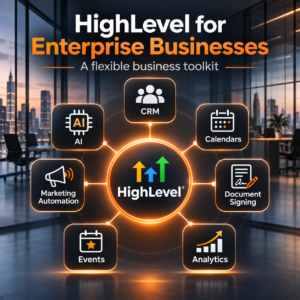
Larger enterprises can use HighLevel as an interconnected toolkit of sales, marketing, customer service, AI and business management software.
They can use individual tools independently, combine them into departmental business systems or integrate them with existing enterprise platforms such as Salesforce and Microsoft Dynamics, without necessarily replacing their existing CRM.
HighLevel can also provide an environment for testing new business ideas, developing bespoke applications and replicating proven business systems across multiple locations.
Contents
- How can larger enterprises use HighLevel?
- What is HighLevel?
- Think of HighLevel as a digital Swiss Army knife
- What software tools are available within HighLevel?
- Marketing automation doesn’t have to be exclusively digital
- How many separate software subscriptions are you paying for?
- An example: Using HighLevel to manage a corporate event
- Four ways larger organisations could use HighLevel
- A large business doesn’t necessarily need a large IT project
- What if the software tool you need doesn’t already exist?
- Using HighLevel across multiple branches, divisions and locations
- Start with a software subscription audit
- What about corporate IT, security and GDPR?
- When wouldn’t I recommend HighLevel?
- How I would recommend a larger organisation gets started
- Frequently asked questions about HighLevel for enterprise businesses
- My final thoughts
- Would you like to explore how HighLevel could work within your organisation?
What is HighLevel?
HighLevel, also commonly referred to as GoHighLevel or GHL, is an integrated business software platform that combines CRM, sales, marketing automation, communications, artificial intelligence and an increasingly broad range of business management tools.
Originally associated primarily with marketing agencies and small businesses, HighLevel has evolved considerably. Its functionality now extends into project management, customer support ticketing, field services, event management, electronic document signing, online communities, customer loyalty programmes and AI-assisted application development.
HighLevel is now second only to Salesforce, according to its CEO
If you have only recently become aware of HighLevel, you might assume it is a relatively small software company trying to establish itself in a marketplace dominated by Salesforce, Microsoft Dynamics and HubSpot.
Think again.
HighLevel co-founder and CEO Shaun Clark has stated that HighLevel is now the world’s second-largest CRM by number of users, behind only Salesforce.
I have written about this separately and included a video interview with Shaun Clark in which he discusses the scale and growth of the business.
This is Shaun Clark’s claim about the number of users, rather than an independently verified ranking of CRM companies by revenue or market share.
Nevertheless, this is a serious bit of kit.
So why hasn’t HighLevel been on your radar?
One of the reasons is the way HighLevel is sold.
Most established enterprise software companies invest heavily in promoting their own software brands directly to businesses. HighLevel has taken a somewhat different approach.
Much of its distribution is through marketing agencies, consultants and software entrepreneurs who can white-label HighLevel and provide it to their customers under their own brands.
My own business, MarketerM8, is one such HighLevel agency. We provide clients with access to the HighLevel platform alongside our consulting, implementation, training and support services.
Across the world, agencies are doing something similar under their own brand names. Two businesses could appear to be using completely different CRM and marketing automation systems when, behind the scenes, both are powered by HighLevel.
Some businesses may not even be aware that the software they are using is HighLevel. That goes some way towards explaining why its name might not be as familiar to corporate decision-makers as Salesforce or HubSpot, despite the scale of its reported user base.
Already interested in exploring how HighLevel could work within your organisation?
Book a Free 20-Minute Discovery Call
Think of HighLevel as a digital Swiss Army knife
I increasingly think of HighLevel as something of a digital Swiss Army knife for businesses.
You don’t buy a Swiss Army knife because you intend to use every tool it contains every day. You buy it because when you need a particular tool, there is a good chance you already have it.
HighLevel is rather similar. It contains dozens of interconnected business software tools.
You can use as much or as little of the toolkit as you like.
Perhaps your organisation simply needs a better appointment booking system. Or an electronic document signing platform. Or a social media planner. Or a customer loyalty programme.
There is no particular reason why you should have to replace your existing corporate CRM to introduce any of these things.
HighLevel could sit alongside your existing systems, either operating independently or exchanging information with them through integrations.
And increasingly, if the particular tool you need doesn’t already exist, you may be able to build it yourself using HighLevel’s AI-assisted development tools.
But before we get into that, let’s look at what is already in the toolkit.
What software tools are available within HighLevel?
I think the easiest way to appreciate the breadth of HighLevel is to compare its individual capabilities with familiar software products. You may already be paying for some of these products within your own organisation.
As you work through the following tables, ask yourself how many of these types of software your business currently uses.
The comparisons illustrate the types of business requirements HighLevel can address. I am not suggesting that every HighLevel tool provides precisely the same functionality as every specialist product listed.
Some entries are individual capabilities rather than standalone modules. Some of the newer features are also in phased release, Labs or beta programmes, and availability varies between plans. Certain capabilities require third-party integrations or additional subscriptions.
Browse the HighLevel toolkit
- 1. CRM, sales and lead management
- 2. Marketing and sophisticated multichannel marketing automation
- 3. Websites, funnels and digital experiences
- 4. Calendars, appointment booking and meetings
- 5. Customer communications and customer support
- 6. Reputation management and customer retention
- 7. Documents, proposals, contracts and electronic signatures
- 8. Payments, invoicing and e-commerce
- 9. Events, memberships and online learning
- 10. Business operations and industry-specific systems
- 11. AI tools and AI employees
- 12. Automation, integrations and bespoke business systems
- 13. Enterprise deployment and multi-location management
1. CRM, sales and lead management
| HighLevel tool or capability | What it does | Comparable software |
|---|---|---|
| CRM | Manage customer records, prospect information and relationships. | Salesforce, HubSpot, Zoho CRM, Keap |
| Sales Pipelines and Opportunities | Manage sales opportunities, deal values and progress through sales stages. | Pipedrive, Freshsales |
| Lead Management | Capture, allocate and nurture sales enquiries. | HubSpot, LeadSquared |
| Lead Scoring | Prioritise prospects using configured engagement and qualification criteria. | ActiveCampaign, HubSpot |
| Task Management | Assign sales and administrative tasks to team members. | Todoist, Microsoft To Do |
| Custom Objects | Create business-specific data structures and relationships. | Salesforce Custom Objects, Airtable |
| Sales Dashboards | Monitor sales activity, pipeline performance and selected KPIs. | Pipedrive Insights, HubSpot Reporting |
2. Marketing and sophisticated multichannel marketing automation
| HighLevel tool or capability | What it does | Comparable software |
|---|---|---|
| Advanced Email Marketing | Design personalised emails, newsletters and targeted broadcast campaigns. | Mailchimp, Campaign Monitor, Brevo |
| Email Marketing Automation | Develop automated email sequences based on customer behaviour and engagement. | ActiveCampaign, Keap, Drip |
| SMS Marketing | Send personalised text messages, promotional campaigns and automated follow-up sequences. | TextMagic, SimpleTexting |
| WhatsApp Marketing | Send approved marketing templates and automate supported customer communications. | WATI, respond.io, Interakt |
| Multichannel Marketing Automation | Combine email, SMS, WhatsApp, telephone calls and supported AI interactions within automated customer journeys. | Salesforce Marketing Cloud, Adobe Marketo Engage, HubSpot |
| Advanced Workflow Automation | Build sophisticated automations using triggers, conditional branching, time delays and business rules. | ActiveCampaign, Keap, Make |
| Customer Segmentation | Segment customers using tags, custom fields, engagement and CRM data. | Klaviyo, ActiveCampaign, HubSpot |
| Dynamic Smart Lists | Automatically maintain customer lists based on defined criteria. | HubSpot Active Lists, ActiveCampaign Segments |
| Personalised Marketing | Dynamically personalise communications using customer information and custom fields. | ActiveCampaign, Salesforce Marketing Cloud |
| Behavioural Marketing | Trigger marketing activities based on supported customer interactions and website activity. | Customer.io, ActiveCampaign, HubSpot |
| Lead Nurturing | Develop automated campaigns to educate prospects and encourage them to take the next step. | Keap, Marketo, ActiveCampaign |
| Customer Reactivation | Identify and re-engage dormant customers and prospects using configured criteria. | Keap, Klaviyo |
| Marketing Campaign Reporting | Monitor supported campaign performance, engagement and delivery statistics. | Mailchimp, HubSpot |
| Email Deliverability Management | Configure sending domains, email authentication and supported deliverability settings. | Mailgun, SendGrid |
| Social Media Planner | Plan, schedule and publish content across supported social media platforms. | Hootsuite, Buffer, SocialPilot, Metricool |
| Ad Manager | Create and manage supported digital advertising campaigns. | AdEspresso, Madgicx |
| Affiliate Manager | Manage affiliate campaigns, referrals and commissions. | FirstPromoter, Tapfiliate |
| QR Code Generator | Create QR codes for marketing campaigns and customer interactions. | Uniqode, QR Code Generator |
| Trigger Links | Track link interactions and trigger automated actions. | ActiveCampaign link actions |
| Email Verification | Check email addresses to help maintain mailing list quality. | NeverBounce, ZeroBounce |
| Countdown Timers | Introduce time-sensitive elements into promotional campaigns. | Deadline Funnel, MotionMail |
| Automated Postal Direct Mail | Trigger personalised letters and postcards to be printed and posted through third-party fulfilment integrations. | Stannp, via integration |
| Online and Offline Marketing Integration | Combine postal direct mail with digital communications within automated customer journeys. | Enterprise marketing automation platforms combined with direct mail integrations |
The real power of HighLevel’s marketing automation isn’t simply that it can send emails, text messages and WhatsApp messages. It is that you can combine these communication channels into sophisticated, automated customer journeys.
For example, a potential customer could receive an email. If they don’t respond, they could receive a text message. If they reply through WhatsApp, an AI agent could continue the conversation. If they are sufficiently interested, they could be invited to book an appointment or be passed to a member of the sales team.
Their interactions can be recorded against their CRM record and used to determine what happens next.
This is direct response marketing automation, rather than simply email marketing.
Naturally, marketing campaigns need to respect customer communication preferences, consent requirements and applicable messaging restrictions.
3. Websites, funnels and digital experiences
| HighLevel tool or capability | What it does | Comparable software |
|---|---|---|
| Website Builder | Build and host business websites using a visual editor. | Wix, Squarespace, WordPress |
| Sales Funnel Builder | Create multi-stage sales funnels. | ClickFunnels, Leadpages |
| Landing Page Builder | Create dedicated campaign and lead-generation pages. | Unbounce, Instapage |
| Blog Builder | Publish and manage articles and website content. | WordPress, Ghost |
| Form Builder | Create online forms and capture customer information. | Jotform, Wufoo |
| Survey Builder | Create customer surveys and questionnaires. | SurveyMonkey, Typeform |
| Quiz Builder | Develop interactive assessments, quizzes and lead-generation tools. | ScoreApp, Interact |
| Website Tracking | Track supported visitor interactions and trigger marketing automation. | ActiveCampaign Site Tracking, HubSpot Tracking |
| Media Library | Store and organise marketing assets. | Basic digital asset management systems |
| Brand Boards | Maintain brand colours, fonts, logos and brand information. | Canva Brand Kit |
4. Calendars, appointment booking and meetings
| HighLevel tool or capability | What it does | Comparable software |
|---|---|---|
| Booking Calendars | Allow customers and prospects to book appointments online. | Calendly, Acuity Scheduling |
| Round Robin Calendars | Distribute appointments between available team members. | Calendly Teams, Chili Piper |
| Service Calendars | Manage bookings for different services and staff members. | SimplyBook.me, Fresha |
| Resource Booking | Coordinate bookings for supported rooms, equipment and resources. | Skedda, SimplyBook.me |
| Paid Appointment Booking | Collect payments when customers book appointments. | Acuity Scheduling, Bookeo |
| Appointment Reminders | Automatically send appointment reminders. | GoReminders, Apptoto |
| Meeting Rooms | Host supported online video meetings within the platform. | Zoom, Google Meet, Microsoft Teams meetings |
5. Customer communications and customer support
| HighLevel tool or capability | What it does | Comparable software |
|---|---|---|
| Customer Support Ticketing | Create, allocate, prioritise and manage customer support tickets. | FuseDesk, Zendesk, Freshdesk, Help Scout |
| Unified Conversations Inbox | Manage customer communications across supported channels. | Front, Missive, respond.io |
| Business Telephone System | Make and receive calls using connected business telephone numbers. | Aircall, RingCentral, CloudTalk |
| Call Tracking | Track telephone enquiries and supported marketing attribution. | CallRail, WhatConverts |
| Call Recording | Record and review supported telephone conversations. | Aircall, CallRail |
| Website Live Chat | Enable website visitors to communicate with staff. | LiveChat, Tidio |
| AI Website Chatbot | Answer customer questions and undertake configured actions. | Intercom Fin, Tidio Lyro |
| AI Telephone Receptionist | Answer calls, capture caller information and assist with bookings. | Smith.ai, Synthflow, Retell AI |
| AI Knowledge Base | Provide business-specific information to AI agents. | Chatbase, CustomGPT.ai |
6. Reputation management and customer retention
| HighLevel tool or capability | What it does | Comparable software |
|---|---|---|
| Review Management | Monitor and respond to customer reviews. | Birdeye, Podium, ReviewTrackers |
| Automated Review Requests | Request customer reviews automatically. | NiceJob, GatherUp |
| Reviews AI | Assist with responding to customer reviews. | Birdeye AI, MARA |
| Review Widgets | Display customer reviews on websites. | Trustindex, Elfsight |
| Business Listings Management | Manage business information across supported online directories. | Yext, Uberall |
| Loyalty and Rewards | Develop customer loyalty and rewards programmes. | Smile.io, LoyaltyLion, Stamp Me |
| Customer Referral Campaigns | Develop referral programmes using integrated marketing tools. | ReferralCandy, Referral Rock |
7. Documents, proposals, contracts and electronic signatures
| HighLevel tool or capability | What it does | Comparable software |
|---|---|---|
| Electronic Document Signing | Send documents for electronic signature and track their completion. | DocuSign, Adobe Acrobat Sign, Dropbox Sign |
| Contracts and Agreements | Create, distribute and track customer agreements and contracts. | PandaDoc, Jotform Sign |
| Proposal Builder | Create professional, personalised business proposals. | Proposify, Better Proposals, PandaDoc |
| Reusable Document Templates | Create standardised templates for frequently used business documents. | DocuSign Templates, PandaDoc |
| Personalised Document Generation | Populate document templates using information held within the CRM. | Formstack Documents, Conga Composer |
| Document Signing Automation | Trigger reminders and subsequent business processes based on document status and completion. | PandaDoc Automations, DocuSign Workflows |
| Integrated Contracts and Payments | Combine agreements, electronic signatures and supported payment collection processes. | PandaDoc, HoneyBook |
Electronic document signing is a particularly interesting capability for larger organisations.
Think about how many documents a business needs people to sign. Customer contracts, supplier agreements, non-disclosure agreements, consent forms, quotations and onboarding documents.
But the interesting part is what happens after somebody signs a document. Because the document signing functionality is connected to HighLevel’s CRM and workflow automation, the completion of a document could automatically trigger the next stage of a business process.
There is no need for somebody to continually check whether a document has been signed and then manually initiate the next activity.
For organisations with specialist electronic signature standards or regulatory requirements, the suitability of HighLevel would need to be assessed against those requirements.
8. Payments, invoicing and e-commerce
| HighLevel tool or capability | What it does | Comparable software |
|---|---|---|
| E-commerce Store | Build an online shop and sell products. | Shopify, WooCommerce |
| Product Catalogue | Manage products, prices and collections. | Shopify product management |
| Order Forms | Create online checkout and order forms. | ThriveCart, SamCart |
| Payment Links | Create shareable online payment links. | Stripe Payment Links, PayPal |
| Invoicing | Create invoices and collect payments. | FreshBooks, Zoho Invoice |
| Estimates and Quotations | Prepare and send customer estimates. | Quotient, Joist |
| Recurring Billing | Collect recurring payments and subscriptions. | Stripe Billing, Chargebee |
| Coupons and Discounts | Create promotional discount offers. | Shopify Discounts |
| Point of Sale | Collect supported in-person payments. | Square POS, SumUp |
9. Events, memberships and online learning
| HighLevel tool or capability | What it does | Comparable software |
|---|---|---|
| Event Management | Create, promote and manage events. | Eventbrite, Ticket Tailor |
| Event Ticketing | Sell tickets and manage event registrations. | TicketSource, Eventbrite |
| Event Check-in | Check attendees into events using supported QR code scanning. | Eventbrite Organizer |
| Event Attendee App | Provide attendees with a digital event experience. | Whova |
| Online Course Builder | Create and distribute training courses. | Thinkific, Teachable, Kajabi |
| Membership Sites | Provide gated access to content and membership services. | MemberPress, Kajabi |
| Online Communities | Create branded communities for customers, members or partners. | Skool, Circle, Mighty Networks |
| Client Portal | Provide customers with access to supported services, documents and content. | SuiteDash, client portal platforms |
| Certificates | Issue course completion certificates. | Accredible, Certifier |
| Learning Assessments | Create supported quizzes and assignments within training programmes. | Thinkific, TalentLMS |
10. Business operations and industry-specific systems
| HighLevel tool or capability | What it does | Comparable software |
|---|---|---|
| Project Management | Organise projects, tasks, responsibilities and deadlines. | Trello, Asana, Monday.com, ClickUp |
| Field Services | Manage field service jobs, scheduling and operational activities. | ServiceM8, Jobber, Housecall Pro |
| Field Staff Management | Coordinate field-based staff and job assignments. | ServiceM8, Commusoft |
| Job Scheduling and Routing | Schedule jobs and coordinate supported field service routes. | Jobber, OptimoRoute |
| Restaurant Reservations | Manage supported restaurant table bookings. | OpenTable, ResDiary |
| Restaurant Menu Builder | Create and manage digital restaurant menus. | GloriaFood, MENU TIGER |
| Restaurant Order Management | Manage supported restaurant ordering processes. | GloriaFood, Flipdish |
| Coaches and Consultants | Provide industry-focused coaching and consultancy tools. | Paperbell, CoachAccountable |
| Workflow Maps | Visualise relationships between business automations. | Lucidchart, Miro |
This is a particularly interesting development. HighLevel is moving beyond helping businesses generate sales enquiries and is increasingly developing tools to help businesses manage what happens after those enquiries have been generated.
I explore this in more detail in my article, HighLevel Is No Longer Just a Marketing Platform: Is It Becoming a Business Operations Platform?.
11. AI tools and AI employees
| HighLevel tool or capability | What it does | Comparable software |
|---|---|---|
| Ask AI | Provide an integrated AI assistant that can undertake supported actions within HighLevel. | Microsoft Copilot, HubSpot Breeze |
| Managed Agents | Deploy AI assistants to undertake configured business tasks. | Lindy, Relevance AI, Zapier Agents |
| Agent Studio | Build customised AI agents for business processes. | Relevance AI, Botpress |
| Conversation AI | Conduct automated customer conversations. | Intercom Fin, ManyChat, Botpress |
| Voice AI | Create conversational AI telephone agents. | Retell AI, Vapi, Synthflow |
| Content AI | Generate and refine marketing content. | Jasper, Copy.ai |
| Creator Studio | Generate creative marketing assets using supported AI models. | Canva AI, Adobe Firefly |
| Workflow AI Builder | Assist with building and modifying automations using natural language. | Zapier Copilot |
| Funnel and Website AI | Assist with the creation of websites and sales funnels. | Wix AI, Durable |
| Email AI | Assist with creating and improving marketing emails. | Mailchimp AI, Jasper |
| AI Studio | Create websites, pages and interactive web experiences using AI. | Lovable, Bolt.new, Replit Agent |
| App Studio | Develop applications for the HighLevel Marketplace ecosystem using AI-assisted development. | Replit Agent, AI application development platforms |
| Client App Builder | Create branded customer-facing app experiences. | GoodBarber, Glide, Adalo |
| AI App Studio | Create branded mobile applications using natural language instructions. | FlutterFlow AI, AI-assisted mobile app builders |
Several of these tools represent relatively recent developments, with some still in beta or phased release.
12. Automation, integrations and bespoke business systems
| HighLevel tool or capability | What it does | Comparable software |
|---|---|---|
| Workflow Automation | Build automated business processes using triggers, conditions and actions. | Zapier, Make, n8n |
| API Connectivity | Exchange information with existing CRM and business systems. | Custom API integrations |
| Webhooks | Send and receive event-driven information between applications. | Zapier Webhooks, Make Webhooks |
| MCP Connectivity | Enable supported AI systems and agents to interact with business software. | MCP-enabled integration platforms |
| Custom Fields | Store business-specific customer information. | Salesforce Custom Fields, HubSpot Properties |
| Custom Values | Maintain reusable information across business assets and templates. | Template personalisation systems |
| Custom Navigation | Tailor supported software navigation to particular business requirements. | Custom business portals |
| Marketplace Applications | Extend the platform with additional third-party functionality. | Salesforce AppExchange, HubSpot Marketplace |
| External Software Integrations | Connect HighLevel with accounting, fulfilment, ERP, CRM and other specialist systems where suitable interfaces exist. | Zapier, Make, n8n, bespoke API integrations |
13. Enterprise deployment and multi-location management
| HighLevel tool or capability | What it does | Comparable software |
|---|---|---|
| Sub-Accounts | Create separate working environments for divisions, brands or locations. | Separate CRM instances, business units |
| Snapshots | Package and replicate configured business systems. | Software configuration and deployment templates |
| User Roles and Permissions | Control access to supported features and business information. | Role-based access control systems |
| User Performance Reporting | Monitor supported staff activities and sales performance. | CRM performance reporting tools |
| White-Label Platform | Provide branded software environments for customers or partners. | White-label CRM platforms |
| SaaS Mode | Package software capabilities into subscription-based offerings. | SaaS provisioning systems |
| Usage Rebilling | Allocate and recharge supported software consumption costs. | Usage-based billing platforms |
As you can see, there is a great deal more to HighLevel than CRM and marketing automation. HighLevel is also developing rapidly, so the list will inevitably continue to evolve.
For the latest information about individual tools and feature availability, see the official HighLevel product changelog.
Marketing automation doesn’t have to be exclusively digital
As somebody who has been involved in direct response marketing since 1996, I think one of the opportunities that is frequently overlooked is combining traditional direct mail with online marketing.
Just because we can communicate with customers electronically doesn’t mean we should abandon the postman.
HighLevel can be integrated with third-party digital direct mail fulfilment companies such as Stannp. These companies can print, personalise and post individual letters and postcards on demand.
Through an API or other suitable integration, a HighLevel marketing automation workflow could trigger a physical letter or postcard to be sent to a customer just as it might trigger an email or text message.
Imagine an automated marketing campaign that works as follows:
- A prospective customer makes an enquiry through your website.
- They immediately receive a personalised email.
- They receive a follow-up text message.
- If they haven’t responded, a personalised letter is automatically printed and posted to them.
- The letter contains a QR code directing them to a dedicated landing page.
- They scan the QR code and book an appointment.
- Their appointment triggers further automated communications.
- Once they become a qualified sales opportunity, their details are passed to the corporate CRM.
HighLevel CRM and workflow automation
Customer information, triggers, conditions and personalisation
↓
via Stannp integration
↓
Customer response and follow-up
Nobody in your marketing department necessarily needs to print a letter, stuff an envelope or visit the post office. The physical direct mail becomes another communication channel within your automated marketing system.
You could apply the same approach to:
- Welcoming new customers.
- Following up high-value sales enquiries.
- Reactivating dormant customers.
- Sending personalised event invitations.
- Reminding customers about contract renewals.
- Promoting additional products and services.
- Sending birthday and anniversary cards.
- Following up quotations.
- Communicating with customers who prefer traditional postal correspondence.
- Supporting account-based marketing campaigns.
In an age when everybody’s email inbox is overflowing, there may be occasions when a personalised letter landing on somebody’s desk is considerably more effective than yet another email.
And unlike traditional direct mail campaigns, you don’t necessarily have to wait until you have thousands of people to write to before organising a mailing. Individual mailings can be triggered by what each customer does, or doesn’t do.
Response mechanisms such as personalised landing page URLs and QR codes can help connect the offline mailing with the subsequent online customer journey. This is sometimes referred to as omnichannel marketing automation.
Of course, the direct mail fulfilment is provided by an external company, rather than HighLevel itself. Printing, postage and integration costs apply, and the exchange of customer information needs to be managed appropriately.
This is where marketing automation becomes particularly powerful. You can combine the best of traditional direct response marketing with modern digital marketing and artificial intelligence.
How many separate software subscriptions are you paying for?
Having looked through the above list, how many of those types of software does your organisation already subscribe to?
Perhaps you use Mailchimp for email marketing. Calendly for appointment booking. Hootsuite for social media. Eventbrite for events. FuseDesk for customer support. Pipedrive for sales opportunities. DocuSign for electronic signatures.
And perhaps you also pay for Zapier or Make to get them all talking to one another.
Individually, these are all perfectly good software products.
But every time you introduce another piece of software into your organisation, you potentially introduce another:
- Supplier relationship.
- Software subscription.
- Procurement process.
- Staff training requirement.
- User login.
- Database of customer information.
- Integration requirement.
- Security and data protection assessment.
- System that somebody needs to administer.
Before long, you have accumulated quite a collection of software. And somebody has to look after it all.
This is where I think the real commercial attraction of HighLevel lies.
The value of HighLevel isn’t simply the number of tools it contains. It is the fact that so many of those tools are already designed to work together.
Another important consideration for larger organisations is that HighLevel’s core sub-account subscription model is not generally based on charging for each individual user. As your team grows, you can add additional users without necessarily incurring the sort of per-user software licence charges associated with many other business software products.
The opportunity isn’t necessarily to replace every specialist product you use. It is to reduce unnecessary complexity and give your staff access to tools that might otherwise require another software procurement exercise.
And where a specialist external service is required, such as direct mail fulfilment, HighLevel can provide the automation that connects it with the rest of your business activities.
An example: Using HighLevel to manage a corporate event
Imagine your marketing department wants to organise a customer conference or product launch.
Consider how many separate software products you might traditionally use to organise that event.
| Activity | HighLevel tool | Comparable standalone software |
|---|---|---|
| Promote the event on social media | Social Media Planner | Hootsuite |
| Create the event website | Website and Landing Page Builder | Unbounce |
| Send personalised printed invitations | Direct Mail Integration | Stannp |
| Manage registrations and ticket sales | Event Management | Eventbrite |
| Send invitations, confirmations, reminders and follow-up communications | Multichannel Marketing Automation | Mailchimp, ActiveCampaign |
| Provide a branded event app for attendees | Event Attendee App | Whova |
| Check in attendees using QR codes | Event Check-in | Ticket Tailor |
| Conduct post-event feedback surveys | Survey Builder | SurveyMonkey |
Rather than purchasing and connecting numerous separate software products, much of the event could be managed within one interconnected platform.
The marketing department could also integrate relevant event registration and attendance information with the existing corporate CRM if required.
This is a good example of how a department within a larger organisation could benefit from HighLevel without replacing any of its core corporate systems.
Four ways larger organisations could use HighLevel
I see four broad approaches to using HighLevel within a larger business. These aren’t necessarily stages you have to progress through. You could use whichever approach makes the most commercial sense.
1. Standalone tool
HighLevel handles one specific requirement independently.
2. Departmental toolkit
Several interconnected tools serve a department.
3. Integrated system
HighLevel exchanges information with the corporate CRM or other systems.
4. Innovation platform
A separate environment for new ventures and bespoke applications.
Level 1: Use HighLevel for an individual business requirement
You don’t necessarily have to use all the tools within HighLevel to justify the cost of the software. Let me give you a real example.
Real-world example: Reducing the cost of appointment booking software
A prospective client came to us who was using Acuity Scheduling to manage appointment bookings for their sales team.
They were paying $50 per month for each of their 10 sales representatives. That’s $500 per month, or $6,000 per year, just for appointment booking software.
Here is how that compares with a MarketerM8 Professional HighLevel account.
| Existing Acuity Scheduling expenditure | MarketerM8 Professional | |
|---|---|---|
| Monthly subscription | $500 | £197 plus VAT |
| Annual subscription | $6,000 | £2,364 plus VAT |
| Number of sales representatives | 10 | No additional core per-user licence fees |
| Appointment booking calendars | Yes | Yes |
| Additional business software tools | Appointment scheduling platform | Dozens of interconnected tools |
With HighLevel, they could provide individual booking calendars for all 10 sales representatives without paying an additional software licence fee for each user.
And if their sales team subsequently grew to 20, 50 or even 100 sales representatives, they could add more users and calendars without increasing the core monthly subscription cost within the same sub-account.
The savings from using just one HighLevel tool could more than justify the cost of the entire platform.
And they would still have dozens of other interconnected business tools available to them.
The Acuity figures are based on the prospective client’s reported expenditure, rather than a comparison with Acuity’s standard advertised pricing. Additional HighLevel usage charges and implementation costs may apply.
Another example: Electronic document signing
Perhaps your organisation is currently paying for an electronic signature platform such as DocuSign.
You could introduce HighLevel purely to manage electronic document signing.
That’s it.
You don’t necessarily want a new CRM, a new website or a new marketing automation system. You simply want to create documents, send them for signature, automatically remind people who haven’t signed and keep track of completed agreements.
But because HighLevel’s document signing functionality is connected to its wider business toolkit, you could also automate what happens next.
When a customer signs a contract, HighLevel could automatically initiate a customer onboarding process, notify the relevant members of staff and pass information to your existing corporate systems.
In both of these examples, the business could initially justify purchasing HighLevel based on a single software requirement. Over time, other members of staff may discover additional tools within the platform that could benefit their departments.
There is no need to implement everything from day one. The rest of the toolkit is there if and when you need it.
Level 2: Create an interconnected departmental system
Perhaps your marketing department wants more control over its own campaigns.
It wants to create landing pages, capture enquiries, follow up prospects, manage social media and book appointments without continually relying on different software suppliers.
HighLevel could provide the department with its own interconnected sales and marketing system, incorporating sophisticated email, SMS, WhatsApp and even postal direct mail campaigns.
The wider organisation continues using its existing corporate infrastructure.
Level 3: Integrate HighLevel with your existing CRM and business systems
There may be occasions when HighLevel needs to exchange information with existing software.
For example, HighLevel could capture and nurture sales enquiries. When an enquiry reaches an agreed stage of qualification, the relevant information could be passed to Salesforce or Microsoft Dynamics.
Similarly, information from the corporate CRM could trigger customer communications or marketing activity within HighLevel.
The existing enterprise CRM remains the authoritative source of customer information. HighLevel handles the additional activities for which it has been introduced.
The precise integration needs to be designed around the available APIs, data structures and business requirements. It isn’t simply a case of pressing a button and expecting everything to work.
Level 4: Use HighLevel as an innovation platform
Imagine your organisation has identified an opportunity to enter a new marketplace. Perhaps you already have a substantial Salesforce implementation.
Does it necessarily make sense to extend that implementation before you have established whether the new business opportunity is viable?
There may be occasions when it does. But there may also be occasions when a lean startup approach makes considerably more sense.
A separate HighLevel environment could provide the new division with a website, CRM, marketing automation, sales pipelines, AI receptionists, customer communications, payments and operational tools.
You can start selling, gather customer feedback and establish whether you actually have a viable business.
If the initiative proves successful, you can then decide whether to retain HighLevel, integrate it more closely with existing corporate systems or move particular activities into the established infrastructure.
Build it. Try it. Learn from it.
Then make the decision about how much more money you want to invest.
I discuss this approach in more detail in my article, What Is the Best CRM, Marketing Automation and AI Platform for a Lean Startup?.
A large business doesn’t necessarily need a large IT project
Imagine you are responsible for marketing within a large organisation. You come up with an idea on Monday morning.
It might be a customer loyalty programme, an automated sales follow-up process or an AI receptionist.
In a small business, the owner might make a decision on Monday and start experimenting with the technology on Tuesday.
In a larger organisation, things can be rather different. There may be procurement procedures, IT committees, technical specifications, integration requirements, security assessments and numerous people involved in the decision-making process.
There are perfectly valid reasons why those procedures exist. But by the time everything has been approved and implemented, the original commercial opportunity may have moved on.
Just because you are a large organisation doesn’t mean you need an enterprise-sized IT project for every business requirement.
One of our clients in Ireland, for example, had previously received a quotation of around £150,000 for a Salesforce implementation.
Now, I am not suggesting that a HighLevel subscription automatically gives you the equivalent of a £150,000 Salesforce system. That would be an entirely misleading comparison.
But it does illustrate why businesses should consider different approaches before committing to a substantial software implementation.
What are you actually trying to achieve? What is the simplest effective way of achieving it? And do you really need a major IT project to do it?
I think these are questions worth asking.
What if the software tool you need doesn’t already exist?
This is where things are becoming particularly interesting.
Historically, if you needed a bespoke software application, you would probably have had to commission a software developer. You would explain what you wanted, somebody would produce a specification and you would be given a quotation.
The entire process could take a considerable amount of time before you even had something you could try out.
AI-assisted application development is beginning to change that. You may have heard the term vibe coding.
Rather than writing all the software code yourself, you describe what you want the application to do in natural language, and AI helps you create and refine it.
HighLevel now offers several different development environments.
HighLevel AI Studio
AI Studio enables businesses to create websites, landing pages and interactive web experiences using natural language instructions.
Imagine your marketing department wants to create an interactive savings calculator that helps prospective customers understand the commercial benefits of your product.
Rather than immediately commissioning a developer, you could explore using AI Studio to create a working prototype.
HighLevel App Studio
App Studio is an AI-assisted application builder within HighLevel’s Developer Portal. It is designed to help create functional applications for the HighLevel Marketplace ecosystem.
This provides a route for businesses and developers to extend the platform beyond its existing functionality.
Branded mobile applications
HighLevel also offers tools for developing branded customer-facing apps, with newer AI-assisted mobile app development capabilities emerging through AI App Studio.
This could be interesting for organisations wanting to provide customers, members, dealers or business partners with their own branded mobile experience.
What sort of bespoke applications could you build?
Here are just a few ideas:
- Interactive product configurators.
- Customer savings calculators.
- Return on investment calculators.
- Customer qualification tools.
- Interactive quotation tools.
- Internal reporting dashboards.
- Customer onboarding experiences.
- Staff assessment applications.
- Supplier enquiry systems.
- Dealer or franchisee support tools.
- Bespoke booking interfaces.
- Customer self-service applications.
- Specialist departmental business tools.
Imagine being able to build something, show it to colleagues, obtain feedback and refine the idea before committing to a major development project.
For the corporate IT department, this could also be useful. Rather than receiving a vague specification explaining what the marketing department thinks it wants, the IT team could be presented with a working prototype.
Of course, a working prototype isn’t necessarily a secure, reliable, production-ready enterprise application.
Testing, security, accessibility, ongoing maintenance and integration still need to be addressed. More complex projects may still require professional developers and additional infrastructure.
But AI-assisted development changes the possibilities.
If the software tool you need isn’t already in the HighLevel toolkit, you may increasingly have the option of developing your own.
Using HighLevel across multiple branches, divisions and locations
Another HighLevel capability that I think deserves the attention of larger businesses is its snapshot functionality.
Imagine you operate 100 branches.
Rather than building 100 separate sales and marketing systems, you could develop a system for one branch, test it, refine it and then replicate supported elements of that system across the remaining branches.
A HighLevel snapshot allows you to package selected elements of a configured system for deployment into other sub-accounts.
These could include:
- Sales pipelines.
- Appointment calendars.
- Enquiry forms.
- Marketing automation workflows.
- Email and SMS templates.
- Landing pages.
- Customer review processes.
- Customer reactivation campaigns.
- Supported AI configurations.
Each branch could then have its own environment, with local staff, telephone numbers, business information and relevant permissions.
There will still be configuration, testing and integration work involved. A snapshot isn’t a magic button that completely installs and configures a finished business.
Nevertheless, the opportunity to develop something once and replicate it across numerous locations is particularly interesting.
Consider the potential applications for:
- Franchise networks.
- Car dealership groups.
- Estate agency groups.
- Dental and optical groups.
- Retail chains.
- Hospitality businesses.
- Field service organisations.
- Professional services firms.
- International subsidiaries.
- Dealer and distributor networks.
I have written more extensively about this in my guides to HighLevel for franchises and building a HighLevel snapshot that can scale across hundreds of businesses.
Start with a software subscription audit
If you are considering HighLevel for your organisation, one of the first things I would recommend is reviewing the software you are already paying for.
You might be surprised by what you discover.
Perhaps different departments are paying for separate subscriptions to similar software. Perhaps you are paying for an expensive product when staff only use a relatively small proportion of its functionality. Perhaps you have software subscriptions that were introduced for a particular project several years ago and are still being paid for.
For each existing software product, ask the following questions.
| Question | What you are trying to establish |
|---|---|
| What does it cost? | The total cost of licences, usage and associated services. |
| Who uses it? | Which departments and staff rely on it. |
| What do they actually use it for? | Whether the functionality being paid for is genuinely needed. |
| Are we paying per user? | Whether costs increase every time we employ another member of staff. |
| Does it duplicate other software? | Whether there are overlapping subscriptions. |
| What is it connected to? | Which other systems and business processes depend on it. |
| Could HighLevel meet the same requirement? | Whether consolidation is worth investigating. |
| What would be involved in changing it? | Migration, integration, training and implementation costs. |
| What would we lose? | Any important specialist features that cannot be replicated. |
I would then place each product into one of three categories:
Retain: It does something important that justifies keeping it.
Replace: HighLevel could meet the requirement without compromising the business.
Integrate: Both systems have a useful role and should exchange information.
Don’t just look at software subscription prices. Consider the staff time involved in maintaining integrations, administering different systems, training employees and transferring information between applications.
HighLevel itself can also involve additional usage charges, payment processing costs, add-ons and implementation work.
The objective isn’t simply to cancel as many software subscriptions as possible. It is to develop a more effective and commercially sensible business software environment.
What about corporate IT, security and GDPR?
I am not suggesting that staff in a large organisation should go off and introduce HighLevel without the knowledge or approval of their IT department.
Quite the opposite.
I think there is an opportunity for corporate IT departments to provide staff with an approved toolkit they can use within clearly agreed boundaries.
Rather than every department independently procuring different pieces of software, the organisation could establish a framework for using HighLevel.
That framework might address:
| Area | What needs to be considered |
|---|---|
| Data protection | What personal information will be processed and where it will be stored. |
| International data transfers | Applicable safeguards and contractual arrangements. |
| Data ownership | Which system maintains the authoritative customer record. |
| Information security | Whether the platform meets the organisation’s security requirements. |
| Access controls | Which staff can access particular information and functionality. |
| Authentication | Corporate identity management and authentication requirements. |
| Integrations | How information will be transferred securely between systems. |
| Third-party service providers | How external suppliers, such as direct mail fulfilment companies, will process information. |
| Marketing compliance | How consent, communication preferences and opt-outs will be managed across different channels. |
| Electronic signatures | Whether document signing processes meet the organisation’s legal, evidential and regulatory requirements. |
| Data retention | How long information will be retained and how it can be deleted. |
| AI processing | What information AI systems may access and process. |
| Human oversight | Which AI-generated actions require human approval. |
| Business continuity | What happens if the platform or an integration is temporarily unavailable. |
| Regulatory requirements | Any industry-specific obligations that need to be met. |
| Procurement | Contractual commitments, supplier assessment and service levels. |
| Application development | Testing, approval and maintenance of bespoke applications. |
| Exit strategy | How data and business processes could be transferred if required. |
A financial services business, healthcare provider or public sector organisation may have very different requirements from a typical marketing department. These need to be investigated before making commitments.
But within appropriate boundaries, staff could have greater freedom to experiment with new ideas, whilst the organisation retains control of its technology and data.
That seems considerably more sensible to me than allowing different departments to accumulate a collection of disconnected software subscriptions.
When wouldn’t I recommend HighLevel?
Whilst I am a HighLevel consultant and advocate for the platform, I wouldn’t recommend HighLevel for every business requirement.
There are occasions when dedicated enterprise software will be a better option.
For instance, HighLevel isn’t a replacement for a sophisticated ERP system, a specialist accounting platform or an advanced warehouse management system.
Your organisation may have particular requirements around security, authentication, data residency, contractual service levels or regulatory compliance that need careful assessment.
Some of the newer HighLevel tools may also not yet be sufficiently mature for a particular enterprise application.
And if your existing software is doing a perfectly good job at a reasonable cost, why change it?
I would much rather help a business identify where HighLevel could add genuine value than attempt to shoehorn every aspect of the business into it.
I discuss this philosophy in more detail in my article, Is HighLevel Right for My Business? When I Would and Wouldn’t Recommend It.
How I would recommend a larger organisation gets started
One of the dangers of discovering HighLevel is that you suddenly start thinking about all the things you could do with it.
Before long, the relatively straightforward business system you originally had in mind has developed into an enormous project.
I see this happen with smaller businesses, and I suspect the temptation is even greater within larger organisations.
Start simple. Remember Gall’s Law.
There is a principle known as Gall’s Law which suggests that complex systems that work tend to evolve from simpler systems that work.
Rather than attempting to design a huge system from day one, start with something relatively simple.
Get it working. Then build upon it.
If you want to introduce AI into a customer service department, for example, you don’t necessarily need an organisation-wide AI transformation programme.
You could begin with an AI chatbot that answers a specific set of customer questions.
Establish how well it works, what customers think of it, whether it saves staff time and what happens when it encounters something it cannot deal with.
Once you understand that, you can make an informed decision about what to do next.
I explain this philosophy in my article, Start Simple: How Gall’s Law Can Help You Build Better HighLevel Marketing Systems.
Develop your own HighLevel Champions
One of the things I encourage my clients to do is identify somebody within their business to become what I call their CRM Champion.
Rather than being permanently dependent on an external consultant, they develop somebody internally who understands the software and how it can be applied within their business.
For a larger organisation, I could see this approach working at departmental level.
Imagine having a trained HighLevel Champion within your marketing department, another within customer service and perhaps another within a new business division.
These people understand the day-to-day requirements of their own departments.
With appropriate training, support and boundaries agreed with central IT, they could develop their own understanding of how to use HighLevel effectively.
When they identify an opportunity to improve a business process, they don’t necessarily have to start from scratch. They already understand the toolkit they have available.
This is very much in keeping with my preferred Done-With-You approach. We provide the experience, guidance and training, whilst the client develops their own internal expertise.
My suggested implementation process
| Stage | What I would recommend |
|---|---|
| 1. Identify the opportunity | Start with a specific business problem or commercial objective. |
| 2. Review existing systems | Establish whether you already have software that could solve the problem. |
| 3. Select the tools | Identify which HighLevel capabilities you actually need. |
| 4. Agree the architecture | Decide whether HighLevel should operate independently or integrate with existing software. |
| 5. Agree the boundaries | Complete the relevant IT, security, procurement and data protection assessments. |
| 6. Establish a pilot | Develop a relatively simple system and train an internal HighLevel Champion. |
| 7. Measure the results | Does it save money, save staff time, improve customer service or generate more business? |
| 8. Decide what comes next | Expand, refine or replicate the system where the results justify it. |
I would apply exactly the same principles to introducing AI.
Don’t introduce AI simply because everybody is talking about it. Identify something useful for it to do.
For more ideas, see my practical guide to AI employees and my article about HighLevel Managed Agents and the move from robotic automation to AI assistants.
Frequently asked questions about HighLevel for enterprise businesses
Can large enterprises use HighLevel?
Yes. Larger organisations can use HighLevel for individual business requirements, departmental sales and marketing systems, customer communications, AI applications, new business initiatives and multi-location deployments. Its suitability depends on the technical, operational and regulatory requirements of the intended application.
How big is HighLevel compared with Salesforce?
HighLevel CEO Shaun Clark has stated that HighLevel is the world’s second-largest CRM by number of users, behind Salesforce. This is a company leadership claim about user numbers, not an independently verified ranking by revenue, market share or enterprise functionality.
Why haven’t I heard of HighLevel before?
HighLevel distributes much of its software through agencies and software providers that can white-label it under their own brands. Consequently, many businesses use HighLevel-powered software without the HighLevel name being prominently displayed.
Can HighLevel work alongside Salesforce or Microsoft Dynamics?
Yes, subject to the specific integration requirements. HighLevel can provide additional sales, marketing, customer service and AI functionality whilst an established enterprise CRM remains the central system of record.
Can an enterprise use just one HighLevel tool?
Yes. An organisation could use HighLevel for a single requirement, such as electronic document signing, appointment booking, social media planning or customer support. Other tools can be introduced as needed.
Does HighLevel charge for every individual user?
HighLevel supports multiple users within a sub-account without the usual per-user licence charges associated with many other business software products. This can make it particularly attractive for larger teams. Account arrangements, additional services and usage charges should still be taken into consideration.
Can HighLevel be used as an alternative to DocuSign?
HighLevel includes document creation, electronic signatures, reusable templates, document tracking and workflow automation. It could provide an alternative to DocuSign for many everyday business document signing requirements, with the added benefit of being connected to CRM and business process automation. Organisations requiring specialist signature standards or advanced contract lifecycle management should assess their specific requirements before switching.
How many software tools does HighLevel include?
HighLevel incorporates dozens of interconnected business software tools and capabilities covering CRM, marketing, sales, communications, AI, payments, events and business operations. The precise number depends on how individual features are classified and which features are available on a particular account.
Can HighLevel replace software such as Calendly, Acuity Scheduling, Mailchimp, Pipedrive or FuseDesk?
HighLevel provides appointment booking, email marketing, sales pipeline management and customer support ticketing functionality. It could meet requirements currently addressed by those products, but organisations should compare their actual feature requirements before replacing existing specialist software.
Can HighLevel manage sophisticated multichannel marketing campaigns?
Yes. HighLevel’s workflow automation can combine email marketing, SMS, WhatsApp, telephone calls and supported AI interactions within automated customer journeys. Campaigns can be personalised and triggered by customer information, behaviour and configured business rules.
Can HighLevel integrate traditional postal direct mail with digital marketing?
Yes. Through third-party direct mail fulfilment integrations with providers such as Stannp, HighLevel workflows can be configured to trigger personalised letters and postcards. This enables businesses to incorporate traditional postal direct mail into automated campaigns alongside email, SMS, WhatsApp and other digital communications. Separate fulfilment and integration costs apply.
Can HighLevel be used to manage field service staff?
HighLevel’s Field Services capabilities are designed to support activities such as job management, scheduling and field staff coordination. Businesses using software such as ServiceM8 or Jobber could investigate whether HighLevel meets their particular requirements, taking account of feature maturity and availability.
Can we create bespoke business applications using HighLevel?
HighLevel offers AI-assisted development tools, including AI Studio and App Studio. These can support the development of interactive web experiences and applications within the HighLevel ecosystem. Enterprise applications still require appropriate testing, security assessments and ongoing maintenance.
Can different departments or locations have their own HighLevel accounts?
HighLevel supports sub-accounts, which can provide separate working environments for departments, subsidiaries, brands or business locations. Its snapshot functionality also allows supported configurations to be replicated across multiple sub-accounts.
Is HighLevel suitable for regulated industries?
That depends on the proposed use of the software and the organisation’s regulatory requirements. Data protection, information security, contractual arrangements and relevant industry-specific obligations should be assessed before implementation.
My final thoughts
I think larger organisations may be overlooking HighLevel because they regard it primarily as a small business CRM. But that is only part of the story.
For an enterprise, the attraction of HighLevel could be having an interconnected toolkit that allows staff to do things their existing corporate software cannot easily do.
You don’t necessarily need to rip out what you already have. And you don’t need to use everything in the toolkit.
As the Acuity Scheduling example demonstrates, the commercial benefits of using just one tool could justify the cost of the entire platform.
Start with something that will benefit your business and develop it from there.
Perhaps the question isn’t whether HighLevel could replace your existing enterprise CRM. Perhaps the more interesting question is what you could do with HighLevel that you can’t easily do today.
Would you like to explore how HighLevel could work within your organisation?
I have been involved in direct response marketing since 1996 and implementing CRM and marketing automation systems since 2009.
As a UK-based HighLevel consultant and Founder agency owner, I work with businesses in the UK and internationally to help them make practical use of CRM, marketing automation and artificial intelligence.
At MarketerM8, we manage over 100 HighLevel sub-accounts, giving us practical experience of how businesses use the software to address a wide range of different commercial requirements.
Whether you are looking to introduce an individual software tool, develop a departmental system, consolidate software subscriptions, launch a new business division or explore a more substantial integration project, the starting point is understanding what you want to achieve.
Book a free 20-minute discovery call and we can explore whether HighLevel could be an appropriate solution for your organisation.
Book a Free 20-Minute Discovery Call

About the Author
Julian Mills
HighLevel Consultant & Marketing Automation Strategist
Julian Mills helps business owners automate lead generation, sales follow-up, customer communication and business processes using HighLevel and MarketerM8. Since 2009 he has helped businesses implement CRM, marketing automation and AI-powered systems that save time, improve customer experience and generate more sales.
About Julian
Book a Discovery Call
Join a Free HighLevel Workshop
Learn About HighLevel with MarketerM8